Travel as Life: A Review of Route 234

I haven’t read many books about travelling around Nigeria written by Nigerians. No doubt they exist (and readers should please recommend some for me in the comment section). I have however read many about traveling in other parts of the world. Tẹ́jú Cole’s (2016) essay collection comes to mind as well as Wọlé Ṣóyínká’s memoir You Must Set Forth At Dawn (2006). There is also America Their America (1964), an “autotravography” by J.P. Clark which caused controversy for what critics thought was a narrow and judgmental view of American values. Recently, there is Okey Ndibe’s Never Look An American In the Eye (2016), an autobiography, and many more.

There are however many more narratives written about the country, and about the continent, by visiting (foreign) journalists, writers, novelists over the years. Karen Blixen‘s Out of Africa (1937), JMG Le Clezio’s Onitsha (1991) and VS Naipaul’s The Masque of Africa (2010) come to mind easily. But so does this one. The overall impression of such books has always been the worry that they rarely depict reality as is, but only as perceived by the visiting foreigner, which – to be fair – is the whole purpose of the subjective narrative. I expect that the impression of America I’ll get from reading travel notes from an African visiting the US in the 1960s will give me an idea of America through that writer’s perspective of events as they unfold to him/her.
fullsizerender-6-1

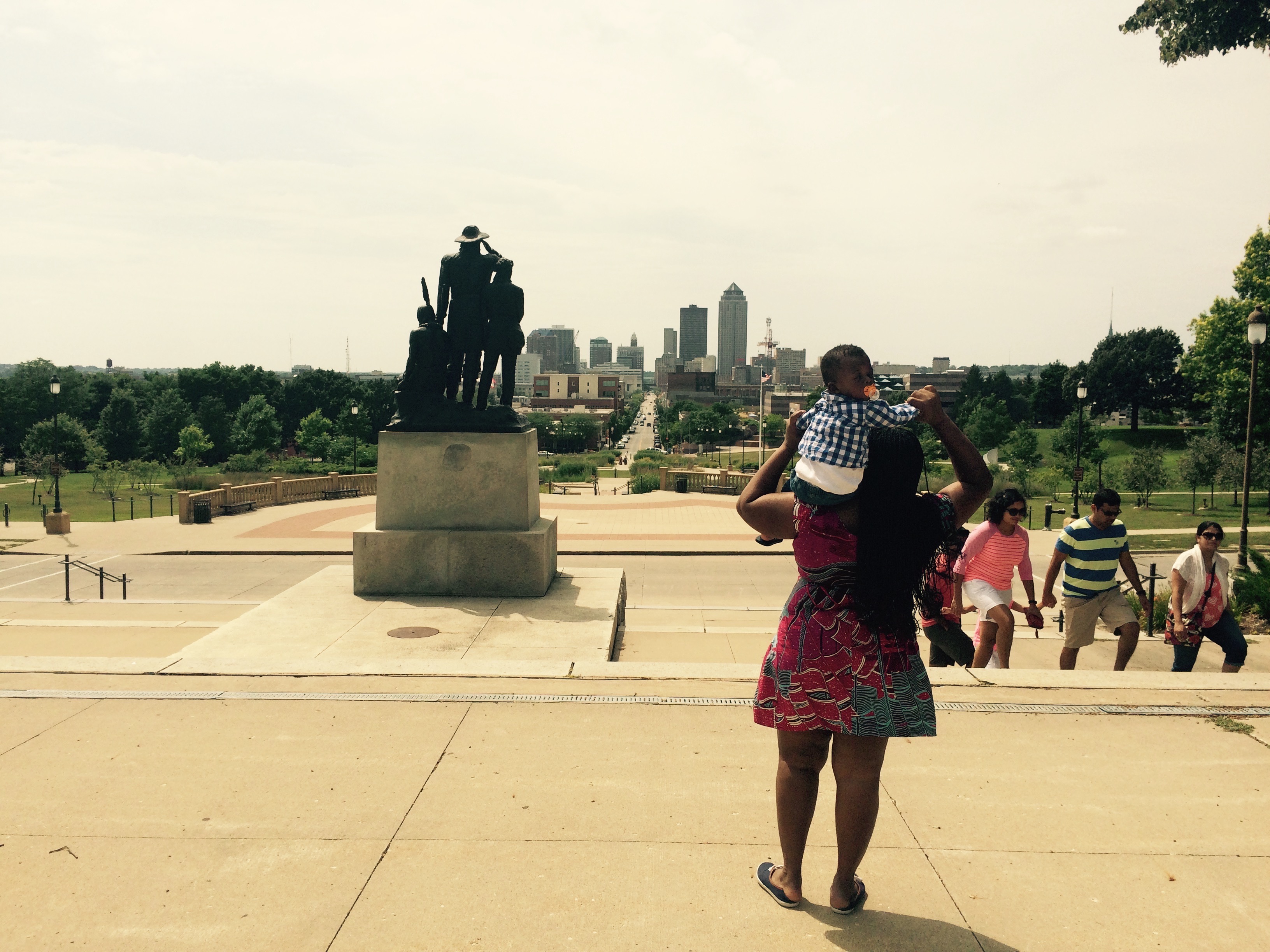
At the Des Moines Capitol, Iowa (2015)

Even in the online space, one might easily find blogs written by foreigners about travel around the continent than one might of blogs by Africans of travel experiences in their own continent. (This is changing, of course. You’re reading this on a travel blog managed by an African, after all). But why is this the case? Human civilization itself is an experiment in travel, documentation and adventure conditioned by necessity, curiosity and sometimes nationalism. We have always left our comfort zones for new experiences. And, as archaeology and anthropology tell us, we have always documented those movements, even unconsciously, in hieroglyphics, and oral poetry, tribal marks, and lately in writing. In the 21st century Africa, the prevailing narrative is that travel for leisure and travel writing is a Western chore, done by the privileged few, and those conditioned to it by their profession in journalism.

Reality, unfortunately, seems to bear it out for the most part except in some rare cases. Olábísí Àjàlá was a Nigerian student who found himself in the United States at age 18 in the late 1940s. Having failed to succeed as a medical student at DePaul University, Chicago, he decided to travel through the country to Los Angeles, on a bicycle and document his experiences along the way. Through deportations, skirmishes with authorities, short Hollywood career (including meeting then actor Ronald Reagan), many short-lived marriages, children, and global fame, through the fifties, sixties, and seventies, he became the patron saint of all adventurers, and an icon in popular culture for African travel. Being called Ajàlá Travels in Nigeria today is a homage to his larger-than-life reputation. He also wrote a book An African Abroad.* 

So why is it that unless in rare cases Africans are not known globally to document our adventures in writing, or is it that we are just generally averse to travelling for its own sake? My friend and scholar Rebecca Jones has been asking this question for a while. In a conference she facilitated in Birmingham earlier in the year, the Call observed:

“For a long time study of African travel writing in the West has focused on Western-authored travel writing about Africa. But this has ignored both the long heritage of the genre amongst African and diaspora authors. African travel writers have traversed both the African continent and the rest of the world, writing about encounters and differences they meet in their own societies and others. They have engaged with colonialism and the post-colonial world, have produced ethnographic description, reportage, poetry, humour and more. They have traversed genres and forms, from the Swahili habari written at the turn of the twentieth century to Yoruba newspaper travel narratives of the 1920s, from accounts of students and soldiers abroad, to newspapers and today’s online travel writing.”

Aside from this blog, there are quite a few other ones online with focus on travel as an African hobby, done especially without the express purpose of becoming a travel “journalist” working for a media house, but for its own sake. Why are there not more. Africans, after all, travel as much as everyone else. Is it that we don’t care about documenting our experiences the way that others do? I have just finished reading Route 234 (2016), an anthology of global travel writing by Nigerian arts and culture journalists, compiled and edited by Pẹ̀lú Awófẹ̀sọ, an award-winning culture journalist. It is a delightful read of many fun, scary, heartwarming, and diverse experience of Nigerians in many different local and international situations. The contributors are however many of the continent’s known arts and culture journalists. This fact will not help our subject matter, but it shouldn’t remove from the value of the book as a necessary work and a delightful read.
image

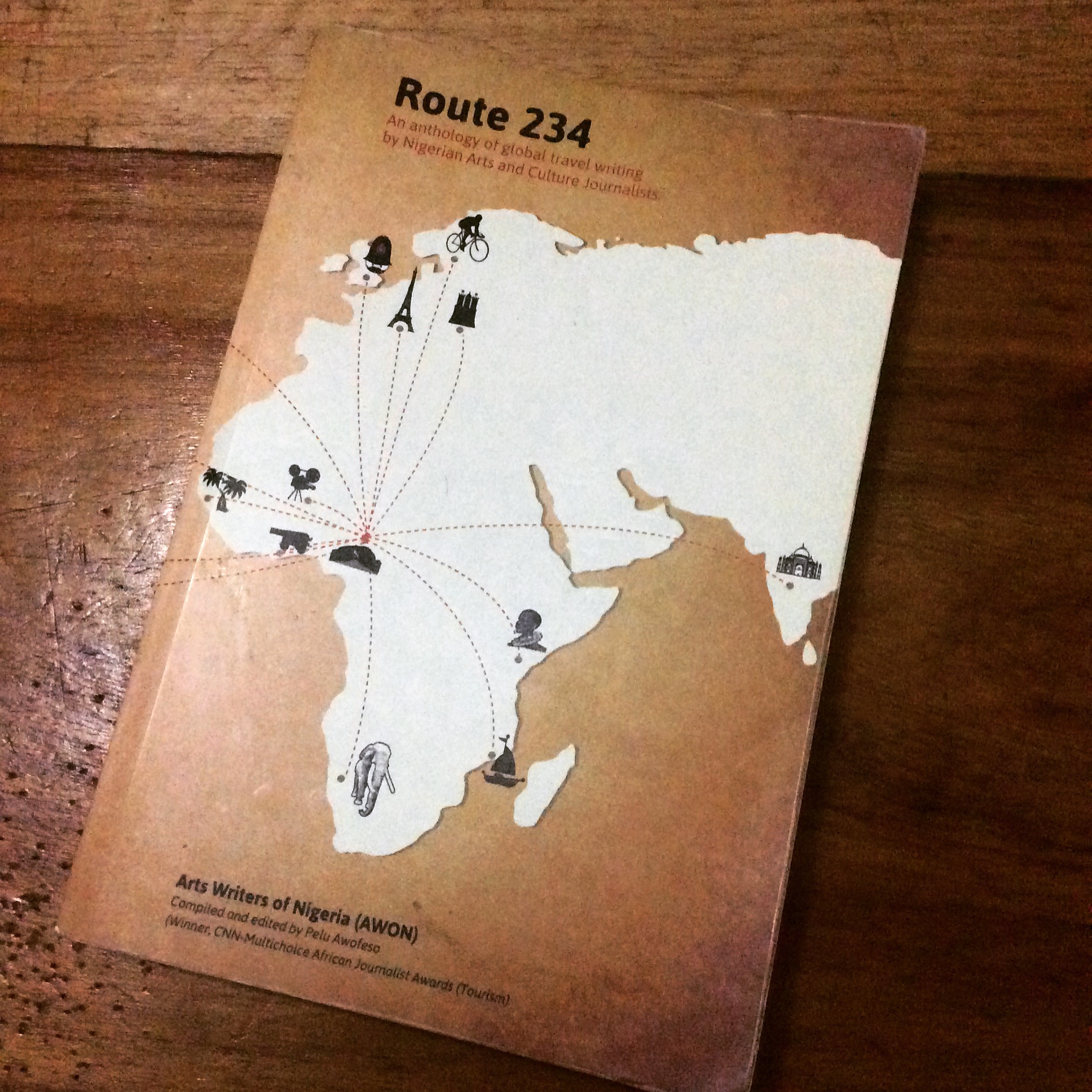
Route 234(2016), edited by Pẹ̀lú Awófẹ̀sọ̀

According to the editor, the idea for the book came from a private listserve conversation among these culture/travel writers earlier in the decade about documenting some of their travel experiences. It took many years before the idea finally became concrete.  The 211-paged book lists Kọ́lé Adé-Odùtọ́la, Olúmìdé Ìyàndá, Ọláyínká Oyègbilé, Èyítáyọ̀ Alọ́h, Mọlará Wood, Steve Ayọ̀rìndé, Pẹ̀lú Awófẹ̀sọ̀, Jahman Aníkúlápó, Túndé Àrẹ̀mú, Nseobong Okon-Ekong, Akíntáyọ̀ Abọ́dúnrìn, Ayẹni Adékúnlé, Fúnkẹ́ Osae-Brown, Sọlá Balógun and Ozolua Uhakheme as contributors. The scope of the travel experiences documented therein covers Los Angeles, Atlanta, Bahia, Juffureh, Accra, Plateau, Nairobi, Durban, Pilanesberg, India, London, France, Frankfurt, Nice, and Holland.

One of my favourite narrative in the work is Mọlará Wood’s “Farewell Juffureh” (page 35), covering a visit to Alex Haley’s ancestral hometown in the heart of Gambia as well as Nseobong Okon-Ekon’s “Trekking the Mambilla Plateau” (page 93). In both, the reader is vividly guided through experiences that must have been much more intense and affecting than words could capture. Some of the others detail culture shocks at visiting a new place for the first time and re-setting their opinions and expectations preconceived from a distance (“Accra Mystic” by Jahman Anikulapo, page 79) while some focus on their immediate task; covering a film festival, for instance (“Film, FESPACO, Ezra” by Steve Ayọ̀rìndé, page 61). A heartwarming one by Ṣọlá Balógun (“The Good Samaritans of Nice”, page 181) describe an experience common to many frequent travellers: being stranded in a strange city after a missed flight.

What the book represents overall is an intervention in a space where much more effort of this nature is needed. But travel isn’t, and shouldn’t be, the preserve of just culture writers and journalists. Writing about it shouldn’t be either. Tourism isn’t a big deal in Nigeria today because of lack of government (and private sector) care, yes, but also because of a seeming lack of interest in the populace itself. As I argued in this recent piece on a visit to historical locations in Ìbàdàn, commercial attention will come when governmental and private sector intervention takes the first step:

“I think back to a recent experience, in Italy, where tourism has built a thriving industry of restaurants, malls, and gift shops around notable structures that tell the country’s history, real and fictional, and how much value that attention (and tourist dollars) has brought to the country. Old churches and abbeys, ancient arenas in Verona and the Colosseum in Rome, among others, are all just ruins of a certain past. But they have been preserved and well branded in order to attract foreigners and their resources. Even a fictional character, Juliet, from Shakespeare’s Romeo and Juliet, has a touristy structure built in her honour, called Casa di Giulietta.”

Travel is fun. And even when it is not, it is always an enlightening exercise. As Mark Twain said in The Innocents Abroad (1869), “travel is fatal to prejudice, bigotry, and narrow-mindedness, and many of our people need it sorely on these accounts. Broad, wholesome, charitable views of men and things cannot be acquired by vegetating in one little corner of the earth all one’s lifetime.” That same perhaps can be said about travel writing, if not as a way to reflect on one’s adventures, as a way to keep said experiences in the memory of the world.

The book is a delightful read, but much more is needed.

_________

There are many other stories like this, no doubt. Ravi on twitter has pointed me out to “Sol Plaatje’s sea travel piece” (by which I assume he means this bookMhudi, an epic of South African native life a hundred years ago), and Rebecca, in the comment section, to a few more published narratives, also of a few years back. Their input also reminded me of Olaudah Equiano’s  equally notable memoir. There are many more like these, I agree. My point is that there are not many more, and certainly not as many notable ones as there should be).

For more reading
Interview with Yagazie Emezi

I caught up with Yagazie Emezi a while ago for a short conversation on her work and on the current Invisible Borders road trip. Here’s an excerpt:

You have spoken before about your interest in documenting physical scars on stranger’s bodies. What informs this interest? And what have you found?

For a while now, I have had a passion for body positivity and awareness, some of my videos address just that. Over the years, I have received numerous messages from people struggling to accept their bodies in various forms. I decided to embark on this project to find individuals who have come to terms with their bodies after going through extreme life changes and understanding their process so as to hopefully aid others still struggling to do so. I have found out so far, body acceptance is a continuous process. Just like we never stop learning in life, do we ever stop learning to accept ourselves through all our changes? Most of the people I have met yes, have accepted their bodies but it appears to be more of a resignation to their bodies.

Read the full interview on Brittle Paper.

Overland From Ibadan to Makurdi

by Tope Salaudeen-Adegoke


“Travel is a vanishing act, a solitary trip down a pinched line of geography to oblivion.”

– Paul Theroux


overlandThe excitement won’t let you sleep, I mean, when you want to travel a long distance you’ve never travelled before. So I woke up very early, unusual of me—I am a late sleeper, that morning, to link up with Servio at Benue Links’ Park, opposite the University of Ibadan’s main gate. Could it even be called a park? It’s right beside the Mobil filling station. Their office is a tiny cubicle behind a warehouse that is also used as a workshop by a roadside vulcaniser. This vulcaniser also doubles as an agent of some sort for the transport company. He helps in unloading luggage.
The two Toyota Hiace buses, commonly known as the Hummer Bus in Nigeria, are painted white with two dark green horizontal stripes at the middle of the vehicles. At the base of the lines, “Benue Links” is painted. They were parked in front of the place. A conductor called our tickets. I was with number four and Servio number five. He directed us to the bus in the front. I had hoped we would be called into the second bus because it was neater and had an automatic gear. I would later understand the reason why the first bus was rough and dirty.

When it comes to efficiency in transport services in Nigeria, just forget it. And never be in a hurry. They could be a pain behind the wheels at times, which is the very reason we had planned to travel earlier so that we could arrive at Makurdi a day before the commencement of the programme we were going for.  After their usual delay, sorting passengers’ luggage under the seats, on the back seats haphazardly, in the trunk—it was a little space because another passenger seat had been wedged onto the little space— spilling to the seat next to it which irked some passengers as they were shoved and made uncomfortable even before we set on the journey, some other passengers entered. It was a reckless combination of people and luggage.

A woman came to the entrance window praying for journey mercies. I was responding “amen” under my breath when squabbling erupted from the back. A passenger and the conductor were arguing over mishandling of her luggage. The praying woman intervened and a compromise was reached. The driver hopped in. He was a rather dirty looking man. He wore a dirty shirt and three-quarter pants. The only thing that impressed me about him was his neatly shaped hair and moustache. His hair, sprinkled with brilliant greyness is the only neat feature belonging to his seemingly nonchalant dress mode. The remaining passengers filed in and took their seats on the three rows behind us. She continued the prayer and by that time I had already lost interest. At the end of the prayer, she was tipped by some passengers. She received it with “God bless you” and the recipients variously salted it with “amen”.

The driver turned on the ignition and pulled up on the road. We zig-zagged out of the city to the expressway of Ọ̀jọ́ọ̀, then to Iwo Road; the time was probably a few minutes to eight.

“Won’t you sleep for a minute?” Servio asked. The question was directed at my red eyes rather than me.

“No. Curiosity won’t let me”. I smiled back.

He feigned a smile and curdled his face on his lap to take a nap. We were speeding along the highway when a man, seated beside the driver, called the attention of the driver to the door of the vehicle; it seemed broken on its hinge and did not close firmly. He parked to examine that and confirmed it was only a kind of rubber missing. He closed the door and joined the road again. Because the landscape was familiar to me, I decided to read a little. I had with me a Kindle from the Kofi Awonoor Memorial Library. I switched it on to return to the books I had been reading. I tried Daniel Dafoe’s The History of the Devil/ As Well Ancient as Modern in Two Parts. It was no good. I tried Satan’s Diary by Leonid Andreyev’s—same thing. The Confessions of St. Augustine Bishop of Hippo—I was not receptive at all; I was torn between the pages. I kept repeating sentences and peregrinating paragraphs. So I put it aside— I did not pick it up again throughout the journey. I returned to looking at the landscape wheezing past us: people, houses, filling stations, etc.

Travelling is a leisurely activity in the Global North with a considerable bit of risk, if at all. It is a daunting, and risky business in Africa. In fact, travelling for fun in some regions in Africa is suicidal. You have many factors to consider— the roads for example. Some have wondered and enquired about the way to hell. In simple truth, it is those potholes on Nigerian highways, which have led many away to their death. Oil tankers ferrying petrol to different parts of the country are noteworthy contributors, too. Carcass of cars like wrinkled cast away rags by the roadside are one of the things that will likely catch your attention if you are travelling on a Nigerian highway. I wonder if it’s supposed to be a reminder of death to travellers or some memento mori to reckless drivers. I can safely count these carcasses I have seen so far on this trip. It’s depressing. At times I imagine the ghost of accident victims perpetually present in the remains of the wreckage wriggling through the windows or driving the cars on the spot.

We had been in Ọ̀sun state, zipping through towns designated with local government signposts. The boundary between Ọ̀sun and Oyo States is a short drive from Iwó road of about 15 minutes. Ibadan is spreading more than ever. People are now building homes along various outskirts of the city. It was a short drive through Ọ̀sun. We took a left turn when we reached Odùduwà University facing the road connects Ifẹ̀ to Ondo State.

Ondo is a strange beast. In one nostril she is sniffing dust, in the other tobacco. Large billboards at various newly completed buildings scream the achievements of the Governor: ultra-modern hospital, modern primary school, newly tarred roads, blah blah. I felt like I was sneaking through the backyard of my neighbours to play with a friend on the next street. The comfort and sense of security that I was still in a Yorùbá speaking place betrayed my wanderlust. I felt like I was rooted on a spot.  Modernity is seeping through the veins of the city of Àkúré. But the rusticity of their Yorùbá is still present in their tongues. The dialect is both fascinating and laughable, just like the core Ibadan accent, that I happen to speak, or old Ọ̀yọ́ accent. If you don’t put down your ears, you may not understand them when speaking.

There are lots of mountains in Ondo state. And for a moment, it seemed our bus flying on the road was like a futile effort of trying to cup water in a palm hoping not a single drop will escape. The driver’s devil-may-care speed was useless. It was as if he was trying to run away from that place. That gave me time to examine the mountains. The sun was already high so it made them clearer from a distance. I was looking at them and the word “black ass” kept tugging at my mind. They were black and hairy with arboreal growth. The thick blackness of the sedimentary rock was puzzling to me. I mentioned my fascination to Servio. He’s very good at providing details. He shared his NYSC experience, he served in Niger state, that there is a particular tribe that lives up mountain in the North, suffusing me with much more I anticipated for. It was almost useless, actually.

There’s a popular restaurant in Àkúrẹ́ that serves as stop over for inter-state buses. We had a stop-over there. Everybody was glad for the few minutes’ break to stretch their legs and empty their bladder. I walked down a road to take a leak. Servio had disappeared into the restaurant looking for a toilet to do his business. He bought a bunch of bananas and a bottle of Eva table water which he later regretted— more than half of the bunch turned out spoilt. Some of the other passengers bought refreshments as well. I love plantain chips, most especially when it’s sparsely salted. I had bought two packs from one of the roadside hawkers on the outskirts of Ọ̀sun, intending to give Servio one.

We slipped through Edo, rather briefly. We passed Akoko-Edo, Magongo, and small towns before we entered Kogi. The mountains there are very hairy. They are like hairy old men. Unlike the youthful blackness of the ones in Ondo, they are like fathers to children in their fifties.

I saw for the first time the Àjàokuta steel company. Labouring through a region where there were only huts— and the huts were poor, no more than mud shelter with grass roofs— and an occasional herd of cattle followed by young boys, we entered Benue. We came upon the bridge overriding the vastness of the Niger.

“A tributary!” Servio beamed. It was a pointer to the Niger River.

“In stagnancy!” I enthused.

I was responding to the wit in his remark. It was about a verse in his poetry collection, A Tributary in Servitude. That was when I decided to write this travelogue. And immediately I told him that, the conversations died down. He was careful of how he would be presented. Servio can be clumsily clammy at times. And his informed paranoia makes him extremely cautious with everything. I wouldn’t care though.

Dusk was approaching now, and I was excited that finally we are in Benue state. Two women alighted on the outskirts of the town. I was pretty disappointed with the dusty town of Otukpo, where the former Senate President hails from. It was rather too primitive except for the big Catholic churches.

It was already dark, around 10pm by the time we arrived Makurdi. Having endured a hideous trip of about 10 hours covering about 613 kilometres in a cramped seat, it’s a wonderful feeling when we arrived at the Benue Links Bus Station. (In fact, it had the ambience of an airport because of the taxi drivers parked outside park soliciting to be hired). I was tired and bus lagged and I couldn’t be happier to get out of the bus. Our host, Su’eddie, came to welcome us.


_________

The Favourite Son of Africa is the pseudonym of Tọ́pẹ́ Salaudeen-Adégòkè. He is an editor, literary critic and poet from Ibadan, Nigeria. A member of WriteHouse Collective, Tope assesses manuscripts for publication and is one of the organisers of Artmosphere, a leading monthly literary event in Ibadan. He also works as the administrator of the Kofi Awoonor Memorial Library in Ibadan. He enjoys travelling and cooking.

Visiting Ikogosi

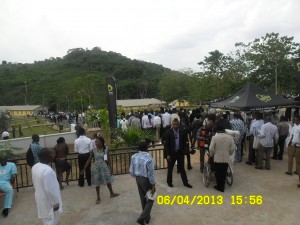
SAM_2194Ikogosi Ekiti is the home of the nation’s only and most famous warm springs, situated on the hills in Ikogosi Ekiti in Ekiti State of Nigeria. The spring itself originates from the top of a rock formation now situated in what the state government calls the Ikogosi Warm Spring Resort. It is a stretch of land fenced and developed with lodgings, entertainment, halls for events, an amphitheatre, and a beautiful view of nature and the famous spring itself. (It never used to be like this, we’re told. The new government has been working).

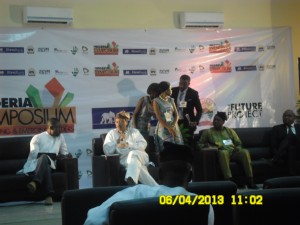
I had gone visiting, along with my wife, as a guest of the Future Awards Project who had organized a nationwide gathering of Nigerian youths (described as those between 18 and 35) to brainstorm on the nature of their participation in government and in the shaping of their future. She was a panelist on one of the sessions.  The three-day symposium that was well attended by young people from all around Ekiti and Lagos (with a few more jetting in from as far away as Kano) had as invited guests former Vice-President of the World Bank (and current Finance Minister) Ngozi Okonjo-Iweala, governors of Ekiti State (the host, Dr. Kayode Fayemi), Rivers (Rotimi Amechi, who already made news with some of his comments), and a representative of the governor of Delta State. There was also Professor Pat Utomi (one-time presidential aspirant), Tonye Cole, Odia Ofiemun (past president of the Association of Nigerian Authors), and many others in government and in business.

SAM_2104The symposium turned out a lot of ideas, and bile, and fun, and anger. Peculiar to a gathering of young people, it brimmed with idealism, and questions, and challenges for the present and for the future. I enjoyed it all, the interaction, the camaraderie, the environment, and the food. (I’d never eaten so much yam in three days). The resort was also a fantastic discovery, a treasure hiding in the hills of a faraway city. The cottage we slept in sat on top of the hill, overlooking the source of the warm spring down below. About half of the new lodgings are just recently built while the rest were renovated from their previous deteriorating states. They had been built a long time ago.
SAM_2088

Speaking of architecture, one thought that occupied my mind throughout the event (and which I had so desperately tried to ask the host governor of Ekiti State, without success), was why in this 21st century Nigeria, public facilities like this resort built with state money should not have adequate access for disabled citizens. One of the participants, a young dignified lady on a wheelchair, had to be lifted into the venue over a flight of stairs because of the absence of any other means. It is a terrible, disappointing oversight. (This is not peculiar to Ekiti, however, but it deserves to be part of the conversation going forward).

There were also a number of prominent youth leaders of thought and young professionals around the country present, from IT professional Gbenga Sesan to activist/politician Japhet Omojuwa. Needless to say, I was meeting many of these folks for the very first time. A few of them, I was hearing about for the first time as well. The organizers of the program include the EIE (Enough is Enough) Nigeria group who came into limelight after a successful walk on Abuja in March 2010 to protest the state of things in Nigeria. I blogged about that here. By the end of the third day, I had made new friends, met a few old ones, and connected with those I’d known on twitter, but never met in person. It was a warm, happy – if short – respite to the quotidian rote of the Lagos life.

SAM_2207I returned to Lagos through the same hills that led us to Ikogosi, seven hours later, through the many Ekitis, Ilesha, Ikire, and Ibadan. It was my first time of visiting that part of Ekiti. An accidental admission to one of the young men seated beside me at the newly furnished swimming pool and bar on Saturday night that my immediate ancestors had migrated to Ibadan from Ekiti a few generations ago, and that my father was an Ekiti title-holding chief, has now landed me in hot water of a constant barrage of request to pack my bags away from Lagos as soon as possible, and come back “home”. After all, “a river that forgets its source is in danger of eventual, inevitable drying up.” It’s true.

It was an apt metaphor anyway, since he had said it while we were sitting just a few metres away from the source of the spring that gave the town, and the state, one of its enduring prestigious images.

____

More on the Future Project here.

Home Never Leaves

I spent the last hour walking through a neigbourhood in Ibadan where I last visited about twenty years ago as a young boy. The memories have almost all faded along with the landscape. New homes and new streets have sprung up where trees and old buildings used to be, and I walked like a stranger that I now am, enjoying the pleasure of the welcome anonymity. None of the relatives I knew who lived around there live there anymore, thankfully. I would have expected shouts of “Kola! Is that you? What are you doing here? And who is this lovely woman walking with you?” Growing up has its perks.

I hope to spend the next hour checking out another part of this town that holds an even deeper memory: the neighbourhood where I spent the first thirteen years of life. The building in which I drew some of my very first breaths now exists in a different neighbourhood than the one I left it in. New neighbours, new ownership, and maybe a new paint job. I don’t know right now. I haven’t seen it in more than ten years. There exists a huge memory of my growing up that lay within the walls of the compound, and has gone with me everywhere I go. There also exists, at some level, a stronger desire to make a reunion with that memory permanent. If I ever become rich, I will pursue the desire. For now, this will become another tour of the long memory lane.

I have my camera ready, and the last image of that building in my head as I saw it through the rear-view mirror of the truck that took us out of there in April 1995.