Pandemic Blues in the Heart of Babylon

by Ọlájídé Sàláwù

Everyone always hoped that January should end. I myself strongly felt it should. The Ides of January are its long tentacles, the sprawl of days, the cheesy Harmattan wind, the dry pocket after the Christmas shopping spree, the lurch for lights after the previous brackish year, and the hope for a new clearer sky. If one looked at it closely in the grand scheme of things, one would always find a reason to want January to end. My savings, for example, were already going down the drain and I was expecting that new stipend would come in soon so as to restock foods before I resumed teaching fully. But, it seemed each day was always getting stretched and there were invisible decimals of hours that kept kneading the month longer than July or August or every other month that has the same almanac of days.

While one felt that January should end because of its potential dryness at least after vacation loss of December, it set one into the New Year race. After all, in Pentecostal Nigeria and the litany of other orthodox churches from where I came to America on Fulbright scholarship, so many wars and battles are fought on “the crossover night.” At the turn of every year, the seers come with their prophecies: some gloom and others bloom. Once upon a time, a Nigerian President had this great vision for the country’s success tagged Vision 2020 for a new Nigeria. He would be fascinated to learn that the country is the same hell-hole he left behind. 

The hankerings over 2020 have been in the loop for long. Like all Januaries, this year’s was filled with so many excitement for me. I would be interacting with my students in person for the first time. The bulk of my work in the previous semester was more of workshops within the University environment and in neighbouring colleges. And I had a thought: This semester, I have got much to get ready for you. Back in Janus-faced Babylon, things were the same and everyone cared less about the organisms incubating in Wuhan, China, and the President had even shooed it off as the flu.
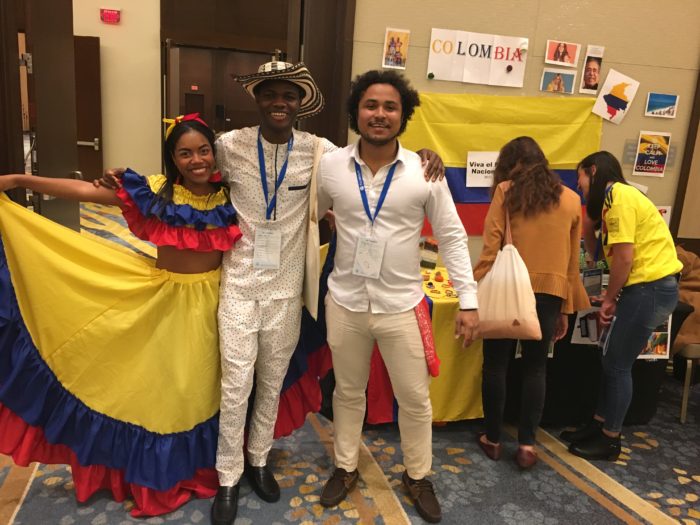
Sàláwu, with friends.

I spent my last winter holiday under the frosty arms of Winnipeg, Canada which was colder than Fayetteville considering it is northernmost in terms of closeness to the Pole. I returned when the month had just broken in the middle and the teaching schedule would commence albeit reluctantly in the following week I arrived. Ten students had already enrolled for the class by the end of Fall. That was in November. On my arrival to Fayetteville, my body still failed to adjust to the weather. Although I had never witnessed a snowy Fayetteville, Winnipeg on the other hand was often white-laced and the heavens were always on the low temp.

I continued to put on my thermal wear to absorb the frigid wind that came with the morning, vamoosed in the afternoon sometimes, and returned arrow-faced in the night. I also threw on my black overall jacket to keep my body safe after the cream-colored thermal underlay. Sometimes, I got layered like onions with more clothes after the thermal dress to wrest myself from the bristling wind of Cumberland where Fayetteville is located. Fayetteville is not always like that.

In the last week of January, classes began proper and the first two classes I had with my students were tellingly diverse. Five of my students were African Americans, the others have by chance of migration of grandparents became citizens of Babylon. The senior professor, a Nigerian-American, who I was co-teaching the class with was also from Ògbómọ̀shọ́, Nigeria, and was part of the brain drain wave of the ‘90s when he embarked on a doctoral program at the University of Florida. His rich knowledge of the culture even after decades of exiting Nigeria amazed me. Well, even if everybody is leaving Nigeria’s hell, there is so much that people hold on tightly to. It is the culture. It is the language. The food! And then, this is a course he has been handling for years.

We had a fair outline in the syllabus to work with that did not only emphasize the communication aspect of Yorùbá language, but also the culture. I would be handling the cultural aspects while the professor would handle the language part, at least for the first few weeks of the semester. Our classes would be held in two different buildings on campus. The Monday and Wednesday classes would hold in one of the rooms at Science Taylor Building while the Friday classes held at Butler Building. The first Monday class was getting the students a Yorùbá identity. So I suggested that the students should check Yoruba Name portal where they could find the name of their choice and also acquaint themselves with the meaning. The following class, they came back with interesting names such as Ayọkù, Jádesími, and Ọrẹolúwa.

That was the first part of the introductory class. We have also instructed them that searching for the names on the website is not compulsory and they could look at circumstances surrounding their births to decide the names they would like to bear during the class. On the first week of February, they all returned with a paragraph on the story surrounding their names. Tatyana had picked the name ‘Odáyàtọ̀’. She claimed she is a unique child in her family. After this introductory week, the class was settled on a slow cruise. In America, the students are kings with a hunch of debt breathing behind their backs. You have to appeal to them how attending classes and seminars related to the course would earn them credits. So I had to re-learn my tolerance in new way and then send the classroom culture which I had imbibed back Nigeria packing.

At the beginning of February, the story of an ultra-modern hospital built in ten days in Wuhan jarred the world into a bit of consciousness.  Most of the media began to place the news of the virus in their headlines. There was a gush of conspiracy theories also flowing from all sides of the world.

At this time, there hadn’t been any announcement in the University on the imminent gloom. As the countries around the world started closing their borders and economy started shutting down, people waltzed bare-nosed into Walmart in Fayetteville. The atmosphere on campus was taken by the faint gossip on the virus but students still loiter around Ecoground Café where I did relaxed with the smell of Starbucks coffee wafting into my nose. As expected, I myself was getting thrilled as my students were beginning to master the Yorùbá greetings, especially the ‘Kú’ greeting. The most enthusiastic among them, Cevyn, was fond of asking me Báwo ni before following that up with Ẹ káàsán o since the classes often held in the afternoon.

Then one day, the University Clinic sent for Yan, the Chinese lady who was also a Foreign Language Teaching Assistant. She was in the office with me when she got the notice that she had to report at the University Clinic for a routine medical check. In December during Fall break, Yan had travelled to Harbin in China to spend her holiday. Although the population of the infected persons in China then was a few thousands and Harbin where Yan had come from was not a hotspot for the spread of the virus, such travel was considered high risk and the University demanded she report herself that morning. During the break, I was away in Canada and there was little or no impact of the pandemic around December and the first two weeks of January when I was there. Whereas Houcien, the Moroccan FLTA who was teaching Arabic, turned her sight towards Grand Canyon and later spent few days in Los Angeles. 

For the semester I was auditing two courses. So ordinarily my weekdays were filled up. In this shuttling, I moved to attend Dr. Murray’s African-American Literature classes and Dr. Bir’s editing and proofreading classes. But since these two were audited courses and not meant for credit, I often leaned on that fact and played truancy while giving more attention to my primary duty. Of course, we had a great plan ahead of us. There was the Global Awareness Day which I had to prepare the students for, and we were already considering scrapping Wednesday’s class for the rehearsal of the songs the students would sing. Besides, I was scheduling a social evening events. One would be for watching Yorùbá film, say Ṣawaoro-Idẹ and the other to listen to Yorùbá songs. There we would also have some local Yorùbá snacks such as ọ̀jọ̀jọ̀! I handled our second class of the last week of February and introduced the students to musical instruments in traditional Yorùbá society. It was their first time they would see the talking drum.

The momentum the virus gained at the beginning of March meant things would go awry sooner or later. Nobody knew where the wave of the virus would move to, but North Carolina had caught a bit of the sneeze via a patient at Wake County. News of class transition had started to breeze in. I carried on with my preparation for the Global Awareness Day, teaching the students the common Yorùbá songs, “Fún Àlááfíà” and “Isẹ́ Àgbẹ̀”. Their pace of learning the songs awed me, and by the second week of March when we had our rehearsal, I added “Eleketo” as the third song. Though the last song was a bit difficult for them as they were yet to grapple with the tonal glides in-between the stanzas. The other aspect of the class had fared well as well. We have moved on from greeting. They can now all read the Yorùbá Alphabet and thankfully memorize some good, fine social gestures.

Things quickly went down south as March approached its end. The University announced that all classes should proceed online and office hours of instructors would take place at an upswing. It was unsurprising considering that the United States declared that all international borders would close. The campus was shut down, save for the faculty should they have some office work to round off before complete closure. So puff went the Global Awareness Day and social evening events which already got the students. I already thought our classes would move to Zoom or Blackboard as other universities were now using these platforms. Few friends at other Universities, who also came from Nigeria on the Fulbright program, were already scheduling synchronous methods. Professor Àjàní told me that I would be completing the other side of my teaching duty by interacting with students on Canvass while he would shoot videos for the rest of the topics on the syllabus at the University’s digital lab. 

On the first week of April, the University Place Apartment came in. We were meant to vacate the residence as all students were issued instruction until the end of March to leave. Drey and Mark, the two black American students, who I and Houcien shared the apartment with moved out as well. Gracefully, an extension was secured for all the FLTAs, for two weeks, by our administrative supervisor, Dr Sharmila. When it was a week before the extension deadline, I asked her what the plan for our last accommodation would be and she replied we might likely to be moved to a hotel, Extended Stay.

On the first Wednesday of April, we received final notification from the Hall Life Management that we have until 12th of April to leave. April had visibly held Spring in sight. The Carolina originals were already shooting out their beauty. The sight of the azaleas and Japanese Maple Tree was alluring.  But what also sprang forth was gory news around the world about the virus devastating the landscape. I wrote to my supervisor about the Extended Stay Hotel. She quipped I should not worry, the University would be moving us into an emergency hall on campus called Renaissance.

And so, the story began. April was the cruelest month.
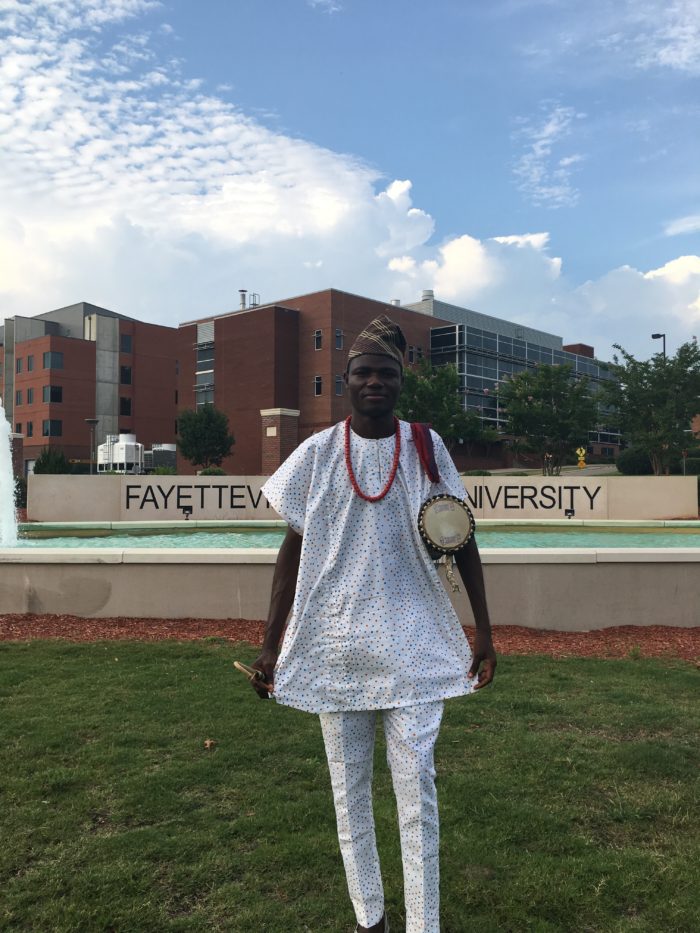
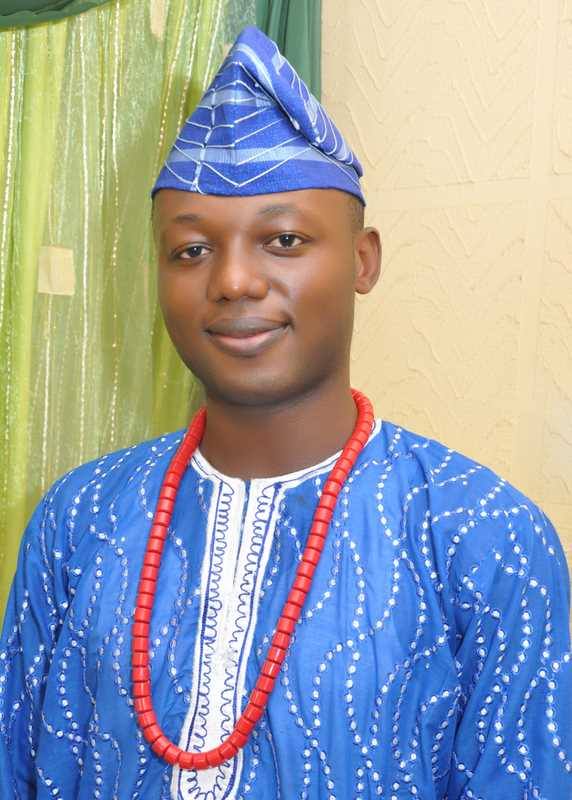
Ọlájídé Sàláwù was, until recently, the Fulbright FLTA at Fayetteville State University, North Carolina. He is the author of Preface for Leaving Homeland published under the African Poetry Book Fund Box Set (Sita) in 2019. 

In Memoriam: Fiyinfoluwa Onarinde (1984 – 2015)

10411811_868467093166267_7783033631112677398_nI first “met” Fiyin Onarinde one day in April, 2014, when I called to tell him, in Lagos, that I had once occupied the Fulbright FLTA role that he had by then being selected to fill at my old university. His supervisor, the director of the SIUE International Programmes Office, had sent me a mail and asked me to talk to him, answer some of his questions, and generally make him comfortable about travelling to the US for a new experience. We talked for a while, and he promised to call me back, which he did.

He eventually went to SIUE to become one of the memorable Fulbright FLTAs at the Department of Foreign Languages where he taught Yorùbá for two semesters, and made lots of friends. While he was there, we kept in touch regularly, and got feedback from his colleagues, who saw him as a kind and sensitive soul. Later that year, I got a request from him to write an introduction to his book of poems which he had been trying to publish. It was a heartwarming request, which I immediately jumped at. You can read the introduction here, on his Facebook page. The book was published in February 2015.

Fiyin is dead now.

I heard the sad news last week through the same person who had first introduced me to him (who is now based in Ghana, who also heard the news from the university). After his Fulbright year, Fiyinfoluwa had moved from Southern Illinois University in Edwardsville to SIU Carbondale to begin a graduate programme. We lost contact for a while, and connected briefly in July while I was in the US. He had wanted to meet, and so did I. We scheduled a meeting, but it didn’t come through, and I haven’t heard from him since. Nobody knows the cause of his death, yet, but foul play has been ruled out, and an autopsy is pending. He was 31 years old, born on Apr 24, 1984, and died on October 18, 2015.

11800125_1008711169141858_7351992305743848883_n

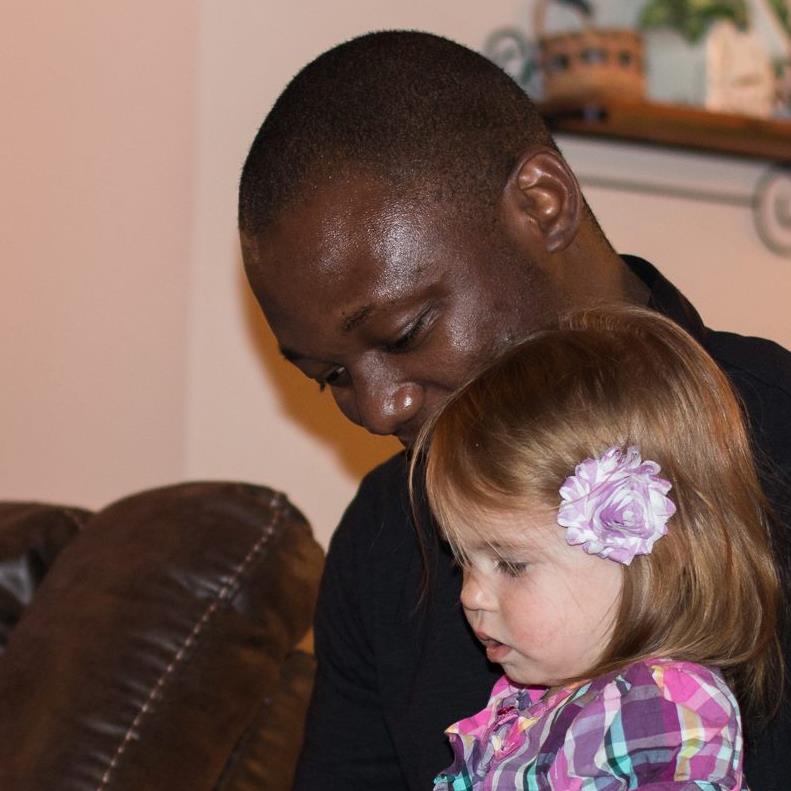
In this picture, he’s reading to the daughter of his host parent. (Photo: Facebook)

The little I know about him show him to be a kind, sensitive, creative, and decent young man. Our Facebook messages were intermittent, but when we talked, we shared ideas about foreign language teaching, poetry, and the university culture in general. I regret not having met him in person, but the outpouring of condolences from those who did confirms that he made quite a significant impact on those who called him friend. His colleagues and supervisors had only nice things to say about him. He is survived by his parents, and a wife, Busola Asaolu Onarinde.

The SIUE African Student Association is holding a memorial service for him on Friday, November 6 at 4:30 at the Center for Spirituality and Sustainability. An online memorial has also been opened for him here.

His new book, Market Parliament and Other Poems can be purchased on Amazon.

Raising Money: The Dictionary Experience

There are many ways to fund a project, I’ve realized. One can work hard, save up for many months, and then put all that savings into the choice project, ignoring family and other more important commitments in the process; or one can ask friends and family for a raise, promising that the money will not all go down the drain of sometimes unrealistic dreams. This is usually a good idea if they are not, at the moment, committed to something else more important themselves. Usually very rare. Or one can apply for a number of grants in the world, promising to make one’s dreams come true.

Most grants however are specific. I got a MacArthur-sponsored grant in 2005, for instance. It came with a stipend of $600 for all of six weeks, with a paid trip to Moi University in Eldoret Kenya for a “Sociocultural Exchange”. The Fulbright of four years later came with a monthly stipend of about $1200 but one had to pay for lodging, and feeding in the United States (totaling usually up to around $800) such that by the end of the program, there was just enough to buy an iPod Classic, a hand-held camera, and a few gifts for hordes of friends and family back home.

Some grants require that the grantee do a couple of things (like write a book, for instance), or stay in a particular location for a period of time. Or do work in a certain area for a period of time. In most cases, except one is already established in that field, it’s hard to find a grant that fits conveniently. That was why when sometimes last year, while pondering a way to continue and expand a project I started as an undergraduate in the University of Ibadan “A Multimedia Dictionary of Yoruba Names”, I constantly ran into a wall of doubt as to the possibility of raising enough funds (and finding enough interested people) to get the project moving. The model I had submitted as an undergraduate project was of just a thousand names borne by Yoruba children, with their meanings and (for the first time) audio pronunciations done by Yoruba speakers. For 2005 Department of Linguistics at the University of Ibadan, it was an impressive work. For a 2015 adult with access to more efficient technology and crowd-sourcing, it was less than a tip of the iceberg.

IMG_6625I didn’t have enough savings to start the project on such a scale that I envisioned, and I couldn’t think of any grants that could fund it. Even the Fulbright Alumni Innovative Fund (for past Fulbrighters), as diverse as it is, was limited to a number of categories which doesn’t accommodate a project focused on lexicography and language documentation. There is the MacArthur Genius Grant, a suitable and appropriate grant that makes no demands on the grantee but rewards them (with $650,000 over five years) to be able to achieve their dreams without the drag of a 9-5 job in a busy city. Problem was, one needed to be nominated, and the folks who nominate are usually not known to anyone but the MacArthur folks. Finally out of options, the idea of crowd-funding struck me, just as quickly as the imperative to use 2015 as a year to proceed with the dictionary idea in the first place. I’ve had some contact with Indiegogo before now, but only through friends who had asked me to donate to their project. I’d also heard of Kickstarter, GoFundMe, GlobalGiving, and a couple of other crowd-funding sites. I did a little search on all of them and found Indiegogo most appropriate. Unlike Kickstarter, they don’t send all the pledged amount back to the owners if the goal is not reached. They do take 5%-9% on all the funds raised though, which makes sense when we realize that they’re also in business to make a profit.

So, on January 6 (a not-so-smart date to start a fundraising drive, when one considers the expense that usually goes into the Christmas holiday period), I launched the Indiegogo campaign, open for 60 days. Yet, in spite of the inauspicious beginning, the idea resonated with a lot of friends, family and colleagues with whom I shared it, and they gave, surpassing my expectations. It may also have had something to do with how obnoxiously I pestered a couple of them who promised to donate and then promptly went AWOL :). More importantly, word about the project got out and many people who had nurtured similar ideas about documenting the Yoruba experience but lacked the means or network to do so wrote to me to volunteer their time and services. It has been the best part of the whole experience. There have also been other not-so-encouraging ones: colleagues who matter-of-factly expressed their unwillingness to support either because I’d never supported their projects in the past (even without my knowing it) or because they had their own projects that also needed financial attention. In all, I learn a lesson in human relation, fundraising (I wonder how politicians do it. Explains why I’d never be one), drive, and persistence.

There are now about 15 days to go until the fundraising effort is over. But yesterday, I realized that this is only a start. Yes, I do want to create a Yoruba Dictionary of Names, and the dream is now more realer than ever, thanks to a number of known and unknown people. I however also want to create a Lexical Dictionary of Yoruba containing all the words in the language, also crowd-sourced, and also multimedia and internet based. There is no excuse for the absence of such a document online and such app in mobile phones of interested people all around the world. I want to translate more work from English into Yoruba (I’ve still not completed the one I’ve been working on for years), and render more work from Yoruba into English, and into audio. I want to work with as many people as are willing to make Yoruba relevant to the next century in information technology. The industry for mother tongue education, and documentation is one that is huge and waiting to be tapped. Yes, we are translating twitter into Yoruba, but that can’t be all. Where’s Facebook? Instagram? Google? Where are machine translations? Where is Siri Yoruba? And to do all of these will take more than the $5000 that we are now on the path to raising. We need more.

Yesterday, I applied for the TED Prize 2015, a prize worth a million dollars to support any dream from anywhere in the world. A total stranger had sent me a link to it via Facebook, believing that I have a shot. I scoffed for all of one second and then sobered up. If life has taught me anything, it’s that more than hard work and persistence (which usually pays), taking a chance on oneself is also usually a good idea. I have also begun to look for any other grants that can support a dream of creating a thriving ecosystem of mother tongue education and use in Nigeria. Not just limited to Yoruba, by the way, but the over 500 languages in the country.  It might happen, or it might not, but it will not be for lack of trying. There is a future worth pursuing. From the kind of enthusiastic support I’ve seen from the Dictionary fundraising, one also within reach.

I Am Confident…

…that one other positive thing about the regime change in Libya is that there will now be new Fulbright FLTAs from that country from now on. The year 2009/10 was the first time that anyone from Afghanistan was admitted into the FLTA program in a long time. A new day will hopefully lead to more understanding and better relation with these parts of the world.

Top Twenty Questions FLTAs Would Be Dying To Ask

Every time I start believing that I am sufficiently removed from my Fulbright experience to return to my anonymous student life, I get requests like this from readers like Darsh who want to know more about the FLTA experience in the United States. I’ve once written about what to expect in a one-year trip away from home, but here are a few more. As soon as you have passed the initial stages of being selected at your local country consulate, you are almost on your way to the United States.

1. How much is the monthly stipend? A: In 2009/2010, it was a little over $1000 per month. I hear that it also depends on where in the US you’re posted to. I was posted to Southern Illinois. f you are on the coast, you get a lot more (but then spend a lot more as well for food, and rent).

2. Is the stipend ever sufficient? A: Yes. With very prudent use, you would usually spend about half of the whole stipend monthly on food, housing and books. At the very worst case scenario, you would still be able to save about $300 every month.

3. Can relatives visit me from home? A: Technically, they can, but that is not what the program is about, so it is not encouraged. Believe me, the last thing you want is carrying the home baggage with you. But then, it’s up to you.

4. Can I date my students? A: No. Bad idea.

5. Can I date other students on campus? A: Yes.

6. If any of the people I date at #5 ever become my student in another semester, what should I do? A: I have no idea. But the fact that you know that such scenario is possible should make you re-think #5. You’ll find very many opportunities to meet other new people.

7. Will I need a mobile phone? A: Yes, but you don’t have to bring it along from your country.

8. Will I need a car? A: Not usually. You’d be able to get by without one on most campuses. Many FLTAs however often apply for, and obtain, a driver’s licence before they leave the US. It could be a worthwhile endeavour, so pursue it if you can.

9. How cold is a cold weather? A: Very cold. If you have never seen snow/experience winter before, chances are you will start needing to buy winter clothes and boots as soon as late October. Right now, it is 6 degrees Celsius.

10. Can I stay in the US after the program? A: No. There is a mandatory “return policy” which you’d sign on your way in. As soon as you’re done, you are required to head home first, before you do anything else. Many people return to the States for advanced degrees afterwards.

11. Tell me more about this “return policy”. A: Every grantee is obligated to spend two straight (consecutive) years in their home country after completing the Fulbright program. The aim of this clause is to make sure that the grantee returns home to contribute to the development of their country. If you do return to the US immediately after you return home after the FLTA, and spend a couple of years pursuing a degree, you will still need to eventually complete this mandatory 2 year home stay period before you’re ever allowed  to process any long-term immigration to the US later in life.

12. Do I have to live in campus housing during my Fulbright year? A: You don’t have to, but in my experience, campus housing gives you a chance to know a bit more about American campus experience. And if you’re lucky to have stayed in a highbrow student housing like we had in Edwardsville, you will have a fantastic experience. However, many FLTAs have found other housing arrangements downtown (or somewhere close to school) that are more affordable than the campus housing (sometimes through r00m sharing with other international students). This can work too, but you may lose out on much of the “executive” campus scholar experience.

13. Can I send money home? A: Why not? But in most cases (refer to #2 above), the money is barely anything. By the time you buy an iPod, a camera, and a few gifts to take home with you, you barely have anything left. And if you hope to return for advanced degrees, you might want to save as aggressively as you can.

14. What do I need to take along to be a successful teacher of my language? A: In my case, a few books, some movies, plenty traditional clothing, and an adventurous spirit. American students are curious and they’d appreciate your efforts. Dressing to class at least once a week in your native wears will send a message of cultural appreciation more visibly than one month of teaching. I also showed a couple of movies in class. Use YouTube. There are plenty there that you can use to illustrate any point that comes up during teaching.

15. Can I travel out of my state? A: You will travel, at least once during the program. The first travel takes place before your teaching starts: you will be taken to another state for the FLTA Orientation. And then, in December, you will have to attend the annual conference in Washington DC. This is a five-day event which will allow you to meet up with your fellow scholars, and visit parts of the nation’s capital. Aside from these mandated trips, you will also have the time during your year to visit any other place you want, as long as you do it during times where your presence is not physically needed in your place of primary assignment. If you’re in Illinois, you should try to visit Chicago or Springfield.


to be continued…