On “The Heresiad” by Ikeogu Oke

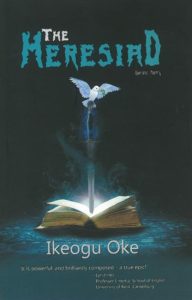
The Heresiad (KraftGriots, 2017) by Ikeogu Oke is, in my opinion, the most ambitious of the books on the prize shortlist this year. It is a book of what the author called “operatic poetry” (another way to put this would be “poetry in drama and song”) featuring one poem extended over a hundred pages. Yes, one poem. It is epic in its scale, ambition, and character (and even in the words of one of the blurbs. See it:

“It is powerful, and brilliantly composed – a true epic!” – Lyn Innes (Professor Emerita, School of English. University of Kent, Canterbury))

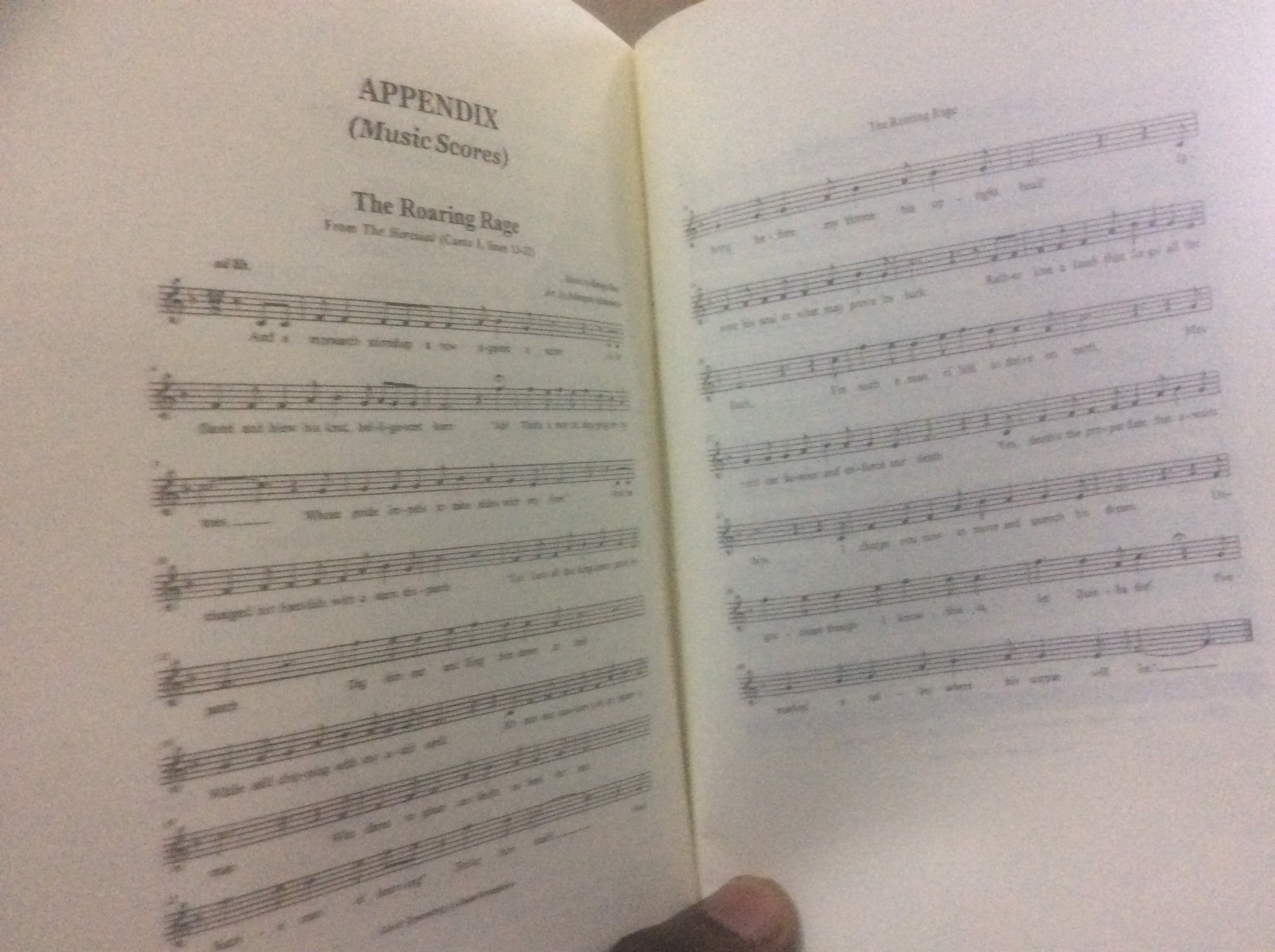
But seriously, the work packs within it a lot of history, philosophy, narrative, culture, allegory, politics, and tradition, rather unapologetically. Without the author’s name, one might confuse it for a work by Shakespeare of any of the writers of the old traditions defined by form, rhyme, and musicality. Only slightly, of course. References intrude from Nigerian (and African) socio-political issues enough to define the work as one addressed to a specific, even if global, audience. And to that idea of musicality, the author graciously provided musical notes with which the poem can be sung.

The name Heresiad, is derived from “heresy” just as the Iliad was derived from “Ilium” or Aeneid from “Aeneas”, as the author explains in the preface. But what needed defending, even more, was the style, operatic poetry, which Oke described as being deliberately crafted as “an art form that transcends verse and goes on to embrace song, music, and drama.” Previous works of this nature which have misled readers into expecting musicality through the use of “Songs of–” in their titles were singled out, from Turold’s The Song of Roland to Vyasa’s The Lord Song to Okot p’Bitek’s Song of Lawino. (He couldn’t have called out Tanure Ojaide’s Songs of Myself, the other book on the shortlist, because this serendipity of both their presence on the shortlist couldn’t have been predicted. But the juxtaposition of this factor in defining Heresiad as unique and better realized as practical literature does appear significant). By discounting the need for a titular nod to musicality and instead embracing it in true form, Oke admits to pursuing a grander ambition: to make written words sing, a homage to Ngugi wa Thiong’o, whose words to that effect was quoted as an epigraph.

Of the thematic preoccupation of the book, Oke says it is written “to make a case for unhindered intellectual and creative freedom… and for mutual respect and harmony between faith and thought, otherwise religion and intellectualism.” In my interview with him, he admitted that the idea of the book, and the first verses in the book, came in 1989 when “a famous writer” was condemned to death for the crime of heresy. He didn’t need to – nor wanted to – mention Salman Rushdie by name, but that connection became immediately apparent. In this book, the condemned author and narrator is Zumba, who was so censured for having writing a “bad” book. To enforce this sentence, and to save him from it, a few other characters, in the person of Reason, Doom, Anger, Sword, Machete, Axe, Stone, Panther, Care, Bluff, Smithy, etc, were introduced with fully-realized characters, compelling presence, and voice. In their thought processes and the unfurling of the curious plot, the poem realizes itself in full glory.

One of the limitations of traditional poetry, which can also become its most enchanting feature, is rhyming. It is a feature that I happen to love. But it is a feature fraught with a lot of risks one of which is the occasional trading of meaning for the benefit of a properly rhyming word, or the use of the immediately available rhyme instead of striving to find the perfect one. In Heresiad, some of these limitations show up, like when “bypass” is made rhyme with “pass”, “reproof” with “proof”, or “unwise” with “wise” (and in one unintentionally hilarious instance, when the native language interference pushes “blade” to rhyme with “head” (page 57). For a book of this type of ambition, it might be that those kinds of lapses are to be expected and tolerated. But for an unlucky book, they can become the flaws by which they are defined.

But when it works, though, it works quite beautifully.

I’m part of this misnomer, I confess,

And so are all you Faithfuls, nonetheless.

Or who among us Faithfuls can have read

The book for which we seek the author’s head?

Rhyming might seem like a trivial issue on which to spend critical time until one realizes that each couplet throughout the work sticks to this rhyming pattern on top of what Oke describes as “lyrical pentameter” (adaptability to lyrical utility). The realization that the author had spent countless man hours crossing all his Ts to achieve this kind of ambitious and thoroughly satisfying theatrical result is most impressive of all.

Now, the author’s plea had reached his ears,

A plea that dripped with anguish and with tears;

And Reason, yes, had pondered through a plan

To take help to the joy-forsaken man.

(page 36)

Equally as impressive is the realization that the book took twenty-seven years to write, over different iterations.

Now lift your voice; lift your voice and say;

Your voice, not mine, must rise and lead the way:

What now transpired among the rising five

Who wished our author more dead than alive?

What – the thought – that, of its own accord,

Changed their common tilt towards discord?

A love as yet profound inspires my choice

To be the human echo of your voice.

(page 52)

Speaking of theatre, when was the last time you read a book of poetry with accompanying musical notations? I certainly haven’t seen any. But here, on page 106-112, the author, with the help of Adéogun Adébọ̀wálé, helpfully guides the future theatre and/or musical director on what is the appropriate way to translate the texts into music.

During my interview with him, I asked whether he would be willing to sing some of the lines to me, and he graciously obliged. It was not as impressive as I’d expected it, but who expects an author of a work to always be its most competent performer? Not me. It is ironic, of course, that this musical characteristic of the work once became a point of risibility when a restless Facebook critic dismissed it as a gimmicky invention to win the $100,000 prize money. On the contrary, I think it is one of the book’s distinctive features, showing it as different as possible from the others on the shortlist in terms of ambition, inventiveness, interdisciplinary scope, and resolve. Now, to see it on the stage!

The author’s habit of including footnotes and references at the bottom of relevant pages irked me at first. They had appeared as an unnecessary usurpation of the critic’s role. But this wasn’t the case. They add a lot of value to the work in illustrating, where necessary, the writer’s influence, allusion, or research. Not one was superfluous.

From what I have observed of the pattern of choice by the NLNG judges, who have typically favoured works of formal and traditional forms in style and ambition (See: The Sahara Testament), I will predict that The Heresiad might take home this year’s prize. There is something about the work that speaks to an intense commitment to innovation, tenacity, joyful experimentation and social commentary in a way that provokes delight and engagement. It is doubly worthy, of course, for its successful bridging of the genres of poetry, drama, and music, while making a strong point, through allegory and an enchanting imagination, about the role of free speech and the responsibility of the writer in a modern society.

I’ll be surprised if the judges disagree, but such surprises are welcome when it’s not one’s work on the shortlist.

______

Find a link to the previous reviews here.

______

Update: October 9, 2017: Ikeogu Oke’s The Heresiad is the 2017 Nigeria Prize for Literature winner. Watch my interview with him here. Congrats to him.

On “Songs of Myself” by Tanure Ojaide

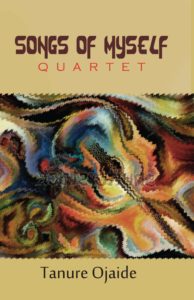
Songs of Myself (KraftGriots, 2016) is a collection of poems by Tanure Ojaide. It is the most personal of the three on the shortlist of this year’s Nigeria Prize, the most introspective, and also the one most (even if inadvertently) expressive of the melancholic aspiration I had prematurely expected from Ogaga Ifowodo’s A Good Mourning because of its ominous title.

Ojaide has published poetry since 1973 and has published twenty collections of poems many of which have won prizes, local and international, like the Commonwealth Poetry Prize (1987), All Africa Okigbo Poetry Prize (1988, 1997), the BBC Arts and Poetry Award (1988), and poetry awards of the Association of Nigerian Authors (1988, 1994, 2003, 2011).  The new work is approachable and deceptively simple, like thin ice over a frozen lake. More on this style later.

The title of the book invites us to approach the collection as work about the author to varying degrees: songs of myself. But in the foreword (which I had personally considered superfluous in a poetry collection, except in a notable instance like in The Heresiad, an exception which I’ll explain in my review of the book), the author explains his approach as incorporating “some of…aspects of oral poetic genre”, particularly of the great Udje poets of Urhoboland, which “deals with self-examination and the minstrel’s alter-ego” in the work as a way of attempting to know oneself with “self-mockery that justifies mocking others.”

This intention changes how I eventually approach the work, not as Ojaide himself recounting his thoughts and opinion on a number of relevant political and social issues alone, but as the voice of an invented poet-persona using a traditional poetic form to interrogate himself and thus the society. The Udje, as he explained it to me in our YouTube interview, are traditional Urhobo griot-poets who work carry social and political significance, and are present as conduits for commentary on the public condition.

So what is this condition? In the book, it is both personal and societal. The poet is both an old man (Gently; page 14) and a young adult (We Have Grown: 155). He’s both the country (Self-Defense; 91) and an individual (On My Birthday; 26). He is a happy observer of the passing of time (For The Muse of Peace) as a cynical record keeper of slights and injuries (Masika; 47). He’s a parent (They Say My Child is Ugly Like a Goat; 107), and a son (Family Counselor; 85); a hopeful lover (Secret Love 147) and a self-critical poet (Wayo Man; 87). The issues addressed are as disparate as they are familiar. Nigeria, the country and the government, is an ever-present villain in most, as are other social issues which the author addresses with sardonic candour.

If I were to ask my people

what they wanted the most,

they would definitely choose money over every other thing,

iincluding good health and peace

that I know there’s a dearth of

because of oil and gas everywhere

that by right should bring us wealth.

(Page 132)

From afar, especially with a misconstrued intention of the writer’s narrative angle, most of the poems appear conditioned into a tried-and-tested style of political and social protest poetry through this staid and resigned voice. But on close contact, especially against the background of its traditional dimension of style, they reveal themselves as both original and intentional, carrying an unflappable tone couched in the simplicity of cynicism. Who is a poet – I ask myself a few times – and what makes a good poem or poetry collection? Is it a successful deployment of inventive gymnastics of modern conventions that appeal to sophisticated palates, or is it an honest recounting of home-grown truths directed at a selected audience even if in a least colourful, or less popularly accessible voice?

So many questions I can’t answer.


After all the birds fall silent in the delta,

how can there be Rex Lawson

with the polyrhythm of weaverbird, sunbird,

carpenter-bird, solos and ensembles?

(page 134)

The question is important in judging the language choice that Ojaide deploys in this work which many times doesn’t read as elevated as one typically expects of offerings of this kind of ambition. Against the background of his stated intention, however, possibilities can be suggested of this character of theirs being defined both by the limitation of translating the cultural and linguistic cadence of Urhobo poetry into English and, less charitably, the author’s helplessness in the face of this challenge. The answer will be resolved by the judges of the Nigeria Prize in a couple of weeks.

When I asked him about his use of language and the idea that the use of English as a conduit for African poetic traditions can be a limiting factor at best and a catalyst for the extinction of those languages, he was less acquiescent. “You must know that there are many Englishes,” he said, to which I say yes, as long as each different variant is able to successfully carry to fruition the stated intentions behind its use, and reach new audiences. In this case, I am not as sold as I should have been, not about the homage to traditional oral poetry, which other authors (and perhaps this one in previous works) have done to great success; but about its seamless and effective deployment. Maybe I have been spoilt.

In many of the poems, the writer includes footnotes, like in the first poem on page 15 where he explains that Dede-e dede-e is an “onomatopoeic expression of ‘gently’ in the Urhobo language.” Of this incursion, there are strong arguments to be made, especially in this work, for doing away with them totally. Footnotes are often distracting, and – to return to contemporary arguments about the audience of our literature – needless. Those who value the work enough to engage with it will do the work needed to unlock much of its secrets. The counter-argument, of course, is that a reader like me who is approaching the work on short notice for the purpose of a review would not have figured out that Aridon is a “god of memory and song/poetry among the Urhobo people” (page 17). That same argument, though, fails in the face of less justifiable ones like “NDDC” on page 133, or “ICU”  on page 24. If I did not know that ICU meant “Intensive Care Unit” either from the context of the work, or from having lived in modern society, then the writer hasn’t done his work or I need to return to school.

These kinds of conflicts show up in other places too, springing up the question of who exactly is the poet’s audience in this case. Since his last five books, Ojaide has started publishing his work first in Nigeria before re-issuing them with foreign publishers, a reversal he said was conditioned by his renewed sensitivity to his role as a poet primarily addressing an African (nay, Nigerian) audience. The justification for this almost “reclusive accessibility” of his literary voice will depend on those to whom the work is addressed or the successful domestication of the reader’s mind to the traditions from which the experiment emerged. It could be that the author isn’t “speaking English” at all, but Urhobo, just barely accessible to us through a shared common lexicon.

They mock me because of my child

whom they say is ugly like a goat.


Don’t mind them who see nothing good.

My pickin fine pass goat.


Where are the mockers when my child

fetches water and runs errads for me?

(page 107)


There are about 91 poems in this collection, making it the bulkiest of the three on the shortlist. In four different sections, the poet bares himself to the world like a local minstrel, under different guises and situations, in an outlook that is mostly dark, self-critical and confrontational in equal parts. The subject matter, a look at the world through a personal self-reflection, is certainly an important addition to current social and political conversations. The language is simple, accessible, and direct. It is a collection that anyone can pick up and enjoy. The prolific nature of the writer’s career and the breadth of this work’s take on Nigeria and Africa’s social and political issues makes it an important presence in the shortlist. And even if I will quibble with the inclusion of some of the poems there for not being strong enough to represent such an accomplished poet on such an important list, I’ll still rate Songs of Myself as an important peek into Ojaide’s poetics, experimentation, and voice. The potential for impact of this type of language and style direction, however, will be subject to practical, and more verifiable, manifestation.

_____

My interview with Tanure Ojaide can be found here. Find a link to the previous reviews here.

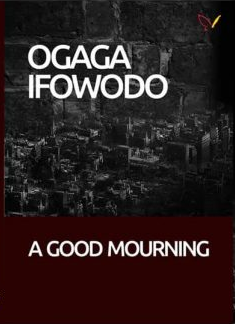
On “A Good Mourning” by Ogaga Ifowodo

As promised, here is my take on the first book on the shortlist of the NLNG-sponsored Nigerian Prize for literature 2017. The book is A Good Mourning (Paressia, 2016) by Ogaga Ifowodo. Ifowodo is a poet and writer, who taught poetry and literature in English at Texas State University, San Marcos, USA. He holds the Master of Fine Art (MFA) in poetry and Ph.D from Cornell University, New York. He studied law at the University of Benin and worked for eight years as a rights activist with Nigeria’s premier non-governmental rights group, the Civil Liberties Organisation (CLO). Between 1997 and 1998, he was held in preventive detention for six months under the military dictatorship of General Sani Abacha.

I’m ashamed to admit that, until now, I hadn’t read anything by that poet with a striking physical resemblance to James Baldwin. But no matter where I have turned, his name had shown up there, from conversations on social media to arguments in closed listservs. Until recently, I also didn’t know that he had served in government in some capacity and that he once contested for (and failed to win) a House seat from his home constituency.

So, I approached his work with an open mind. The title of the book A Good Mourning carried a curious double-edged sword of meaning that intrigued anyone from afar. The cover conveyed darkness as does the paradox of the title itself. If it is “mourning”, how is it also “good”? And how does it contrast with what we have grown to expect when we hear the phrase, devoid of the physical surprise of the spelling difference?

The work does not disappoint. The copy I got was loaned to me by Doctor-Poet Dami Àjàyí to whom the writer had autographed it in 2016: “Good morning & poetry”. I hadn’t found a copy anywhere else that I had looked, inviting conversations to the recurring topic of accessibility of books to the general public before they are selected for the Nigerian Prize. (It is a ridiculous argument, to be clear. The prize is set up to reward excellence, not distribution savvy. But it does raise valid questions about why publishers in 2017 haven’t yet heard of the Kindle, eBooks, and an authentically Nigerian electronic book distribution system called OkadaBooks which can put the books at the literal fingertips of millions of people via their mobile phones).

A Good Mourning is an impressive book that is marked by competence, style, grace, and a distinct authentic voice. It is that competence that I intend to dwell on a bit more because some of the snide remarks about the shortlist had focused on what they regarded as substandard work on the shortlist. Thankfully none had mentioned Ogaga’s name in the diatribes. He is a competent voice whose work leaves no one in doubt of his facility with words, dexterity with decades of African and modern poetic traditions, and sincerity in the pursuit of his numerous truths and points of view.

The poems delight, inspire, provoke, entertain, and intrigue. They cover a range of themes that, contrary to the expectation that the poems in the collection will all be morose and depressing, excite and titillate. In one poem Ten Hours (page 8), the poet describes an appendectomy in a German hospital with such mischief and lexical dexterity that what one feels isn’t just breathless anxiety of a man hanging between life and death but a playful appreciation of the affectation of the doctors’ efficiency and their terrible grasp of English (one confuses “rupture” for “rapture”). He asks for the piece of his gut back, on regaining consciousness, and was told that it had been cut up, and it will no longer, as he had hoped, become

pickled in a beaker,

displayed in bookcase at eye-level

for breaking barren moments,

getting guests to know me inside out.

These kinds of unexpected levity litter the book in random places, turning what was billed as a melancholic take on national life into a delightful, thorough, and serious look at different issues in one citizen’s life.

In the following poem, a serious religious ceremony is gently mocked.

Once an alter boy, he pined for wine

and wafer, not communion with the Lord

Too young for the mysteries of eating God’s


flesh and drinking his blood, he prayed only:

Lord, let this cup pass to me!

The priest sent him out of the holy sanctuary.

You get the idea.

Actually, you don’t.

Ifowodo does this effortlessly throughout the work, especially in places where seriousness is expected. It almost seems like the whole book is an attempt at shattering gloomy expectations. Or else a practical interrogation of life as comprising of both gloom and levity, mixed in the right dosage, waiting to be teased out by the right inquisitor.

The title poem was dedicated to Chief Moshood Káṣìmawò Abíọ́lá. It reads like a recap of history, with snide barbs reserved for players and villains, living or dead.

The false-star general

was first to flee his stolen throne

seeking refuge in a hilltop mansion

built with stolen money.

Since the book was published in 2016, there will be questions about why the author chose now as a good time to write about the June 12 crises, and why the title poem takes about ten pages (37-46) to tell us what we already know about an event whose significance has now almost paled against the background of even more pressing matters. (I asked him about this in our interview. More on this later)

What won’t be asked is whether the work was well written – because it was. In four different sections, Ifowodo explores what it means to be human, with a diverse range of fascinating experiences over many decades and many geographical spaces. The poems are as experimental as they are traditional (though he notably avoids any attempt at rhyming). The book is described as the author’s “reflections on the intimacy of evil anchored in the brazen military annulment in 1993 of the will of the Nigerian people to self-representation…”. I will not argue here with his choice of description of his own work and aspiration, but the work appeared to me more like a nuanced mosaic of a yet unfolding, if rich and fascinating, life of the author himself.

The outward-facing and ambiguous appearance of the title and its however belated tribute to the memory of June 12 will be important in inviting in a curious reader, but won’t be what keeps them. That will be the delightful competence, playfulness, and dexterity of the writer’s voice. I will mark A Good Mourning down as a very strong contender for this year’s prize, but that’s not saying anything since it is already on the shortlist of three. A more specific compliment will be that it is certainly one of the stronger two on the list.

______

The video of my interview with the author can be found hereThe prize announcement will be made on October 9, 2017.

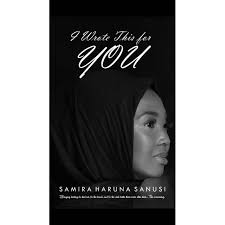
“I Wrote This For You”: Mapping Triumph in the Midst of Pain

Samira Sanusi’s new poetry collection is a map of pain. Line after line, in her book I Wrote This For You (WRR/Authorpedia; 2017), the author traces a tough path through difficult memories like a hot iron through wax. It appears like an uncomfortable experience at first, one with a rebound of traumatic recollection. But what emerges, for sure, is triumph. Survival.

I first met Sanusi in Kaduna at the maiden edition of the Kaduna Book and Arts Festival (KABAFEST) where she was a guest on a panel discussing the issue of sickle cell anemia (full panel video here).  She had written a book called S is for Survivor detailing the path of her healing from a sufferer and victim to a survivor and warrior. After many years of suffering through medical trials, twenty-eight surgeries, and other travails, she was finally healed when a bone marrow transplant turned her blood from a sickle cell blood to AA. She is now the President of the Samira Sanusi Sickle Cell Foundation (SSSCF), an Abuja based NGO.

Until then, I’d never heard of the idea of a blood transplant changing one’s genotype. But I haven’t followed the advances in medical science in this regard. So the revelation, as well as the heartbreaking tale of her survival, was both thrilling and heartwarming. I wanted to read her book. In this collection, Samira opens up in the best way she knows how: in words, mostly written to self, documenting the painful process of this journey to survival and all the attendant doubts, setbacks, despair, joy, and hope.

I finished reading this book a couple of weeks ago but I didn’t have the time to put down my thoughts about it, many of which I wrote down in a notebook I’ve now had to dig out from under a pile of other books. Here, a few of my favourite and memorable lines.

“That you have seen worse, doesn’t

mean the hell I’m seeing is a second-hand fire.

My worse is valid, even

when your bad is worse than mine.”

This came at the beginning of the book which – to my embarrassment – I’d initially assumed to be another prose work from the author. Nothing on the cover prepared the reader for poetry, so the words that came at me from the opening pages seemed, at first, like the preface to something else until they led one into each other throughout the book. It would appear that she had been documenting her thoughts and feelings about her pain and process throughout her encounter with the sickle cell trauma.

“Keep your truth away from me.

You don’t know what lies I have to tell myself

to sleep at night.”
But don’t expect a clean arrangement either. The words flow into each other sometimes like aphorisms, separated by asterisks or other special characters. At other times, they appear as chapters carefully grouped together in a specified theme. But there were no chapters. Only verses. We walk through the lines as though experiencing the process and pain of the writer’s lived experiences.

Who she was addressing wasn’t always obvious, but that was never a prerequisite to understanding or enjoying what was offered in the most private of words. In baring herself this way, the author invites us to see her not as a perfect survivor but one who had only persistently endured, with her head held up high, but with a few notable scars to show.

“She was so beautiful, the way

She kept people from falling into

Pieces as she broke apart.”

In the book are several themes which sometimes morph into each other, even in contrast. There is self-loving sometimes with self-loathing. There is gratitude as much as bewilderment, there is surrender and sometimes defiance.

“If you ask me about my dreams,

I would tell you to watch me,

for I am living them.”

Sometimes, she talks to herself, either in pity or in a berating tone.

“Looking into your eyes

I can tell you went to war

And did not come back with yourself.”

And sometimes with a challenge:

“You must come back to yourself

to find you waiting on the couch,

hoping to kiss and make up. Begging

for another chance at self-love.”

In other matters, she hints at love, lust, rejection, and romance:

“The first time he touched me

I yelled ‘Don’t hold my hand and don’t touch my heart!’

He asked, ‘Who happened to you?’

‘Your access pass to come in and save me so they can call you

Hero is rejected!”

Feminism? It sure seems so. Yet a certain religious conservatism also present underneath the soft and vulnerable persona the author presents in this book seems to sometimes intrude to confuse us as to whether the narrator is a helpless character in a patriarchal space or a defiant voice against it. Evidence of both can sometimes be found.

“Whose idea was it to look

at a boy’s eyes, filled with tears

and tell them men don’t cry?”

And on another…

“Dear Arewa woman
You’re not just somebody with a body
You’re body, mind, heart and soul
They’re all yours to share, as you please.”

I enjoyed reading the work in all its rollercoaster of emotions, aspirations, reflections, and ruminations.

Parts of the book do sometimes let go of its aspirations to poetry and spread out in plain prose, towards the end. But even in them are relevant nuggets of inspiration directed at an imagined audience of readers, and sometimes at the writer herself. The result is a book that both defies categorization as much as it defines it, expanding the possibilities for artistic self-reflection. I have not read many books of poetry from Northern Nigeria. But if Samira’s offering is any indication of what to expect when vulnerability and a questing mind meet at the junction of a page of poetry, then we are in for a good time.

The irony of enjoying work written in pain isn’t lost on the reader of course. But the writer never intended it as an invitation to pity. Rather, it is a celebration of triumph, survival. Each verse in the collection, whether intended to please, to stimulate, or to instruct, comes across in a form that also delights in soluble bites. I look forward to reading more from this author, this warrior, in whose survival we have also come to discover beauty, grace, and strength.

A Book for the Tasting

By Kọ́lá Túbọ̀sún

Book: Longthroat Memoirs: Soups, Sex, and the Nigerian Taste Buds

Publisher: Cassava Republic Press

Publication Date: October 31, 2016

Pages: 357

The Great Nigerian Food Memoir

Nigerian food is the most endearing, enduring, topic in the world, especially since we have gone so long without talking about it.” – Yẹ́misí Aríbisálà

The allure of Yẹ́misí Aríbisálà’s debut book of nonfiction, titled Longthroat Memoirs: Soups, Sex, and the Nigerian Taste Buds, is, surprisingly, not the food, nor the promised “sex” in the title.Published by Cassava Republic Press, this book of essays comes with a more satisfying delight of well-crafted sentences, stories, and attention to detail, style, and ambition. An unapologetically Nigerian book of such brilliance, scope, and purpose has been needed for such a long time that it is hard to believe, going through its pages, that it has indeed arrived. The author it was who wrote a food column, for a few years, in the now defunct Nigerian paper 234Next as “Yẹ́misí Ogbe”. For those familiar with the understated brilliance of her style and approach, this all makes sense, and is timely.

Longthroat begins with an introduction fourteen and a half pages long, which coyly attempts to manage expectations of what is to come, through caveats about the author’s unlikely role as the bearer of the country’s food biographer, among other “confessions”. This part could, arguably, serve as a review of the book, except that it takes too much away from what follows. So, it whets the appetite of the new reader instead, and sets the table. In that introductory treatise, we are gently eased into the kitchen of the author’s mind where both the idea and the steps of implementation of this culinary journey take place first before they meet the page. I would return to the introduction again and again.

The first chapter is a review of the reputation of Nigerian food (and names) in the imagination of the foreigner. The first culprit here is Michael Barry, a half-Welsh, half Indian man whose “Nigerian River Province soup”, listed in his 1996 book Exotic Book the Crafty Way as an authentic Nigerian food, left the author scratching her head trying to identify its parts. She gave up eventually disappointed with both the writer’s imagination and the accessibility of Nigerian food to the outsider. Our ẹ̀bà, it turns out, was what was being described as “cassava bread” in Michael Barry’s book. A disappointing find! We never find out what the “River Province soup” is because it doesn’t exist. It is, also, the creation of a foreigner as an idea of what a random Nigerian food looks or behaves like. Yẹ́misí did not hold back: “I would hate for Michael Barry to get away with… suggesting that our food can be simplified and reformulated into something else, something it is not.” Her idea of the Nigerian soup as a person, more than just a passing item on a plate, takes off from here. It “may seem aloof at first,” Yẹ́misí writes, “but once given its due, it will immediately make itself friendly at the very least.”

The book proceeds smoothly along these lines, paving way to other encounters, hilarious personal stories, told through the keyhole of a writer obsessed with the dimension of food in everything, from sex to dreams. The chapters move in different ways. In one, which came early in the book, the author describes a typical Ìbàdàn boy in a marketplace arguing with his mother about eating àmàlà (or ọkà, as she put it), to illustrate the mischief of adults, and the eternal devotion of Ìbàdàn indigenes to their carbohydrate meal made from “desiccated yam ground into a dense white flour, and then made into a grey mound using boiling water”. In another narrative in the same chapter (listen to audio excerpt here), a ram goes for a ride on a motorbike and ends up on jollof rice: quite a common scenario in many Nigerian cities during festive seasons. The description lures in the oblivious reader with gentle words until the macabre nature of that ill-fated ride becomes suddenly obvious. To the Nigerian already familiar with it, the passage plays out like dark humour gently hovering above the conscience of the meat-eater. Another chapter which further elevates the book into canon of essential Nigerian literature is the story of the author’s father-in-law and his travails in the Nigerian Civil War; how the pursuit of the next meal drove the conversation of survival. It was, aptly titled, Dead Man’s Helmet.

Reading the book, deceptively called a “memoir” (it is, to be clear, but the character of the book both defies and enriches the genre) takes the reader back decades into a happy place where food and observations of food carried some reward of discovery. Here, I speak for myself. What is the difference between irú wooro and irú pẹ̀tẹ̀, for instance? What are they anyway? Why did they smell so much and why did my grandmother like them so? Why are they wrapped so tightly in those small leaves? Why are the ones my grandfather’s youngest wife bring from the farm better than the ones we bought in the neighbourhood? How come I sometimes saw them in food (as in okro) but not in some (ewédú)? How is irú different from ògìrì? How does Dadawa, the cubed variant that debuted in the 90s, improve on what was a local condiment that supposedly added character to our local meals?

Sometimes a chapter is a journey into a forgotten part of one’s culinary past left unappreciated through the passage of time. One word or a sentence here stirs it up, smell, aroma and all, into new awakening. At other times, it is the wonder of a shared experience which in one’s memory had previously amounted to nothing more than a mundane occurrence, but which in literature transmutes now into a notable cultural event, properly highlighted and intensified through the writer’s power of observation and documentation. This is where the work shines out the most: elevating the most common experiences—what defines Nigerian culture: our cooking and eating habits, among ourselves and on the world stage—through beautiful sentences that delight and titillate.  

Who remembers, for instance, breaking open ẹ̀gúsí shells with their fingers, usually while seated with mothers or grandmothers to whom that kind of chore is a perfectly productive use of afternoon time? In a world now defined by “finesse”—a type of accepted snobbery against deliberateness, patience, commonality—that image of simpler times spent sitting with grandparents and helping out with cooking over several hours, along with stories, songs, and admonition, brings the reader as close to emotional time travel as one can get. Yẹ́misí calls this particular food preparation act: “hand-shelling” ẹ̀gúsí. We who are familiar know that she meant “hand de-shelling” or “de-husking” if we’re being technical, but one could see why the former appeals more. In Yorùbá, we say “wọ́n ń ṣẹ́ ẹ̀gúsí”. That act of “ṣẹ́-ing” the ẹ̀gúsi, breaking the shell in half and removing the content, is what gets the white pointed seeds out to where it can be useful. But that attempted homage to the phonetics of ṣẹ́-ing the seed, instead of the mechanically-sounding “de-shelling”, warms my linguist heart (though that English translation wasn’t the only relevant pull to the vivid sense of nostalgia that the chapter beautifully evokes).

Of Sex,  Subtlety, and More

What I ate last night is as significant and as tangible as my dreams. My dreams are as tangible as what I’m eating. Neither of them can safely be taken for granted. Life seen through the prism of food has more colours, not fewer.” – YA

The “sex” in the subtitle of Longthroat Memoirs does not materialize in the way readers conditioned to the treatment of the subject in Nigerian writing might expect it. But it does materialize in different other ways, sometimes gentle, and sometimes hot and vivid, usually around food and cultural attitudes. I, for instance, will not be able to look at a the velvety black covering of the African snail the same way again. Through word association and the writer’s imagination of their role in our sexual myths, vividly and mischievously imagined in the chapter called The Snail Tree, a Nigerian foodie’s insistence on a snail diet will now always task the mind in the direction of more intimate parts. The treatment of sex here however, as one would realize, is deliberate. Check out, for instance, this sentence from the second paragraph from that same chapter:

There are places in a woman that a penis will never reach.”

The sentence that follows this gives too much away so I will not quote that here. But the chapter itself, one of the most directly polemic in the book, tackles the author’s discomfort with the ubiquitous fascination with sex in contemporary literature. Here, she opines directly on the Nigerian/African writing and literary culture in a way that is fresh and unflinching, using food as a contact point. Chimamanda Adichie and Binyavanga Wainaina make appearances and not in a flattering way. The chapter also explores the way in which food can be used to sublimate other human impulses. But because of the understated way in which sex appears and disappears throughout the work, I expect some mild reader rebellion. Pointing out the irony of using “sex” to sell a book in which the use of sex as a selling point in modern writing is so directly challenged will be too good to pass up.

In a yet unpublished interview with me, Yẹ́misí clarifies her purpose:

Our manifestations of sexuality seem mostly dysfunctional. In writing, in the media, it is mostly titillation and misunderstandings. Are there some things that the application of words disfigures? Obscures? We all seem to be grasping at straws in private lives bragging about our involvement on public platforms. So if we are going to be real and honest, “liberality” should be prima facie the admission of incompetence and fumblings and disastrous encounters. The chapter was me saying, look I’m not going to pretend I’m good at this, that I apprenticed with Cirque du soleil. If I’m going to be truthful and free in my writing about sex, I’ll have to talk about my confusion and incompetence. Everyone else can write titillation if they want.

I wanted to point out obvious and not so obvious parallels between appetites… I wanted to offer the perspective of seeing something better by not looking directly at it.

That chapter alone, The Snail Tree, capable of winning any prize for nonfiction anywhere, makes the whole book worth reading.

But the book does (and packs) much more. It challenges assumptions (Will a Maiguard in Lagos prefer carefully made white soup or his Agege bread and fried eggs, if given a chance?), attacks hubris (Yorùbá people, with your pride of “sophistication”, come to Calabar and experience food cooked with some imagination and creativity), and examines contradictions (How are Yorùbá the oily-food-eaters—ndi ofe mmanu—when Easterners add oil to their garri at every instance? And how are Igbos the eaters of solid-as-stone food—aj’òkuta má mun’mi—when their invention of garry-with-oil has rescued ẹ̀bà from the tyranny of turgidity?). Longthroat Memoirs successfully situates itself in a prominent space for not just the sensual narratives around food but of cultural attitudes, defining the country and its people in our own taste and words. A cookbook, a narrative of one culinary pilgrim’s journey through Nigeria’s cultural environments (from Ìbàdàn to Calabar), an exposition on prejudices and pretensions of some of our cooking myths, a personal and historical diary, all at once, Longthroat Memoirsmanages to fulfill more than gastronomic desires.

How to Cook a Sentence

Writing about food in the way I do involves noting the influence of food on life and life on food, and attempting to weave an accurate cultural landscape.”  – YA

Something that Aríbisálà has, and exhibits in abundance in this work, is patience. (That, along with the discipline to remember the names of all the food items she encountered while living in Calabar, and the diligence to verify the Englishand sometimes Botanicalnames of the local vegetables and fruits we are used to under different local names.) Reading any book is a race against time and the writers intentions. But the style in Longthroat Memoirs is deliberately contemplative of each individual reference, attentive to the moment enough to satiate an impatient reader and possessive of the right depth to reward a patient one. We know now that the book came about from a number of essays written first for a weekly newspaper column. But in setting each word to the page, the writer has deployed a rare skill that draws the reader in with an inviting aroma and keeps them satisfied after each course. In Peppered Snails, Aríbisálà introduces new Nigerian concepts (“toaster”, “yíláta”, etc) to the unfamiliar reader and spent considerable time weaving these into a tale about the cooking or endurance of hot peppered snail, all without taking the focus off the important direction of the narration. The style reminds of the best offerings of greats like Sóyínká in a work like Aké or Ìbàdàn, the Penkelemes Years, for instance. This is no idle comparison.

How does Yẹ́misí do it? How does one person deftly convey a vivid sense of smell and presence through words? We have read countless fiction and nonfiction by African writers, but not many of them have handled the treatment of food or any intimate contact with this much dexterity. I have an idea, but it is an inadequate one. Growing up in South-Western Nigeria isn’t enough motivation to care about its food, nor is having been transposed—through marriage—out of that environment into a contrasting one in the South-South a sufficient excuse either. There are many coincidences along the way, one of which is discovering, a while ago, that her health, as well as her children’s, was being affected by what they were consuming. She wrote about how she found out, in her trademark style of patient literary exploration of ordinary facts, combining personal history with a collective journey around food, in the piece for Medium in 2015 titled Mother Hunger.

Though that piece, along with many others of hers scattered around the web, are not included in this collection, they offer some clues as to the motivation for her craft, but not the germination of her skill. The writer’s obligation to memory and her diligent recollection seems to have been wrought through plodding hard work of deliberate crafting over many years.

Eventually reaching the end of such a book feels satisfying as equally as it feels deeply dissatisfying: it is not a book that should be read from cover to cover in one stretch. Each chapter, like slivers of mọinmọin under the leaves after a wrap is finished, should be returned to for extra flavours and spice. It is a shame that the book is not universally available on Kindle. Those equally likely to enjoy the literary delight of its letters juggling the taste buds of memory are Nigerians abroad or people everywhere with interest in Nigerian food culture. This book is for them. And for non-Nigerians, I suspect that its successful grounding of Nigerian recipes, ideas, misconceptions, myths, and stories through a personal lens will also be a brilliant introduction to both our cuisine and a different kind of nonfiction narrative. Listen to Yẹ́misí describe Lagos through the eyes of a drive to Yaba:

Lagos knows how to primp and sashay on bridges, new skyscrapers, tall swanky things. It has $1,200-a-night hotel rooms; overestimated real estate on anxious hairlines of land arbitrarily reclaimed from the sea; fragile, sand-filled peninsulas anchored on the Grace of God…

***

What are the knocks? A few. Olúbàdàn, the king of Ìbàdàn, was once referred to as Aláàfin of Ìbàdàn – an unintended slight that would have caused a warring of tribes in a different time. There’s also the perennial issue in Nigerian literature of having Yorùbá names/words written without appropriate diacritics. This should change in 2017, please!

In the chapter called Peppered Snails, the description of “toasting” on the campus of University of Ifẹ̀ spoke about taking a girl to “a new buka” to eat dodgy Chinese food instead of “an old buka” to eat pounded yam and soup. Those who have lived on that campus would know that the passage referred, instead, to New Buka and Old Buka respectively. These are not generic eating places, but known brands and locations.

So, What is This Book?

“(Nigerian Soup) is a multifaceted cultural treasure trove full of intriguing stories. It might not be gastronomically illustrious, but it is energetic and good-hearted. It belongs to one of the most fascinating personalities in the world: the Nigerian.” – YA

Is it a cultural resource, an encyclopedia of relevant memories, a cookbook, a dialogue with nostalgia, a thorough work in the documentation of the Nigerian food and cultural experience, a hard-wrought piece of literary exploration? All would be right and all would be insufficient. Yẹ́misí has, simply put, written a Nigerian book of stunning brilliance. Until now, when I am asked to provide a book from which to appreciate and understand Nigerian culture, I have usually had very few to mention. Peter Enahoro’s How to be a Nigerian comes quickly to mind, as does Chimamanda Adichie’s Half of a Yellow Sun. But the latter is fiction and political while the former is mostly cultural and humorous. Yẹ́misí Aríbisálà’s book is both and more. 

Memoirs are fun usually because we know that they tell us something interesting about an author, a situation they were in, or a certain time or a subject. When terribly done, they are too self-assured, too boastful and thus inauthentic, unsatisfying and unrepresentative of expected situations. Others are doomed by self-censorship to be of any real value for the genre, or by too much focus on the self to offer us more. But, depending on our initial expectation, it is usually easy to be satisfied with a personal account, which is by definition subjective. Being stimulated, engaged, or elevated by such work is another thing. That requires a different experience found in very rare instances in the hands of a skilled writer. Longthroat Memoirs falls into the latter category: a book that carries the weight of so much cultural and literary burden, and manages to discharge it with grace and style.

_____________

This essay was first published on Village Factor on January 21, 2017