In 2024, I wrote and directed my first documentary film titled Ebrohimie Road: A Museum of Memory.
It is a story about a house at the University of Ibadan where Wole Soyinka lived and worked between 1967 and 1971 as the first indigenous director of the School of Drama (later Theatre Arts Department). The film is now on Vimeo, pending general distribution. See below.
Ebrohimie Road premiered in Ibadan on July 12, 2024. Since then, it has travelled the film festival circuits making new friends, gathering laurels, and generally exploring the world as a new creative work.
It examines not just the events surrounding Soyinka’s 1967 arrest, but also the lives of other members of that neighbourhood, and their interwoven lives. For the first time, it also documents the issues surrounding why Soyinka left the University of Ibadan and went into excile. “How do we preserve not just what we remember, but the physical markers of such transient memory?” we ask.
Thanks to family members, colleagues, and generous funding from Open Society Foundations and Sterling Bank Nigeria, the film continues to travel, and to engage with the question of memory, heritage, home, and history.
This was written in early 2020 and it was never published — in part because of the global pandemic that started shortly after, but mostly because it was supposed to be a private record of my trip to learn a bit more about the state of libraries and documentation in my country while I worked as a research fellow at the British Library in London. I’d always been fascinated by libraries and their role in the preservation and reinforcement of culture and history (Here’s one of my last visits to the best small library in America in 2010) so working at the BL brought many of my questions and curiosities to the fore. I went back to Nigeria to connect some dots that hadn’t yet made sense. I found the report in my drafts yesterday and I realised that it does stand alone as an important record. Still not satisfactory of all the queries I had then, it remains important as a guidepost to anyone else interested in the issues. Also, since then there have been some new private efforts in documentation in Nigeria, one of which is Archivi.ng, which gives me hope for the future.
***
I spent much of my time in Lagos between February 12 to March 1, 2020, learning about the library and archival culture in Nigeria. Until my fellowship began last September, I did not even know that there was a National Library in Nigeria, where it was located, or whether it was accessible for use. This was partly because I never looked, and also because — if it existed — enough work hadn’t been done to make citizens aware.
When I was in high school, the closest ‘library’ around me was a private one, run by the Association of Reproductive and Family Health (ARFH) which owned the building in which it was located. They had made contact with my school as a way of introducing teenagers to information about reproductive health. So after school, we went to the building, where we could borrow books, spend some time in the reading rooms, join reproductive health clubs, and participate in a number of activities that complemented our learning in school. If there were public libraries in Ìbàdàn at the time — and my knowledge now shows that there were — I had no idea. At least in Ìbàdàn, there is a state library, a publicly funded library open to everyone. But it was centrally located and far from where my school was.
But on return to Lagos this February, I was more interested in learning about the National Library, which I believed would be the equivalent of the British Library in the UK — an organisation which collected all the books published in the country, which ostensibly had a record of all the books that have ever been published, had accessible reading rooms, and served about the same purpose as the BL does in the UK.
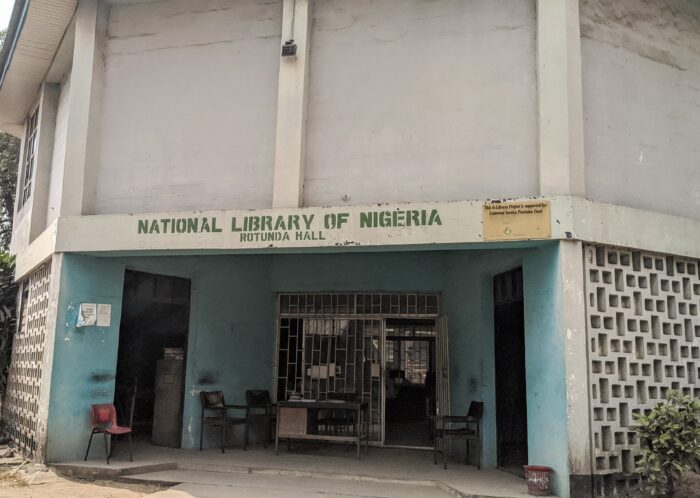
Through social media, I found that there was an office located in Yaba in Lagos. So I drove there on February 21. It was located off Herbert Macaulay Road, in an alcove that made it easy to miss from the main road. Even the sign had been obstructed by a half-broken fence and an electric pole. Still, there it was. The compound was big enough to allow for parking. The building itself was spacious and the visit looked promising. Outside, by the fence, were a couple of students reading on small tables.
At the National Library branch in Lagos
On my way in, I noticed shelves and cupboards placed outside, and in positions that suggested that some renovation was going on. This would be confirmed later. The Library was out of service on this day. Some renovation was going on that would not be complete for a few weeks. So only a few skeletal services were available. Even the director was not around. But I found two officers who would speak to me and answer some of my questions.
One of the things I was curious about was Legal Deposit, the law that mandates that every book published in the country be sent to the National Library for keeping and archiving. I knew, by having read up on it (some links are online here, here, and here), that the law existed in Nigeria, but I didn’t know how it worked on the ground. I was also curious about how it was being implemented.
In Nigeria, the law mandates at least three copies of books to be sent to the National Library in the state where the book was published. There are 27 branches of the National Library though more are being considered for the other states. The plan, according to the person who attended to me, was to have a branch in each of the 36 states in Nigeria. These three copies are then sent from the local branch to Abuja, the headquarters, where a bibliographic record is made, after which one of the copies of the book is retained in Abuja, one is sent to the Kenneth Dike Library at the University of Ìbàdàn, while the final one is sent randomly to any one of the 27 branches around the country.
The Nigerian Legal Deposit law, it seems, stems from the fact that the Nigerian National Library is also the source of all ISBN numbers issued for books about to be published. This is not the same in the UK. So maybe the thinking is that publishers hoping to continue to get ISBN numbers will hold up their own part of the bargain by continuing to send in published books as required by law. I was surprised to find that, in spite of this, there are still some publishers who either forget or choose not to send in their required legal deposit. The woman who spoke to me said that there are some enforcement mechanisms to take care of this. Visits are often made to these publishers to remind them of their responsibilities.
So, because copies sent to the branches are selected randomly, no branch in the country has all the titles published that year. And none can boast of having copies even of the books published in the state. I found it interesting. I was also fascinated by the new discovery that the library in my alma mater, the University of Ìbàdàn — called Kenneth Dike Library — had copies of all the books published in the country since the establishment of the National Library in 1964 or even earlier. The suggestion was that even colonial legal deposit materials would be there. And so I arranged to visit it. But I was also interested in visiting the Ìbàdàn branch of the National Library, if only to compare the services, the environment, and the structure. I was also interested in at least making a connection, for the British Library, with the curators there.
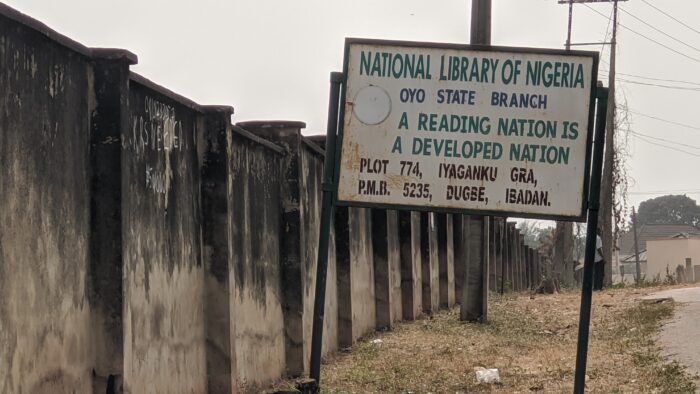
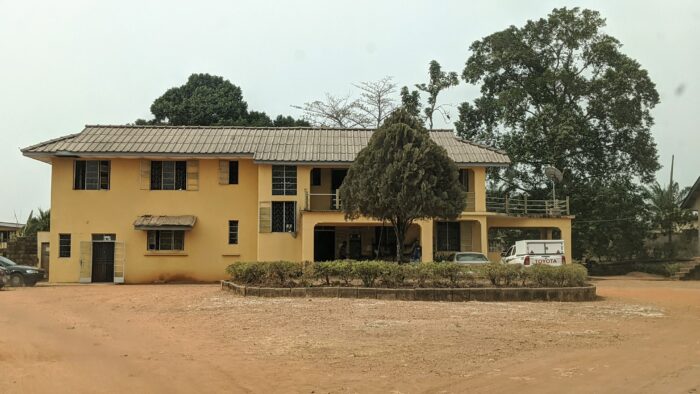
At the National Library Branch in Ìbàdàn
The Ìbàdàn branch of the Library is at Iyaganku, across from the Customary Court of Appeals. It had a wider compound. The building used to be a residential house for one of the country’s earliest leaders and politicians. It was said that Anthony Enahoro once lived there. Even the compound of the Customary Court once hosted the second Premier of the Western Region, Chief Ládòkè Akíntọ́lá, who was murdered there during the first coup d’etat in January of 1966.
On the fence on my way in was the poster for an event that happened many months earlier inviting the general public for a sensitization workshop “on Legal Deposit Compliance and ISBN & ISSN” Inside, after parking, I got in, and met a number of workers there who showed me the reading rooms, the storage rooms, and answered a number of questions I had about the challenges they have with running the place, attitudes of users, the state of libraries in Nigeria, and other things. They also asked me about the British Library, what I did there, and how to better create a collaboration between the two institutions.
The director wasn’t around on this day either, so I arranged to return, especially after seeing Kenneth Dike Library in Ìbàdàn.
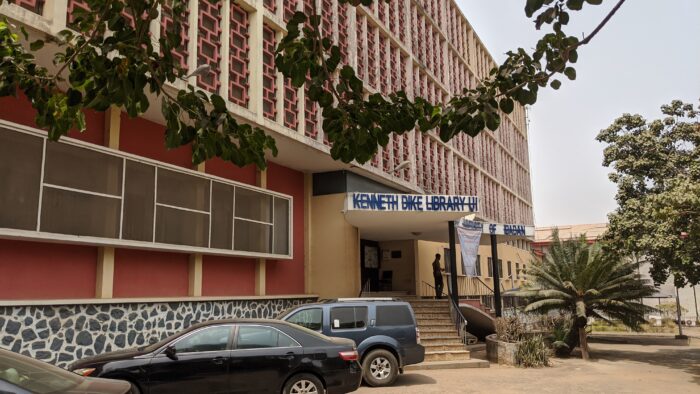
At Kenneth Dike Library, University of Ìbàdàn.
KDL, as we often called it, is as old as the university itself. I had spent some time there as an undergraduate between 2000 and 2005. I just hadn’t known that it was also a library of archival records. Its role as a repository for all legal deposit materials was a revelation that I was interested in exploring.
Kenneth Dike Library, University of Ìbàdàn
I secured a meeting with the Head Librarian for a conversation. There was a strike action of non-Academic staff on the day I went there on February 25th, so she had some free time. We talked for almost an hour, some of which were productive. Mostly, she appeared either unfamiliar with the role of the Library as a legal depository for books from the National Library, or not understanding of my questions and follow-ups about where exactly one could find those books. The focus of the Library, she said, was on academic publications. Acquisitions are done only for publications that would help the students and professors in their research. All other materials — including fiction, history, or other “irrelevant” ones — are regularly pruned from the shelves to make way for these important ones. She also did not know much about colonial legal deposits, which I had been told at the Iyaganku branch of the National Library should also be in the holdings of the Kenneth Dike Library.
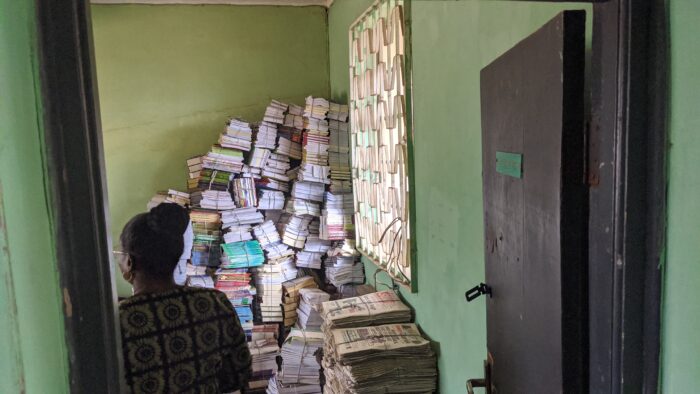
After a generally unhelpful conversation, I proceeded downstairs to speak to someone she had recommended had sufficient knowledge. This was Seun Obasola, who happened to have been my predecessor at the British Library as the Chevening Research Fellow. If the last hour had been frustrating, the next three were the opposite. Obasola, who had worked at the Library for over ten years, knew its ins and outs. She knew that KDL was, indeed, a repository for legal deposit materials from Abuja (and had an idea of where I could find them). She also admitted the already obvious fact that many people who currently work in, and occupy high administrative positions in, the Library might not always be the most knowledgeable about the location of many of its holdings. She pointed to me the storage areas where many archival and historical materials belonging to the Library from way back were stored, sometimes in terrible conditions. She is currently applying for an EAP grant to catalogue and digitize some of them. The sad fact, she said, was that there was just too much, and too little manpower. Thus, over time, materials just get piled up with no one knowing where they are or what to do with them. More funding, and more manpower would be very helpful. Not helped, also, is the fact that she herself was just about to begin another two-year fellowship in Canada, which may take her even farther from a place that needed her competence so badly.
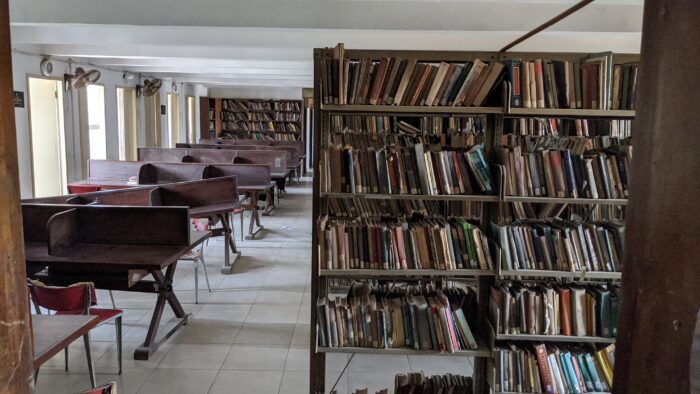
Inside the KDL
It was a delight to hear that the catalogue records of KDL — at least of the materials that have been found and properly stored — was almost all available online through the online public access catalogue. Like the BLExplore page, one could search for any item in the KDL catalogue even without being on the physical premises. This is not the same for the Nigerian National Library, where manual cardboard catalogues are still being used. I was told that the Abuja office had an electronic record, but it just wasn’t online. It seemed unhelpful to think of a national library without a nationally-accessible catalogue, but that’s where we currently are. I have harboured the hope of one day meeting with the National Librarian, Professor Lenrie Ọlátòkunbọ̀ Àìná, whom I have been told is a progressive-leaning administrator, to discuss these questions.
The Biggest Issues
It seems, from my experience during this visit, that the biggest issues in public library administration are funding allocation and management.
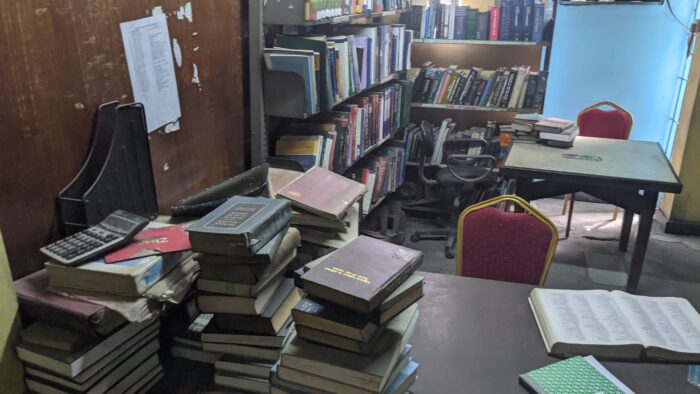
The 2020 budget for the organisation was 2.9 billion naira (£6.12 million). This looks small compared to the annual budget of the British Library which is currently at £142 million but for what services it can offer in Nigeria, that is a lot. It is perhaps not efficient to have 27 branches (while aspiring to have 9 more). Current overhead costs are 227.9m naira (£480,965.24) which could probably be better used for acquisitions, digitization, storage, and other expenses. The capital expenses cost 1.6 billion naira (£3.37 million). From what I saw in Ìbàdàn and Lagos, which should certainly be the two most prominent centers apart from the HQ, that money is terribly spent. The computers don’t work. Those that work aren’t being used by students. The catalogues are still manual. There is no electricity or inverters to provide power. The generators are rarely on, and people who use the reading rooms are often in quasi-dark environments. The library’s branches do not pay for their own acquisitions, and often even turn their backs on donations, for lack of space to store and preserve the materials being donated. I would be interested in knowing what capital expenses were made with £3.37 million every year!
National Library in Lagos. The condition of book storage.
The other, of course, is leadership. Until I speak with the National Librarian, I will have nothing particular to say here. But I hope to in the future. He apparently has a home in Ìbàdàn, and comes around often, every few months. Putting the right directors at each center — who know what is right, and who are capable of better managing the funds allocated there — might be a way out. One, of course, needs transparency about how much is being allocated to each branch. None of this information was made available to me, for the obvious reason of my non-insider status. But there were insinuations, particularly by the lower members of staff that I talked to, that mismanagement was also a part of the problem.
Everyone I met had mentioned the Olúsẹ́gun Ọbásanjọ́ Presidential Library in Abẹ́òkuta as one model of a decently managed and decently run library in Nigeria. It was founded shortly after the tenure of the man in whose name it was built, who had then ruled Nigeria for the second time as a civilian president. It turned out that Chief Ọbasanjọ́ himself had been instrumental in securing the land for the permanent site of the National Library in Abuja, and was a passionate advocate for proper archiving and documentation in Nigeria. So I was intensely curious about meeting him. Unfortunately, my time in Lagos had run out by the time the necessary arrangements were made, and I could not make the trip to Abẹ́òkuta. I intend to do this on my return from the fellowship. The Presidential Library, according to those who have visited it, boasts of a number of relevant records in Nigerian political and social history, and also the life of its patron as well, who was imprisoned in 1995 on the accusation of being an accessory to a fabricated coup. He was freed in 1998 as part of the amnesty programme of the subsequent military administrator. He became a candidate for office that same year, and was elected president in 1999.
One of the limitations, I believe, in getting sufficient funding for the Nigerian National Library is the ban on fundraising. All the funds for running the Library is given by the government. The act setting it up also prohibits any fundraising of any kind. So people can use it “free”. The result of that is that if the money disbursed from Abuja is insufficient, the library and the books suffer. At the British Library, at least one could pay to become a member, or use venues in the Library, or buy food at the public cafeteria. The BL also gets private funding, for activities such as the Endangered Archives Project or the Eccles Center. Those help support the Library as a public institution. I saw no sign of any such public-private partnership with the Nigerian equivalent. Perhaps changing the laws to make this possible, and allowing the branches to make money through small services, will help improve their use and competence.
Conditions at the National Library in Lagos
There are a number of grants that have supported library work in Nigeria. A sign at the Yaba branch says “This e-Library Project is supported by the Universal Service Provision Fund.” In Ìbàdàn, I learnt about TETFUND, which is a fund dedicated to helping tertiary institutions in Nigeria. Kenneth Dike Library got some of it. EAP at the BL has also been named as a potential funder for some documentation projects. These and many more can be helpful if properly managed.
Other Libraries, Comparisms, Conclusions
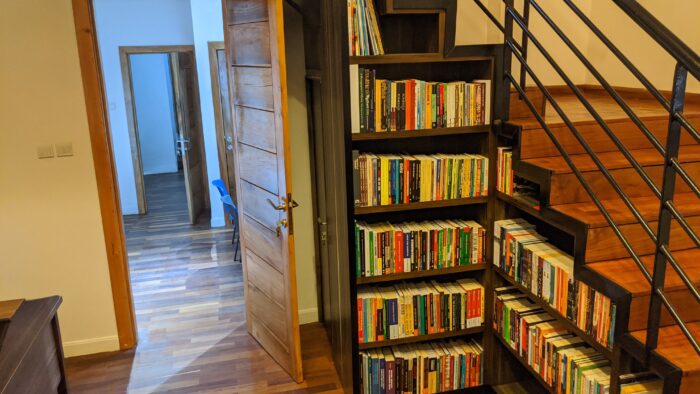
In Nigeria today, especially in more metropolitan places like Lagos, private libraries and reading spaces are springing up. In the same Yaba, about a kilometre or so from the National Library, there is a new private library renovated by a private bank and used to host readers and other enthusiasts. Some public events have been held there as well, including the famous one where a Guinness Record was made in 2018. There are also state-controlled public libraries which, very likely, suffer from the same problem as the federal one. One of my favourite places to go in Lagos, of course, is the Ouida House. It is not a library per se, but a bookshop with a public-facing side. It also has a reading room that is accessible.
A private library and reading space in Lagos Island
But in all, the library I found closest in ambition, scope, capability, and history, to the British Library is the Kenneth Dike Library in Ìbàdàn. With better funding and management, it might do even better. I suspect that the Hezekiah Oluwasanmi Library at the University of Ifẹ̀ comes real close, but I never got a chance to explore it either.
____
Thanks to Budgit for some of the budget figures I used here.
Panduan Modern untuk Akses Gaming Online dan Hiburan Digital
Dunia gaming online berkembang dengan sangat pesat bos67. Dari yang awalnya hanya dianggap sebagai aktivitas internet yang cukup niche, kini gaming telah berubah menjadi bagian besar dari ekosistem hiburan digital yang bisa diakses melalui berbagai perangkat dan dari beragam lokasi. Platform modern saat ini semakin menaruh perhatian pada kemudahan akses, desain responsif, waktu loading yang cepat, serta navigasi yang simpel dan user-friendly. Daripada haha303 menggunakan tampilan yang ribet dan bikin pengguna harus klik ke sana kemari, banyak layanan digital kini berusaha menghadirkan pengalaman yang lebih smooth agar pengunjung dapat menjelajahi konten yang tersedia dengan cepat sekaligus memahami fungsi setiap bagian dengan mudah.
Salah satu perkembangan yang paling terasa adalah semakin pentingnya hokihoki akses website yang praktis dan nyaman. Pengguna sekarang sudah terbiasa mengharapkan sebuah platform digital dapat berjalan dengan baik di smartphone, tablet, laptop, maupun komputer desktop. Halaman yang loading-nya lambat, navigasinya membingungkan, atau terlalu sering tidak dapat diakses tentu berpotensi membuat pengunjung langsung cabut. Karena itu, platform gaming masa kini umumnya mengutamakan tampilan responsif, menu yang lebih ringkas, serta fitur akses akun yang sederhana dan mudah dipahami.
Akses Website yang Praktis
Halaman akses alternatif juga sudah menjadi konsep yang cukup umum dalam lingkungan hokihoki.link. Ketika sebuah halaman utama mengalami kendala teknis, sedang menjalani maintenance, atau menghadapi keterbatasan akses di wilayah tertentu, operator layanan terkadang menyediakan alamat alternatif. Meski begitu, pengguna tetap harus memastikan bahwa alamat tersebut benar-benar resmi dan dapat dipercaya sebelum memasukkan informasi pribadi. Jangan asal klik koko11 link yang beredar di media sosial, aplikasi pesan, atau website yang tidak dikenal, karena tautan random seperti itu bisa membawa risiko keamanan yang sebenarnya tidak perlu.
Keamanan dalam Hiburan Digital
Aspek keamanan harus selalu menjadi perhatian utama ketika koko188 seseorang berinteraksi dengan platform hiburan online. Tampilan website yang modern dan terlihat profesional bukan berarti secara otomatis menjamin bahwa platform tersebut aman atau terpercaya. Pengguna sebaiknya memperhatikan koneksi yang aman, kebijakan yang transparan, bagaimana informasi pribadi dikelola, serta apakah tersedia saluran kontak yang jelas. Selain itu, hindari memasukkan koko288 password atau informasi privat lainnya pada website yang diakses melalui iklan mencurigakan maupun pesan yang datang tanpa diminta.
Perkembangan Desain Website Gaming
Desain website gaming online juga mengalami perubahan koko303 yang cukup signifikan. Platform lama sering kali menggunakan halaman yang penuh dengan banner, tombol, tulisan, dan berbagai elemen visual sekaligus. Sementara itu, pengguna masa kini cenderung lebih menyukai layout yang clean, kategori yang jelas, serta susunan visual yang membuat informasi penting langsung terlihat. Pengunjung idealnya tidak perlu melewati banyak halaman yang tidak relevan hanya untuk https://koko303.cfd/ menemukan informasi dasar. Perubahan ini sebenarnya merupakan bagian dari tren internet yang lebih luas, di mana kesederhanaan, kecepatan, dan kemudahan penggunaan semakin menjadi standar utama dalam desain produk digital.
Menemukan Game dengan Lebih Mudah
Kemudahan menemukan game juga menjadi bagian penting dari pengalaman koko33 modern. Sebuah platform online dapat memiliki berbagai macam kategori hiburan, mulai dari game digital, permainan bergaya arcade, pengalaman bertema olahraga, puzzle, casual game, hingga berbagai format interaktif lainnya. Interface yang tertata dengan baik memungkinkan pengguna menjelajahi kategori tersebut tanpa merasa overwhelmed. Fitur pencarian, filter, preview, serta informasi deskriptif dapat membuat proses menemukan konten menjadi jauh lebih praktis dan tidak ribet.
Gaming dan Teknologi Mobile
Popularitas gaming digital juga memiliki hubungan yang sangat erat koko5000 dengan perkembangan teknologi mobile. Smartphone saat ini sudah memiliki kemampuan yang cukup tinggi untuk menjalankan berbagai pengalaman berbasis browser dengan tampilan yang kompleks. Artinya, seseorang dapat menikmati hiburan interaktif tanpa harus selalu duduk di depan komputer. Website responsif bahkan dapat menyesuaikan layout secara otomatis berdasarkan ukuran layar, sehingga navigasi tetap nyaman meskipun pengguna mengaksesnya melalui layar smartphone yang lebih kecil.
Pentingnya Performa Website
Performa website juga tidak kalah penting. Pengguna internet https://koko5000.link/ modern sudah terbiasa dengan layanan digital yang serba cepat. Karena itu, beberapa detik tambahan ketika sebuah halaman sedang loading saja bisa memengaruhi pengalaman secara keseluruhan. Struktur website yang efisien, gambar koko 5000 yang telah dioptimalkan, hosting yang stabil, serta kompatibilitas dengan browser modern dapat membantu menciptakan performa yang lebih smooth. Fondasi teknis yang stabil menjadi semakin penting bagi website yang memiliki elemen interaktif, menu dinamis, serta informasi yang diperbarui secara berkala.
Konten yang Fresh dan Relevan
Tren modern lainnya adalah meningkatnya perhatian terhadap kokogacor77 konten yang fresh dan relevan. Pengguna internet biasanya lebih tertarik pada platform yang secara rutin memperbarui informasinya dibandingkan halaman yang terlihat seperti sudah lama ditinggalkan. Deskripsi yang diperbarui, tampilan interface yang lebih fresh, kategori hiburan baru, serta informasi layanan yang akurat dapat membuat sebuah platform terasa lebih aktif dan relevan mami188. Namun, update yang terlalu sering juga tidak seharusnya mengorbankan kejelasan, konsistensi, atau tingkat kepercayaan terhadap informasi yang diberikan.
Sisi Sosial dalam Hiburan Digital
Hiburan digital juga semakin memiliki sisi sosial. Banyak mega288 orang menemukan game dan platform baru melalui komunitas online, forum diskusi, content creator, serta berbagai jejaring sosial. Sebuah rekomendasi bahkan bisa menyebar dengan sangat cepat, terutama ketika game atau platform tertentu sedang menjadi bagian dari tren internet. Namun, popularitas tidak boleh langsung dianggap sebagai bukti bahwa sebuah layanan aman atau legitimate. Sebuah layanan bisa saja mendapatkan perhatian besar di internet, tetapi tetap perlu diperiksa dan dievaluasi secara kritis sebelum digunakan.
Partisipasi yang Bertanggung Jawab
Partisipasi secara bertanggung jawab menjadi semakin penting ketika sebuah platform megawin188 hiburan melibatkan aktivitas yang menggunakan uang sungguhan. Pengguna perlu memahami perbedaan antara hiburan dan ekspektasi finansial. Tidak ada game yang secara sah dapat menjamin hasil tertentu, sehingga klaim mengenai keuntungan instan atau kemenangan yang seolah-olah pasti sebaiknya disikapi dengan skeptis. Aktivitas yang melibatkan unsur keberuntungan memiliki hasil yang tidak dapat dipastikan, dan bahasa promosi seharusnya tidak pernah dianggap sebagai sebuah jaminan.
Menetapkan Batas Pribadi
Menetapkan batas pribadi dapat membantu menciptakan hubungan yang lebih sehat dengan hiburan digital. Batas waktu dan batas pengeluaran merupakan langkah praktis untuk mencegah aktivitas rekreasi mengganggu kehidupan sehari-hari. Jangan sampai seseorang merasa harus terus bermain hanya karena sebelumnya sudah mengeluarkan uang atau mengalami kerugian. Mengambil jeda merupakan pilihan yang wajar, terutama ketika sebuah aktivitas sudah tidak lagi terasa menyenangkan atau mulai memberikan tekanan.
Memahami Syarat dan Ketentuan
Kebiasaan lain yang tidak kalah berguna adalah membaca syarat dan ketentuan pulsa303 sebelum menggunakan layanan yang belum dikenal. Informasi mengenai persyaratan pengguna, kebutuhan akun, kebijakan privasi, prosedur pembayaran, ketentuan penarikan dana, serta mekanisme penyelesaian masalah dapat memberikan gambaran mengenai bagaimana sebuah platform beroperasi. Memang, dokumen semacam ini terkadang terlihat panjang dan agak bikin malas membaca. Namun, memahami aturan dasarnya dapat membantu pengguna menghindari kejutan yang tidak menyenangkan di kemudian hari.
Menjaga Privasi Pengguna
Privasi juga membutuhkan perhatian yang sama seriusnya. Pengguna sebaiknya berhati-hati terhadap website yang meminta terlalu banyak informasi pribadi. Menggunakan password yang kuat dan berbeda untuk setiap akun, memperbarui perangkat secara rutin, serta mengaktifkan autentikasi dua faktor apabila tersedia dapat memberikan lapisan perlindungan tambahan. Jangan sembarangan membagikan detail akun kepada orang lain, bahkan ketika seseorang mengaku sedang menawarkan bantuan teknis.
Bahasa Modern dalam Digital Marketing
Lingkungan online modern bergerak dengan sangat cepat, dan istilah yang digunakan di dalamnya ikut berubah mengikuti tren. Kata-kata seperti “trending”, “viral”, “next-level”, dan “instant access” sering digunakan dalam digital marketing karena mampu menciptakan kesan yang menarik dan membangun rasa penasaran. Bahasa seperti ini memang bisa membuat sebuah konten terasa lebih fresh dan engaging, tetapi pengguna tetap harus bisa membedakan antara kata-kata marketing yang catchy dengan informasi yang benar-benar dapat diverifikasi.
Pentingnya Konten Berkualitas
Bagi pemilik website, membuat konten yang benar-benar bermanfaat kini sama pentingnya virtusplay dengan menciptakan interface yang menarik. Search engine dan pengguna internet semakin menghargai halaman yang memberikan informasi genuine dibandingkan konten yang hanya mengulang kalimat promosi secara terus-menerus. Penjelasan yang original, penggunaan bahasa yang natural, struktur yang jelas, serta informasi yang relevan dapat membuat sebuah artikel lebih berguna bagi pembaca sekaligus meningkatkan kualitas keseluruhan website.
Originalitas dan Autentisitas
Karena itu, artikel tentang hiburan digital yang berkualitas seharusnya tidak hanya mengulang frasa yang sudah sering digunakan. Konten yang baik perlu menjelaskan apa yang dapat diharapkan pengguna, membahas berbagai hal penting terkait akses, menjelaskan aspek keamanan, serta memberikan informasi realistis mengenai penggunaan platform secara bertanggung jawab. Pembaca modern biasanya cukup cepat menyadari ketika sebuah artikel terasa terlalu repetitif atau dibuat secara asal-asalan. Itulah kenapa originalitas dan autentisitas menjadi semakin penting.
Perkembangan Teknologi Internet
Pada akhirnya, gaming online dan hiburan digital akan terus berkembang seiring dengan kemajuan teknologi internet. Koneksi yang semakin cepat, desain yang mengutamakan perangkat mobile, layanan berbasis cloud, interface yang semakin baik, serta pengalaman yang semakin personal terus membentuk cara orang berinteraksi dengan platform digital. Semua perkembangan tersebut memang membuat hiburan menjadi lebih praktis dan accessible, tetapi kemudahan tetap harus diimbangi dengan kesadaran dan kehati-hatian.
Gaming sebagai Hiburan
Pendekatan terbaik adalah melihat gaming online sebagai bentuk hiburan, bukan sebagai sumber pendapatan yang dijamin. Sebelum mengakses platform yang belum dikenal, pengguna sebaiknya memeriksa legitimasi layanan tersebut, memahami kebijakannya, menjaga keamanan informasi pribadi, serta menetapkan batas yang masuk akal. Interface yang terlihat keren atau rekomendasi yang sedang viral tidak seharusnya menggantikan prinsip dasar keamanan digital.
Masa Depan Hiburan Online
Seiring internet terus berkembang, masa depan hiburan online kemungkinan https://www.ktravula.com/2025/01/whats-happening-at-randle-centre/ akan menjadi semakin terkoneksi, mobile-friendly, dan interaktif. Platform yang mampu menggabungkan desain berkualitas dengan transparansi, keamanan, praktik yang bertanggung jawab, serta informasi yang benar-benar berguna akan memiliki peluang lebih besar untuk membangun kepercayaan pengguna dalam jangka panjang. Bagi pengguna, kuncinya adalah tetap update, mampu mengenali klaim yang berlebihan, dan mengambil keputusan berdasarkan informasi, bukan sekadar mengikuti hype.
Di tengah lanskap digital yang dipenuhi begitu banyak pilihan, satu prinsip sederhana tetap relevan: kemudahan memang penting, tetapi keputusan yang didasari informasi jauh lebih penting. Baik ketika seseorang sedang mengeksplorasi casual game, hiburan interaktif, maupun pengalaman digital lainnya, memahami sebuah platform sebelum menggunakannya dapat membantu menciptakan perjalanan online yang lebih aman, nyaman, dan terkendali.
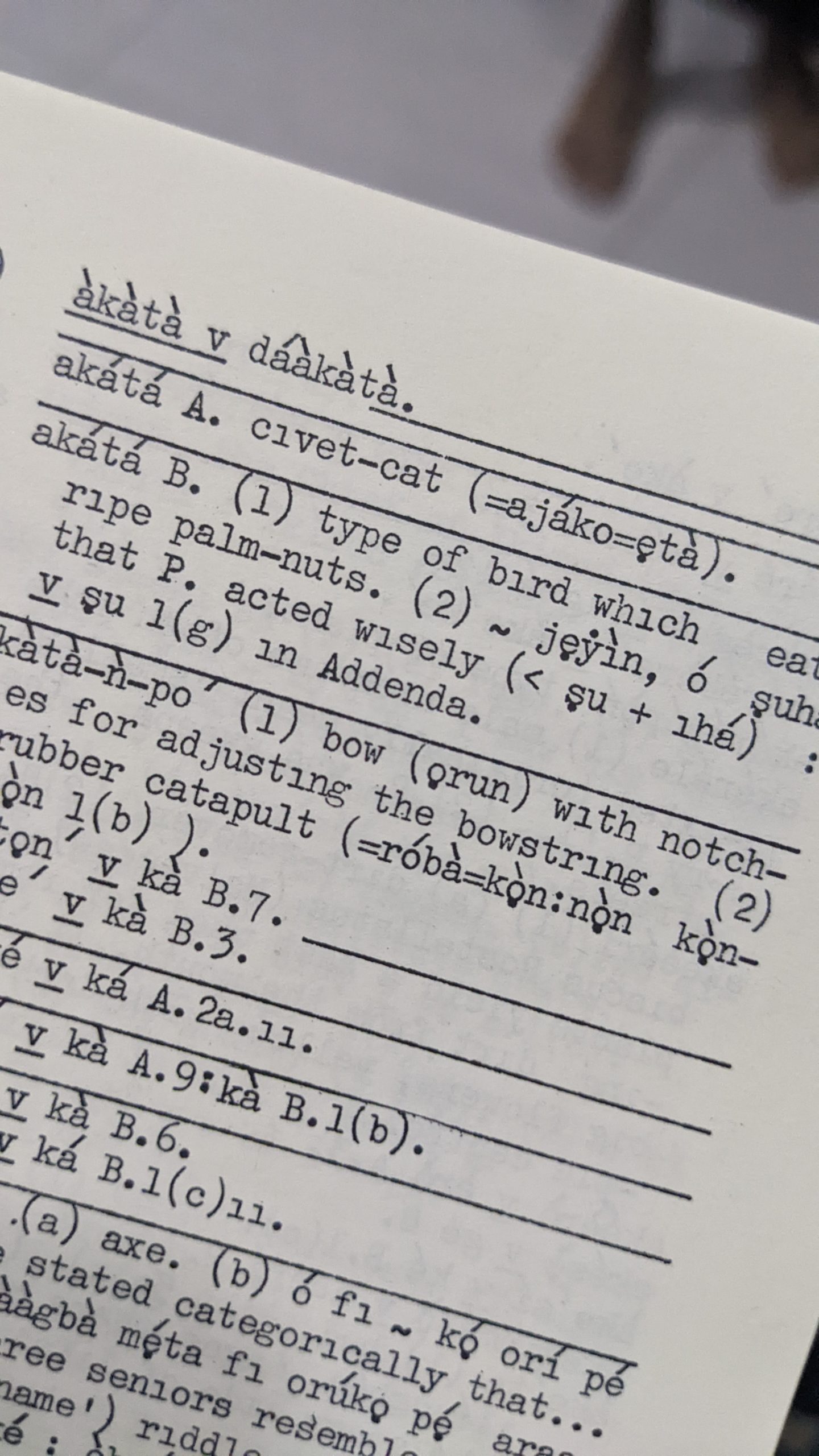
Every once in a while, a conversation returns to my timeline about the meaning of ‘akata’, the origin, the use, and other social dimensions of its existence in the relationship between Africans on the continent and those in America. Discussions are had and the issue goes away, only to return in another form at another time. Yesterday was one such event when, shortly before going to bed, someone tagged me on Twitter about the meaning of the word again. I shared photos of the entries in two of my dictionaries and thought that was all.
I found out, later, that the invitation came from a bigger context: an apology by my colleague and language professor, Uju Anya, for using the word in the past in different twitter contexts. The debate that followed was whether the word was a slur in the first place, whether she had the reason to apologise, whether those calling for her resignation were overplaying their hand about an issue of no relevance, or whether certain words are allowed a pass if the intentions are pure.
This time, I thought it best to put my thoughts down on what I know about the word, what I think about the perennial controversy. This essay draws from my experience as a linguist and lexicographer, native speaker of Yorùbá, and a scholar of history, especially of transatlantic slavery and attendant consequences.
What is akata?
Let’s start with the three meanings recorded in the Yorùbá dictionary:
From the CMS dictionary from 1913
n. Jackal, same as ‘Ajako’. Source: A Dictionary of Yorùbá Language by CMS (1913).
n. Civet-cat. Also “ajáko ẹtà”. Source: Dictionary of Modern Yorùbá by R.C Abraham (1958)
n. A type of bird which eats ripe-palm nuts. Source: Dictionary of Modern Yorùbá by R.C Abraham (1958)
As far as we know, the word doesn’t exist in any other Nigerian language.* It is a Yorùbá word — at least in its origin.
Is it a slur?
First, let’s start with history. Growing up in the eighties in Nigeria, I heard the word only as a descriptive term with no pejorative intent.
It was just any word, to refer to a certain demographic. We had òyìnbó for ‘white people’ (similar to muzungu in Swahili or onyi ocha in Igbo, or gringo in Spanish/Portuguese); we had akátá for Black Americans; we had Gambari for northerners in Nigeria (Sulu Gambari was the name of a famous Yorùbá-Fulani king in Ìlọrin); we had Tápà for Nupe people many of whom had intermarried with Yorùbá people; and we had kòbòkóbò for almost everyone else that didn’t speak Yorùbá.
Of all the terms, kòbòkóbò was the only one that seemed to carry a negative intent, because it referred to someone who, in the imagination of the Yorùbá person using the word, was not cultured enough to understand the language. The people we referred to with those words knew they were called that, and it never — to my knowledge — carried any negative blowback. It was used in film and popular culture.
There was a famous fuji music album by Àyìndé Barrister from the late eighties or early nineties in which he sang the following lines:
Akátá gba ‘jó
Òyìnbó gba ‘jó
Yorùbá gba ‘jó o
Translated:
American blacks danced to my song
American whites danced to my song
Yorùbás also danced to my song.
The album was one he waxed shortly after returning from an American tour, so it was a celebration of his popular appeal across different demographics. No slur in sight.
How did akátá even come to refer to African Americans?
No one has found any verifiable answer, but a plausible one goes like this:
In the sixties and seventies, African Americans channelled their social and political rebellion through the Black Panther movement, claiming an African cat as a symbol of their struggle for self-actualization. Yorùbá Nigerians in the States at the time, perhaps happy to participate, referred from then on to African Americans as akátá. It was not the exact Yorùbá word for panther**, but it was close. Whether that initial use was meant to be derogatory is something that needs to be researched, but there is no substantive proof of that, and many notable African scholars of Yorùbá extraction have written favourably about the Civil Rights Movement and all that came with it in the African-American struggle.
When/How did it become a slur?
It was when I became an adult that I started noticing different ways in which the word was used. Not just akátá, by the way, but also gàm̀bàrí and the others. You would hear someone being called gàmbàrí because he didn’t pay attention to instructions or appeared slow to act. Or for any random reason. This would be in-group conversations, particularly when no northerner was in sight. So it was not directed at the outsider, but at a Yorùbá person as an insult. The insult was to the Yorùbá target, not the northerner (even though the secondary insult to the northerner is also implied, but not overt). It is possible that akátá also then took on this character as time went on.
Such that almost every time I heard it from the early 2000s, it had a non-positive character. It was not a slur in a way that the n-word or even gàmbàrí was, that is, it was not a word that was used to insult a person to their face. In fact, I don’t think I recall any instance in which someone used akátá as a weapon. You can’t stand in front of someone and say “you bloody akátá”, it doesn’t quite work. But when it was used to refer to African-Americans, the meaning seemed to have changed. It could be about crime rates in the US, about any other unsavoury characteristic, or even about a normal or even friendly conversation. Which of those black people standing there do you want me to call? The akáta one? Okay. In fact, not many people today even know that it referred to a certain cat or bird — either of which are likely extinct anyway. You hear akátá and you think African-American. Not Obama, but Jesse Jackson. African parents could mention not wanting their children to “behave like those spoilt akátá kids” Or a man could tell his friend that his new girlfriend is an akátá; not as a pejorative but as a descriptor. Maybe it was the fact that such a word exists at all that referred to our black cousins on the other side of the Atlantic that brought the pejorative colouring; or maybe because people started saying it meant “wild animal” or maybe it was because of the conspiratorial way in which I’ve heard people use it as if in a secret code to prevent the subject of the conversation from knowing that it’s them to whom the word refers. There was just some othering seemingly implied in the common contemporary usage that perceptive listeners started to decry. The word itself had not changed, but it was no longer possible to call it just a descriptor.
But as with when meanings of words change everywhere, there are still people in Nigeria today who knew the word only in its first cross-continental non-negative use. People of my parent’s generation fall into this category. In normal everyday conversation, they will use akátá to demarcate an African in America from an African-American. They do not know it any other way, because we never found another word for that demographic. There are also other people, who don’t speak Yorùbá, who have only encountered the word from other Nigerians or from other Africans, and just continue to use it.
Does intention matter?
This is where the debate gets interesting: the question of whether one should mean to denigrate before the meaning of a word is called into question. This is a big ongoing debate. Not just with the n-word but also with words in other domains. Even the word ‘òyìnbó’, which I mentioned earlier, got me thinking a few years ago, after a white student asked me in class if it was a slur. I knew that it was not, but I realized, in explaining to her, that I couldn’t successfully convey all the contexts in which we use it without raising her suspicion that I was hiding something. I wrote an essay instead, but the response I got to it, especially from Nigerians, showed me that even the question of whether the word could be derogatory in certain contexts was not one that people wanted to have. “If we don’t mean it to be offensive, then why should we listen to you who say you find the usage uncomfortable?” the argument went. If you told my mother that akátá was derogatory, when she had not used it in that way, she would strongly object. I can point her to African-Americans finding it objectionable, so she might not use the word in public, but it won’t be because she believes that she’d done something wrong.
Recently, Beyoncé conceded that her use of spazz was ableist and she had it removed from an album — even when she didn’t have such an intention from the start. The word ‘negro’, which started as being just descriptive, is no longer in fashion today, because of the other connotations it took on in the hands of a more powerful culture. Shouldn’t akátá suffer the same fate?
I’m of the opinion, knowing how I’ve seen the word used, that we lose nothing by no longer using it for anything other than the animals. But I am also sympathetic to those who recognize their past usage, and apologise for doing so. I don’t expect that every Nigerian knows the origin of the word or the ways in which modern usage seems to have perverted it. The only thing we know is that African-Americans do not like it as well, and that should be enough, especially if the purpose of the conversation is to improve relations across the pond.
But the word won’t go away, because not every Yorùbá speaker lives on the internet or care about language-based social crusades, and because words don’t just disappear. Gringo and mzungu will continue to be in use, even if we can point to instances in which their usage is problematic. All we can do is continue to have the conversation.
Should anyone who uses it be cancelled?
No. As with many things, intent matters. So does knowledge, and one’s response to new information. We continue to evolve as a society, and so will our use of language and interaction with each other. Not every African-American is insulted by akátá either, perhaps because not every one of them has heard it, and some who have don’t care, unless they encounter it first through an online essay in which the meaning of the word is put as “cotton picker”, which it has never been. But many deeply resent it, either because of what they think it represents or just because of the othering implied in the way it has been used over the years. This is valid, and Africans should absolutely take it into account when they speak. My recommendation is that we stop using it totally to refer to anything but the animal. But I know that I’m not in the majority. If this is your first time hearing the word, all you need to know is that the origin is benign, its growth in use is muddy but complex, and that there are people from the language community where the word originated who never use it, just as there are some who don’t have any other way, but mean absolutely no harm.
Platform Slot Online: Panduan Modern untuk Akses Game Digital dan Bermain Secara Bertanggung Jawab
Dunia gaming online telah aman788 mengalami perubahan yang cukup drastis dalam beberapa tahun terakhir. Apa yang dulunya hanya dianggap sebagai bentuk hiburan digital yang cukup niche, kini sudah menjadi bagian yang sangat populer dari aktivitas internet. Banyak pemain mencari platform yang praktis, koleksi game yang selalu diperbarui, tampilan responsif, serta akses yang lebih simpel untuk menikmati berbagai permainan favorit mereka. Seiring persaingan ayo788 yang semakin ketat, platform slot online pun terus beradaptasi agar tetap relevan dengan kebutuhan pengguna dan kebiasaan digital masa kini.
Kemudahan Akses dan Pengalaman Pengguna
Bagi pengguna yang sedang mencari gghoki hiburan melalui slot online, salah satu hal yang paling diperhatikan adalah kemudahan akses. Tidak ada yang mau berhadapan dengan navigasi ribet, halaman yang terasa jadul, tautan yang tidak berfungsi, atau tampilan yang seolah-olah belum mengikuti perkembangan zaman. Platform modern idealnya mampu memberikan pengalaman yang straightforward sejak pertama kali pengguna membuka halaman. Menu yang jelas, waktu loading ggtoto yang cepat, kompatibilitas dengan perangkat mobile, serta informasi yang mudah dipahami dapat membuat keseluruhan pengalaman terasa jauh lebih praktis.
Keberagaman Game Online
Selain aksesibilitas, keberagaman gokil33 game juga menjadi salah satu alasan mengapa slot online terus menarik perhatian. Saat ini, pemain dapat menemukan berbagai macam permainan digital dengan tema, desain visual, mekanisme, dan gaya penyajian yang berbeda-beda. Beberapa game mengandalkan visual bergaya sinematik yang detail, sementara lainnya justru mempertahankan konsep sederhana dengan reel klasik dan simbol yang familiar. Ada pula permainan gototo yang mengusung tema petualangan, dunia fantasi, mitologi, teknologi, olahraga, hingga berbagai konsep kreatif lainnya.
Variasi tersebut membuat dunia gaming online terasa lebih dinamis haha788 dan tidak gampang membosankan. Pengguna tidak lagi terpaku pada koleksi permainan tradisional dalam jumlah terbatas, tetapi dapat mengeksplorasi berbagai format sesuai dengan selera masing-masing. Bagi pengguna kasual, menemukan game baru bisa menjadi bagian seru dari aktivitas hiburan. Sementara bagi pemain yang sudah lebih berpengalaman, membandingkan mekanisme hahagacor permainan dan gaya visual juga dapat menjadi bagian dari pengalaman menjelajah platform.
Optimasi untuk Perangkat Mobile
Platform slot modern juga semakin memperhatikan pengguna smartphone hao788. Saat ini, smartphone sudah menjadi bagian penting dari aktivitas internet sehari-hari. Karena itu, website yang tidak mampu bekerja dengan baik pada layar berukuran kecil berpotensi kehilangan perhatian pengguna dengan cepat. Desain responsif memungkinkan halaman menyesuaikan diri dengan berbagai ukuran layar sehingga menu, tombol, tampilan permainan, dan bagian informasi hwtoto menjadi lebih nyaman untuk diakses.
Desain yang Sederhana dan Responsif
Namun, desain mobile-friendly bukan berarti sebuah website istana2000 harus dipenuhi efek visual yang berlebihan. Justru, tampilan sederhana sering kali menjadi nilai plus. Layout yang rapi, tulisan yang mudah dibaca, navigasi intuitif, serta posisi tombol yang tepat dapat membuat sebuah platform terlihat jauh lebih profesional. Di tengah aktivitas digital yang serba cepat seperti sekarang, pengguna biasanya lebih menghargai website liga2000 yang memungkinkan mereka menemukan informasi penting tanpa harus melewati terlalu banyak halaman.
Kecepatan Akses Website
Kecepatan akses juga menjadi faktor yang tidak kalah penting. Pengguna internet modern sudah terbiasa dengan website yang cepat dan konten yang dapat diakses hampir secara instan. Ketika sebuah halaman membutuhkan waktu terlalu liga5000 lama untuk terbuka, pengunjung bisa saja langsung pergi dan mencari alternatif lain. Struktur website yang efisien, gambar yang telah dioptimalkan, server yang stabil, serta desain yang ringan dapat membantu menciptakan pengalaman browsing yang lebih smooth.
Keamanan dan Transparansi
Keamanan dan transparansi juga wajib menjadi perhatian utama ligatoto. Sebelum berinteraksi dengan sebuah platform gaming online, pengguna sebaiknya memahami terlebih dahulu bagaimana layanan tersebut bekerja. Informasi mengenai aturan penggunaan, prosedur akun, kebijakan privasi, metode pembayaran, serta ketersediaan layanan berdasarkan wilayah seharusnya disampaikan secara jelas. Tampilan website yang terlihat profesional saja tidak cukup untuk membuktikan mcmtoto bahwa sebuah platform benar-benar legal, terpercaya, atau aman digunakan.
Informasi Lisensi dan Regulasi
Informasi mengenai lisensi naga2000 juga dapat menjadi pertimbangan, tergantung pada wilayah hukum tempat platform tersebut beroperasi. Pengguna sebaiknya melakukan verifikasi secara mandiri untuk memastikan bahwa lisensi yang dicantumkan memang valid dan operator memiliki izin untuk menyediakan layanan di wilayah mereka. Setiap negara dan wilayah memiliki aturan yang berbeda, sehingga layanan yang tersedia secara legal di satu tempat belum tentu diperbolehkan di tempat lainnya.
Memahami Istilah “Slot Gacor”
Istilah “slot gacor” sendiri cukup sering digunakan dalam berbagai naga5000 diskusi online untuk menggambarkan permainan yang menurut sebagian pemain sedang terasa lebih menguntungkan atau memiliki performa tertentu. Namun, istilah tersebut pada dasarnya lebih merupakan bagian dari budaya dan bahasa komunitas gaming internet, bukan jaminan terhadap hasil yang akan datang. Permainan berbasis sistem acak tetap memiliki pptoto.click unsur ketidakpastian, sehingga hasil sebelumnya tidak dapat dijadikan patokan yang benar-benar dapat memprediksi putaran berikutnya.
Bermain Secara Bertanggung Jawab
Di sinilah konsep bermain secara bertanggung jawab menjadi sangat penting pptoto. Slot online sebaiknya dipandang sebagai bentuk hiburan, bukan sebagai metode yang dapat diandalkan untuk menghasilkan pendapatan. Tidak ada jalan pintas yang sah untuk menjamin kemenangan secara konsisten. Karena itu, berbagai klaim yang memberikan kesan seolah hasil tertentu dapat dipastikan sebaiknya disikapi dengan hati-hati. Bahasa promosi terkadang membuat aktivitas hiburan terlihat seperti jalan mudah menuju keuntungan finansial, padahal pengguna tetap perlu membedakan antara materi pemasaran dan ekspektasi yang realistis.
Mode Demo atau Latihan
Mode demo atau latihan juga dapat menjadi pilihan bagi pengguna pucuk33 yang ingin mengenal sebuah permainan tanpa langsung menggunakan uang sungguhan. Jika tersedia secara resmi, mode seperti ini memungkinkan pengguna mempelajari tampilan antarmuka, paylines, mekanisme bonus, serta cara kerja permainan secara umum. Fitur tersebut cukup berguna terutama bagi pengguna baru yang ingin memahami sebuah game terlebih dahulu sebelum menentukan apakah permainan tersebut sesuai dengan preferensi mereka.
Perkembangan Teknologi Gaming
Perkembangan gaming online turut memengaruhi cara developer rextoto menghadirkan sebuah permainan. Grafik beresolusi tinggi, efek animasi, soundtrack yang imersif, bonus interaktif, hingga mekanisme permainan yang lebih inovatif kini sudah menjadi bagian umum dari industri ini. Para developer tidak hanya bersaing melalui gameplay, tetapi juga melalui storytelling, konsep kreatif, dan identitas visual yang membuat sebuah judul terasa lebih memorable.
Memahami Mekanisme Permainan
Meski perkembangan visual semakin keren, pengguna tetap tidak seharusnya rrtoto membiarkan tampilan yang flashy mengalihkan perhatian dari mekanisme dasar permainan. Game dengan desain yang sangat menarik tetap dapat memiliki hasil yang tidak dapat diprediksi. Karena itu, memahami aturan dan informasi yang tersedia jauh lebih penting daripada menganggap bahwa tampilan yang lebih menarik otomatis berarti peluang hasil yang lebih baik.
User Experience yang Lebih Baik
Tren lainnya adalah meningkatnya perhatian terhadap user experience. Sebuah platform mungkin memiliki koleksi game yang sangat banyak, tetapi tetap dapat terasa menyebalkan jika navigasinya membingungkan. Pengguna masa kini cenderung menyukai website yang menyusun konten secara logis dan menyampaikan informasi penting tanpa membuat semuanya terasa complicated. Fitur pencarian, kategori yang jelas, deskripsi singkat, serta saluran bantuan yang mudah ditemukan dapat memberikan perbedaan besar dalam pengalaman pengguna.
Customer Support
Customer support juga memiliki peran penting ketika pengguna mengalami masalah teknis maupun kendala terkait akun. Layanan yang profesional seharusnya menyediakan metode yang jelas untuk mendapatkan bantuan sekaligus menjelaskan proses dukungan kepada pengguna. Di sisi lain, pengguna perlu tetap waspada jika ada pihak yang meminta informasi sensitif melalui saluran komunikasi tidak resmi.
Komunitas Gaming Online
Komunitas gaming online juga memiliki pengaruh yang cukup besar. Media sosial, forum diskusi, platform streaming, dan komunitas gaming memungkinkan orang saling bertukar pendapat mengenai game baru maupun tren slot2000 yang sedang berkembang. Diskusi semacam ini dapat membantu pengguna mendapatkan perspektif berbeda, tetapi komentar komunitas tidak seharusnya langsung dianggap sebagai fakta. Pengalaman setiap orang berbeda, sementara klaim mengenai hasil yang dijamin tetap perlu dipertanyakan secara kritis.
Perkembangan Bahasa dan Tren Gaming
Perkembangan tren pencarian di internet juga menunjukkan betapa cepatnya bahasa dalam komunitas gaming berubah. Istilah baru, singkatan, serta berbagai bahasa informal terus bermunculan seiring berkembangnya budaya komunitas digital. Menggabungkan bahasa santai dengan informasi formal kini menjadi hal yang cukup umum di berbagai website gaming modern. Meski begitu, konten yang bertanggung jawab tetap perlu membedakan dengan jelas antara bahasa hiburan dan informasi yang benar-benar bersifat faktual.
Pendekatan yang Bijak dalam Gaming Online
Bagi siapa pun yang ingin mengeksplorasi platform slot online, pendekatan paling bijak adalah tetap informatif dan realistis. Baca ketentuan website, pahami regulasi yang berlaku, lakukan verifikasi terhadap klaim penting, dan jangan pernah menganggap sebuah game atau platform dapat menjamin hasil tertentu. Jika permainan dengan uang sungguhan memang diperbolehkan secara hukum di wilayah Anda, tentukan batas pengeluaran sejak awal dan jangan melewatinya.
Baca ketentuan website sebelum menggunakan layanan.
Pahami regulasi yang berlaku di wilayah Anda.
Lakukan verifikasi terhadap klaim penting.
Jangan menganggap sebuah game atau platform dapat menjamin hasil tertentu.
Tentukan batas pengeluaran sebelum bermain jika permainan uang sungguhan diperbolehkan secara hukum.
Menjaga Keseimbangan dalam Aktivitas Gaming
Penting juga untuk memahami bahwa mengambil jeda dari aktivitas gaming adalah xxtoto sesuatu yang normal. Hiburan digital seharusnya tetap menjadi bagian yang seimbang dalam kehidupan sehari-hari dan tidak sampai mengganggu pekerjaan, hubungan sosial, kondisi finansial, maupun tanggung jawab pribadi. Jika aktivitas bermain mulai terasa tidak menyenangkan dan justru menimbulkan tekanan atau masalah finansial, mengambil langkah mundur merupakan pilihan yang lebih sehat.
Masa Depan Pengalaman Slot Online
Pada akhirnya, pengalaman slot online modern berkaitan erat dengan aksesibilitas, variasi, teknologi, dan hiburan. Berbagai platform terus mencoba menghadirkan desain baru serta konsep gameplay yang semakin beragam, sementara pengguna semakin mengharapkan performa cepat, kompatibilitas mobile, informasi transparan, dan navigasi yang praktis.
Memahami Realitas Gaming Digital
Seiring industri gaming digital terus berkembang, pendekatan yang paling berharga bukanlah mengejar janji yang terdengar terlalu bagus untuk menjadi kenyataan, melainkan memahami apa yang sebenarnya ditawarkan sebuah platform. Interface yang rapi, koleksi permainan yang beragam, serta akses yang nyaman memang dapat meningkatkan pengalaman hiburan, tetapi tidak satu pun dari fitur tersebut dapat menghilangkan unsur ketidakpastian yang melekat pada permainan berbasis keberuntungan.
Eksplorasi Digital Secara Bertanggung Jawab
Internet kemungkinan besar akan terus menghadirkan konsep gaming baru, interface yang semakin inovatif, serta cara-cara berbeda bagi pengguna untuk berinteraksi dengan hiburan digital. Bagi pengguna sendiri, tetap memiliki informasi yang cukup adalah langkah paling aman. Eksplorasi secara bertanggung jawab, pahami aturan yang berlaku, lindungi informasi pribadi, dan tempatkan gaming sebagai hiburan, bukan sebagai sumber keuntungan finansial yang dijamin.
Dengan pola pikir tersebut, pengguna tetap dapat menikmati perkembangan teknologi, kreativitas desain, dan berbagai inovasi yang hadir dalam dunia gaming modern tanpa membangun ekspektasi yang tidak realistis. Pada akhirnya, pengalaman digital yang baik bukan hanya soal seberapa menarik sebuah game terlihat, tetapi juga tentang bagaimana pengguna https://www.ktravula.com/2024/07/living-the-toulousain-life-my-language-teaching-assistant-experience/ memahami fitur, aturan, risiko, dan batasan yang menyertainya.
One day I am twenty-one in Ibadan as a young undergraduate, looking to the future and what it might bring. Then I wake up and it’s already forty. Where did all that time go?
It’s either the earth is moving faster around the sun than I remember, or the days have just been filled with so much adventure than it’s hard to keep track of.
I started this blog in 2009 when I was barely 28. Even that was supposed to be a short experiment. But here I am twelve years later. Even that time has gone by quicker than I can say WordPress, and all the travel books I’d planned to write from my blogs remain in drafts and proposals.
Last week, I completed the manuscript of my third book, a biography of Nigeria’s (and Africa’s) first Nobel Prizewinner in Literature, Wọlé Ṣóyínká. The editor is looking at it. It is one of the most difficult projects I’ve ever worked on, but I’m happy I have completed it before the 40+ years begin.
My second book, a translated collection of poetry titled Ìgbà Èwe was published last July. It’s now available worldwide via Amazon, Amazon UK, eBay and bookstores in Nigeria.
So what does it feel like to have hit the big 4-0? I can’t tell you that it feels different, or that it doesn’t.
One, however, feels a renewed sense of urgency about things one cares about. For instance, I want to write more books, and I want to visit more places. I want to do more things that bring me joy. I want to create great art and literature.
Two weeks ago, I went with family to visit Addis Ababa and Nairobi, the former for the first time. It was great to once again discover how big the continent is, and the tremendous breadth of colour each new experience of humanity brings on one’s own perception of the world and one’s place in it. Both places changed and renewed me.
So here’s to more of such new and varied experiences as the forties begin.
While the formal fact-finding panels pursue their assignment, and bewildered minds attempt to absorb the turn of events, reflect upon, and engage in informal caucuses on ‘what really happened’ during, and following the authentic #ENDSARS campaign, both in the Lekki arena and in horrifying dimensions across the nation, I believe that it will not be out of place to offer a parable extracted from a forthcoming work of fiction. A parable, yes, but an actuality that has become virtually institutionalized across the nation. It is offered as a public service before the events of the month of October 20/20 congeal in the minds of participants, onlookers and consumers of the Nigerian staple of the now mandatory UFN (Unidentified Flying Narratives).
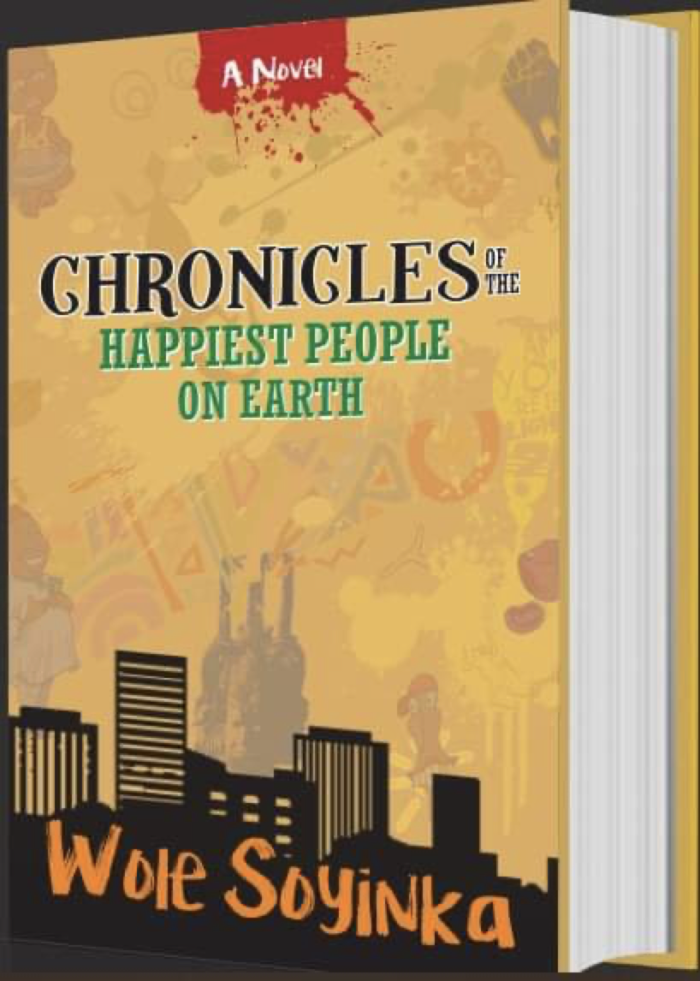
The forthcoming novel from which it is extracted — CHRONICLES FROM THE LAND OF THE HAPPIEST PEOPLE IN THE WORLD (BookCraft) – will be published towards the end of the month of November, 2020. – Wọlé Ṣóyínká
Read on:
Excerpt from CHRONICLES
Adjusting to a new culture was his main concern, but not an insurmountable culture shock. Badagry, after all, albeit closely intertwined with Lagos, was still Badagry. Pitan-Payne was on hand, though keeping a frenetic pace to wind up his affairs and proceed to his UN assignment on schedule. The engineer seemed to thrive on interlocking calendars, and in any case, he now had Menka to pick up the loose ends for him in his absence….
The timing could not have been more thoughtfully ordained. The unexpected and the planned seemed to dovetail neatly, like the finely adjusted sprockets or his mechanical prototypes. And while Lagos/Badagry lacked the excitement of receiving sudden cartloads of human debris from Boko Haram’s latest efforts to out-Allah Allah in their own image, one could count on gratuitous equivalents from multiple directions. Such as the near daily explosion of a petroleum tanker on the expressway or city centre. Or a roofless lorry bulging with cattle and humans tipping over on a bridge and dropping several feet onto an obliging rock outcrop in the midst of the river. Sometimes, more parsimoniously, a victim of military amour propre – in uniform or mufti, it made no difference. That class seemed to believe in safety in numbers, and all it took was that even a low-ranking sergeant should take offence at another motorist, who perhaps refused to give way to his car, a mere ‘bloody civilian’, never mind that the latter had the right of way. An on-the-spot educational measure was mandated. Guns bristling, his accompanying detail, trained to obey even the command of a mere twitch of the lip, leapt out of their escort vehicle, dragged out the hapless driver, unbuckled their studded belts, whipped him senseless, threw him in the car boot or on the floor of the escort van and took him to their barracks for further instruction. However, the wretch sometimes created a problem by suffocating en route – which left society to develop structures for neutralizing such inconvenience.
The contradicting, ironic sequence occurred to Menka only for the first time – yes, come to think of it, the military hardly ever recorded a fatality – once or twice, maybe even three times in a month — yes, the accident of excess did happen, but mostly such terminal disposal was left to the police, whose favourite execution site was a road block, legal or moonlighting. Perhaps a recalcitrant commuter, or passenger bus driver had refused to collaborate in providing a bribe on demand, or insulted the rank of the demanding officer with a derisive sum. And it did not have to be the original offender but some too-know grammar spouting public defender who had intervened on behalf of the potential source of extortion. The outcome was predictable – victim or good Samaritan advocate instantly joined the statistics of the fallen from ‘accidental discharge’. The expression was still current, but often it was anything but. Accidents had become infrequent and unfashionable. Oftener to be expected was that the frustrated, froth-lipped police pointed the gun, calmly, deliberately, at the head of the unbelieving statistic and, pulled the trigger. Again, the inconvenience of body disposal.
But then, the community of victims themselves – what a specialized breed of the species! The roles, it constantly appeared, had become gleefully, compulsively interchangeable. Allowing him only a few days to ‘catch your breath and get your bearings’, Pitan-Payne lost no time in taking Menka to inspect the land designated for the Gumchi Rehabilitation Centre, for victims of Boko Haram, ISWAP and other redeemers – nothing like striking while the iron was hot! On their way, the familiar sight of crowd agitation – how would the day justify itself without some kind of street eruption somewhere, wherever! Trapped in the chug-stop-chug of traffic, the favourite commuter distraction was to attempt to guess what was the cause, and even place bets on propositions. That morning, Menka’s first in nearly a year down south did not disappoint. But for the milling blockage by intervening viewers, they could have claimed the privilege of ringside seats. Compensating for that obstructed viewing however was the sight of men and women trotting gaily, anticipation all over their faces, towards the surrounded spot of attraction. From every direction they came, some vaulting over car bonnets, squishing their legs against the fenders, squeezing through earlier arrived bodies or simply scrabbling for discovered vantage viewing points. They climbed on parked vehicles and the raised concrete median. Commuter buses slowed down and stopped, keke napep — the motor-cycle taxis — pulled aside, drivers and passengers alike rubber necking on both sides of, or in the direction of a wide gutter that sank into a culvert. The lights changed to green and Pitan-Payne drove on, their last shared image a pair of muscular arms raised above the bobbing heads, clutching an outsize stone, slamming that object downwards into the gutter. Very likely a snake, Pitan suggested. With the rainy season, quite a few sneaked through the marshes into culverts and slithered their way into parking lots and even offices.
A police van came racing down the road, against the traffic, strobes flashing and sirens blaring, so Menka looked back, saw the crowd drawing back and drifting reluctantly away from the uniformed spoilsports. This opened an avenue just in time for Menka to obtain the briefest glimpse of an object slumped over the rim of the gutter, once human, but not any longer. Indeed the only human identity left him was his iodine-red tunic and black trousers, still recognizable as the uniform of a LASA officer, an unarmed unit whose function was simply to unplug traffic – stoppered as readily by truculent drivers as by the roadside markets, vendors of all the world commodities who had taken over the streets, haggled, negotiated, delivered change and goods at their own pace. If the activities delayed movement over half a dozen changes from red to green and back again, it did not concern them in the least.
Later that evening, the television newscast narrated the full story. After futile spurts of preventive measures, Authority had commenced arrests of vendors and seizures of their wares. The LASA team, their van parked in a side street, had pursued several such malfeasants. In a desperate attempt to escape capture however, one ran straight into the snout of a speeding vehicle, was tossed up, landed with an ominous thud on the sidewalk and remained there, unmoving. In a trice, a mob had gathered. They set the parked LASA vehicle on fire and worked up further appetite for vengeance. The unarmed officers had already fled. A hunt party pursued and eventually brought down a scapegoat, quite some distance from the actual scene of crime. They proceeded to the ritual battering of their catch. He broke free, ran into the gutter, tried crawling into the culvert for safety. They dragged him out by his feet, trunk and head smeared and reeking from the accumulated sludge of the blocked tunnel. Passers-by, totally ignorant of the beginning or mid-act of the mayhem, refused to be left out. They grabbed the nearest assault weapon to hand and joined in the gratification of the thrill for the day, a newbreed citizen phenomenon. The massive stone, raised above a throng of heads, quivered lightly against a Lagosian skyline of ultra-modern skyscrapers before its descent onto bone and brain. It took on an iconic dimension that stuck instantly to Menka’s surgical album of retentions, a rampant insignia of the transfiguration of a collective psyche.
“I envy you” Menka remarked the following morning, as they confronted the print media coverage, their scalding coffee no match for the nausea aroused by the photograph sensationally smeared across the front page. “You are going away for a while. You’ll be spared such sights.”
“I feel guilty”. confessed Duyole. “Guilty, but yes, that is one spectacle I shall not miss.”
“Careful!” Menka quickly cautioned. They have their equivalents over there. Ask the black population.”
“No. Not like this. Occasionally yes, there does erupt a Rodney King scenario. Or a fascistic spree of ‘I can’t breathe’. America is a product of slave culture, prosperity as the reward of racist cruelty. This is different. This – let me confess – reaches into – a word I would rather avoid but can’t – soul. It challenges the collective notion of soul. Something is broken. Beyond race. Outside colour or history. Something has cracked. Can’t be put back together.” And then Pitan-Payne gasped, paused, folded over the pages and passed the newspaper to Menka. “Take a look at this. Not that it changes anything but – here, read it yourself.”
There was a chastening coda. It altered nothing. The fleeing vendor, whom no one had even thought to help, was very much alive. He had picked himself up, salvaged most of his scattered goods, and found his way home despite a sprained ankle and some bruises. Most of the earlier spectators had retreated to a safe distance. They continued what they had been doing earlier – filming the action with their phone cameras. The police did however capture the Goliath with the terminating stone who had administered the coup de grace. He remained on the spot, to all appearance, admiring the evidence of his work.
He vehemently protested the injustice of his arrest: “I thought he was an armed robber.”