A Book for the Tasting

By Kọ́lá Túbọ̀sún

Book: Longthroat Memoirs: Soups, Sex, and the Nigerian Taste Buds

Publisher: Cassava Republic Press

Publication Date: October 31, 2016

Pages: 357

The Great Nigerian Food Memoir

“Nigerian food is the most endearing, enduring, topic in the world, especially since we have gone so long without talking about it.” – Yẹ́misí Aríbisálà

The allure of Yẹ́misí Aríbisálà’s debut book of nonfiction, titled Longthroat Memoirs: Soups, Sex, and the Nigerian Taste Buds, is, surprisingly, not the food, nor the promised “sex” in the title.Published by Cassava Republic Press, this book of essays comes with a more satisfying delight of well-crafted sentences, stories, and attention to detail, style, and ambition. An unapologetically Nigerian book of such brilliance, scope, and purpose has been needed for such a long time that it is hard to believe, going through its pages, that it has indeed arrived. The author it was who wrote a food column, for a few years, in the now defunct Nigerian paper 234Next as “Yẹ́misí Ogbe”. For those familiar with the understated brilliance of her style and approach, this all makes sense, and is timely.

Longthroat begins with an introduction fourteen and a half pages long, which coyly attempts to manage expectations of what is to come, through caveats about the author’s unlikely role as the bearer of the country’s food biographer, among other “confessions”. This part could, arguably, serve as a review of the book, except that it takes too much away from what follows. So, it whets the appetite of the new reader instead, and sets the table. In that introductory treatise, we are gently eased into the kitchen of the author’s mind where both the idea and the steps of implementation of this culinary journey take place first before they meet the page. I would return to the introduction again and again.

The first chapter is a review of the reputation of Nigerian food (and names) in the imagination of the foreigner. The first culprit here is Michael Barry, a half-Welsh, half Indian man whose “Nigerian River Province soup”, listed in his 1996 book Exotic Book the Crafty Way as an authentic Nigerian food, left the author scratching her head trying to identify its parts. She gave up eventually disappointed with both the writer’s imagination and the accessibility of Nigerian food to the outsider. Our ẹ̀bà, it turns out, was what was being described as “cassava bread” in Michael Barry’s book. A disappointing find! We never find out what the “River Province soup” is because it doesn’t exist. It is, also, the creation of a foreigner as an idea of what a random Nigerian food looks or behaves like. Yẹ́misí did not hold back: “I would hate for Michael Barry to get away with… suggesting that our food can be simplified and reformulated into something else, something it is not.” Her idea of the Nigerian soup as a person, more than just a passing item on a plate, takes off from here. It “may seem aloof at first,” Yẹ́misí writes, “but once given its due, it will immediately make itself friendly at the very least.”

The book proceeds smoothly along these lines, paving way to other encounters, hilarious personal stories, told through the keyhole of a writer obsessed with the dimension of food in everything, from sex to dreams. The chapters move in different ways. In one, which came early in the book, the author describes a typical Ìbàdàn boy in a marketplace arguing with his mother about eating àmàlà (or ọkà, as she put it), to illustrate the mischief of adults, and the eternal devotion of Ìbàdàn indigenes to their carbohydrate meal made from “desiccated yam ground into a dense white flour, and then made into a grey mound using boiling water”. In another narrative in the same chapter (listen to audio excerpt here), a ram goes for a ride on a motorbike and ends up on jollof rice: quite a common scenario in many Nigerian cities during festive seasons. The description lures in the oblivious reader with gentle words until the macabre nature of that ill-fated ride becomes suddenly obvious. To the Nigerian already familiar with it, the passage plays out like dark humour gently hovering above the conscience of the meat-eater. Another chapter which further elevates the book into canon of essential Nigerian literature is the story of the author’s father-in-law and his travails in the Nigerian Civil War; how the pursuit of the next meal drove the conversation of survival. It was, aptly titled, Dead Man’s Helmet.

Reading the book, deceptively called a “memoir” (it is, to be clear, but the character of the book both defies and enriches the genre) takes the reader back decades into a happy place where food and observations of food carried some reward of discovery. Here, I speak for myself. What is the difference between irú wooro and irú pẹ̀tẹ̀, for instance? What are they anyway? Why did they smell so much and why did my grandmother like them so? Why are they wrapped so tightly in those small leaves? Why are the ones my grandfather’s youngest wife bring from the farm better than the ones we bought in the neighbourhood? How come I sometimes saw them in food (as in okro) but not in some (ewédú)? How is irú different from ògìrì? How does Dadawa, the cubed variant that debuted in the 90s, improve on what was a local condiment that supposedly added character to our local meals?

Sometimes a chapter is a journey into a forgotten part of one’s culinary past left unappreciated through the passage of time. One word or a sentence here stirs it up, smell, aroma and all, into new awakening. At other times, it is the wonder of a shared experience which in one’s memory had previously amounted to nothing more than a mundane occurrence, but which in literature transmutes now into a notable cultural event, properly highlighted and intensified through the writer’s power of observation and documentation. This is where the work shines out the most: elevating the most common experiences—what defines Nigerian culture: our cooking and eating habits, among ourselves and on the world stage—through beautiful sentences that delight and titillate.  

Who remembers, for instance, breaking open ẹ̀gúsí shells with their fingers, usually while seated with mothers or grandmothers to whom that kind of chore is a perfectly productive use of afternoon time? In a world now defined by “finesse”—a type of accepted snobbery against deliberateness, patience, commonality—that image of simpler times spent sitting with grandparents and helping out with cooking over several hours, along with stories, songs, and admonition, brings the reader as close to emotional time travel as one can get. Yẹ́misí calls this particular food preparation act: “hand-shelling” ẹ̀gúsí. We who are familiar know that she meant “hand de-shelling” or “de-husking” if we’re being technical, but one could see why the former appeals more. In Yorùbá, we say “wọ́n ń ṣẹ́ ẹ̀gúsí”. That act of “ṣẹ́-ing” the ẹ̀gúsi, breaking the shell in half and removing the content, is what gets the white pointed seeds out to where it can be useful. But that attempted homage to the phonetics of ṣẹ́-ing the seed, instead of the mechanically-sounding “de-shelling”, warms my linguist heart (though that English translation wasn’t the only relevant pull to the vivid sense of nostalgia that the chapter beautifully evokes).

Of Sex,  Subtlety, and More

“What I ate last night is as significant and as tangible as my dreams. My dreams are as tangible as what I’m eating. Neither of them can safely be taken for granted. Life seen through the prism of food has more colours, not fewer.” – YA

The “sex” in the subtitle of Longthroat Memoirs does not materialize in the way readers conditioned to the treatment of the subject in Nigerian writing might expect it. But it does materialize in different other ways, sometimes gentle, and sometimes hot and vivid, usually around food and cultural attitudes. I, for instance, will not be able to look at a the velvety black covering of the African snail the same way again. Through word association and the writer’s imagination of their role in our sexual myths, vividly and mischievously imagined in the chapter called The Snail Tree, a Nigerian foodie’s insistence on a snail diet will now always task the mind in the direction of more intimate parts. The treatment of sex here however, as one would realize, is deliberate. Check out, for instance, this sentence from the second paragraph from that same chapter:

“There are places in a woman that a penis will never reach.”

The sentence that follows this gives too much away so I will not quote that here. But the chapter itself, one of the most directly polemic in the book, tackles the author’s discomfort with the ubiquitous fascination with sex in contemporary literature. Here, she opines directly on the Nigerian/African writing and literary culture in a way that is fresh and unflinching, using food as a contact point. Chimamanda Adichie and Binyavanga Wainaina make appearances and not in a flattering way. The chapter also explores the way in which food can be used to sublimate other human impulses. But because of the understated way in which sex appears and disappears throughout the work, I expect some mild reader rebellion. Pointing out the irony of using “sex” to sell a book in which the use of sex as a selling point in modern writing is so directly challenged will be too good to pass up.

In a yet unpublished interview with me, Yẹ́misí clarifies her purpose:

“Our manifestations of sexuality seem mostly dysfunctional. In writing, in the media, it is mostly titillation and misunderstandings. Are there some things that the application of words disfigures? Obscures? We all seem to be grasping at straws in private lives bragging about our involvement on public platforms. So if we are going to be real and honest, “liberality” should be prima facie the admission of incompetence and fumblings and disastrous encounters. The chapter was me saying, look I’m not going to pretend I’m good at this, that I apprenticed with Cirque du soleil. If I’m going to be truthful and free in my writing about sex, I’ll have to talk about my confusion and incompetence. Everyone else can write titillation if they want.

I wanted to point out obvious and not so obvious parallels between appetites… I wanted to offer the perspective of seeing something better by not looking directly at it.”

That chapter alone, The Snail Tree, capable of winning any prize for nonfiction anywhere, makes the whole book worth reading.

But the book does (and packs) much more. It challenges assumptions (Will a Maiguard in Lagos prefer carefully made white soup or his Agege bread and fried eggs, if given a chance?), attacks hubris (Yorùbá people, with your pride of “sophistication”, come to Calabar and experience food cooked with some imagination and creativity), and examines contradictions (How are Yorùbá the oily-food-eaters—ndi ofe mmanu—when Easterners add oil to their garri at every instance? And how are Igbos the eaters of solid-as-stone food—aj’òkuta má mun’mi—when their invention of garry-with-oil has rescued ẹ̀bà from the tyranny of turgidity?). Longthroat Memoirs successfully situates itself in a prominent space for not just the sensual narratives around food but of cultural attitudes, defining the country and its people in our own taste and words. A cookbook, a narrative of one culinary pilgrim’s journey through Nigeria’s cultural environments (from Ìbàdàn to Calabar), an exposition on prejudices and pretensions of some of our cooking myths, a personal and historical diary, all at once, Longthroat Memoirsmanages to fulfill more than gastronomic desires.

How to Cook a Sentence

“Writing about food in the way I do involves noting the influence of food on life and life on food, and attempting to weave an accurate cultural landscape.”  – YA

Something that Aríbisálà has, and exhibits in abundance in this work, is patience. (That, along with the discipline to remember the names of all the food items she encountered while living in Calabar, and the diligence to verify the English—and sometimes Botanical—names of the local vegetables and fruits we are used to under different local names.) Reading any book is a race against time and the writers intentions. But the style in Longthroat Memoirs is deliberately contemplative of each individual reference, attentive to the moment enough to satiate an impatient reader and possessive of the right depth to reward a patient one. We know now that the book came about from a number of essays written first for a weekly newspaper column. But in setting each word to the page, the writer has deployed a rare skill that draws the reader in with an inviting aroma and keeps them satisfied after each course. In Peppered Snails, Aríbisálà introduces new Nigerian concepts (“toaster”, “yíláta”, etc) to the unfamiliar reader and spent considerable time weaving these into a tale about the cooking or endurance of hot peppered snail, all without taking the focus off the important direction of the narration. The style reminds of the best offerings of greats like Sóyínká in a work like Aké or Ìbàdàn, the Penkelemes Years, for instance. This is no idle comparison.

How does Yẹ́misí do it? How does one person deftly convey a vivid sense of smell and presence through words? We have read countless fiction and nonfiction by African writers, but not many of them have handled the treatment of food or any intimate contact with this much dexterity. I have an idea, but it is an inadequate one. Growing up in South-Western Nigeria isn’t enough motivation to care about its food, nor is having been transposed—through marriage—out of that environment into a contrasting one in the South-South a sufficient excuse either. There are many coincidences along the way, one of which is discovering, a while ago, that her health, as well as her children’s, was being affected by what they were consuming. She wrote about how she found out, in her trademark style of patient literary exploration of ordinary facts, combining personal history with a collective journey around food, in the piece for Medium in 2015 titled Mother Hunger.

Though that piece, along with many others of hers scattered around the web, are not included in this collection, they offer some clues as to the motivation for her craft, but not the germination of her skill. The writer’s obligation to memory and her diligent recollection seems to have been wrought through plodding hard work of deliberate crafting over many years.

Eventually reaching the end of such a book feels satisfying as equally as it feels deeply dissatisfying: it is not a book that should be read from cover to cover in one stretch. Each chapter, like slivers of mọinmọin under the leaves after a wrap is finished, should be returned to for extra flavours and spice. It is a shame that the book is not universally available on Kindle. Those equally likely to enjoy the literary delight of its letters juggling the taste buds of memory are Nigerians abroad or people everywhere with interest in Nigerian food culture. This book is for them. And for non-Nigerians, I suspect that its successful grounding of Nigerian recipes, ideas, misconceptions, myths, and stories through a personal lens will also be a brilliant introduction to both our cuisine and a different kind of nonfiction narrative. Listen to Yẹ́misí describe Lagos through the eyes of a drive to Yaba:

“Lagos knows how to primp and sashay on bridges, new skyscrapers, tall swanky things. It has $1,200-a-night hotel rooms; overestimated real estate on anxious hairlines of land arbitrarily reclaimed from the sea; fragile, sand-filled peninsulas anchored on the Grace of God…”

***

What are the knocks? A few. Olúbàdàn, the king of Ìbàdàn, was once referred to as Aláàfin of Ìbàdàn – an unintended slight that would have caused a warring of tribes in a different time. There’s also the perennial issue in Nigerian literature of having Yorùbá names/words written without appropriate diacritics. This should change in 2017, please!

In the chapter called Peppered Snails, the description of “toasting” on the campus of University of Ifẹ̀ spoke about taking a girl to “a new buka” to eat dodgy Chinese food instead of “an old buka” to eat pounded yam and soup. Those who have lived on that campus would know that the passage referred, instead, to New Buka and Old Buka respectively. These are not generic eating places, but known brands and locations.

So, What is This Book?

“(Nigerian Soup) is a multifaceted cultural treasure trove full of intriguing stories. It might not be gastronomically illustrious, but it is energetic and good-hearted. It belongs to one of the most fascinating personalities in the world: the Nigerian.” – YA

Is it a cultural resource, an encyclopedia of relevant memories, a cookbook, a dialogue with nostalgia, a thorough work in the documentation of the Nigerian food and cultural experience, a hard-wrought piece of literary exploration? All would be right and all would be insufficient. Yẹ́misí has, simply put, written a Nigerian book of stunning brilliance. Until now, when I am asked to provide a book from which to appreciate and understand Nigerian culture, I have usually had very few to mention. Peter Enahoro’s How to be a Nigerian comes quickly to mind, as does Chimamanda Adichie’s Half of a Yellow Sun. But the latter is fiction and political while the former is mostly cultural and humorous. Yẹ́misí Aríbisálà’s book is both and more. 

Memoirs are fun usually because we know that they tell us something interesting about an author, a situation they were in, or a certain time or a subject. When terribly done, they are too self-assured, too boastful and thus inauthentic, unsatisfying and unrepresentative of expected situations. Others are doomed by self-censorship to be of any real value for the genre, or by too much focus on the self to offer us more. But, depending on our initial expectation, it is usually easy to be satisfied with a personal account, which is by definition subjective. Being stimulated, engaged, or elevated by such work is another thing. That requires a different experience found in very rare instances in the hands of a skilled writer. Longthroat Memoirs falls into the latter category: a book that carries the weight of so much cultural and literary burden, and manages to discharge it with grace and style.

_____________

This essay was first published on Village Factor on January 21, 2017

Tope Folarin on Accessibility

topefolarinIn this long but compelling essay in the LA Review of Books, Nigerian-American writer and winner of the 2013 Caine Prize Tọ́pẹ́ Fọlárìn discusses the challenge faced by new African writers trying to gain international recognition and being judged against a standard of “accessibility” set by selected role models.

The long essay slash book review is written in a smooth and accessible – he won’t like that word – style that sustains interest from beginning to end, making a valid argument against a single-story stereotyping of African stories that inevitably happens because of a conditioning of taste by the gatekeepers of the profession.

Here’s an excerpt:

It can be said that black artists who live in the United States or produce art that is consumed in the United States are “expected” to create certain kinds of art, but the reason these expectations exist is because some black artist has produced a pioneering work that, for any number of reasons, garners significant attention and is thus perceived by a predominantly white Western audience as the height of black achievement, the precise standard that every other black artist in the same field must strive to achieve in order for their work to be accessible to an audience that otherwise knows next to nothing about the community the black artist has emerged from.

I don’t know whether his conclusion in the essay point more to the laziness of popular culture that chooses instead to anoint one messenger in every generation and move on rather than spending time sampling every offering for a varied taste, or whether there indeed a nefarious effort against the thriving of a diverse minority voice from around the continent. What he insists on however – as the crux of the essay – is that thriving as a prominent voice in African literature often requires a combination of luck, accessibility in the right kind of way, and talent, not necessarily in that order.

Still worth a read.

_______

Photo: DailyMaverick.co.za

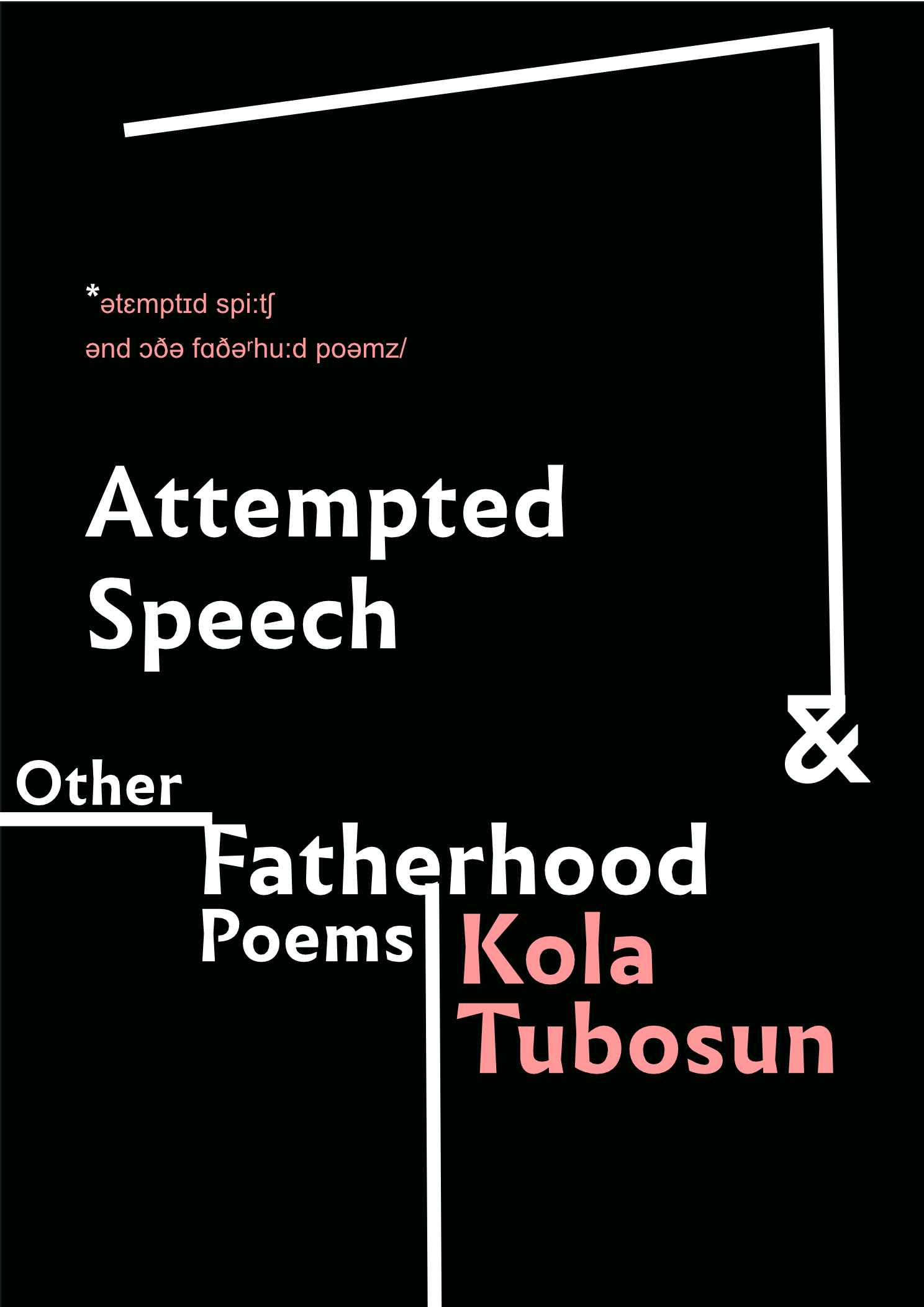
Oyin Oludipe Reviews “Attempted Speech”

Attempted-Speech_Kola-Tubosun-page001-2One of the questions we asked guests coming to the Aké Arts and Books Festival in Abẹ́òkuta this November was whether they read reviews about their work. The responses were intriguing, from “No, never!” to “Well, only if it’s good” to “Oh, why not?” I’m paraphrasing. You’ll need to get your hands on the Aké Review 2015 to get a better idea!

In any case, my response to the question would not be published in the Review, since I’m one of its editors. If that were not the case, you’d have read something like “Well, why not, as long as it’s thorough — and thoroughly fawning, ha ha!” Or something.

Yesterday, I came across the first review of my recently released chapbook of poems which I’ve talked about here once before. It wasn’t fawning, but it was thorough. It was published in the Luxembourg Review which I was also discovering for the first time. At times I had to go check the collection itself again to be sure that the lines being referenced were indeed mine. It’s true what they say that when you’re writing, you’re often possessed by something more than yourself.

A quote?

“One prominent quality of Kola’s poetry, as it is with Lola Shoneyin’s, Jumoke Verissimo’s and others, is that it is structured within a fluid framework which very effectively navigates the core of the sentiments of human consciousness. What ensues is a powerful inter-fusion of muse, thought and story.”

Now, you’ll have to go read the rest for yourself!

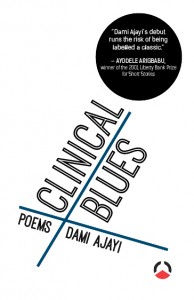
Of National Neurosis and Private Psychosis: Preliminary Reflections on Dami Ajayi’s Clinical Blues

Title: Clinical Blues

Year: 2014

Pages: 88pp

Author: Dami Ajayi

Publisher: WriteHouse, Ibadan

Reviewer: Tosin Gbogi


Of National Neurosis and Private Psychosis: Preliminary Reflections on Dami Ajayi’s Clinical Blues[1]

At a time when a whole nation has become a nest of singing birds, when the same stylistic path is repeatedly trodden in the name of a certain kind of dubious ‘tradition’, and in poem after poem, the thematic character of a failed postcolonial desire called Nigeria constitutes the formulaic lens through which good poetry is (re)interpreted and ideologically legitimized, Dami Ajayi interrupts the dirge with a riveting collection of poems entitled Clinical Blues. As the title suggests, CB simultaneously drags a nation into the hospital and drags the hospital into a nation but also permits us—within that overlapping spectrum—to conceive of the two as irreducible to one another. Divided into five sections that draw on imagination, memory, history, and the quotidian wisecracks of a beer-parlour strain, the collection frankly interrogates love, sex, emotional longing, alcoholism, hypertension, amnesia, schizophrenia, and other clinical concerns. Of course, Ajayi is neither the first to bring his medical training into poetry nor the first to set poetry within the uncertain despair of the ward. The avant-garde Williams Carlos Williams, perhaps, remains one of the best known to date. Before him, Anton Chekhov had experimented with stream of consciousness and mood in both his short stories and plays, making him one of the key figures of early modernism. And to return ‘home’,[2] Lenrie Peters is not just famous for his ‘writing back’ gestures but also for his use of medical terminologies in poetry. The same holds true for Latunde Odeku, Femi Oyebode, Niran Okewole, and Tolu Oloruntoba. Ajayi connects with these poets in many remarkable ways. Consider, for instance, the first three stanzas of the ten-part title (and longest) poem, ‘Clinical Blues’:

Sing me a song

Not from your larynx;CB_Final3

Probe deep,

Deeper into lungs

The recesses of your soul.


I am a lonesome observer,

The clinical sentinel

Who sits still to wage

Wars against infirmities


And your organic sax

Plunges snot and sounds

Into my drink of patience

The truth is eerie, tall

Like swabs of heavy winds (42)


The above introduces us to the caustic tone and medical register that permeate the entire collection. Like the Child-persona in J.P. Clark’s ‘Streamside Exchange’, the poetic subject of this poem asks us to sing, but from our lungs (the depth of our being), not from our larynx (voice box). With the task taken over by the persona himself in the second stanza, we soon realize that this is only a griot’s legerdemain to draw us into the performative, call-and-response space of the poem. The task remains the griot’s and the rule he sets for us also applies to him: to sing nothing but a sardonic song from the ‘recesses of … [the] soul’. Apart from this, the poet also permits us to extrapolate from the third stanza that this is a modern griot’s song, using such instruments as sax and harmonica to reproduce on the page an organic blend of Afrobeat, Highlife, Jazz, and folk songs. More importantly, this voice presents us with an observer’s account of an ailing health system and country. This is the point here:


The blip of an ailing heart

Tolls a symphony of symptoms

But I am no open chest surgeon

For I am a jazz pianist

With a little stint with blood (42)


In the above, a patient’s ‘ailing heart’ becomes symptomatic of the worsening state of a dying nation. Ostensibly a doctor, the persona informs us that he is no surgeon. He is a ‘jazz pianist’ and the alliterated ‘symphony of symptoms’ certifies just that. Beyond this, however, the confessional lines above intersect neatly with Chekhov’s oft-quoted dictum: ‘Medicine is my lawful wife, and literature is my mistress. When I get fed up with one I spend the night with the other’ (91).[3] Here, then, is where the fictional persona of the poem merges with the supposedly external personality of the poet. The result is a confrontational lyricism of stark honesty that speaks directly to one of the crucial centres of power:


I know of clinical meetings,

Not where doctors wage

Wars against themselves with literature,

But where diseases wield

Their many forms in a game

Of hide and sick (sic). (43)

……………………………..


Doctors wield wide bore cannulae

Plastic pistols don’t repair tissues

The clinical truth is Post-Mortem

At least we can lie that we tried. (45)

……………………………..


Three hearty cheers

To the Registrar who gave

Rave morning reviews

At the sitting of grey

Obstetricians and medical students

Who warmed his bed and beer table. (45)


Meaning-layered, the three stanzas bring to our attention a system that often evades critical attention. It is not uncommon, for instance, for doctors to assert their omniscient selves while dealing with their patients. Not uncommon either to find them constructing what Norman Fairclough calls passive ‘subject positions’ for their helpless ‘technical objects’ (one implicit meaning of the word patient).[4] The consequence, often times, is that in the minds of patients, doctors become gods. Ajayi shatters this illusion. First, he makes us realize that the petty politics of the trade might just be as dirty as any other. In other words, like any profession in Nigeria, doctors engage in petty battles, not with regard to best practices but for supremacy. Because these battles are symbolically oriented, it would seem that the one adjudged to have the highest epistemic and linguistic capital (within Medicine) dominates.[5] That, of course, is why it is a ‘war waged with literature’. But the poet is not interested in these battles (though he is, for the mere fact that he denies it!) as he tells us. He is interested in ‘clinical heavens/ where doctors’ hopes levitate when they die’ (43).

Second, his concern revolves around another of the illusions: Post-Mortem. Because we have, for the most part, come to accept science as infallible, Post-Mortem becomes a ploy used to absolve the doctor of culpability (at least in our own context) while transforming the cause of death into a medical puzzle and abstraction. Of course, anyone familiar with the Nigerian medical system might have heard stories of pathologists who, constrained by medical equipment, embarrassingly scratch their heads while trying to determine the cause of death. These are the same pathologists who, nevertheless, still go ahead to report a definite cause to the coroners. The second of the stanzas excerpted above jolts us into this reality and reverses the much-vaunted truth of Post-Mortem to that of a clinical lie.

In a way, the last of the three stanzas seems more troubling. Building on the frame of battle that he sets up at the beginning of the poem, the poet gives the familiar military salute of ‘Three hearty cheers’ to the Registrar in whose bed medical students finish their postings. Comically satirical, this stanza paints the rot that pervades not only the Nigerian medical institution but also the entire Nigerian educational system. It particularly shocks us with the unfortunate fact that what Okey Ndibe describes as ‘Sexually Transmitted Degrees’ is no exclusive problem of any one field of study in Nigeria’s higher institutions.[6] This is the level of the poet’s audacity.

‘Clinical Blues’ does not, however, stop at an external level of interrogation. By the sixth part of the poem, the exploration narrows down to the mind. Much like William Carlos Williams’ ‘The Mental Hospital’, in which the observed transforms into the observer, this part of the poem reveals a complex relationship between a patient and his doctor(s). It partly reads:


The Man with the bald pate

Is Ward Seven. We

Are mere gate-keepers.

Ro-ma-sin-der

Isn’t that Upper Room glossolalia?

But Keke says it’s a synonym

For God, the answer to all things. (46)


In this atypical encounter, the patient and the doctor reverse their hierarchical roles.[7] Keke, his name a reduplicated echo between whisper and silence, personifies the psychiatric ‘Ward Seven’ and his doctors are his ‘mere gate-keepers’. Although reduced to the characteristic clinical specimen, Keke generates a tedious equation—’the answer to all things’—for his attendants. At once, the equation—a ‘[n]ew differential for intactness’ (46)—points the doctor-persona(e) to the limitations of their body of received knowledge. That they ambiguously ask if the equation is not ‘that Upper Room glossolalia’,[8] a symptom of neurosis/psychosis subtly expressed through a Christian metaphor, shows their own level of confusion and helplessness. And in this confused state, the reader is transported into a national theatre of madness where the sane intersect with the insane at the crossroads of tongues: glossolalia.[9]

Importantly, this fantastic poeticization of schizophrenia reminds us of those moments, in the words of Michel Foucault, when we ‘come to notice [the] words of madmen in our own speech’ (217).[10] The poet-persona admits exactly this about himself when he croons, ‘[a]nything but Haloperidol/ For this schizophrenic poet’ (47). But apart from this, if as Mae G. Henderson opines, the ‘psyche functions as an internalization of heterogeneous  social voice … [and] speech/writing becomes at once a dialogue between self and society and between self and psyche’ (350),[11] then Romasinder can be conceived of as the elusive answer/treatment to a national neurosis. The straightforward implication of this analytic mode is that Ward Seven at once becomes an allegorical setting for a nation while the patient and the doctors figure, respectively, for a confused, solution-proffering citizen, and the clueless elite who preside over Nigeria.

Besides ‘Clinical Blues’—my singular central concern in this preliminary note—there are many other interesting poems in this volume. There are the earthy, playful ‘Konji Blues’ series from the first section where a persona bids a ‘Baby, [to] take off your cool,/ That brief frock that abuts/ Above your knees. Let me unclasp/ You, free you of all earthly girdles’ (26). There is the androcentric ‘Love in Alcohol’ in which ‘[t]he future is shaped like a testicle’ (34) and so also is ‘Measuring Resistance’ in which we meet Rex Lawson and Orlando Owoh’s ‘Yellow Sisi’ sitting down in a corner of a poem,[12] her hand on her jaw! In the third section, similarly, are such remarkable poems as ‘House of Hunger, Revisited’ where we stumble on ‘a popular African street./ We’ve all passed by’ and ‘A Libretto for Fela’ in which ‘Fela christened a new breed of/ Mutated idiots who feed, eat/ And seek national cakes/ Dug from underground and water’ (67). The latter is specifically interesting in its deft appropriation and reproduction of Fela’s lyrics through what Julia Kristeva famously calls ‘a mosaic of quotations’ (37).[13]

This collection, however, clearly has its pitfalls. The most disappointing, for example, seems to be the conflation of ‘Romasinder Blues’—earlier published as a separate poem—with the other bits in ‘Clinical Blues’. Not only does this poem seem out of place in its new space, its full force is stifled by both the part that came before and after it. This point also connects with another: a couple of the poems in this volume are needlessly long. Generous editorial suggestions would have done well to cut them to shape. I have no doubt also that some of the poems ought not to have appeared in this collection for the simple fact that they are thematically repetitive. Further, the book’s title makes one ask a slightly different version of Louis Gates’ question to Joyce Joyce:[14] what has blues got to do with it? That is, reading this work, one wonders what kind of blues is being presented here. Are these the ‘work songs and secular songs of sorrow and tough luck known as the blues’ (Schuyler 662)[15] or the ‘field hollers, sacred harmonies, proverbial wisdom … elegiac lament’ (Baker 231)?[16] While clearly a couple of the poems fit into the blues matrix as we know it, many more clearly belong to different genres: Keneri, Afrobeat and Highlife, among others. However, Ajayi’s use of blues as part of this book’s title reflects a general tendency in new Nigerian poetry. As more of the older voices of modern Nigerian poetry cross the world into the Americas, re-uniting Black vernacular traditions with their ancestral origins and relatives (see Osundare’s Random Blues and Ojaide’s Delta Blues),[17] blues titles appear to be emerging as a new categorial feature. In other words, if the songs of the ‘traditional performer/raconteur’ (as Ekwuazi calls this group of poets)[18] dominated the last two decades of the 20th century, blues seems to be the new dominant trope since the beginning of the 21st century. Unfortunately, unlike the song motif that can be classified based on its use of traditional songs as backdrops, the new blues titles are structurally diffuse, correlating with the sort of ‘incoherences, contradictions and multiplicities without . . . resolution’ (65) that Harry Garuba has delineated as a feature of the ‘post-’88 poets’ (68).[19] Perhaps as we plunge deeper into the 21st century, a more definite schema for understanding this emerging aesthetic will be developed (or perhaps not)! But then, these few issues do not detract from the overall value of such a well-paced offering as CB.

Consistently, what seems to me the sheer exuberance of the poems, their vulgar character, their investment in the ribald language of the body—something that Charles Nnolim and Femi Osofisan have regretfully noted about the new Nigerian writing—is carefully counterbalanced by a tenor of contemplation that turns even the most mundane of these poems into the essentially sublime.[20] And what this collection lacks in terms of a spiritual focus, it gains in its deep concentration on the intra-psychic conflicts that both make and unmake the human subject. While CB will be particularly relevant to both faculty and students working in the field of Literature and Medicine, it will generally be appealing to all those who are keen on understanding the shifting vistas of modern Nigerian poetry in the 21st century. A pleasure to read!


Tosin Gbogi is the author of the tongues of a shattered s-k-y (Blackgraphics, 2012), Tosin Gbogi is a doctoral fellow in Interdisciplinary Linguistics at Tulane University, New Orleans, USA. His research interests cover hip hop linguistics, African literature, and literature of the African Diaspora.


____________________

Notes

[1] Far from the neat linearity that my title suggests, I like to think of neurosis and psychosis in this volume as always inscribing themselves on a national or personae’s psyche(s) in a criss-crossing, overlapping manner. In fact, I am more inclined to see the two as rhizomic, as schizophrenic, both disconnected and connected in ‘multiple entryways and exits’ (Deleuze & Guatarri 21). See Gilles Deleuze & Félix Guattari, A Thousand Plateaus: Capitalism & Schizophrenia. Trans. Brian Massumi. Minneapolis: Minnesota UP, 1987.

[2] I pun here on Lenrie Peters’ famous poem ‘We Have Come Home’.

[3] See letter to Alexel Suvorin dated 11 September 1988 on p. 91 of Letters of Anton Chekhov to His Family and Friends. Trans. Costance Barnett. Pennsylvania: PSU’s An Electronic Classics Series Publication.

[4] Norman Fairclough, Language and Power. Harlow: Longman, 1989; see pp. 58-62 for the discussion of subject positions and p. 103 for the connection between the word patient and helplessness.

[5] Just as Pierre Bourdieu notes (in Language and Symbolic Power) of the inter-class symbolic struggle over legitimate language, I hold that the same degree of struggle for domination takes place at an intra-class level. This is why it is legitimate and commonsensical that within the (Nigerian) medical practice, a sort of hierarchy will be set up: (a) Academic: Professor > Consultant > Senior Registrar > Junior Registrar > House Officer (a.k.a. Intern) > X & Y and (b) Non-Academic: Chief Medical Officer > Principal Medical Officer > Senior Medical Officer > Medical Officer > X & Y. Expectedly, the struggle to both sustain and dismantle this hierarchy has fuelled many crises within this institution. The last nationwide doctors’ strike is one clear demonstration of this. I suggest that this is equally one of the things that Dami Ajayi draws our attention to with the line that he foregrounds by pretending to background.

[6] Okey Ndibe, ‘Sexually Transmitted Degrees’. Sahara Reporters. Web. 11 Jul. 2011.

[7] For some discussion of this hierarchy and how Felix Guattarri sought to reverse them, see Franҫois Dosse, Gilles Deleuze & Félix Guattari: Intersecting Lives. NY: Columbia UP, 2010.  

[8] I admit that this single question has the most plural of the meanings expressed in this poem. With the graphological cue in ‘Upper Room glossolalia’, the poet foregrounds the patient’s capital neurosis/psychosis. And taken together, the entire phrase, which may also be taken as a code phrase among the doctor-personae, suggests the ironical nature of the patient’s supposed madness, which though is unknown to him, is decipherable in his speech by the doctors. This interpretation works well when we consider that the same irony holds for glossolalia in the Bible: apostles spoke in tongues whose meanings were apparent to others but perhaps not them. As Apostle Paul notes, this phenomenon may mistakenly be interpreted as madness in the absence of such interpreters that the apostles had: ‘if unbelievers or people who don’t understand these things come into your church meeting and hear everyone speaking in an unknown language, they will think you are crazy’ (NLT 1 Cor. 14:23). Of course, in psychiatry, a radically disconnected, inaccessible speech that compares to glossolalia can be taken as a symptom of madness since this is not taking place within the boundaries of the church. I suggest, further, that the hasty connection that the doctor-personae draw between Keke’s speech and neurosis/psychosis sharply reveals the normalized habit of discarding words of psychiatric patients as hopelessly meaningless. The implication of this is that Foucault’s point about pre-19th century psychiatrists not critically analysing/listening to the content of one of the primary means—i.e. speech—by which they distinguished between reason and madness may still be very much true in today’s practice of psychiatry. Of course this is my argument about the psychiatrist(s) in this poem not being less mad than the patient they pretend to help.

[9] This is, perhaps, why a more ambitious reading of this poem will be to think of it as a fictional response to Fanon’s reading of the colonial subject. In other words, if Fanon is more interested in the psychological questions of colonialism as they affect the colonized subject, this poet is interested in similar questions but with regard to the oppression/violence/failure called Nigerian post-colonial project. See Frantz Fanon. 1952. Black Skin, White Masks. Trans. Charles Lam Markmann. London: Pluto, 2008.

[10] Michel Foucault. The Archaeology of Knowledge & the Discourse on Language. Trans. A. M. Sheridan Smith. New York: Pantheon Books. See also Foucault’s History of Madness.

[11] Mae Gwendolyn Henderson, ‘Speaking in Tongues: Dialogics, Dialectics, and the Black Woman Writer’s Literary Tradition’. African American Literary Theory: A Reader. Ed. Winston Napier. New York & London: New York UP, 2000.

[12] It is also possible, however, to read this poem as having gynocentric possibilities since the male sex is only left with a testicle!

[13] Julia Kristeva, ‘Word, Dialogue and Novel’. The Kristeva Reader. Ed. Toril Moi. New York: Columbia UP, 1986. 34-61.

[14] Henry Louis Gates, Jr., ‘“What Has Love Got to Do with It?’’: Critical Theory, Integrity, and the Black Idiom’. New Literary History 18 (Winter 1987): 345-62.

[15] George S. Schuyler, ‘The Negro-Art Hokum’. The Nation (1926): 662-663.

[16] Houston A. Baker, Jr., ‘Belief, Theory, and Blues’: Notes for a Post-Structuralist Criticism of Afro-American Literature’. African American Literary Theory: A Reader. Ed. Winston Napier. New York & London: New York UP, 2000. 224-241.

[17] I am of the opinion that Niyi Osundare has been more influential in both the songs (first with the publication of Songs of the Marketplace and later with both the Sunday Tribune and book versions of Songs of the Season) and blues directions (with the Sunday Tribune version of ‘Random Blues’ especially).   

[18] Hyginus Ekwuazi, ‘The Portrait of the Nigerian Poet’. Nigerian Literature Today: A Journal of Contemporary Nigerian Writing 1: 123-8. See also ‘Modern Nigerian Poetry—A Long Night’s Journey into Creation Day’. Nigerian Sunday Guardian. Web. 31 Mar. 2013.

[19] Harry Garuba, ‘The Unbearable Lightness of Being: Re-Figuring Trends in Recent Nigerian Poetry’. English in Africa 32.1 (May 2005): 51-72.

[20] Charles Nnolim, ‘Chimamanda Adichie’s Half of a Yellow Sun: A Comment’. ANA Abia Review: Journal of the Association of Nigerian Authors, Abia State Chapter 1.1 (1st Quarter, 2009): 13-20. See also Femi Osofisan, ‘Wounded Eros and Cantillating Cupids: Sensuality and the Future of Nigerian Literature in the Post-Military Era’. African Literature and Development in the Twenty First Century. Ed. Joy Eyisi, Ike Odimegwu, and Ngozi Ezenwa-Ohaeto. Owerri: Living Flames Resources, 2009. 30-60.

On Saraba’s Solitude

In one of the stories in the latest issue of Saraba Magazine (#16), the author goes to movie cinemas because of the opportunity provided by its dark and quiet space to rest hands on his partners’ laps. In another, a writer paints a harrowing picture of solitude expressed best through “writing her bones”, as she puts it; a painful but therapeutic process where every experience is an opportunity for reflection as well as escape, and where artistic output and expression is a solution as much as a problem. In another, a writer describes the haunting experience of a domestic accident with a little child that ends with a quirky and sardonic anti-climax, while another piece recounts, in a series of verses like enchanted incantations of many stories, a journey through a writer’s head during “a decade of madness”. And through the work that populate this edition of the magazine dedicated to the concept of solitude, the reader is taken in a multiplicity of mental directions.

AVPageView 8202014 120629 PM.bmpThat is the fiction.

In the poems and accompanying artworks, the editors’ selections show adherence to the widest interpretation of the theme. A disabled on woman on a wheelchair, with sample selections of food recipes all around her (Rosi Martez) portray solitude as much as a middle-aged black man sitting on a distant chair in an otherwise social environment (Moustapha Dime). So does a young man holding an open book, and a pen, pondering what next to write in an inconclusive paragraph, or a gypsy woman with a musical instrument or walking staff. What they have in common, beside their aesthetic appeal that invites the beholder to further exploration of ideas beyond the first contact, is a simplicity that complements everything else in the issue. This is a familiar style for Saraba issues: a minimalist approach that projects brilliance in its modesty and understatement of its internally throbbing energies.

To have put this together as the editors have from across their physical distance from each other is a feat creditable to today’s electronic bridge of solitude: the internet. Dami Ajayi is now a jobless medical doctor in Lagos, while Emmanuel Iduma is on the road with the Invisible Borders roadtrip from Lagos to Sarajevo. Together, they have created a thriving brand and a viable platform for new voices in creative and artistic expression around the continent.

I skimmed the poems, but not all. Even a most perfunctory glance, conditioned by a short attention span, or a recent conditioned apathy to poetry reveals gems in stanzas like this:

To ask a poet about solitude
is to speak about lost moments
and untold stories of life
scribbled on brown sheets, old letters
hanging on the wall

As he plays the piano for his departed lover
in a room where cobwebs hang like portraits on old walls;Saraba-logo-e1355435770738-300x89
where cockroaches exchange dreams with old manuscripts

beneath the mattress where
a suicide letter lies
waiting to be read:

only the words survive
as time carries the burden
of memory like a scarf on a cobra’s head

(Gbolahan: 8)

And with that, the feast is complete, deliciously served. Not in the least diminished by sharing, the rest are thus left, best repackaged as it should be, by the selfless re-gifter of all good things. You will take it slow, as I did – to the consternation of my pressuring editors, and enjoy in soluble bites. There’s something for everyone.

The Issue can be downloaded here.