On the “Giants of History” – Book Review

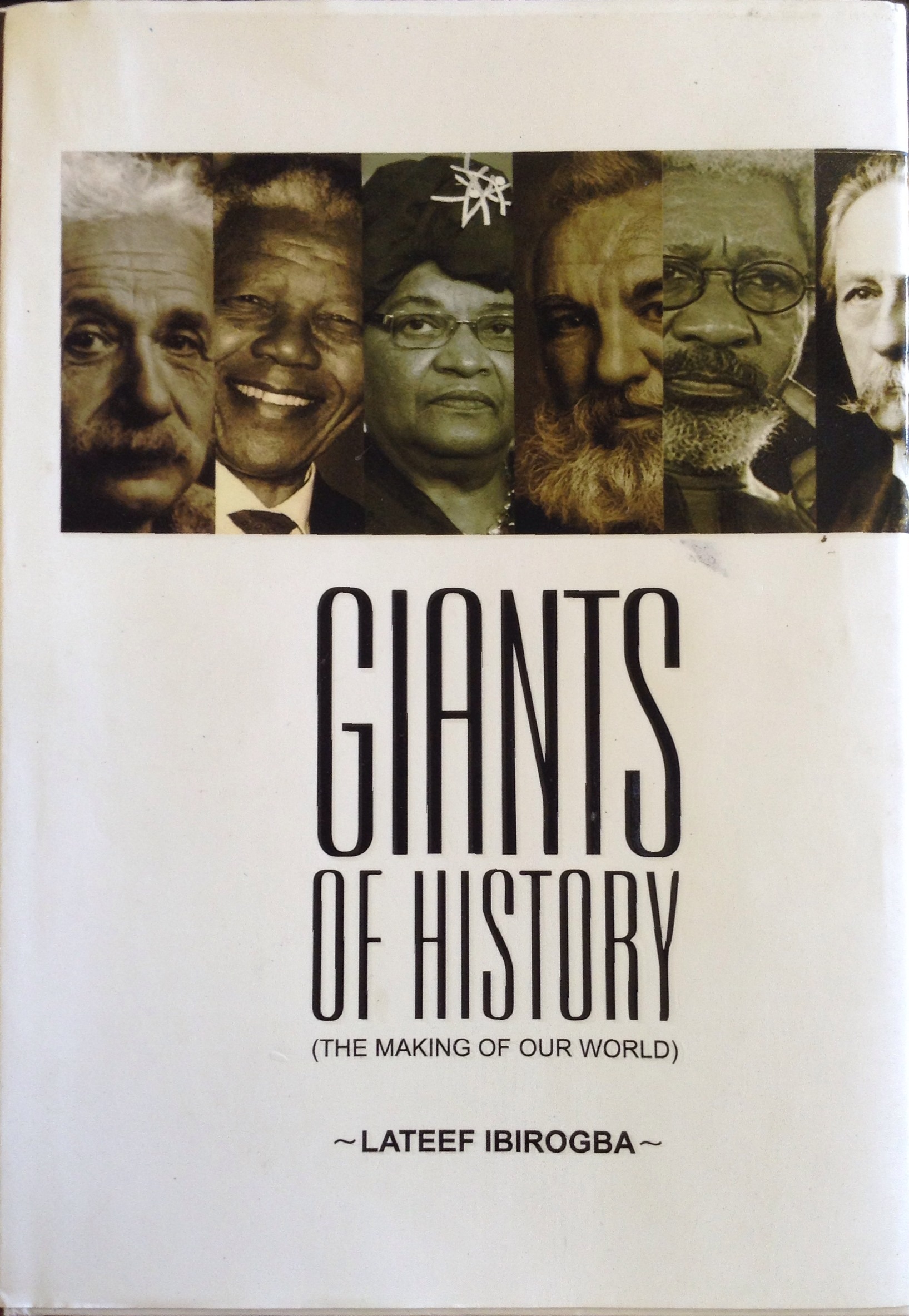
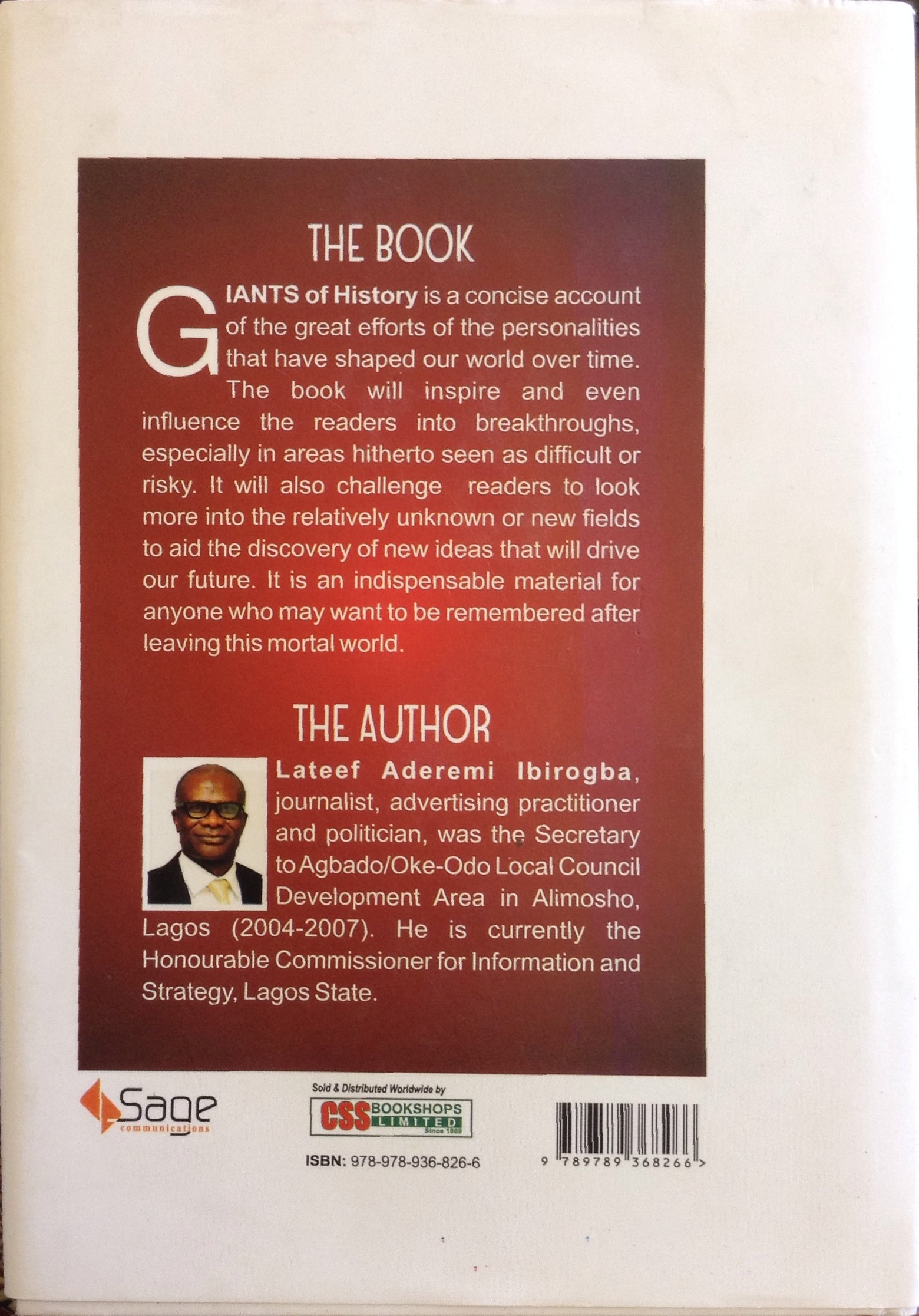
One of the projects I worked on from the middle of last year (in many capacities, most notably as an editor and all-round busybody) is a book of profiles and biographies titled Giants of History. (322 pages. Sage Publishers. Lagos)

WP_20140220_001 (1)

Written by journalist, and politician, Lateef Ibirogba (Currently the commissioner for Information in Lagos State), it is a look at 150 selected great men and women in history whose lives were exemplars of tenacity, dedication, leadership, and hard work – most of them. Readers who pick up the book will see why these descriptors don’t apply to all of the “giants” selected. The only thing that ties them together as deserving of being in the book is the extraordinarily notable lives they lived, the number of lives they touched, the power of their example, and their tremendous influence on the generations that followed them.

I was drawn to the book because of a number of reasons. When I was young, one of the most notable books I read that opened my mind to the idea of doing great things, and living a life worthy of being written about, was a book by Sanya Onabamiro titled Philosophical Essays (1980), and another by Tam David West, also with a similar title: Philosophical Essays: Reflections on the Good Life (1980). What both of them did – and I can’t tell one apart from the other anymore now – was lay down arguments supporting or opposing particular events in history, while highlighting why they had to happen and who was responsible. I will get those books again if I can ever find them, but one of the most important things they did for me was to open my mind, and challenge me to dream. They also informed me about a number of relevant historical events and their effect on the world. When I was invited to work on Giants of History, I had flashbacks to my delight with these great books. The format that Lateef Ibirogba chose to use in presenting this book in was just as important, and the role of his book serves just about the same purpose as highlighting history for those interested in it, and giving credit where due to the important human precursors to today’s important inventions and achievements.

frontThe book has now been published, to be launched in Lagos on April 22nd. I will be there at the launch, which should feature a number of heavy names in politics, publishing, and writing in Nigeria. The book reviewer, Tade Ipadeola – a lawyer and creative writer – was the winner of the 2013 Nigerian Prize for Literature (the highest literary prize on the continent, which carries a prize money of $100,000). I expect that the governor of the state will be there as well, along with a number of other still-living Nigerians whose names also made it into the book. It is important to mention that one of the impressive nature of a work of this kind is its good sense to include in the work not just historical figures from older civilizations around the world, like Plato, Aristotle, Isaac Newton, Mahatma Gandhi, Abraham Lincoln, but also notable historical figures from our own national environment, like Obafemi Awolowo, Nnamdi Azikiwe, Mary Slessor, Funmilayo Ransome-Kuti, Madam Tinubu, Fela Kuti, Chinua Achebe, among many others.

backI invite you to look out for the book, and to buy not just for yourself, but for your relatives, especially the young ones not yet sure of where life would take them, or what the point of everything is. If I could still remember the influence of a book on me as a thirteen-year old reader, then precocious thirteen year-olds around you will definitely appreciate you giving them a gift of such work.

A contrarian case might be made as to why publish a book of biographies when there is Wikipedia and the world-wide web to inform us – in multimedia richness – of the lives of living and dead heroes. The answer would be that the book is not dead. It is movable and presentable, and it is still the closest way to reach a reader, not hindered by access to electricity or the internet. It can be read in the village as in the city, and thus its relevance.

The book is available for purchase for now at www.digitalbooks.com.ng.

The Travails of Logan – A Review of “Foreign Aid”

Here are my thoughts on the third story on the Caine Prize shortlist: Foreign Aid by Pede Hollist

___________

I began reading this story with trepidation, and a worry that after reading Elnathan John’s “Bayan Layi” which moved me in a disturbing yet endearing way, and Tope Folarin’s “Miracle”, which made me think a lot about dimensions of faith and unbelief in the socialization process of young Africans, I had lost the innocence of my expectations, and thus perhaps irreparably damaged in my ability to see any new (or delightful) surprises in any of the last three shortlisted stories. After finishing Pede Hollist’s story Foreign Aid, I can now reluctantly admit that the trepidation was unnecessary.

The really long short-story that is Foreign Aid follows the travails of a returnee American, Balogun (who became Logan as part of his necessary painful American socialization experience)  all the way from America where he had emigrated with hopes of becoming an economist to his Sierra Leonean homeland where he had come, after a long absence, to visit his parents and right some wrongs. Things didn’t go quite as planned, and thus the story. Nothing explains the length of this work – a little over 10,000 words – except a guess that, like many of the others, it is part of a longer story that continues beyond the limit of a short story. To the its credit, the plot captivates one enough to take the reader from one part to the next one, onto an eventual, climatic (if predictable) end.

Many parts of the story made me smile, a few others made me very upset, and a couple more made me feel sorry for the protagonist, Logan, who reminds me of a number of American emigrés returning home for the first time in years. The accent, the impatience, and the righteous indignation at the state of things in the homeland is carefully depicted in a believable way. Much of the depictions of the warm, cheerful receptions in Freetown, and Logan’s introduction to long-lost relatives reminded me of a book I’d recently re-“read” in audio form – a story of another young man visiting his “hometown” this time for the very first time. It is Dreams from my Father by Barack Obama. The depiction of Kenya’s physical and human landscapes were affecting, and vivid in DFMF, as it was in Mr. Hollist’s work.

Here’s one from Foreign Aid:

Over the next two hours, in the television-less but now mosquito-filled
room, Father, Mother, and son chatted quietly, beginning with the events
at the ferry terminal and working their way back twenty years, alternating
stories of home and abroad, their conversation punctuated by the occasional
horn from a speeding car and Mother’s palms crushing hapless mosquitoes
that ventured within her reach.
“We’ve arranged a thanksgiving service for you to thank God for
protecting you and making your life a success.”
“I don’t go to church,” Logan said.
“America!” Mother sighed.
“What does that mean?” Father, a lifetime chorister, quizzed.
“God was nowhere when I gat kicked outta my cousin’s house, had no
job, nothing!”
“Were you praying and going to church?” Mother asked.
“All I know is that I gat no one but me,” Logan poked his chest, “to
thank for where I’m today.” He proceeded to tell the story of his twenty-year
sojourn in America. They went to bed that night with smiles and handshakes,
but they were like those offered through the bars of a jail cell between a prisoner and visiting relatives—well-meaning and hopeful but grounded in two
different realities, and neither party fully understood the reality of the other.

The “coming home” factor brought an affecting quality to the story that makes it hard to judge Logan as harshly as one would have if we had just encountered him at a bus park, a train station, or at an airport, screaming impatiently at a bus driver for driving too slow, or for losing his luggage. We know him intimately, we come to believe, and we take as much pity on him as we would if he were us. His reflection at the end of the scene quoted above is common through the story. Like Obama’s in his own autobiography, but unlike him in the circumstances of their return, their relationships with the hosts, the eventual consequences of their return, and the depth of their reflection, there is a sense of keen observation, reflection, and disappointments.

In many ways then, the story is one of transition, of hope and disappointments, of the price of alienation and intervention, and of the futility of assuming on returning to an old place that things would remain the same or remain within one’s reach to improve. The metaphor of the changing of name from the Yoruba name Balogun (warrior) to the Americanese “Logan” is a sad and constant reminder of this transition and its ramification for immigrants everywhere. It’s more enhanced by a realization that these Yoruba group in Sierra Leone may have originally migrated from Nigeria themselves over a certain period of time. And, importantly, that Sierra Leone was founded as a resettling spot for freed slaves from America who had also – at some point far up in history – come from these parts and others around West Africa.

In one last, moving, scene, Logan speaks to a youth at the airport already contemplating his own migration pattern:

“Do you go to school?”
“Form five.” Lahai puffed his chest.
“What do you want to do after school?”
“Go to Nigeria and study to become a pilot.”
“Nigeria! Why not America?”
The youth chuckled. “I won’t have the money for America, but maybe
I will have enough for Nigeria.”

The – I assume, authorial – self-reflection, and the notable irony of this opposite migratory pattern eastwards as contrasted with Logan’s own to the West, created – for me – a moment of profound empathy. It is not hard to imagine the youth one day taking on a Nigerian name, and maybe a Nigerian wife of his own in the nearest future.

There was another brief moment of such reflection when we find out that [spoiler alert] the Coral scum who had impregnated the author’s sister was not a foreigner at all, but a native Sierra Leonean himself [/spoiler alert]. It was not a long scene, but readers sensitive to challenges on the continent relating to belonging and nationality might find it significant. Reading the author’s bio as having interests in “the literature of the African imagination—literary expressions in the African continent as well as in the African diaspora” puts all of this exploration of movements into a proper perspective. He could as well be a Chimamanda Adichie, an Uwem Akpan, a Chika Unigwe, or – with some finesse – even a Teju Cole.

The story may have been told before in many different forms, but the development of the characters here, and the attention the writer pays to them and their foibles makes for a refreshing, if entertaining, perspective. I do not know much about Sierra Leone and its political and social situation, so this gave me a little glimpse. I didn’t know how similar to Nigeria it was. This helped. I also like the unapologetic use of the Sierra Leonean Creole throughout. Those who pay attention would easily spot that Tenki ya meant “thank you”, that Sa meant “sir”, that Luk ya meant “look at you”, that Salone meant Sierra Leone, that Yu no yehri wetin a se? asked “Can’t you hear what I said?”, or that Minista bizi meant “the minister is busy.” They may not know that Coral referred to a bastardized form of “Korean” or basically “Asian” (or any brown foreigner, used to refer to Lebanese immigrants in Africa), or the meaning of Borbor, except they are familiar with the pidgins of West Africa. They would not have lost much however, as they story flowed nevertheless.

I have saved my beef with the writing for last – a minor but irritating quirk of the writer to capitalize “white” whenever it referred to a Caucasian woman in the story: “The White officer grumbled” (262), “two marriages, one to a White woman, and three child-support payments later” (258), and “to his mother that he would take care of himself and not marry a White woman…” (258). It was unnecessary, ungrammatical, and needlessly distracting. It is also jarring enough, I would assume, to not have escaped the eyes of a diligent journal editor. Overall, it is a brilliant and enjoyable work that improves on re-reading; challenged, perhaps, for this competition, only by its incredible length.

____________

Also published on the Nigerianstalk LitMag

The Children of “Bayan Layi”

As part of my five-week blogathon on the five shortlisted stories in the 2013 Caine Prize, I present some thoughts on the first story: Elnathan John’s Bayan Layifirst published at http://www.percontra.net/issues/25/fiction/bayan-layi/.

______

Bayin Layi is a story of street children, located this time,IMG_8916 unlike those in Olufemi Terry’s Caine Prize-winning Stickfighting Days, in a real and defined city. The violence they experience is situated in recognizable political landmarks and scenarios, but like in Terry’s work, the scourge they in turn infest on themselves and the society is portrayed in isolation from the children’s personal stories. Who are they? Why are they here? Who are their parents? We are to assume that we know, because they are almajiris, merely hapless homeless urchins forced to survive.  And survive they did, these children, aggregated from different defective backgrounds from around town, finding themselves without anyone else but each other, decide to live by rules they made up, egged on by a selfish and enabling society. Their presence in these larger crises in turn destroys society, and the cycle continues.

I approach the story from the familiar. A similarly sounding small town in Plateau State, called Barkin Ladi, was close to the little town of Riyom where I spent a year in 2005 as a “Youth Corper”. And through the rough year, living hundreds of kilometres away from home, one constant worry was a threat of sudden violence by aggrieved youths pursuing a social, political, or religious cause. By the time the NYSC was over, there were at least five nationally-reported cases of violence around Plateau, sometimes very close to where we were, where many people lost their lives. Compared to what is going on in the Plateau today, and Northern Nigeria in general, those were the more peaceful times in the state.

The similarity with Terry’s work are many: the kids fought a lot, they used hard drugs, they killed when necessary to survive in the harsh and brutal life they lived, kids fighting to survive on their own without any redeeming lifeline from the world of adults. Thematically, the author should prepare for these comparisons although the placing of the kids in an abstract reality in Terry’s work insulates it almost successfully from the problem of verisimilitude. At least it affords us more opportunity, than Elnathan’s work does, to suspend disbelief.  He should also expect unflattering comparisons to style.

Here’s an excerpt from Stickfighting Days:

I’d dreamed of a killing blow, the single cut that cleanly ends life, but I’ve done that already, with Tauzin earlier. It was sweet. But now’s not the time for precision. I swing and thrust, mindlessly raining blows, and Markham is with me, shares my aim for we club at the judge’s head with no thought for accuracy. Even when he no longer moves, Markham and I swing for some minutes. Then I stop.

while the following is from Bayan Layi:

I hate that he was hiding like a rat, fat as he is. I strike behind his neck as he stumbles by me. He crashes to the ground. He groans. I strike again. The machete is sharp. Sharper than I expected, light. I wonder where they got them from…

The man isn’t shaking much. Banda picks up the gallon and pours some fuel on the body. He looks at me to strike the match. I stare at the body. Banda seizes the matchbox from me and lights it. The man squirms only a little as the fire begins to eat his clothes and flesh. He is dead already.

The sentences in both work are short and reasonable, with apt and vivid depictions of violence. In Elnathan John’s story at least, we come to expect that anything could happen.

In one short and frightening scene, the boys could not repress an ethnic blood lust that led eventually to a lynching when a boy suspected to be Igbo gave his name as Idowu, a Yoruba name. Sophisticated enough to know which name sounded Igbo, or which sounded Yoruba, they still gave the poor victim a beating which led to his death later in the day, away from the triumphant mob. “He had the nose of an Igbo boy,” we heard the mob say, and one’s blood boiled. As is the case with an actor getting into character to play an extremely dark role in a movie enough to elicit hate from an audience so believing of the portrayal, the writer succeeds in getting us into the children’s heads, and want to get out as soon as we can.

In another scene, a man escaping from a fire is referred to as dan daudu or “effeminate/homosexual” just before he was struck down and set on fire. We know from reading this that it is no exaggeration, that bigotry lives healthy and strong in many parts of the country, even on Facebook, that we fought a 30 month civil war over a series of crises that involved acts of genocide stemming from ethnic affiliation, and that in the hands of those to whom a sacred duty to purge the world has reputedly been granted from on high, this is a moment of cathartic orgasm. But the story is not one of that kind of balance, or political retribution, or justice. It is one of participant observation and reportage in a horrible scene. Anyone seeking redemption, or an artistic righting of that emotional assault somewhere in the story, would not likely find it.

According to Leila Aboulela, one of this year’s judges of the Caine Prize, in a piece discussing her process of choosing the stories, “nearly every submitted story reflected the economic, political and social difficulties of life in Africa.” In the case of this particular story, we glean the factors that enable child soldiers, child election riggers, child urchins, child thieves, and even children terrorists and suicide bombers: neglect, hunger, and immaturity. Does this reflect the “economic, political and social difficulties of life in Africa”? Yes, in many cases. Is that the whole story? No. But Leila continues: “The writers did not shy away from sensitive issues or gruelling realities.”

But serious subject matters do not guarantee a good story.  There are other qualities that are more important – creative imagination, skills, the ability to invoke delight,  plough depth, stir drama and chart connections, a sense of place, history and culture,  characters who intrigue, an individual vision.

I will leave to the judges the decision on how this story meets the other criteria, or at least reserve my overall comparative judgment until I’ve read the other four shortlisted stories. As a creative treatise on the cause and effect of election violence, stolen childhood, and life on the streets however, it is an affecting story, but not a fresh intervention. The universality of the story and its premise makes it at once easy to relate to and understand, and to abuse.

Those interested in resurrecting old debates about the audience of our stories will have a field day with Bayin Layi. Addressed to a Nigerian audience, the line between good and justifiable evil not being clearly delineated might turn the text in the hands of a less-discerning audience into a justification for evil.  The hero of Bayan Layi is no hero at all, but a victim. We feel sorry for him in the end because the authors made us do it, but we are not sure that he – the character – is thus totally purged or cleansed from the conditions that created him (or his kind) in the first place. At the end of the story, he is fleeing, but there is no indication that it is a permanent one. How long until he returns in company of others to wreak violence? We don’t know. There is no redeeming factor. In the hands of a foreigner, the story plays into the caricature of the African experience as a cycle of meaningless violence, and the escape is romantic, redemptive, and cathartic. Not to me. Yet I suspect that it is the foreign audience for which the story is written. After all, many of the Hausa phrases in there are translated immediately afterwards.

Don’t get me wrong, the story is well-written. It is an important piece in the understanding the mosaic of violence now in the age of Al-Qaeda and Boko Haram. It barely tells us anything new though (and by us, I don’t mean aliens just arriving in the world and meeting Nigeria – or Northern Nigeria – for the very first time). It does however create an affective interest in a flawed character, and makes us care for him as if he were one of us – which he is. This, for me, might be the story’s greatest strength. Across from the government secondary school where I taught English language as a Youth Corper was the country home of a popular Berom politician who once hosted us young graduates in his home to talk about politics, policy, and developmental issues. Sometime in 2012, after he had been a member of the Nigerian Senate, he was dead, killed in a sporadic (or, who knows, planned) attack on his convoy somewhere in the city of Jos, by warring tribes of suspected Fulani fighters. This depiction of the reality and root of violence (as inevitable results of neglect), though familiar, designates Elnathan’s work as a cautiously important one.

****

A glossary of the Hausa words in the story: Lambu means “garden”. Kuka means “cry” or a “Baobab tree”. Bayin Layi means “toilet” or “the next street” depending on context, while Gobedanisa is a proverb which means, literally, “tomorrow is far” or “tomorrow maybe late”. Acishuru (mistakenly written phonetically at least once in the story as Ashishiru) is a type of dwarf bean seeds, Ladadi is the name of a female born on Sunday, while Tanimu is a name given to a male born on Monday. Dantala, our character’s name, means “born on a Tuesday”. Sabon Layi is a “new street”. Dan daudu means “effeminate” or as usually used as a form of extreme insult, “homosexual.”

_________________

Also reproduced on the Nigerianstalk LitMag
December 24 in Lagos, Nigeria

It is three days after the end of the world, and another end looms in sight. Depending on the location of the observer, many ends, in fact. The leap into a fiscal cliff all around the USA – an irresponsibly manufactured end to the sanity of the country’s finances. In Kauntan, Malaysia, a different end. Scenes of flooding that I’ve witnessed from pictures posted online, and tweets by concerned denizens of the place, show apprehension for what is to come. If I ever have to worry about an alligator swimming casually into my house on a December morning, I would be very scared too indeed.

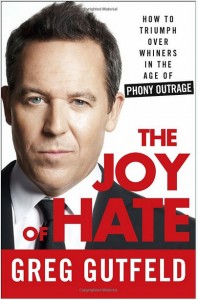
Fullscreen capture 12242012 65525 PM.bmpI am currently reading Greg Gutfeld’s “The Joy of Hate“, a fascinating book from what I’ve read so far. It is perhaps one of the few books I’ve enjoyed while disagreeing with most of what it says. Mr. Gutfeld is a co-host and funnyman on one of my favourite TV shows on Fox News: The Five. He also hosts another nightly show called “Red Eye” (to which I owe much of my sleepless nights in Edwardsville). Where we agree is our inherent rebellious streak: “I became a conservative by hanging out with liberals…and I became a libertarian by hanging out with conservatives“, he says. Watching him duel with his co-hosts on “The Five”, it is hard to disagree. But not all the time. By the time the reader is done reading Greg’s tirade on Sandra Fluke (the young Georgetown law student who became the poster child for the inclusion of contraceptive coverage in insurance policy for women in the US), it would be hard to separate him from a fellow right-wing co-host on the channel, Eric Bolling (and other right-wing ideologue you’ve ever heard from). Time and time again, he attacks Ms. Fluke of wanting “free” stuff from the government, sometimes from “all of us”, without noting if only for once that what the young woman was fighting for wasn’t government handout but an insurance system that treated everyone equally without discriminating against customers purely on the basis of their gender. It always took some stepping back to see from among the odium of Cable News chatter, but it was always clear to all who cared about the issue what Ms. Fluke represented. This particular chapter, since I have not gone too far into the book, has unfortunately cemented the reputation of the book in my head as nothing more than the same old, except this time coming from the mouth of an otherwise smart, funny, and generally perceptive personality.

Everything else is fine, as they should be. Movies are showing “Argo”, “Life of Pi”, “1000 Words”, all of which I’ve now seen, and a few other inconsequential ones. When they bring “Lincoln”, “Django Unchained” or “Zero Dark Thirty”, I will have something to be excited about. The Mayans had predicted an end by December 2012. Here in Lagos, Nigeria, there will probably be no end at all, except to all the fireworks that have now taken over the air to celebrate the season. The harmattan haze will be gone, as will the crazy traffic that has become the lot of roads. People will return to work in January and some measure of sanity will return, if only in the form of broke returnees from holiday travels. Until then, a Merry Christmas to you.

“Emerging Aesthetics in Nigerian Literature”

As a symposium participant in an event at the Draper’s Hall, University of Ibadan, at the weekend to celebrate the work of Rotimi Babatunde, winner of the 2012 Caine Prize for African Writing, I made a few points regarding the distinguishing features of Rotimi’s work, and the opportunity it offers for emerging writing. More importantly, the way it conforms to the already established trends in great storytelling.

In craft, Bombay’s Republic distinguishes itself by being able to re-tell a story already told in a longer form in Biyi Bandele’s Burma Boy in a different form, and from a different angle. This is not an easy feat. As a contribution to history, the work also moves between fiction and real life in a way that is not only authentic, but also affecting. Like Eleshin Oba in Wole Soyinka’s famous Death and the King’s Horsemen, and Okonkwo in Chinua Achebe’s Things Fall Apart, the main character in Bombay’s Republic lived at a crossroads of a certain time in history and automatically assumed the perils and rewards of such serendipitous existence.

As a contribution to language, I made note of my most fascinating discovery, made close to the end of the story, that the author had not used quotation marks at all throughout the text of the short story. That I discovered this towards the end of the piece only added to the interesting point that unlike what prescriptive grammarians would have us believe, our brains usually process text in chunks rather than as individual pieces of written information. Quote marks, as good as they are, and as aesthetically pleasing their presence on the page might me, fade in significance if a story can still be told, brilliantly as was in this case, without any use for their now rather annoying presence.

The event was hosted by a Committee of Friends, including Yomi Ogunsanya, Ropo Ewenla, Benson Eluma, Iwalewa Olorunyomi, et al. Other participants included Sola Olorunyomi (Author of Fela: Afrobeat and the Imagined Continent), Benson Eluma, Tade Ipadeola, Niran Okewole, Jumoke Verissimo (Author of I Am Memory), Biyi Olasope, Remi Raji (President of the Association of Nigerian Authors, and poet), Ayodele Olofintuade, and Olisakwe Ukamaka Evelyn.