Jason Braun, a spoken word poet operates out of Edwardsville. He’s a friend and a Hemingway aficionado. I spoke with him a few days ago about his influences and his opinion on spoken word poetry. His spoken word mixtape is entitled “Made This For You: The Mix Tape as Literature” given away yesterday at Jasonandthebeast.com. This mixtape was a product of the Association of Writers Programs & Writing Programs (AWP) Conference, Chicago.
Tell me about the source of your fascination with rap and poetry.
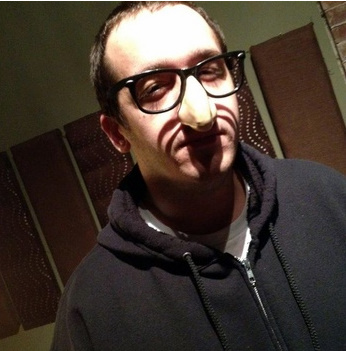 I started writing poetry in high school after reading Shakespeare. I was listening to the Wu Tang Clan at the same time. Eventually I realized that these two things were more similar than they were different. Then for a long time I was influenced by the Poetry Slam, the Beats and the Black Arts Movement. I was lucky to get to study with Eugene B. Redmond at siue and his jazz backed album was a big influence on me.
Later I started a band called Jupiter Jazz with Jerry Hill (DJ Uptown) and it was Hip Hop, Jazz, and Poetry. We had some big breaks and played some great shows including Riverfest in Little Rock, Arkansas with people like B.B. King and The Wallflowers. I then started the “Jason and The Beast” project to make sonnets into a Hip Hop album.
“Made This For You: The Mix Tape as Literature” is about pushing the boundaries of what music, poetry, can do and where they can do it.
“What direction do you see for spoken word poetry in today’s world, especially because of the influence of social media?”
I see it moving in at least two directions. On the one hand you have spoken word and slam as new place that publishing poets can come from. I don’t want to call them academic poets but they’re poets that want to publish books. Two of my favorite poets that started in Slam and have left it behind are Patricia Smith and Tyehimba Jess. On the other hand spoken word poetry is being put to good use in the global community by people like my friend Michael Rothenberg and his”100 Thousand Poets for Change.”
These two directions won’t diminish the great thing that Marc Kelly Smith started when he created the Poetry Slam. He’ll still be drawing a crowd at the Green Mill in Chicago.
Do you see spoken word poetry as complementing publishing or standing alone from it. Do spoken word poets have to publish poems or does it just suffice to participate in the trade as oral griots.
I like to make stuff. Books, CD’s, downloads, apps, backpacks that prepare people for the coming mayan apocalypse–I’ve got all of those things in the works. Really. And I like to put on shows, sing, rap, and teach. The griots and Homer might be closer to my heart. I think about this a lot.
Are there any other shows that you’ve participated in that you can highlight? Where and when?
I’ve co-directed a multi media show for Adrian Matejka’s National Poetry Series winning book, Mixology. Me and DJ Uptown played a short set there. It great to rap for my professors and former professors and help try to bring Matejka’s amazing book into 3D.
Beside the jasonandthebeast website, where else can we find you (online and elsewhere)?
If you’re in Chicago from Feb 29th-March 3rd you can find me and some of my collaborators at the AWP Book fair by going to the Sou’wester table G5. If you don’t have tickets to AWP you can probably find me during the evening at the main bar at the Hilton Chicago (720 South Michigan Ave) or hanging out at The Green Mill (4802 N. Broadway), where Marc Smith once put me on as a featured guest of his Poetry Slam.
In the St. Louis area:
On Tuesday, March 27 from 12:30 – 2pm in the Maple/Dogwood Rooms of the MUC, Jason Braun will be presenting at SIUE’s College of Arts and Sciences Colloquium during the creative writing panel on “Thinking about Space.”
On Thursday, March 29th at 7pm Jason Braun will be featured at the SIUE bookstore as part of the Graduate Writers Read Series.
On Saturday, March the 31st from 7pm Jason Braun will be featured by the St. Louis Writers Guild for a night of poetry and music, which will be at Kirkwood Train Station. Raven Wolf will be doing jazz back-ups. Other poets include Treasure Shields Redmond, Nicky Rainey, Erin Chapman, Gerry Mandel.
And on 88.1 KDHX Monday Nights from 9-10pm hosting “Literature for the Halibut.” You can listen from anywhere in the world at kdhx.org
You can find more about Jason’s mixtape here.
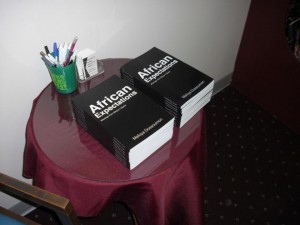 I find English a much simpler language for writing. French can become quite convoluted. My goal with African Expectations was not to write beautiful or intricate language but to convey ideas in the most direct and forceful manner as possible. I found the English language most suited to this requirement. Overall it was fairly easy to render the book purely in English but certain passages in the book, I have had to translate in my head from French to English. At this point, I mostly think and dream in English but sometimes I am unable to convey certain subtleties of thought directly in English. In those instances, I have had to think in French and translate to English. The translation part of the process has been a challenge because I have had to do research to make sure that what I wrote in English actually had the same meaning as the original thought.