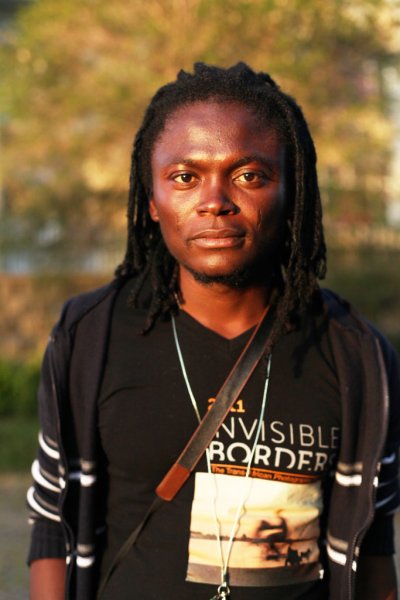
“There’s a lot of ignorance amongst ourselves.” Interview with Uche Okonkwo

Uche Okonkwo is one of the participants in the ongoing Invisible Borders road trip. Born in September 1988, she has an MA in Creative Writing from the University of Manchester, UK. Her short stories have been published in print anthologies and online. She lives in Lagos, Nigeria where she works as a Managing Editor at Farafina. In 2014 she won the first ever Etisalat Prize for Flash Fiction for her story, ‘Neverland’. Her work is forthcoming in Ploughshares, Per Contra and ellipsis. I caught up with her for a brief chat about her work and her experience on the road.

___________

Uche-Okonkwo2Do you hear this question “Is ‘Uche’ a female name?” very often?

I think Uche is a fairly common female name. I know more female Uches than male actually. But, strangely enough, I get this question often.

You currently work as a managing editor in Lagos. What does a managing editor do?

A managing editor manages an editorial department. So, along with actual editing, a managing editor manages other editors, graphics designers, authors, illustrators and freelancers. A managing editor also decides (or plays a key role in deciding) what gets published by the publication or publisher.  

Your interest in this trip, you mentioned, is to explore this same issue of identity with the people you meet, trying to understand how their language competence affects the way they look at the country. I’m very interested in this. What have you found so far?

Well, I’ve shifted the core focus of my work on this trip from language. Now my focus is on questioning the idea of ‘unity in diversity’. Language will become secondary to my work, one of the ways through which I will look at the idea of diversity in the various locations where we visit.

I’ve chosen to shift focus in this way because I realize that this (the subject of Nigeria’s diversity and how we are able or unable to be unified because of or in spite of it) is actually the big question behind my thoughts, and it then leads into language, identity and so on.

What informs your artistic and creative interests, besides the multiethnic nature of your upbringing – which many Nigerians share? And how long have you had these curiosities?

Simple answer: anything can and does inform my artistic and creative interests. I cannot name one thing. Books, movies, other writers, places, my faith, romance and heartbreak, human behaviour, it could be anything. But more specifically, I tend more toward exploring human relationships in my writing.

As far as “the multi-ethnic nature of my upbringing” goes, it’s not something that I can say has been of particular or special interest to me with my writing. It’s just the thing that sparked my interest in looking at identity and diversity, for this particular Invisible Borders road trip.

But relationship with Asaba must also play a role. It was moving to read your account of your father’s recounting of growing up in Asaba during the Nigerian Civil War.

I wasn’t brought up in Asaba. My family moved to Lagos when I was about three years old, and we’ve been there since. Which is why, even though I have visited Asaba over the years (though not very often), the story of the place and its history are not very familiar to me. Uche3

Who are your biggest artistic/creative influences?

The writers that I read (of which there are many). And the people in my life: friends, family, relatives.

Your story “Neverland” which won the first Etisalat Prize for Flash Fiction is a beautiful tale of love, heartbreak, vengeance, mischief, and redemption, in under 500 words. You said it was inspired by nostalgia, and that was evident. How many more like that have you written, and when should we expect a book?

I’ve written many pieces of flash fiction, a lot of which appear on my blog. I’ve also written many short stories, some of which have been published or are forthcoming in magazines and journals. I’m currently working on putting together a collection of short stories, but it’s not something I’m in a big hurry about.  

What do you remember most fondly about the Etisalat Prize experience?

I think my fondest memory of the experience was the awards ceremony itself, when Ama Ata Aidoo announced my name. She went, ‘oh, it’s a girl!’ and there was such happiness in her face and tone. I liked how pleased she’d seemed.

How did you get into the Invisible Borders project?

I heard through a friend that Invisible Borders was looking for a writer for this road trip. I had heard about Invisible Borders before and had always been intrigued by the idea. And so when I heard this I told my friend I was interested, and I sent a sample of my writing, which she passed on to Emmanuel Iduma, and that was how it began. It’s been a great experience so far, working with these wonderful artists and learning so much. And the people from the Diamond Bank team (who are travelling with us) have been amazing as well.

Uche2I got on this road trip because I recognized it as something important and timely. I think that as much as we say that Nigeria is one country, there’s a lot of ignorance amongst ourselves; about our past, about the country’s different ethnicities. There’s also a lot of uncertainty about our future as a nation. Projects like this road trip help us to explore and ask questions and start necessary conversations about our identity, as individuals and as a people.

On a more personal note, I enjoy travelling, and road trips more so. No way was I going to pass up on this opportunity, in spite of my fears about visiting a place like Maiduguri.

Considering your experience for the last couple of weeks on the road, what would you describe as your most memorable experience?

I think that so far my most memorable experience has been in Asaba. Hearing my dad talk about his experience of the civil war was particularly powerful for me. Besides that, there have been many other precious moments during the trip: from visiting with Pa Ayomike in Warri to meeting the Iyase of Asaba, and the many serendipitous encounters with strangers that ended up having such a profound impact. Even just sitting and talking with the other participants of the road trip is often enriching and insightful.

What are your plans for the nearest future?

My plans are to keep writing and finding ways to do (or keep doing) the things that I enjoy, and to take life one day at a time.

Thank you for talking to me.

Thank you for your time as well. It’s been a pleasure.

__________

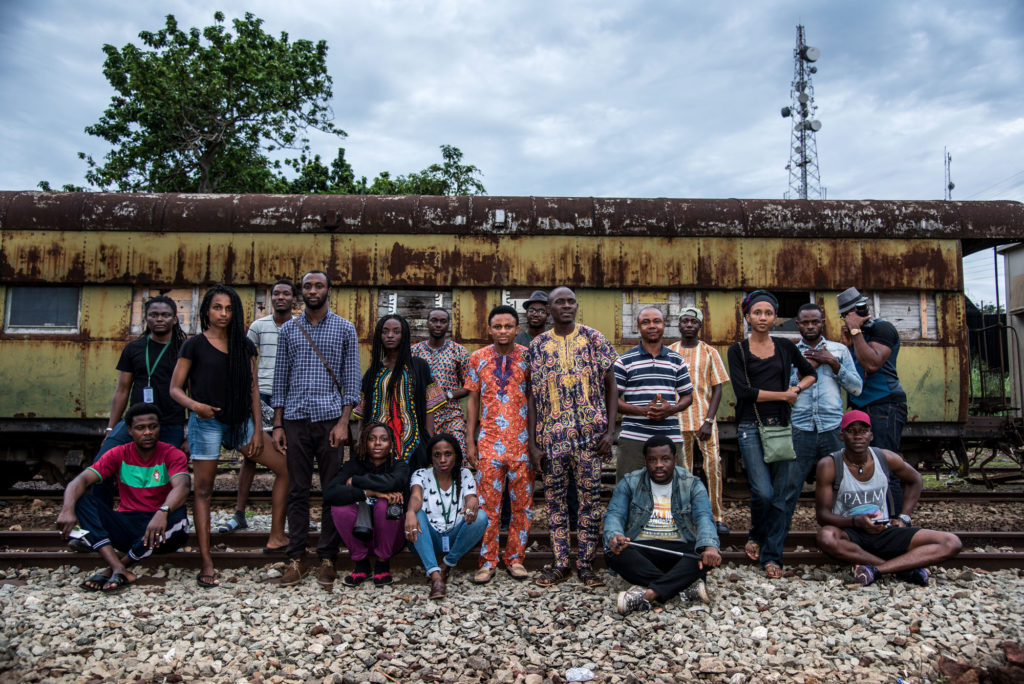
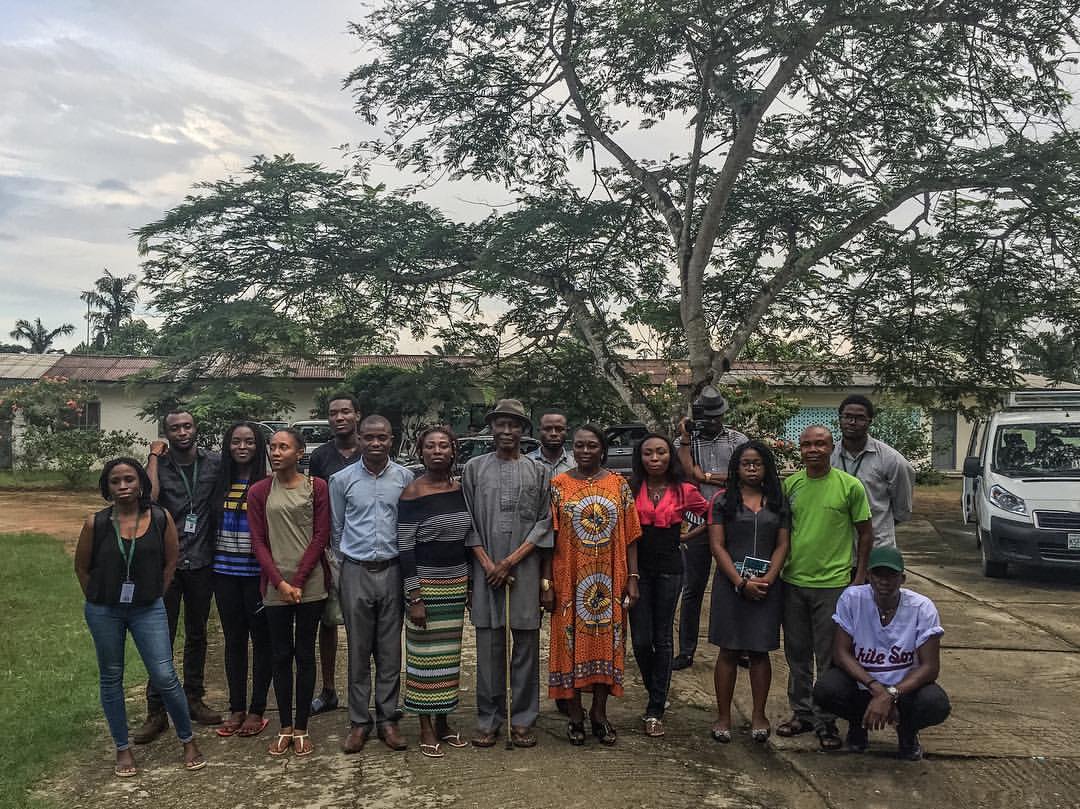
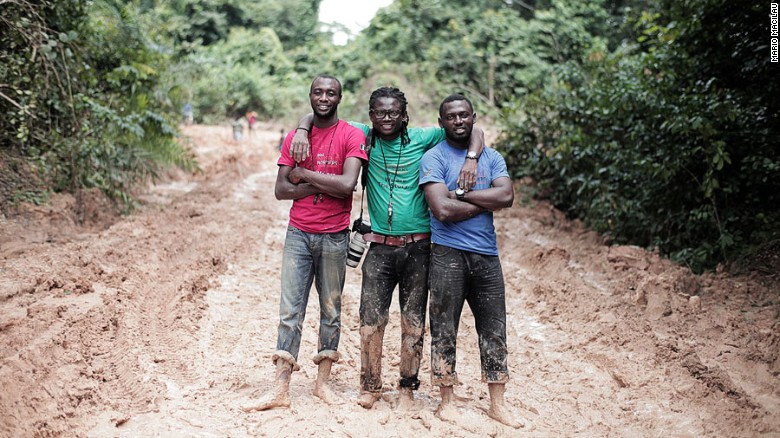
Photos from Invisible-Borders.com and KonnectAfrica.net.

You can read interviews of other current participants on the trip here and here and here.

Invisible Borders: Interview with Emmanuel Iduma and Emeka Okereke

By now you must have heard about the Invisible Borders TransAfrican project and a proposed trip around Nigeria starting from May 12. I catch up with the two leading members of the trip for a quick chat. Emeka Okereke (EO) is a filmmaker and photographer while Emmanuel Iduma (EI) is a novelist and art critic. They discuss what we should expect from the trip, their motivation, how we can help, among others. Enjoy.

———-


Let me start this way: How did your paths and intentions cross, the two of you? One of you is a photographer and the other is a writer. How did you meet and how did the relationship bring you here?
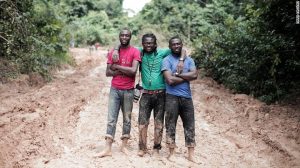
cnnphotoEI: I met Emeka first in 2009, in the company of Qudus Onikeku, Sokari Ekine, Dominique Malaquais, Tèmítáyọ̀ Amogunlà, and others. A workshop on contemporary African dance criticism—actually that was my introduction to art writing. It was a quick meeting. But in 2011 I wrote to him again, asking if I could participate in the road trip of that year. He thought I was a good fit. Our relationship has been part-friendship and part-collaboration. Emeka is very important to my trajectory as a writer. I credit him as one of those who is teaching me to see.

EO: In addition to Emmanuel’s answer above, I would add that from the onset, I have always seen in Emmanuel the future of critical writing from a Nigerian and African perspective. His trajectory (and indeed the man himself) is representative of this needful hybrid between the literary world and that of art criticism. Over the years, we have learnt to tap into our affinity for understanding imagery and its possibilities, our quest to find a new voice inspired by our everyday realities. On the other hand, he reminds me of my vigour when I was younger – with the added incentive of his much calmer constructive temperament.

Let me ask you, Emeka, as the founder of the project. What started this whole idea of traveling around the world and documenting stories? How long did it take to mature from the early stages to where it is now?
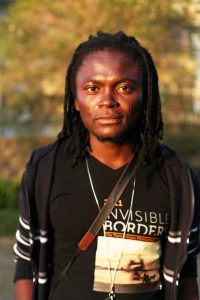
emeka-okereke-02

Emeka Okereke

EO: I have always been of the belief that there is no life without movement – there you go, my personal philosophy summarized in one sentence. Growing up, I lived a life whereby the only way I could find solace was in the conviction that life is full of unimaginable possibilities, that it is not as rigid as a singular story. The best thing that happened to me therefore was to become an artist, with the only limitation to my self-expression being my medium, my thinking and the art world! Invisible Borders came therefore out of that belief in perpetual movement to escape stagnation.

The more I delve into the history of Africa, the more I realise it’s a history of an incredibly mobile energetic people stifled by the advent of imperialism and Occidental hegemony. After so many centuries of oppression and suppression, of defining Africa only by her limitations, such projects as Invisible Borders propose that we readjust our mindset and perspective to that which breaks away from an enclosed definition of who we are, and harness the positive attributes of our diversity to create hybrids of multifarious forms of existence. This is what we mean when we say Africa is the future. But how do we attain this future when we are so divided amongst ourselves? Therefore the work begins with a Trans-African exchange.

Travelling, especially around Africa, has presented a surprising amount of challenges. You’d be surprised at how more expensive it is to go to Kenya than to go to London. Travelling by road is even worse, with visible borders, bureaucracies, security challenges, and all. How do you hope that this project changes things for the better?

EO: The most urgent need beyond how expensive or cumbersome it is to travel is to get people to imbibe the perception and attitude of Trans-African exchange. I believe that with this as the foremost, the challenges will be met. We are basically talking economics here with most of the practical and logistical concerns. We have in the past emphasised on the actual infrastructure – the Trans-African highways, the indispensability of road as a tangible conduit and facilitator of this exchange much the same as the artistic interventions. Over the past year, we have seen how our project has inspired many other Road Trip endeavours across Africa. Just recently, a group of Nigerian artists took to the Road, from Lagos to Dakar sponsored by the Goethe Institut Nigeria. Besides it being glaring that this project was modelled after the Invisible Borders project, it is a route we have travelled in 2010. Such projects and many more is an indication that our work is impactful. We shall keep at it for a very long time, and until we have inspired the many agents of change – the artists, cultural administrators, and individuals – in the course of this century.

I have known you, Emmanuel, as a fiction writer and publisher (and later as an art critic). But somewhere in-between, you became a travel writer as well. Could you enlighten me about the transition (or the epiphany, as the case may be)?
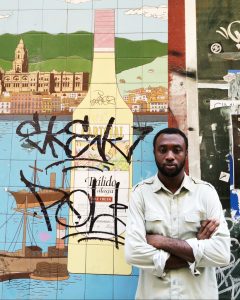
Iduma

Emmanuel Iduma

EI: There is a rich twilight between those forms, at least for me. A lot of my work depends on restlessness, or what I fancifully call peripeteia. The idea for me is to constantly think of what’s possible in my writing, and to put the essayist in me in conversation with the novelist in me. I have been thinking a lot about two statements. One is what Barthes wrote: “A critic should be a novelist in disguise.” The other is something one of my heroes said to me: “Crystallize your vision as a writer in such a way that it becomes ennobling and edifying for others.”

I like the liminality you propose. “Somewhere in-between, I became a travel writer.” But to be honest, I have not yet considered the idea of working in mainstream travel writing. I haven’t been able to match my ambition for my travel recollections with the form of more traditional travel writing. In my recent writing, especially after the road trips, the way I remember the journeys is not linear. There’s no narrative arc. It’s like a dog sniffing a field. Dogs don’t follow a straight line. They follow their noses and go all over the place.

So, yeah, the transition isn’t complete.

Travel is a fascinating enterprise. I remember talking to you about joining one of these trips (I believe it was the one of two or three years ago). But travel is also quite a physically and mentally tasking experience, needing 100% of attention and dedication. What interests you, both, in this experience, and what have you gained the most from past editions?

EI: After each trip I usually swear I won’t participate in the next one. My friends are quick to mock how easily I renege on that promise. I want to constantly go afield. The idea of being a stranger in a place, scarcely having the audacity and permission to relate with locals, fascinates me. I mean, much of our travels have been in Francophone Africa. And I can’t make a sentence in French, or Wolof, or Bambara, or Moghrebi Arabic. What does that incommunicability allow? What does it eclipse? This is why I haven’t been able to say no to traveling more with Invisible Borders. The other reason: I can’t separate art from art-making. I can’t distinguish what the head imagines and what the hand does. To see real bodies struggle with art-making, as a writer interested in images, is a gift.  
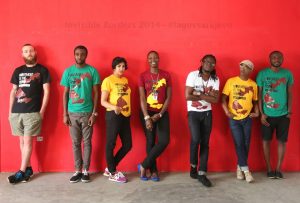
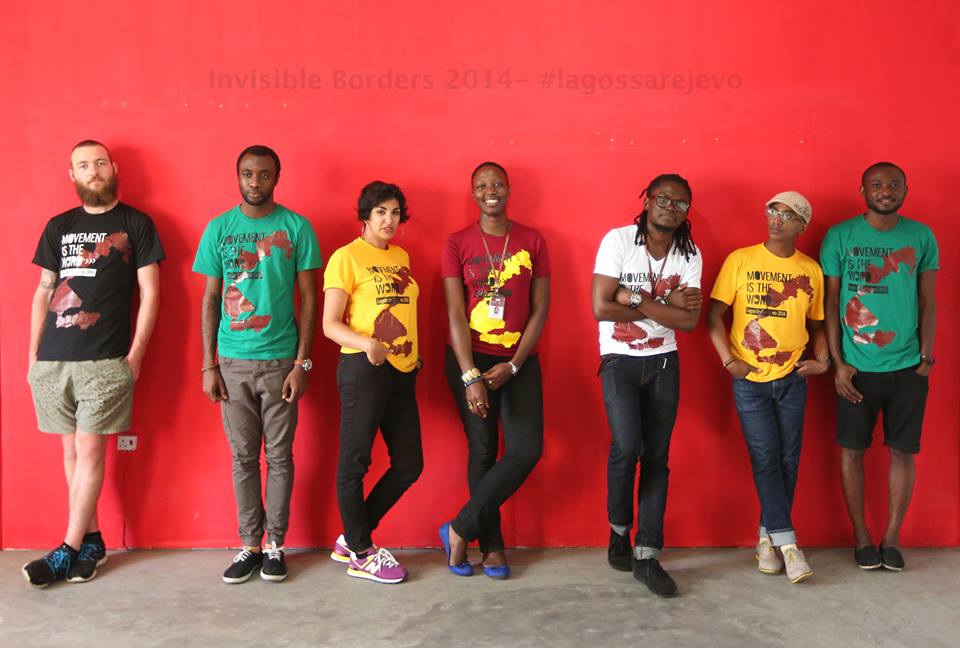
Invisiblebordersparticipants2014EO: I think for me, it’s about the notion of constantly inhabiting a space of transition, the Middle Ground like Chinua Achebe called it. He went on to explain this as “where everything is allowed to play a role in coexistence, and whatever cannot survive this space is expunged by the same process by which they became a part of it. It is the process by which foreground and background comes into being; it is the core of social formation”. The Invisible Borders is exactly this space or distance of transition sandwiched between preconceived notions and freshly acquired perceptions, between mystery and meaning. Over the past five years we have constantly inhabited this space, and by that generated reflections which to my belief are useful aberrations to the prevalent African narrative. It is a highly charged creative space – I think this is what keeps pulling us back to it.

Specifically, which ones of the earlier editions of this road trip delighted you the most and why?

EI: My first, in late 2011. There was something valuable about my naiveté, and the fact that a lot of the clarity I’m now gaining about my work wasn’t available to me then. Also, I was traveling out of Nigeria for the first time.

EO: The first impression is always the best! So I will say the 2009 edition. But in the way of valuable experience, I will go for the 2014 from Lagos to Sarajevo. After that trip, I feel invincible, there is really nothing we can’t do!

How did you choose the participants in this edition, and what do you look forward to the most?

EO: It has always been the norm since 2011 to make an open call. But this year, we thought it wise and more effective to go by internal research and handpick certain artists whose work we have been following. We always try to experiment with the different kind of artists we bring on board. This year we have gone with a lot of young and budding artists because we try to position the reflections around the Nigerian Road Trip in the frame of the present/future generation, it is really a project that looks at the future. But again, we are focusing very much on the history of how Nigeria came to be. You understand that we cannot talk about the future of Nigeria in detachment from history because history is the ground under our feet.

If I speak with any of the currently selected participants, what do you think would be their responses to a question like “What is your biggest fear about this trip?”
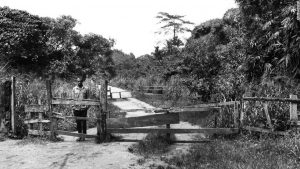
invisibleEO: It’s simple: going to the North from the South. And this fear has a history. Today, it’s due to the violence from Boko Haram, but it all began with that Amalgamation in 1914. Since this time caution has always preceded the South-North transitioning. But we are Nigerians, and off we go!

The trip, the poster says, will go from Lagos to the South-South, then northwards through the heart of one of the most dangerous parts of Nigeria in 2016. What are you hoping to find out, and how do you think the findings would impact on the public?

EI: How about we investigate what makes the northeast dangerous? The lives inscribed within this danger, what do they look like? I am constantly aware that Nigeria as we know it, from the time of its naming until now, is constructed. So we know as little as we have been told. This is not to say Maiduguri is a safe place, or Enugu for that matter. For this trip we’re outdistancing the stereotypes we’ve been given about northern Nigeria—especially since a number of us have lived mainly in the south. A work of art brings closer what has been kept afar. I am hoping that in this trip we can add our voice to the chorus of all that is sublime and nuanced, and even paradoxical, about Nigeria. There’s a great sentence in Maxine Hong Kingston’s The Woman Warrior, now framed in my mind: “I learned to make my mind large, as the universe is large, so that there is room for paradoxes.”

EO: Emmanuel nailed it. there couldn’t have been a more perfect answer!

Emeka, as a photographer, and Emmanuel as an art critic and writer, what do you, individually, look for when you walk through a crowd of people, particularly in a place you’ve never been before? What images gives you the most feeling of ‘this is highly significant!”
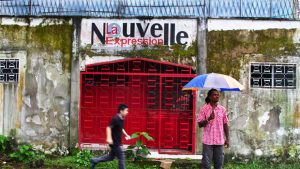
aaEI: I’ll go back to the image of a dog sniffing a field, which is a metaphor Tacita Dean uses in relation to her research method, quoting the great Sebald. “You allow yourself to be interrupted on your journey and led elsewhere by whatever you encounter,” she said. I believe in this very much. If an art critic must be as intelligent as possible, that intelligence is ultimately the possibility of testing the fitness of my instincts. I learn a lot from the language of improvisational dancers, especially those who allow the energy of an audience shape their movement on stage. This is a roundabout way of saying I have a vague sense of what to look for when I walk in a crowd as a stranger. My goal is to forget my assumptions. To listen.

EO: The image is always a precipitate of a lived experience. Part of preparing myself for the trip is to divorce myself of any idea of an image that I would like to have. There is something funny about images: there is a thin line between an image which limits perception and that which liberates it. Rather than talk of an image, I would reflect on the kind of encounters we hope to make. I look forward to meeting Nigerians from all walks of life – from the farmer, the mechanic, the trader in the market to the business tycoon, politician, advocate of human rights, nurses, doctors, you name them –  listen to their unique stories, share their moments with them, learn from our exchange. It is only after then that the camera comes in, to bear witness or emblemize the occasion.

One more question that i’ve always wanted to ask photographers, Emeka, what actually happens to all the images you take over many years? I sometimes look into my records and wonder what I should do with photos taken which at some point meant a lot to me. I assume that many of them are shown at exhibitions. Do you ever duel with yourself as to which to keep and which not to, which to exhibit and which not to? What helps you in making those decisions?

EO: We are all asking ourselves the same question. Especially at a time of digital proliferation of images. Selection of images is part of the daunting process of image making, so it comes with the profession. Beyond that, the biggest challenge at the moment is figuring out methods of archiving. I have always said that for every click we make in and about the African continent, history is made. So while we meticulously chose images for exhibitions and presentations after the road trip project, we throw nothing into the bin. We always thinking of posterity, some of these images need to age – like fine wine.

How can the public help this trip?
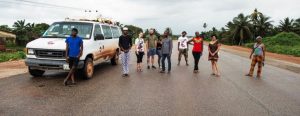
invisible-borders-2014-726x280

EO: We have reached out to the public, asking for their contribution in the way of knowledge about the historic and contemporary narratives of the states, cities and regions we are scheduled to visit. We really want this project to be about profound encounters, and doing so through assistance of well-meaning indigenes of these places is the most productive way to go.

What should we look forward to at the end?

EI: A solid amount of images, film, and writing. A body of work from each of the participants. Because there’s so much to make sense of in Nigeria, I don’t think there will be an excess of responses.


End

__________

Still to come: interview with other participants in the road trip.

__________

Photos from OkayAfrica, CNN, and Google Images.
“Ours is Not Yet a Humane Society” | Conversation with Niyi Osundare

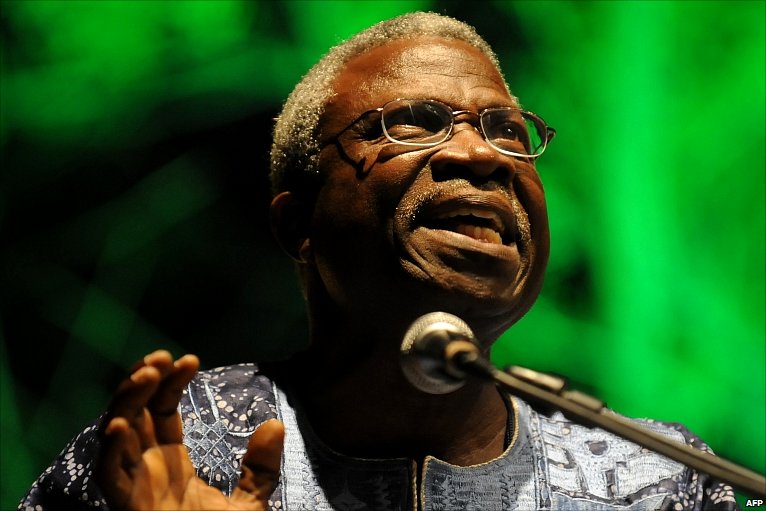
Professor Níyì sundáre is Professor of English at University of New Orleans, USA, and one of the best-known poets from Africa. His works of published poetry include Songs of the Marketplace (1983), Village Voices (1984), A Nib in the Pond(1986), The Eye of the Earth (1986), which won both the Association of Nigerian Authors Poetry Prize and The Commonwealth Poetry Prize in its year of publication. He was also a recipient of the prestigious Folon/Nichols Award for ‘excellence in literary creativity combined with significant contributions to Human Rights in Africa’. Other published volumes of poetry include Songs of the Season (1987), Moonsongs (1988), Waiting Laughters (1990), Selected Poems (1992), Midlife (1993), The Word is an Egg (2000) and Tender Moments(2006). Niyi Osundare has also published four plays and essays on literature, politics and culture. Orality and performance are important features of his works, which have been translated into the Italian, French, Dutch, Czech, Slovenian, and Korean languages.

________

Thank you for talking to me. And congrats on your 2014 National Merit Award.

I should be the one thanking you for providing the forum, for making it possible for this exchange to take place.

Let’s start with your poetry for which you’ve been widely acclaimed. The last recorded work from you was in 2006, titled “Tender Moments”. Is there a reason you haven’t released another published collection since then, almost a decade ago?

Tender Moments is, actually, not my last publication. The book has got two aburos: City Without People: the Katrina Poems, published here in the US, and Random Blues, the first volume of the collection of my weekly poetry column in the Sunday Tribune. Both were published in 2011. And right now, the publisher is looking at a new book of poems, some kind of travelogue-in-verse, which I completed last year after many years of preparation. I’m also working on a sequel to The Eye of the Earth, a 1986 book whose resonance and thrust I consider so achingly relevant in this age of the deniers of the scourge of climate change and global warming, even when the effects are so palpably, so tragically evident. Many of the poems from this manuscript have featured in three influential international journals on either side of the Atlantic:  Interdisciplinary Studies in Literature and the Environment (ISLE), University of Oklahoma’s  World Literature Today,  and Moving Worlds of the University of Leeds, UK . Mine were invited contributions, and I am both glad and inspired by these journals’ single-minded concern with some of the burning issues (all pun intended) of our time: nature, climate change, wild winds and tsunamis, etc.  So, you can see I’ve not been sleeping on duty!

I first met you on the campus of the University of Ibadan where you taught in the department of English, and then left for New Orleans. What was your most significant memory of teaching in Nigeria compared to teaching in the United States?

Now, you’re asking me to cast in the past tense  a narrative that is  still very much in the present tense. My pedagogical and academic relationship with the University of Ibadan (and other Nigerian universities) continues, though at a less formal, less regimented level than before.  You will remember that I said in my 2004 valedictory lecture that my relationship with the University of Ibadan is a laelae  (lifelong, everlasting ) affair. This is why I do not come on the summer vacation without having one kind of interactive session or another  with students in the Department of English – a mutually beneficial activity which I thank the present Head of Department for facilitating. I also actively participate in academic events in other departments. But I do know that both the tenure and the tenor of my service have changed, and things are not exactly where they were when I left in 1997.

Now, teaching at Ibadan versus teaching at the University of New Orleans. Many similarities and a few differences. To begin with, in both institutions, I have to deal with students, the centre of my professional concern. I have discovered that students are virtually the same everywhere: young, vulnerable, unsure, even fearful, but inquisitive, ambitious, demanding, generally idealistic. And on both sides students who are sharp as razor, engaging, and quick on the uptake, and those who are a little slow and need some gentle prodding. But what makes the real difference is the environment. It is common knowledge that the Nigerian student as well as her/his teacher are still engaged in a life-or-death struggle for the provision of amenities which their American counterparts have come to take for granted: steady power supply, potable water, relative freedom from hunger and suchlike harassment by social needs, a predictable academic programming and scheduling,  and above all, a relatively stable political system. A book comes out on Monday; by Thursday it is already within your grasp; access to internet facilities that are fast and inexpensive. These are facilities still far from the grasp of the Nigerian student.  But in a way there is some ‘sweet uses’ to the Nigerian’s student’s ‘adversity’ – to echo Shakespeare. Driven by need and necessity, the Nigerian student tends to be more aggressive, less complacent, and less dependent (Who are you going to depend on: parents who are barely striving to survive, or a government that has no interest in your welfare?). I have observed that drop-out rate is much, much lower among Nigerian undergraduates; for to drop out is to drop under and, in many cases, to drop dead; for the kind of socio-economic safety nets available to American students are nowhere there for their Nigerian counterparts.


At the faculty level, surely, the American academic has much more to work with: the laboratories are well equipped and functional, research funds are made available (depending on the buoyancy of the university’s budget; for, yes, even in America, colleges and universities do go broke!). As a result of a situation of general relative contentment, labour union activity is almost non-existent in American Academe. Many times I miss the rousing militancy of ASUU!

You were notably affected by Hurricane Katrina in New Orleans in 2005, and you’ve given a number of interviews about that sad event. Do you hope to write a memoir about it at some point? Many of us would like to read what it was like to get through those harrowing times.


Thank you for your concern.  The book mentioned earlier on in this interview, City Without People: The Katrina Poems, has tried to explore and articulate some of the harrowing experiences. The poems themselves are sandwiched between two prose pieces: a prose preface and an interview both of which put the Katrina narrative in proper perspective. But there was a prose parallel I was writing while composing the poems. Somehow, I managed to complete the book of poems, but the prose narrative stopped a few pages after 40. The memory of our losses weighed me down. The prose narrative literally collapsed under the debris. Why and how I found poetry a readier bearer of the tragic experiences, I still do not know. I think this would be an interesting study for psychanalysts.  Even the poems, I couldn’t complete until six years after the hurricane… I may go back to that prose narrative someday – maybe when I’ve retired from this penny-a-day teaching job and I have more free time to myself. And when the trauma engendered by memory of the event would have thinned out sufficiently to allow for relatively painless recollection. But then, who knows: some memories never let go of our faculty of remembrance.

Being influenced by your Yorùbá background, you must have strong opinions about poetry as performance (spoken-word) as opposed to poetry as text. How best do you think poetry should be enjoyed or employed?

Both ways, both modes. And more. In the house of poetry and its practice, there are many rooms. Some poems are written for the eye, some for the ear, and others for both. I see my Yorùbá background as abundant blessing to my poetry. I have always wondered what kind of poet I would have been without this fabulously rich culture and its language. Or, indeed, whether I would have been a poet at all. Come to look at it: everything in Yorùbá is poetry-in-motion, poetry-in-action. Yoruba language is music: from its intricate tone-system to its inimitable ideophones. Sounding is meaning, and meaning is sounding. A language whose syllables sound like drumbeats. A generously metaphoric language which can render the most abstract concept in the most arrestingly imagistic way. Compare ‘I am hungry’ with ‘Ebi npa mi’ (Hunger is beating/killing me); ‘I am shy’ with ‘Oju nti mi’ (Eye is pushing me) . This phonological and imagistic paradigms are central to my poetics. For me, the line is not complete until I make it sing and make it sing meaningfully.  My Muse is never far from her/his music. Those who cavil at the abundance of repetition in my poetry need to know the music behind my Muse. Fortunately, this is not an exclusively Yoruba attribute. The music of Welsh language drives the prosody of Gerard Manley Hopkins and, to a lesser extent, Dylan Thomas; Irish inflections in the drama of John Millington Synge. How can one come to a full experience of Igbo masquerade chants in the poetry of Obiora Udechukwu and Ezenwa Ohaeto; of udje songs in Tanure Ojaide,  without remembering the haunting  musicality of Soyinka’s Death and the King’s Horseman and Osofisan’s The Chatterinng and the Song, the threnodic minstrelsy of JP Clark in Casualties and Song of a Goat? It is this blend of sounding and meaning, music and movement that lies at the heart of the performative strategies and enactive potentialities of the poetry of Akeem Lasisi and Segun Akinlolu (Beautiful Nubia)… At the personal level, I hear my words before I set them down on paper. I allow them to indulge me in the sheer musicality of their essence, their dramatic possibilities. Most times, I see with my ears.  For every word I care about, all the world’s a stage.

It’s been said that your decision to resettle in the United States was based on the educational opportunities afforded your daughter who is hearing-impaired. What has been your experience from the time of your resettlement about what’s lacking in Nigeria and what can be done about it?

Thank you for not forgetting this personal dimension. Yes, indeed, my family and I left Nigeria hurriedly in 1997, (leaving behind  our son who was then an undergraduate at the University of Ibadan).  My wife had to leave her job while I took an unexpected leave of absence from mine. The English Department of the University of New Orleans facilitated our relocation by providing me a job. Upon our arrival in the US our daughter was enrolled in the Louisiana School for the Deaf in Baton Rouge, about one- hour drive from New Orleans where we live. That school provided the necessary educational needs and a conducive environment, and our daughter took full advantage of these and began to thrive. Her talent in Fine Arts was spotted straightaway and fully encouraged. Two years later she was recommended for admission to Gallaudet University, America’s famous university for the deaf, in Washington, DC. where she graduated with a degree in Fine Arts. She is out of school now, still figuring out what to do to earn a living. It’s been a challenging period for all the family, but we are happy this girl has not ended as a roadside beggar in Nigeria. Our experience has shown us all the more how little Nigeria is doing for her citizens, especially those impaired and those with special needs. Ours is not yet a humane society. There is plenty of work to do to get us to achieve that ideal. But we must not relent. Every child deserves the best.

What role do you think that poetry should play in the political and cultural environment in Nigeria and around the continent?

Seven cheers to you for asking this question which many would have considered  intolerably old-school,  even passé, in our triumphally ‘post-colonial’,  post-functionalist, post-humanist condition… Poetry is the soul of a people, their heartbeat, the rhythm of/in their movement, the rhyme in their reason. It is that magic which distills cosmos out of their chaos, the song which salves their sorrow and exults their gladness. It is that oríkì which causes the head to swell; that èébú which makes the victim feel like jumping into a bottomless river. Poetry has never been far from politics, for the real poet is one who holds up the mirror to  the naked emperor; one who calls evil by its original name;  one who perceives hope where others only see despair. Have I idealized the poet and the role of poetry? Yes, and deliberately so. The poet is no insulated saint nor is s/he an angel. I am inclined to judging life by its possibilities, not its failures; to accept life’s cup as half-full while I join others in finding a way to fill the remaining half.. It is legendary now, the staunch, life-affirming role that poetry has played in African politics, from the anti-colonial, pro-Independence versifying of the Osadebays to the towncrier griotism of the post-Independence era, and the ‘decentred’, ‘indeterminate’ collage of the ‘post-colonial’ present.  Has poetry ever caused the toppling of bad governments in Africa? I wouldn’t know for sure; but I do know that excoriative words and guillotine verses have chipped away at the ramparts of despots, military or civilian, opening up fissures and cracks for the entry of revolutionary barbs. As for culture, African poetry keeps reminding the African tree of the neglected importance of its roots, the African society of the pollution of its values.

Literary output in the local languages of Nigeria has been abysmal in the last couple of decades. Why is this so? What can be done to revitalise the industry? Is it even worth it?

Our indigenous languages are in that state because they have been neglected by our government and ignored by our school system – just like other aspects of our culture.   The enthusiasm brought to bear on their cultivation and promotion in the  1970’s and 1980’s has fizzled out just as aggressive, and philistine foreign religions have desecrated and taken over the temples and shrines of indigenous deities. Ọmọlará Wood put the matter so succinctly well in her book chat at the  First (2013) Ake Book and Arts Festival when she said ‘I think a lot of our ways are demonized, especially in the Nigeria of today where it is perceived to be uncouth to speak your language’. She then sums it all up in this painfully crisp, undeniable statement:  ‘Others rubbish our culture because we don’t value it’ (Both quotes from Sunday Tribune, January 13, 2014).  We Africans are a people in danger of a looming culturecide. In the southwest, people like Adébáyọ̀ Fálétí and Akínwùmí Iṣọ̀lá have built on the solid foundation of the likes of Fágúnwà and Ọdúnjọ, and produced literary works that are deep and enduring. I shudder to think of what will become of creative writing in Yorùbá when these intrepid cultural and linguistic nationalists are gone. Well, maybe it will be Nollywood to the rescue, though the kind of trivialization and literalization the indigenous languages are going through in the video world are a cause for worry. Needed urgently an educational policy that will make the teaching and study of Nigerian languages compulsory in all Nigerian schools, and a mindset that does not privilege the foreign over the indigenous. Without an iota of doubt, we can only get to that juncture when/if we get our politics right.

How do you see the future of literature in Nigeria? What gives you hope? What gives you despair?

On the positive side: Thronged.  Complex.  Diverse.  Largely relevant

On the not-so-positive, my concern about the increasing diasporization of Nigerian/African literature in conjunction with the phoney globalization which deceives  people into the acceptance of  a world  on whose map their own home is missing. Consider this:  Our ‘best sellers’ are determined abroad, in places where the values which propel our imagination are either unknown or disdainfully discounted. Virtually every young Nigerian now dreams of getting published abroad (read USA and Europe). The cultural, socio-economic, and aesthetic repercussions of this exogeneist mentality are grave and far-reaching. Our writers’ charity no longer begins at home. This is culturally and psychologically suicidal.  But who can blame these young folks, considering Nigeria’s illiterate, philistine political leadership, our inefficient and dishonest publishing culture and abysmal reading habit, and the consequent slump in the sale of books. We must create an enabling environment that does not alienate Nigerian writers and their vast and diverse talents.  For this to happen, again, I say: we need to get our politics right.

____

This interview first appeared in Aké Review 2015

Interview with Eghosa Imasuen

PUBLISHING IS PERILOUS, BUT ALSO SOMETIMES REWARDING. SINCE MOVING FROM FULL-TIME WRITING TO FULL-TIME PUBLISHING, WHAT HAS BEEN YOUR EXPERIENCE, POSITIVE AND NEGATIVE?

eghosaYes. It is perilous. I only had a view of this, barely, because I was a backseat driver, one of those authors who always chided the publisher for not enough publicity, do more, do more. But now that I have taken the wheel, at the firm that published my first two novels, no less, I see things a bit more clearly. It is a difficult business. Both for the pocket and soul. The pirates dictate how you price your books. You are in competition with yourself. Cost of finance in high in Nigeria. There are issues with power and noisy generators that affect productivity in the editorial department. Then there is what reading reams and reams of bad submissions does to someone. It is killing; bad writing kills me.

– Read the rest of the interview on Brittle Paper

Challenges of Translation, et al

Q: Thinking about your main target language, what would you say are your biggest challenges when translating from English into that language?

A: The biggest, classical, problem in English to Yoruba translation is the problem of one-to-one equivalents. There are expressions in English that cannot be rendered with the same number of words in Yoruba (“I’m sorry” is one). There are also tones of those in Yoruba as well, that you can’t express in English without having to write an epistle. (“pẹlẹ” is one such, or “ẹ kú ilé).

It is a “problem” easily surmounted if the target text allows for it. But while translating for mobile communication, or computer/software jobs, it forces one to be creative, since the client usually requires one-to-one translation as much as possible, and there is usually not enough space to elaborate.

The other problem is that of diacritics – the fact that tone and vowel markings in Yoruba need to be present to avoid ambiguity. While most computers can be manipulated to place the tone marks on the translated words, many software may not be able to process them, and some clients don’t have need for them, so the translator is forced to send in products that are unsatisfactory and can cause ambiguity.

Read more of my interview with Translate Africa, on my work in translation, the #tweetYoruba project, language attitudes, among others, here.