Are We Past the Height of Culture?

The current play on my phone at this moment is a tribute ewì album to the departed Tìmì of Ẹdẹ (Febryary 1899 – May 16, 1975), a literate Yorùbá king in both the western and traditional sense. He was a drummer and a prominent culture custodian. There’s a documentary about him on YouTube as well, which you can see here.

The album was done by Lánrewájú Adépọ̀jù, a prominent Yorùbá poet and contemporary of my father’s — both foremost practitioners of the oral poetic form. Likely released in 1975 or shortly after, to mark the death of the king.

Earlier this morning, I was listening to another work by the same ewì exponent. This time, it was the album he waxed for the coronation of the Aláàfin of Ọ̀yọ̀, Làmídì Adéyẹmí who passed away at 83 in 2022. Adépọ̀jù himself died at 83 two years ago. What was common to both works was the depth of the poetry, the thoughtfulness of the work, and the significance of the documentation that the work have come to represent for those of us not privileged to have occupied the same lifetime as some of these prominent Yorùbá kings.

A few weeks ago, the selection of a new Aláàfin Ọ̀yọ́, in the person of Akeem Abímbọ́lá Ọ̀wọ́adé, was announced. It was, perhaps, that singular event that brought me to contemplation about what we may have lost. Along with the album by Lánrewájú in 1975, the poet Odòlayé Àrẹ̀mú did one titled Aládé Ọ̀yọ́, which I haven’t been able to date. There, too, the lineage of the then newly-selected young Aláàfin was poetically preserved.

In 1977, a new Olúbàdàn was crowned — the third Christian king of the military town. Ọba Daniel Táyọ̀ Akínbíyìí. His reign lasted for five years, ending in 1982. But at the time he was crowned, also one of the Western-educated kings of his time — Odòlayé Àrẹ̀mú waxed poetic in his honour. It’s still one of my favourite albums of his to return to once in a while, produced by Ọlátúbọ̀sún Records.

What the naming of the new Aláàfin Ọ̀yọ́ brought to me in sadness was the absence of any capable cultural practitioner of the type of Odòlayé, Adépọ̀jù, and Ọládàpọ̀ to put the new king in context, and in poetry, for a generation that desperately needs it. Look, for instance, at this collaboration between Túbọ̀sún Ọládàpọ̀ and the aforementioned Odòlayé Àrẹ̀mú when the Ṣọ̀ún Ògbómọ̀ṣọ́ was crowned.

or to mark the demise of the Premier Samuel Ládòkè Akíntọ́lá…

Or Àlàbí Ògúndépò’s panegyric tribute to the crowning of the Ọọ̀ni of Ifẹ̀, Okùnadé Ṣíjúwadé in 1980…

Over the last five years, prominent Yorùbá stools have been filled. The King of Ìwó has become a crusader for the Islamic Religion, while the new Ṣọ̀ún of Ògbómọ̀ṣọ́ was chosen from a Redeemed Church in the United States. There have been at least four Olúbàdàn of Ìbàdàn kings over the last ten years, none of which have had any contemporary poet, musician, or artists do noteworthy commemorative albums in their honour. It is not just for the royal personalities themselves, mind you. My worry is what this represents for what goes for public art performance today in the Yorùbá culture.

Here are two albums created by Adépọ̀jù and Ọládàpọ̀ to mark the passing of Ọbáfẹ́mi Awólọ́wọ̀.

Adépọ̀jù:

and Ọládàpọ̀:


Recently, I asked Mọlará Wood, a culture critic, about this phenomenon. What was it, I wondered, that made those times welcoming of these kinds of artistic expression? Obviously, the characters that were celebrated in these notable poetic expressions were important and remarkable characters themselves. Could it be that we have only found mediocre personalities to replace them? Or, also more likely, could we also have run out of original creative thinkers able to wrought remarkable pieces of art in memorial for our departed or emerging culture heroes? Her response, in brief, was that perhaps those were the days of the height of culture.

And that is a depressing thought; that we have indeed peaked, and what is left are the dregs of society with values at variance with the collective need of a society that once thrived on intellection, art, and original creative expression and documentation. While society is being replaced by the sugar-high of popular culture — Afrobeats, Amapiano, Alte, and the rest of the modern saccharine — what is being lost is the worldview and values that once kept our head high, where entertainment was deeply embedded with information, community, and knowledge-sharing, where art was meant to last and to engage, and not just to vainly move.

Shortly before the pandemic, I started work with the Poetry Translation Centre in London to translate a number of important Nigerian oral poetry into English. One of the subjects was Lánrewájú Adépọ̀jù — a natural choice, considering his status in the genre. But what I later found was equally challenging: the near impossibility of translating what makes poetry beautiful in Yorùbá to English. Ocassionally, as you’d see in the excerpt below, the poetry manages to cross over mainly through the strenuous wringing of meaning through English prosody. But for most of his work — and those of his contemporaries — the beauty remains only when the work remains in their source language. This presents the key challenge to those who might respond to the main thrust of this blog with “Perhaps globalization is the saviour, come to save us from traditional Yorùbá poetry; so the dearth of new work should be seen through that lens, and their transmutation through modern music rather than a sign of a confirmed path to extinction. As long as we can write and express ourselves in English, and translate works from and into it, then what’s the problem?”

Well, the problem exists in the lack of new original work. If we were to agree that the culture has become confirmed to a fossilized state where all we have are nostalgic longing for what used to be, and no new creative ferments burst in to shake us out of our complacency, inspire us to new heights, and codify for us in poetic language what the moment means, then maybe we have lost something irretrievable.

I did find, at last, a contemporary work that could perhaps compete with some of the old. It was Kwam 1’s tribute to the departed Aláàfin (see below). Even if the rest of the work didn’t always engage much beyond the deeply moving poetic introduction (a result of my own taste, perhaps), it is heartening that it exists.

But how many more of these do we have before the culture is declared functionally dead?

Goodwill Towards Men

If I could, I’d get a Santa hat to wear around this little town. The smell of snow and the colour of lights around houses in the neighbourhoods comes with a pleasant feeling of Christmas. If I could, I’ll get a Santa hat like the big American guy I saw early today at Walmart. He wore a pair of jeans, a tee shirt, and a Santa hat. He was not Santa Claus. Santa Claus doesn’t exist. He didn’t look good either. He looked goofy. But he had a Santa hat. If I could, I’d buy a Santa hat. But I won’t. I’m done with all things hats.

Hats are so last year, aren’t they? Let me leave that to Mohammed and Ameenah to project their Africanness wherever they go in the United States. They’re our new royalty of cultural exchange (although she still would not budge to my constant nagging that she takes off the religious head covering and replace it with something more culturally authentic – You’re Yoruba, for goodness’s sake. Get a Yoruba head gear. You’re and not from Saudi Arabia; and he would never stop complaining of how people become automatically distanced whenever they discover that he’s Arab. I wouldn’t suggest to him to wear a turban to class for his students either. Actually, now that I think about it, I would. Isn’t that the whole purpose of the exchange? Now that would be something). It is an interesting time to be here, learning good new lessons in cultural exchange through the eyes and experiences of some others standing at a different front line. Ameenah is Moslem from Nigeria. Mohamed is Arab from Morocco. Same continent, same religion, different people, a different outlook on life.

If I could get a Santa hat, I would. It is cold, and my hair (two months old) will soon become unable to provide needed protection. If my brain does eventually freeze itself off, I will have myself to blame, and lose the ability to do anything ever again. I should get a hat, again, truly. Ignore the fact that the last three I bought all got lost after the very first time I wore them. I ran into poet Eugene Redmond today on campus, almost by chance. An African-American writer from the United States, I met him in 2002 on the campus of my University in Ibadan and what struck me the most about his appearance was that he was always wearing an African-designed hat. Today was no exception.

If I could, I would get a Santa hat if only because it is the Christmas season. I could keep my head warm and fuzzy, and delight in the season, with goodwill towards men.

Adventures in Paris

So I was in France, but only for a few hours as well. No, I didn’t visit the Eiffel Tower. (I at least said “Bonjour” and “Au revoir” to some woman, and she smiled back if only for a second. That should count for something.) Commuting from one part of the Charles De Gaulle airport to another, I couldn’t help but notice a very wide range of African clothings worn by the Africans and non-Africans moving through the airport. It gave a beautiful view of a colourful town. It was the first airport I’d been that had such array of cultural attires. American airports have everyone in jeans, tops and sneakers, or in jackets, ties and boots. No variety. Go to France and see a real multicultural environment. Well, not totally: everyone there spoke French. But in dressing, they all seemed to assert their identity, and I felt a little out of place wearing my SIUE sweat shirt.

Buying at airports have never always been my thing, but I saw a couple of nice “I was in France” t-shirts in the lounge and I tried to buy them. The conversation that ensued went somewhat like this:

Me (approaching the empty counter. It was about 5.40am, French time): Hellooo. Who’s here?

About two people who were already (window) shopping in the open shop looked at me for a brief second, and looked away.

Me: I’d like to buy a few of these. Who’s in charge?

Some young woman then came forward from the corner. She spoke some French that I couldn’t comprehend.

Me: Bonjour.

She speaks some more French.

Me: Erm, sorry. I don’t speak that much French. Do you speak English?

She: Yes.

There is something innately beautiful in a French person speaking the English language. I was mesmerized.

Me: Good. I’d like to take this, and this. How much are they?

She: So-and-so euros.

Me: Euros?

She: Yes.

Me: Do you accept dollars?

She: Yes.

Me: Alright, here is a hundred.

She: Oh, I’m sorry, we don’t have change for this.

Sigh.

She: If you’d go down that hall, you could get it changed.

I was too tired from the previous trip, and I didn’t want to make any more efforts so I said no.

Me: Do you take cards?

She: Yes.

Me: Good. Have this.

She collects it and swipes it on the machine.

She: It doesn’t work.

I gave up. I know I shouldn’t have expected an American card to work in a European country without first having directed it to by the issuing bank. The disappointment from the encounter was not only that I couldn’t buy some fancy French clothes and perfumes as gifts, but that I couldn’t stay long enough to hear much of that French English of hers. Super, I tell you.

The Magun Report

Picture this hypothetical scenario:

A woman, suspected by her husband to have been cheating on him, is infected with a hate charm meant to kill the first man who sleeps with her within a period of nine weeks (including her husband if he so becomes stupid as to make love to her within that period). But wait, that is not all. If within nine weeks no man does so, the woman dies too, so it ends up as a lose-lose situation for the woman in question, and a sadistic win for the man depending on what his motives are.

Now picture this further conflict in the story: the woman, by some unexplainable coincidences, discovers that she has this charm on her, and later that her husband was the one who had put it there, since – on being given the chance to help her get it off in the presence of spiritualists waiting to remedy the situation once and for all – he had run scared, couldn’t do it and then didn’t deny his heinous crime when eventually confronted. Time is running down and she has only seven days to live, what should the woman do? Divorce, it would seem, is already a granted option. Here were the others…

a. Sleep with a stranger, a charming medical doctor, who has volunteered himself as the guinea pig for two reasons: He doesn’t believe in the existence of such charm anyway, and he had an eye for the woman since a long time.

b. Wait it out, disbelieving in such crap as a hate charm, especially since she is not from that culture that believes in such a thing as magun as the charm is called. The risk is a 50-50 chance that she might die.

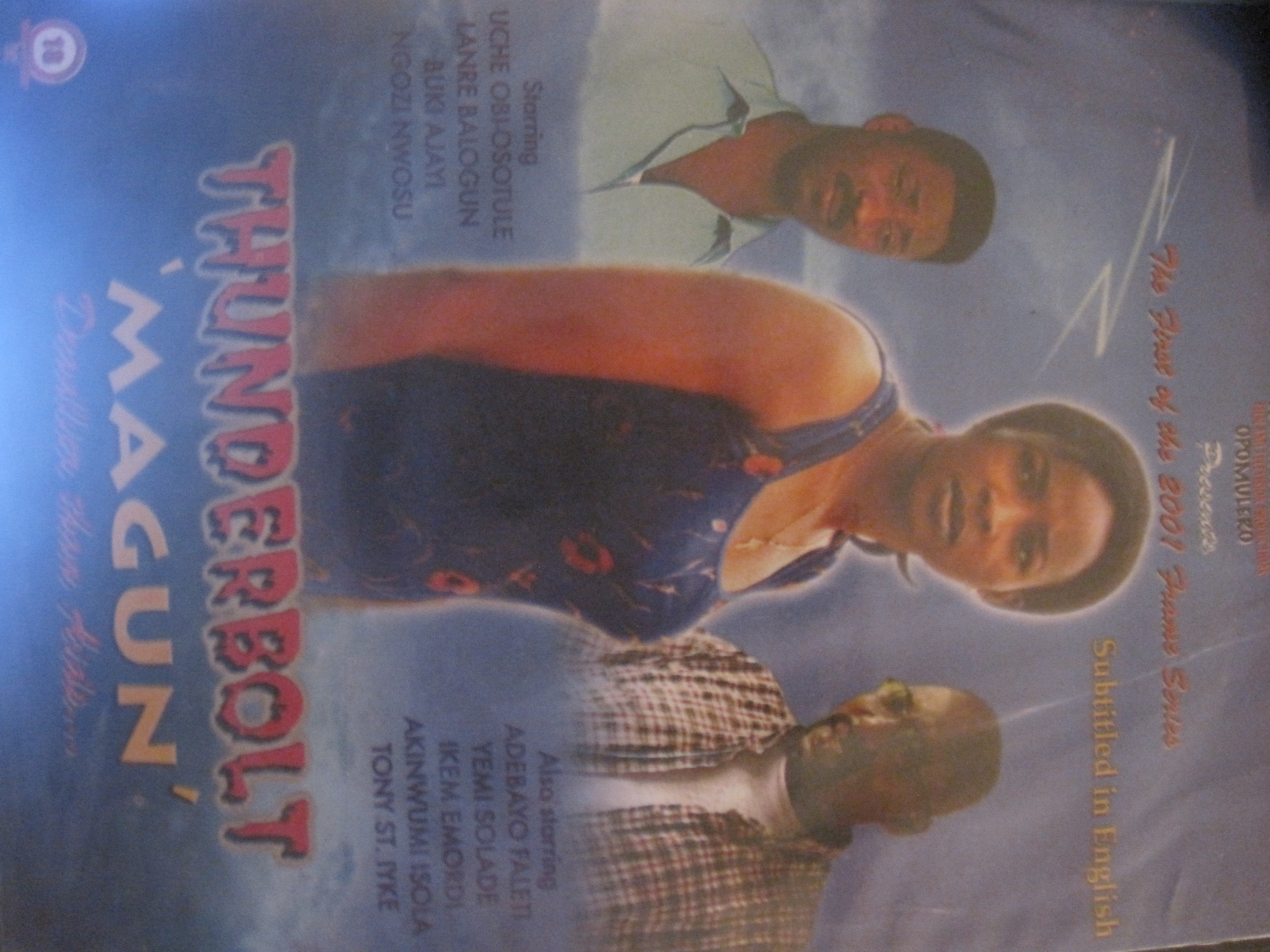
This is the subject of a class movie that we just saw to the end on Monday. The 2001 movie is titled THUNDERBOLT (Magun) and is an adaptation of a story by Yoruba writer Adebayo Faleti, and directed by multi award-winning director Tunde Kelani. Magun (literally meaning “don’t climb”) is an old and notorious myth in the Yoruba culture, and it has been credited for all the strange or spooky things that have happened to people engaged in illicit affairs. The scientific verification of the curse is impossible since no one has ever claimed responsibility for its activation, nor narrated experiences of its infection. The men concubines are supposed to die immediately afterwards, and the woman shamed. Thus so far, it exists purely at the level of myths, literature, movies and academic papers. The movie is instructive in the way it brings the western culture into a spectacular clash with the local traditional medicine, and superstition, and how the love triangle of death, intrigue and betrayal was resolved in the end.

We saw this movie last semester in class, and the students loved it. This semester, they did too, but there was at least one objection to the way adultery was portrayed as the solution to the death triangle. “I just don’t believe that it is right,” the student said, having walked out of the class at the last scene where a medical doctor who didn’t believe in “such crap” had volunteered himself as the guinea pig to test the veracity of the myth and thus get a chance to write an academic paper about its demystification. “It is a marriage for God’s sake,” she said, not really in these exact words “and marriage is a sacred institution. To allow such portrayal of adultery as a solution to something that is purely mythical is barbaric and ridiculous.” And for a moment, it seemed that the fiction on the screen had taken a life of its own out in the real world of the classroom. What she didn’t see in the last moments of the movie as she walked out in protest was how the guinea pig medical doctor who had put the myth to test had come face-to-face with immediate death thus adding veracity to the myth, at least for the benefit of the story. Much of the conflict in the movie however was about that clash of civilization and tradition, and the extent of human tolerance, love, respect and curiosity.

I had brought it along from Nigeria because it was one of the my favourite Nigerian Yoruba movies, because of its drama, and because of the way it explores a cultural myth and its interaction with a modernizing world. I recommend it for watching for everyone, and not just because one of my (now late) Professors was one of the main characters, but because it raises valid questions of what is to be done when one is suddenly confronted with the a life-threatening, time-bound discovery that the world is not all good and kind.

PS: Said student is the only married student in the class, which could make it easier – or not – to understand her objection. That said, I’m glad that the movie provoked such a discussion. Theatre/Fiction tends to do just that.

Jute Hair, Good Hair

My most-recent recollection of self-consciousness about my hair must have been less than three weeks ago, even if it had always been in my subconscious one way or the other long before then. I do like my hair, and I’ve never had any problems with it except when it becomes too much to carry around, and I have dealt with that by cutting it down at the right time, getting a good comb, or wearing a nice-fitting cap. But a friend had looked at my hair during a minor discussion about interracial marriage and said “Whooo! I’d never ever want my child to have your kind of hair. It’s looks like jute! I would cry if I had to look at something like this on my child’s head every morning. How will I live with myself?” It would have been funny if she was only joking, but in the expressions of her hair preference for an unborn child, I found a certain seriousness that has kept the relevance of the issue around my head (no pun intended) for a while.

So when I finally sat down on Saturday to watch Chris Rock’s comedy/documentary called Good Hair to the end, I was prepared for a journey of discovery, pleased that someone was taking a journalistic trip into the politics, the culture and the world of hair, and I was there to witness it with him. Chris Rock has been one of my favourite comedians and thinkers, and I had heard good things about the movie. But all through the theatre run of Good Hair in the theatre, it just never showed up in Edwardsville, so I have had to wait for the DVD. Now that I am finally through with it, I can tell you without a doubt that it is one of the best documentaries I’ve seen in a long while. Ever.

The documentary according to Rock was inspired by his three year old daughter’s question to him about whether her hair was “good hair”. The pursuit of the answer to the question took the comedian around the world from his base in the United States to India where young religious women in the country volunteer to have their heads shaven in temples every time, to Los Angeles and Atlanta in the United States where said hair are eventually used as beauty enhancements after having been sold by the priests in whose temples the hairs were acquired, to the dealer who would later process them into a presentable and usable form. Apparently, as the movie shows, India is the biggest source of hair weaves and attachments to the developed world, especially black women. What Chris Rock very vividly portrays is not just a kind of displeasure of (black) women with their own hair types for a foreign one, but also their sometimes unexplainable nonchalance as to the implication of economic enslavement that comes with it. I grew up in a household of so many women so the idea of weaves is not strange to me, yet over the years of interaction with women either as family, friends, lovers or just plain acquaintances, I still haven’t got myself around the motivations that must fuel such an addiction to straightening, weaves, and a different kind of look than permitted by the hair’s natural characteristics.

So in putting the movie/documentary together, Chris Rock interviewed the Reverend Al Sharpton, the civil rights activist and a former James Brown fan whose physical identity is defined by his straightened all-back hairstyle; the poet and writer Maya Angelou who revealed to much surprise that she never used the “relaxer” until she was seventy years old; Nia Long, a hollywood actor with a fondness for weaves; Ice-T, who once confessed to have had a mug shot while wearing one of the hair rollers used after a relaxer; Eve, Salt N Pepa, and very many others ordinary Americans as regards their motivations, drawbacks and challenges of wearing weaves, as well as their dos and don’ts.

Dos:

(I can’t remember)

Don’ts:

Never touch a black woman’s hair (except you’re friends)

Never touch your girlfriend’s hair. (What? Yes, you heard right. Don’t do it, even while in bed together. Alright! I’d never heard this one before.)

(For women) Never immerse your hair in water, not even in the pool…

Don’t ask a (black) woman whether her hair is real or fake.

among many others.

The movie has however been criticized for failing to provide answers to the question of motivation of the women who go through extreme pain to look “good” with Sodium Hydroxide relaxers or imported Indian hair obtained mostly by some kind of exploitation, or whether the percentage of African and African-American women who prefer straightened or weaved hair fall into a majority. In my opinion, it wasn’t really the comedian’s place to provide such answers. From it’s very nature, the movie/documentary was made to be eye-opening through questions and queries rather than through answers through the actor’s mouth. And this format worked very well to take the viewer into the very many dimensions of the politics of hair.

From the despair in my Indian friend’s mind about the possibility of ever having a child with “jute” African hair, to the not favourable (or at least understandably condescending) perception that educated Indians must now have of Hollywood stars and ordinary African folks from all over the world who spend a fortune every year to acquire their kind of human hair, to the criminality of such religion that must brainwash young women to give up their hair for free as sacrifice to God while such is immediately sold for huge sums of money to the highest bidder, to the very many dynamics that makes the business of hair a multi-billion dollar industry in the world (with the black community occupying only on the paying – and not the earning – side), and the finickiness of all my female friends about how their hair looks whenever I whip out my camera for a quick shot, I have definitely found a renewed interest – thanks to Good Hair – in the phenomenon of women’s hair, and the cultural/economic/political dimensions of their shade, colour, length and style. And I’m not always pleased.

What I should add here is that the movie/documentary is VERY hilarious. What else would you expect from Chris Rock? Every family should watch it. Find the trailer here.