Browsing the archives for the Opinion category.

Another Kind of Poverty Gap: The Erosion of Language Diversity

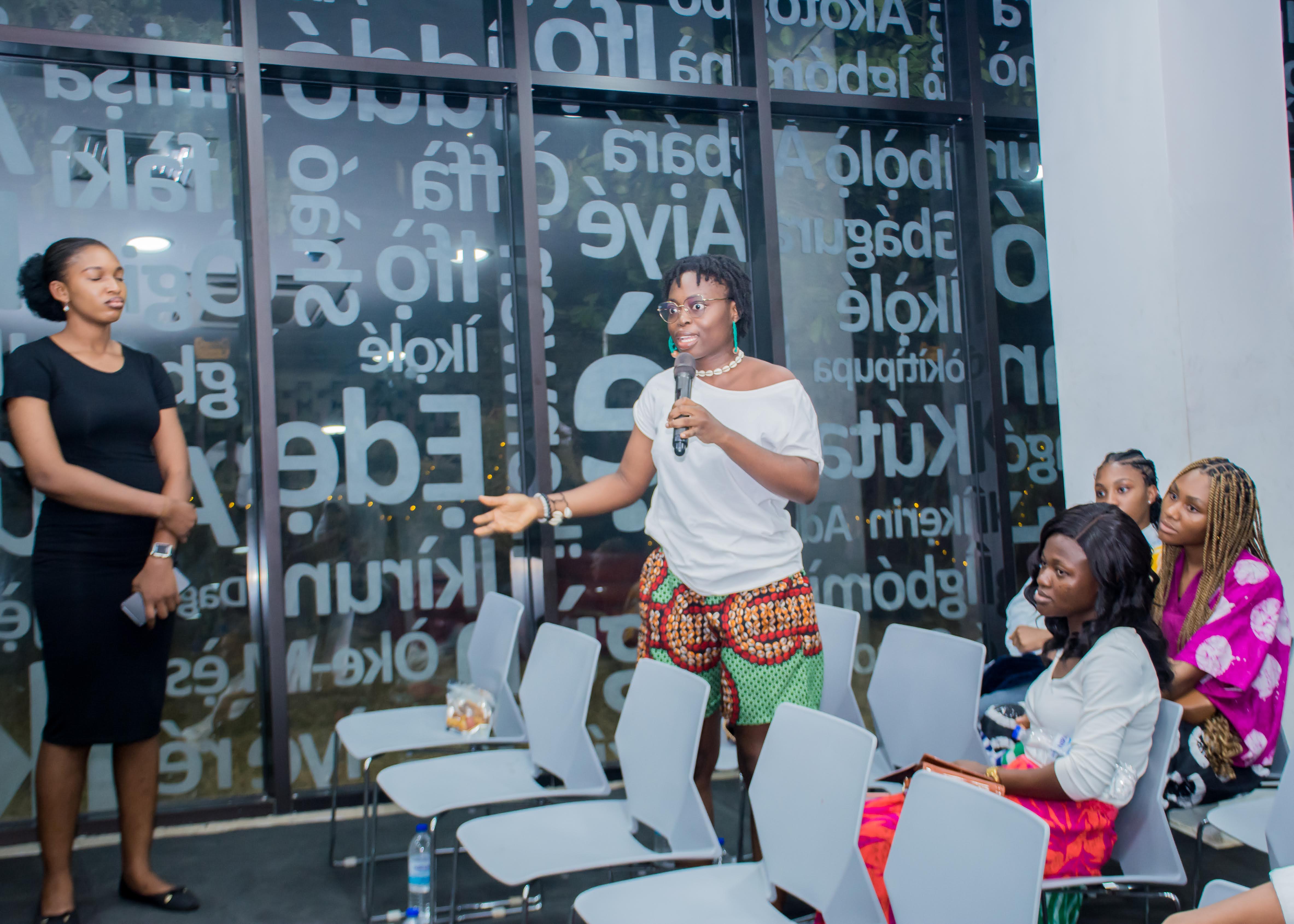
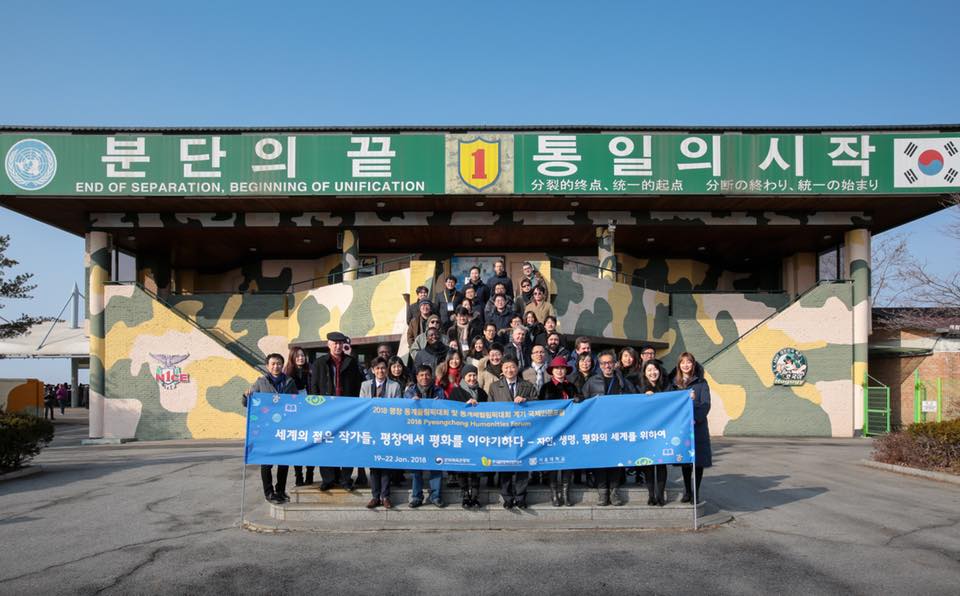
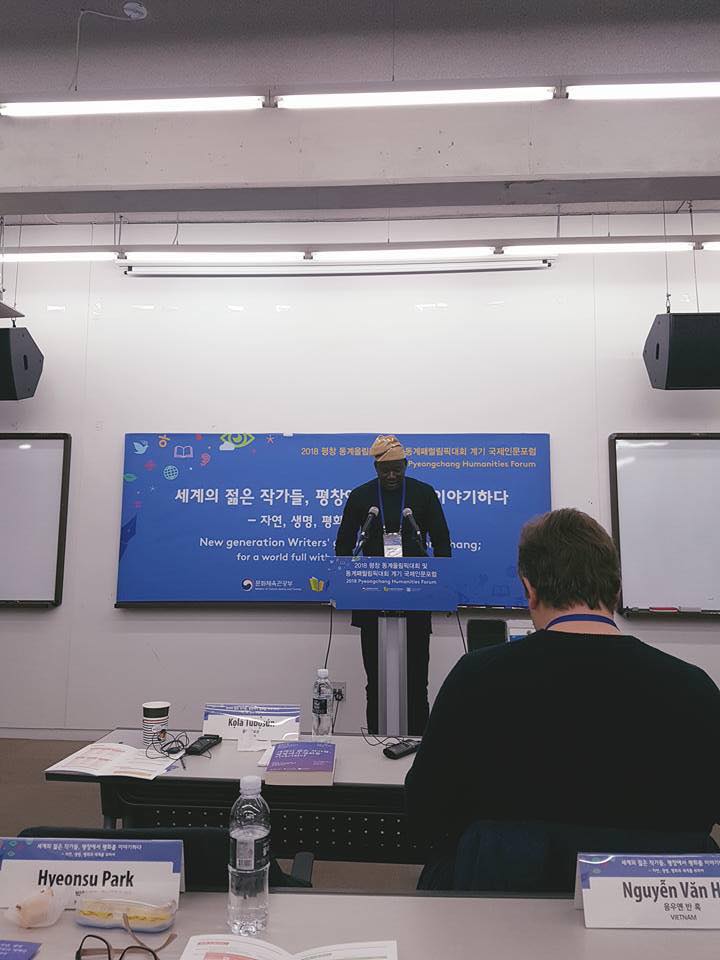
(Being a paper delivered at the PyeonChang Humanities Forum at the Seoul National University Seoul, South Korea, on January 20, 2018 by Kọ́lá Túbọ̀ṣún. The audio recording of the talk can be found here)


Ẹ káàrọ̀ o. Good morning. Annyeonghaseyo.

First of all, let me express my profound appreciation to the organisers of this event for choosing me out of many to be here, among all these important people from around the world, to give you my own perspective on an important discussion. These are precarious times. And to be here in this place at this time to give a talk on a topic that is dear to my heart, is an honour. So, thank you. As we say in my language, adúpẹ́. I bring you greetings from West Africa.

I am here to speak about poverty. But before you assume that I am going in a predictable direction you have been familiar with from watching cable news from your different parts of the world about Africa, let me advise that you set a different expectation. My talk is about a different kind of poverty, one caused by exclusion, and one relating to one particular type of exclusion: language.

I come from Nigeria, a country of about 170 million people with over five hundred different languages and cultures. It is a place that offers as diverse a landscape in terms of both viewpoint and attitude to life. On the one hand, binaries can be found: The north is mostly conservative while the south is mostly liberal. The north is mostly arid and desert while the south is mostly rainforest and humid. On the other, we have an assemblage of cultures and languages which range from mildly intelligible dialects to distinct languages with no discernable cognate, even when they live around each other. This has made my country, Nigeria, a country created from a British colonial experiment, a very interesting place. From what I have read, this is not the same as what obtains here on the Korean peninsula, where Korean is generally described as a “language isolate”, with no discernable genetic or genealogical link with any neighbouring tongues.

Human migration and mandatory inter-mingling of tribes ensured that we are all exposed, in some way or the other, to characteristics of each other’s culture. Through warfare, conquests, and other forms of domination, a number of us have also become subservient, linguistically, to some larger languages around the country, such that, before the British came to colonize the whole swathe that makes up the country Nigeria, a certain linguistic mosaic had emerged. A mosaic, because it was not just one language which every others must speak, but several big languages, and several small ones, each occupying a particular space in the society, fulfilling particular roles in facilitating contact.

I bring up the linguistic character of my hometown to create an image in your minds of both diversity and richness. Even many decades after the colonial processes that were set in place to create a homogenous society out of colourful and diverse peoples, the mosaic is still evident, though not in as bold a colour as was many years ago. The changes started with colonialism, and the prevailing mindsets of the invading strangers from Europe and newly “educated” Africans that our languages could be discarded without consequences. It was a gradual change, reinforced with every government policy, every textbook recommendation, every change in the educational syllabus, and every recommended dress code in government offices. Today, we are a people whose worldview is being conditioned and defined by competence in a new language, English, to the exclusion of our own.

Let me address an important irony: that which concerns the fact that I am presenting this talk in English and not in my own language. I have, after all, advocated that Nigeria’s president use his own language (Hausa/Fulfde) whenever he is out of the country. If I were the president of Nigeria in this instance, Yorùbá nìkan ni mo máa sọ. Aá fi sílẹ̀ fún àwọn ògbifọ̀ láti ṣàlàyé (I’ll be speaking only in Yorùbá, leaving it to the translators to explain). This is a suggestion borne out of my belief that the head of state represents the country and its multilingualism. His or her decision to speak the nation’s language outside shows a pride in the language and provides jobs for translators living in that foreign country while portraying a complexity of that country’s cultural landscape.

The irony comes because the purpose of my talk here is to advocate for a return to the local language use and support, and to explain why I believe that the poverty of imagination is equally as tragic as a poverty of the stomach. You, my hosts in Korea, don’t seem to have this dilemma. Your language is one (unless we discuss the widening gap that is happening between the version spoken here in the South, and that one spoken in the North). You don’t have too many dialects of the language, and citizens of this country do not have hundreds more competing for attention. But you are also lucky in another way. Even though English is spoken here as a second language, Korean still holds an important place as a vessel for the culture of the people. You can think in the language. You can conduct all your daily activities in it. It has a distinct writing style, and children are taught how to use it. And big technological giants care enough about it, and your buying power, that they carry it along with every new tool they create.

This is not the same for the languages in my country.

The problem, like I mentioned earlier originated in the over-simplistic tools we chose for dealing with diversity, and in colonialism. But it has also been carried along by an attitude of the population that rather than assert individual identity or spend valuable time developing each language through use in literature and other means of transmission, we might as well surrender and adopt English as the only “uniting” language. Don’t ask me how successful that drive for unity is. But the result is a gradual attrition of local languages. As at the last count, about twenty-seven languages in the country are either vulnerable, critically endangered, or severely endangered. It doesn’t look like the situation will improve anytime soon because unlike what obtained in the country a couple of decades ago, we no longer teach local languages in schools. The new students we produce from schools each year will only claim English as their first language. This doesn’t mean that they will be accepted abroad as first language speakers since the term “native speaker” is imbued with more than mere language competence, but with both political and cultural characteristics. I’ve spoken about this in other forums. This leaves us, Nigerians, and many other post-colonial outposts around the continent, at a terrible psychological, social, economic, and even political disadvantage.

A more noticeable example of this kind of poverty comes with technology, which is my current focus as a writer and linguist. In some ways, it will be proper to look at the progress of today’s modern inventions through the lens of colonialism, carried into every part of the world on the back of convenience. From my part of the world, where we consume technology much more than we create it, a pattern has emerged. The new technological tools created to make life better for us are monolingual in nature. For an environment where thousands of languages are spoken, this is grossly deficient. And there’s no poverty as great as one that prevents a person from interrogating life in the language with which they are intimately familiar.

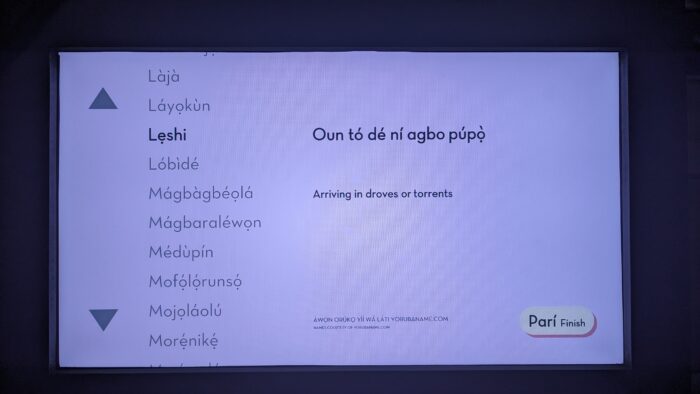
When I was in the university between 2000 and 2005, I used to wonder why Microsoft Word underlined my name with a red wriggly line whenever I typed it. But the answer was simple: Microsoft simply didn’t recognize a Yorùbá name. As long as the name wasn’t an English name, the red wriggly line showed you that something was wrong. So when I wrote my long essay, I did it on a project called a Multimedia Dictionary of Yorùbá Names. It was my way of introducing Yorùbá names to technology. Ten years later, I expanded the project to a fully functional and crowdsourced multimedia dictionary to which people can add new names, and improve current ones. And I did this not just for Yorùbá this time, but under the umbrella of what we called the African Language Project, we want to document all African languages and other intangible cultural materials like names, customs, norms, and words. As at this moment, there is no multimedia dictionary of Yorùbá on the internet. None that Africans can access on their phones at a moment’s notice. We are trying to create one. If more Africans who do not speak English at all, or as a first language, cannot interact with technology in their own language, then they are being left behind in the progress of technology. And that’s a powerful kind of poverty.

Around Nigeria today, there is barely any ATM machines that one can use in a local language. This means that people who only speak a local language will not put their money in banks, since the process of getting it out is onerous. Because of this, they are excluded from the big economy and thus remain poor. In a part of Northern Nigeria, poor farmers who need to work with modern implements have to first learn English before they can understand how to read the manuals. I know a couple of my friends who are working on artificial intelligence applications that can help these farmers communicate in Hausa and get access to all they need in a language they speak. But these efforts are far in-between. There’s a lot of work to be done, not just with widening the access that technology provides, but also in reading and producing literature, in engaging with participating in and discerning the details of our politics, and engaging with our everyday life. Like we say in Yorùbá, ọwọ́ ara ẹni la fi ń tún ìwà ara ẹni ṣe (“we have to use our own hands to fix our own issues”).

There are different kinds of poverty, all of them damaging to the dignity of man. A deprivation of language is one that is more pernicious than the rest because it deprives not just the body, but also the mind. The world is a colourful and delightful place to be in because of the multiplicity of languages and culture. I do not want to live in a world where only ONE language is spoken. That is a world that has lost its storehouses of wealth. We are all richer by the experiences we share from participating in each other’s cultures, language, worldview, and way of life. By working hard, and fighting hard in my own part of the world, to make sure that the movement of technology does not leave us behind in our own languages, we attack poverty, and build a new and exciting future that better reflects the mosaic; the colours, and the realities of the African – and our global – existence.

Thank you for listening. Kamsa hamida.

The Suspended Leg of the Tripod of Identity: Yorùbá Around the World Today

By Kọ́lá Túbọ̀sún

.

“Il suono di pan” (2017)

.

I am Yorùbá by birth and by blood, a privilege that has sat me in good stead, professionally and personally, through a wide network of associations, resources, legacies and traditions. From great award-winning novels (many in translation) to great art works curated in museums all over the world, there are many valuable responses that attend my questing glances around the world for validation and direction. In today’s world, to be Yorùbá is to embody all that is complex and dynamic in a culture and civilization that predates even the birth of Christ.

But due to centuries of colonial contact, my identity today is a complex one. I say complex, because saying “incomplete” would carry too much of a burden of judgment. My identity is complex because were we to return to early Yorùbá societies of 4th Century BC in Ifẹ̀, what I am would embody not just the language I speak, my racial composition, the clothes I wear, the scarifications on my face and my role in society, but also my religion, yet untouched by the crusading powers of Christianity that would come centuries later. 

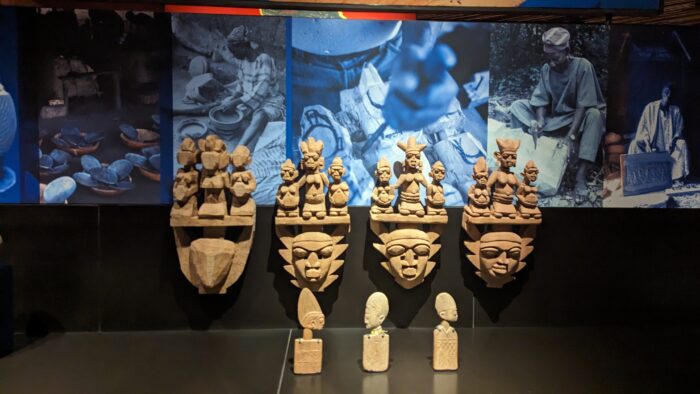
In that 4th Century BC in Ifẹ̀, I would either be a citizen, with roles and responsibilities, or a member of the priesthood – which isn’t the same as the Christian one, but which carries similar significance to the proper ordering of society, or a royal. An important group of citizens, a hybrid between genuine plebeians and important religious personas, are the sculptors. The working class men — it was a more gendered time — whose role was to continue the tradition of preserving and interpreting the culture through the moulding of bronze heads. (A similar tradition would take root decades later in Benin — 270km SE of Ifẹ̀ — with more bronze heads of different shapes and styles moulded in the same lost-wax tradition not before conceived in the capitals of Europe). 

Because of the hard work of thorough artistry sustained through both civic and religious significance by the practitioners of those times, a record of who the Yorùbá were, what they did, and how long they have been around, was set. This would be helpful in 1938 when Leo Frobenius and his crew came across them at the Wunmonije Compound in Ifẹ̀, buried deep into the soil. So stunned were the European archeologists at the sophistication of the art works (they “compared them to the highest achievements of ancient Roman or Greek art” – source: Wikipedia) that they began to doubt that they could have been created by Africans. They must have been imported from Greece or Rome, they suggested, full of hubris.

In today’s Yorùbáland, I am still a citizen with roles and responsibilities. But I have embodied a new role, that of a citizen of a larger entity called Nigeria, brought into being in 1914 through colonial force, and before that by other forces of globalization, including the transatlantic slave trade and Christianity. (I’ll speak more on that in a second). The internet is a latter-day version of that movement, arriving in time to complete the cycle of connecting what is an individual culture and worldview to a supposedly larger one. In submitting myself to the forces of this expansion of our social and religious space, I also surrender to a new way of thinking. Christianity, in the intervening period, has taken over the world, through the invading forces of colonialism and slave trade. Our religious and cultural autonomy was destroyed and replaced with what is said to be superior and benign.

A friend of mine once visited Brazil and met with a number of caucasian residents of Bahia. In approaching him, because of his mode of dressing, they were curious about his origin. When he told them that he was Yorùbá, they were very excited, and they told him that they, too, were Yorùbá. Never before been exposed to this kind of unfamiliar acculturation, he became disoriented. How, his face wondered, could people of this skin tone and racial make-up be Yorùbá? Then, after recovering himself in a few seconds, he began to speak to them in the language. And to his consternation, they could neither speak nor respond. “But you said you were Yorùbá” he wondered. “Yes,” they responded. “We belong to the Yorùbá religion. We do not speak the language!” That cleared it up, and he learnt something new. Belonging to a religion is not always the same as belonging to the culture.

The Yorùbá religion, consisting of hundreds of Òrìṣà in a dynamic network, centers around Olódùmarè as the supreme being. And through Ifá divination, and its founding father of wisdom—Ọ̀rúnmìlà—the will of the divine one is made known to the people. Ifá as a symbol of divination has been the bedrock of Yorùbá belief system since its recorded history. Along with a corpus of stories, admonitions, aphorisms, songs and chants, that body of knowledge is one through which Ifá priests and priestesses predict the future and understand the past, and one with which the inidividual Yorùbá citizen understands his/her place in the cosmos. So when, in the 16th century, the transatlantic slave trade began, and citizens from inside Yorùbá country were stolen and sold off into the new world, the only valuable resource not capable of being destroyed by the invading slavers and their accomplices across the ocean was the knowledge of these old systems of religious knowledge. Though their bodies were broken down by hard labour, dehumanization, mutilation, separation and other forms of indignity, they held onto these songs and religious rituals and passed them to their children, sometimes in secret.

It is unclear why the religion did not survive in a stronger form in the United States as it did south of the Rio Grande. But we know that in Latin America, particularly in Brazil, Cuba, Trinidad, and Jamaica, variations of the indigenous African religious practices, particularly from the Yorùbá country survived, sometimes in isolation but mostly in syncretism and other forms of mutation, so that today, there are racially and culturally different people who are nevertheless religiously Yorùbá. Their worldview may be Western, as is their racial composition and language, but their soul and heart are Yorùbá, or aspires to be. This is in a sharp contrast with the homeland where many Yorùbá citizens today are Christian or Moslem (converted through a later trans-Saharan slave trade that came through the north), but Yorùbá only in cultural and linguistic heritage, that is, possessing everything but the third leg of the tripod of identity.

It is tempting, then, to assume that the spiritual identity of the Yorùbá has undergone a weakening since the dawn of European civilization. This would have been true only without the knowledge of the depth of hold that the religion has had around the new world, and among those at home who have retained the independent cultural, spiritual, and mental identity away from what the imported religions recommended. In any case, the “suspension” of this leg in Nigeria and much of Africa, deplorable as it is, has only deepened the support for the religion among those to whom that is all that is left after centuries of plundering. And so there is the silver lining. Over the last couple of decades, practitioners of Lukumi (a religious variation of the Yorùbá Òrìṣà religion, which uses Ifá as its divinatory centre, and modified Yorùbá incantations and songs for liturgy) have made pilgrimages to Nigeria and connected the relevant dots of their religious ancestry. And through a fertile continuation of that relationship, the practice of Ifá and Òrìṣà worship has resumed around the country. A number have also started taking to learning the Yorùbá language as well, as something to add to what they already have in Spanish, Portuguese, and English. And while the Yorùbá in the home country have also shown a lukewarm attitude to the language, the diaspora comes in to save it through a warm embrace.

In 2008, Ifá became classified as an “Intangible Cultural Heritage” by UNESCO. There is a sort of delightful ending in the fact that Ifá had to travel all the way across the world in a slave ship before returning home to rescue its people at home. But maybe that was necessary, especially in its now inevitable expansion across all hitherto forbidden spaces. 

_________

(first published, in a slightly different version, in English and Italian; in Il Suono di Pan, an anthology edited by Prof. MM Tosolini and launched at Cividale del Friuli, near Udine in Italy. November 2017)

_________

For Further reading

On “Songs of Myself” by Tanure Ojaide

Songs of Myself (KraftGriots, 2016) is a collection of poems by Tanure Ojaide. It is the most personal of the three on the shortlist of this year’s Nigeria Prize, the most introspective, and also the one most (even if inadvertently) expressive of the melancholic aspiration I had prematurely expected from Ogaga Ifowodo’s A Good Mourning because of its ominous title.

Ojaide has published poetry since 1973 and has published twenty collections of poems many of which have won prizes, local and international, like the Commonwealth Poetry Prize (1987), All Africa Okigbo Poetry Prize (1988, 1997), the BBC Arts and Poetry Award (1988), and poetry awards of the Association of Nigerian Authors (1988, 1994, 2003, 2011).  The new work is approachable and deceptively simple, like thin ice over a frozen lake. More on this style later.

The title of the book invites us to approach the collection as work about the author to varying degrees: songs of myself. But in the foreword (which I had personally considered superfluous in a poetry collection, except in a notable instance like in The Heresiad, an exception which I’ll explain in my review of the book), the author explains his approach as incorporating “some of…aspects of oral poetic genre”, particularly of the great Udje poets of Urhoboland, which “deals with self-examination and the minstrel’s alter-ego” in the work as a way of attempting to know oneself with “self-mockery that justifies mocking others.”

This intention changes how I eventually approach the work, not as Ojaide himself recounting his thoughts and opinion on a number of relevant political and social issues alone, but as the voice of an invented poet-persona using a traditional poetic form to interrogate himself and thus the society. The Udje, as he explained it to me in our YouTube interview, are traditional Urhobo griot-poets who work carry social and political significance, and are present as conduits for commentary on the public condition.

So what is this condition? In the book, it is both personal and societal. The poet is both an old man (Gently; page 14) and a young adult (We Have Grown: 155). He’s both the country (Self-Defense; 91) and an individual (On My Birthday; 26). He is a happy observer of the passing of time (For The Muse of Peace) as a cynical record keeper of slights and injuries (Masika; 47). He’s a parent (They Say My Child is Ugly Like a Goat; 107), and a son (Family Counselor; 85); a hopeful lover (Secret Love 147) and a self-critical poet (Wayo Man; 87). The issues addressed are as disparate as they are familiar. Nigeria, the country and the government, is an ever-present villain in most, as are other social issues which the author addresses with sardonic candour.

If I were to ask my people

what they wanted the most,

they would definitely choose money over every other thing,

iincluding good health and peace

that I know there’s a dearth of

because of oil and gas everywhere

that by right should bring us wealth.

(Page 132)

From afar, especially with a misconstrued intention of the writer’s narrative angle, most of the poems appear conditioned into a tried-and-tested style of political and social protest poetry through this staid and resigned voice. But on close contact, especially against the background of its traditional dimension of style, they reveal themselves as both original and intentional, carrying an unflappable tone couched in the simplicity of cynicism. Who is a poet – I ask myself a few times – and what makes a good poem or poetry collection? Is it a successful deployment of inventive gymnastics of modern conventions that appeal to sophisticated palates, or is it an honest recounting of home-grown truths directed at a selected audience even if in a least colourful, or less popularly accessible voice?

So many questions I can’t answer.


After all the birds fall silent in the delta,

how can there be Rex Lawson

with the polyrhythm of weaverbird, sunbird,

carpenter-bird, solos and ensembles?

(page 134)

The question is important in judging the language choice that Ojaide deploys in this work which many times doesn’t read as elevated as one typically expects of offerings of this kind of ambition. Against the background of his stated intention, however, possibilities can be suggested of this character of theirs being defined both by the limitation of translating the cultural and linguistic cadence of Urhobo poetry into English and, less charitably, the author’s helplessness in the face of this challenge. The answer will be resolved by the judges of the Nigeria Prize in a couple of weeks.

When I asked him about his use of language and the idea that the use of English as a conduit for African poetic traditions can be a limiting factor at best and a catalyst for the extinction of those languages, he was less acquiescent. “You must know that there are many Englishes,” he said, to which I say yes, as long as each different variant is able to successfully carry to fruition the stated intentions behind its use, and reach new audiences. In this case, I am not as sold as I should have been, not about the homage to traditional oral poetry, which other authors (and perhaps this one in previous works) have done to great success; but about its seamless and effective deployment. Maybe I have been spoilt.

In many of the poems, the writer includes footnotes, like in the first poem on page 15 where he explains that Dede-e dede-e is an “onomatopoeic expression of ‘gently’ in the Urhobo language.” Of this incursion, there are strong arguments to be made, especially in this work, for doing away with them totally. Footnotes are often distracting, and – to return to contemporary arguments about the audience of our literature – needless. Those who value the work enough to engage with it will do the work needed to unlock much of its secrets. The counter-argument, of course, is that a reader like me who is approaching the work on short notice for the purpose of a review would not have figured out that Aridon is a “god of memory and song/poetry among the Urhobo people” (page 17). That same argument, though, fails in the face of less justifiable ones like “NDDC” on page 133, or “ICU”  on page 24. If I did not know that ICU meant “Intensive Care Unit” either from the context of the work, or from having lived in modern society, then the writer hasn’t done his work or I need to return to school.

These kinds of conflicts show up in other places too, springing up the question of who exactly is the poet’s audience in this case. Since his last five books, Ojaide has started publishing his work first in Nigeria before re-issuing them with foreign publishers, a reversal he said was conditioned by his renewed sensitivity to his role as a poet primarily addressing an African (nay, Nigerian) audience. The justification for this almost “reclusive accessibility” of his literary voice will depend on those to whom the work is addressed or the successful domestication of the reader’s mind to the traditions from which the experiment emerged. It could be that the author isn’t “speaking English” at all, but Urhobo, just barely accessible to us through a shared common lexicon.

They mock me because of my child

whom they say is ugly like a goat.


Don’t mind them who see nothing good.

My pickin fine pass goat.


Where are the mockers when my child

fetches water and runs errads for me?

(page 107)


There are about 91 poems in this collection, making it the bulkiest of the three on the shortlist. In four different sections, the poet bares himself to the world like a local minstrel, under different guises and situations, in an outlook that is mostly dark, self-critical and confrontational in equal parts. The subject matter, a look at the world through a personal self-reflection, is certainly an important addition to current social and political conversations. The language is simple, accessible, and direct. It is a collection that anyone can pick up and enjoy. The prolific nature of the writer’s career and the breadth of this work’s take on Nigeria and Africa’s social and political issues makes it an important presence in the shortlist. And even if I will quibble with the inclusion of some of the poems there for not being strong enough to represent such an accomplished poet on such an important list, I’ll still rate Songs of Myself as an important peek into Ojaide’s poetics, experimentation, and voice. The potential for impact of this type of language and style direction, however, will be subject to practical, and more verifiable, manifestation.

_____

My interview with Tanure Ojaide can be found here. Find a link to the previous reviews here.

“I Wrote This For You”: Mapping Triumph in the Midst of Pain

Samira Sanusi’s new poetry collection is a map of pain. Line after line, in her book I Wrote This For You (WRR/Authorpedia; 2017), the author traces a tough path through difficult memories like a hot iron through wax. It appears like an uncomfortable experience at first, one with a rebound of traumatic recollection. But what emerges, for sure, is triumph. Survival.

I first met Sanusi in Kaduna at the maiden edition of the Kaduna Book and Arts Festival (KABAFEST) where she was a guest on a panel discussing the issue of sickle cell anemia (full panel video here).  She had written a book called S is for Survivor detailing the path of her healing from a sufferer and victim to a survivor and warrior. After many years of suffering through medical trials, twenty-eight surgeries, and other travails, she was finally healed when a bone marrow transplant turned her blood from a sickle cell blood to AA. She is now the President of the Samira Sanusi Sickle Cell Foundation (SSSCF), an Abuja based NGO.

Until then, I’d never heard of the idea of a blood transplant changing one’s genotype. But I haven’t followed the advances in medical science in this regard. So the revelation, as well as the heartbreaking tale of her survival, was both thrilling and heartwarming. I wanted to read her book. In this collection, Samira opens up in the best way she knows how: in words, mostly written to self, documenting the painful process of this journey to survival and all the attendant doubts, setbacks, despair, joy, and hope.

I finished reading this book a couple of weeks ago but I didn’t have the time to put down my thoughts about it, many of which I wrote down in a notebook I’ve now had to dig out from under a pile of other books. Here, a few of my favourite and memorable lines.

“That you have seen worse, doesn’t

mean the hell I’m seeing is a second-hand fire.

My worse is valid, even

when your bad is worse than mine.”

This came at the beginning of the book which – to my embarrassment – I’d initially assumed to be another prose work from the author. Nothing on the cover prepared the reader for poetry, so the words that came at me from the opening pages seemed, at first, like the preface to something else until they led one into each other throughout the book. It would appear that she had been documenting her thoughts and feelings about her pain and process throughout her encounter with the sickle cell trauma.

“Keep your truth away from me.

You don’t know what lies I have to tell myself

to sleep at night.”

But don’t expect a clean arrangement either. The words flow into each other sometimes like aphorisms, separated by asterisks or other special characters. At other times, they appear as chapters carefully grouped together in a specified theme. But there were no chapters. Only verses. We walk through the lines as though experiencing the process and pain of the writer’s lived experiences.

Who she was addressing wasn’t always obvious, but that was never a prerequisite to understanding or enjoying what was offered in the most private of words. In baring herself this way, the author invites us to see her not as a perfect survivor but one who had only persistently endured, with her head held up high, but with a few notable scars to show.

“She was so beautiful, the way

She kept people from falling into

Pieces as she broke apart.”

In the book are several themes which sometimes morph into each other, even in contrast. There is self-loving sometimes with self-loathing. There is gratitude as much as bewilderment, there is surrender and sometimes defiance.

“If you ask me about my dreams,

I would tell you to watch me,

for I am living them.”

Sometimes, she talks to herself, either in pity or in a berating tone.

“Looking into your eyes

I can tell you went to war

And did not come back with yourself.”

And sometimes with a challenge:

“You must come back to yourself

to find you waiting on the couch,

hoping to kiss and make up. Begging

for another chance at self-love.”

In other matters, she hints at love, lust, rejection, and romance:

“The first time he touched me

I yelled ‘Don’t hold my hand and don’t touch my heart!’

He asked, ‘Who happened to you?’

‘Your access pass to come in and save me so they can call you

Hero is rejected!”

Feminism? It sure seems so. Yet a certain religious conservatism also present underneath the soft and vulnerable persona the author presents in this book seems to sometimes intrude to confuse us as to whether the narrator is a helpless character in a patriarchal space or a defiant voice against it. Evidence of both can sometimes be found.

“Whose idea was it to look

at a boy’s eyes, filled with tears

and tell them men don’t cry?”

And on another…

“Dear Arewa woman
You’re not just somebody with a body
You’re body, mind, heart and soul
They’re all yours to share, as you please.”

I enjoyed reading the work in all its rollercoaster of emotions, aspirations, reflections, and ruminations.

Parts of the book do sometimes let go of its aspirations to poetry and spread out in plain prose, towards the end. But even in them are relevant nuggets of inspiration directed at an imagined audience of readers, and sometimes at the writer herself. The result is a book that both defies categorization as much as it defines it, expanding the possibilities for artistic self-reflection. I have not read many books of poetry from Northern Nigeria. But if Samira’s offering is any indication of what to expect when vulnerability and a questing mind meet at the junction of a page of poetry, then we are in for a good time.

The irony of enjoying work written in pain isn’t lost on the reader of course. But the writer never intended it as an invitation to pity. Rather, it is a celebration of triumph, survival. Each verse in the collection, whether intended to please, to stimulate, or to instruct, comes across in a form that also delights in soluble bites. I look forward to reading more from this author, this warrior, in whose survival we have also come to discover beauty, grace, and strength.

“Like Listening To An Aunt” | Sefi Atta’s Tribute to Buchi Emecheta

The first time I met Buchi Emecheta in person was in 2005, just after my debut novel Everything Good Will Come was published. I had contacted her through an old college mate, Kadija George, to ask for an endorsement, which she very kindly agreed to give. To paraphrase her endorsement, she wrote that reading my novel was like listening to an old friend talk about Lagos.

That was the same year she was awarded an OBE for her contribution to literature, and Kadija organised a celebratory dinner at a Caribbean restaurant in North London, to which I was invited. At the restaurant, she signed a copy of her book Head Above Water for me, with a message: “To Sefi, good luck with your publication, love from Auntie Buchi”. I read an excerpt from the book at today’s memorial event, not just because it’s autographed, but because it’s a testimony of what it means to be a writing mother, and because it’s good storytelling: entertaining and informative, guileless and revealing, intimate, and rendered in the meandering fashion of Igbo oral history, which, by the way, bears some resemblance to that of the American South, where I’m based most of the year.

Anyway, that evening at the restaurant, I found Buchi Emecheta pensive. I imagined she was aware of her achievements and was proud of them: all the novels, plays and children’s books she’d written, the family she had raised, and the obstacles she’d had to overcome. People often mention the burning of her first manuscript, but the daily grind of being a mother to young children, while getting a university degree and writing, was hard enough.

I know this. I have one child, a daughter, much beloved, but I didn’t think I would be capable of giving her the attention she deserved if I had more. I was thirty-three when I started writing full time and she was three. I was working on Everything Good Will Come and had more stories to tell. I wanted to go back to school to get a Master of Fine Arts in creative writing. My husband, Gbóyèga Ransome-Kútì, a doctor, got a job in Mississippi, of all places, and we had just moved there. Before the move, I had worked as a Chartered Accountant and Certified Public Accountant. Following the move, I was not legally allowed to work in the United States until I had found an employer to sponsor my work visa. I was in two minds about living in Mississippi but Gbóyèga quite liked his job. He was supportive of my writing, to the extent that he would cook while I wrote, and thankfully, on the issue of children, we were both on the same page.

Buchi Emecheta often said she saw her books as children. I don’t look at mine that way. My daughter is my child, and my books are my work, though the time I spent writing them did take away from time I could have spent with her. She is graduating from college this year, after a four-year degree. At twenty-two, she is the same age Buchi Emecheta was when she had five children and was studying sociology at London University, and writing. So, to me, Buchi Emecheta was a child bride, child mother and child divorcee, who would later become a renowned writer published in journals such as Granta and the New Statesman, with television scripts produced by the BBC and Granada. And even though one of my first interviews in Nigeria, as a published writer, was titled “Sefi Atta following in the footsteps of Buchi Emecheta”, or something to that effect, my path has been quite different from hers. However, like most Nigerian women writers, we’ve had similar preoccupations with girlhood, womanhood and motherhood, with marriage and religion. For some of us, I would add the death of relatives and the state of being African overseas.

When Buchi Emecheta writes about missing her late father, so I have missed mine. When she writes about her children walking around in wet nappies, I admit, I was sometimes too busy writing to notice my daughter’s diapers needed to be changed. When she writes about racist or xenophobic employers and colleagues in London, I remember my experiences as an accountant in London and New York. She recounts details of difficult relationships with editors and agents; I can recall one or two. She takes a swipe at Enoch Powell; I immediately think of Trump.

What I find most interesting about her works are the paradoxes – of forging ahead from one generation to the next, yet returning to old positions; of her ability to be naïve and insightful at the same time. And judging from her autobiography, what sets her apart from most Nigerian women writers of her time, and mine, is that she was incredibly resourceful, industrious and tenacious. For a self-described small woman, Buchi Emecheta had enormous strength. She could also be stubborn. In Head Above Water, she tells us how she constantly defied people who tried to patronise or diminish her, and how she was reluctant to be labelled by anyone, feminists included. In a book titled In Their Own Voices, a collection of interviews with African women writers, edited by Adeola James, she expressed her frustration about feminists she encountered in the West, who took centre stage at conferences and overlooked her views.

Twelve years ago, when I met her, feminism was a lot more unpopular than it is now, and although I proudly called myself a feminist back then, whenever I was asked, I was reluctant to be labelled a feminist writer because my stories weren’t always in line with feminist narratives. Besides, if you’ve experienced conflicts solely because you’re a girl or a woman, and you write about them, that doesn’t mean you’re a feminist. It just means you’re female.

I was forty-one when I met Buchi Emecheta. I’m fifty-three now. These days, feminism is more mainstream, and commodified, and celebrity-driven. In fact, if you’re an actress announcing your next film, or a singer releasing your latest album, it helps to declare that you’re a feminist, even if you might face some backlash.

I must confess that although I still call myself a feminist whenever I’m asked, I’ve never seriously studied feminist thought. I’ve read about notable feminists like Simone de Beauvoir and Germaine Greer. I’ve read bell hooks’ works because they appeal to me and speak to my experience in America. I’ve also read academic books on Nigerian and African women writers, but that’s about it. Now, I have met, online and in person, Nigerian academics who have written about feminism, such as Mọlará Ògúndípẹ̀-Leslie, Amina Mama and Oyèrónkẹ́ Oyèyẹmí, but I am yet to read their works, or any scholarly works that address the penkelemesis – the peculiar messes – that Nigerian women find themselves in. I think it is necessary to educate yourself on feminist ideas, and to live up to feminist ideals, if you call yourself a feminist; otherwise, it’s rather like saying you’re a born-again Christian. Every other Christian in Nigeria is born-again. They’re usually versed in the Bible, I’ll give them that – though I might quarrel with their interpretations of it and question whether they live up to Christian ideals. I mention Christianity not to be perverse. It was a foreign imposition we now readily embrace, so maybe there’s hope for feminism.

Like Buchi Emecheta, I don’t want to be labelled by any word that excludes my experiences, and, to be honest, I no longer think it’s necessary to call a woman a feminist simply because she has common sense and uses it. When you expect and demand equality and fairness, that’s all you’re doing: using your common sense.

But I digress. The point is, Buchi Emecheta’s works were my introduction to Nigerian feminist ideas. I understood her ambivalence about Western feminism and welcomed her calls for unity amongst women. In Head Above Water, she expressed her disappointment at women who resented her whenever she made progress. To piggyback off bell hooks’ term, in a tribalistic capitalist patriarchal culture like ours, women who claim to be pro-women are not always pro women they regard as competition. It’s the same between men, except they don’t profess to be pro-men. They just are.

Buchi Emecheta didn’t seem to regard other Nigerian women writers as threats to her success. Flora Nwapa, in In Their Own Voices, referred to her as a friend. On a separate note, she didn’t appear to be prejudiced against Nigerians of other ethnic groups, either. Her works suggest she honoured Igbo culture without idealising it, and opposed tribalism even after she faced it. She apparently responded to racism the same way, which I don’t understand. It takes a lot of grace to resist retaliating to prejudice. I’m still working on it.

For me, reading Buchi Emecheta is like listening to an aunt, a busy aunt who makes time to tell you her story. You almost hear her saying, “This happened and then this happened. Wait, wait. I haven’t finished. Don’t cry for me. Don’t get angry yet. Listen to what I have to say and learn from it.” You take your cue from her on how to react. There were sections in Head Above Water where I was sad for her, but she lightened them with humour. There were other sections in which I was angry on her behalf, but she didn’t allow my anger to last. It wasn’t until I reached the end of the book that my emotions overwhelmed me. But, according to her, that was how she coped with hers. She didn’t have time to dwell on them.

In fact, Buchi Emecheta is – and I use the word “is” deliberately: I often talk about deceased writers as if they’re still alive – she is the aunt in your family who stands out. The one who has done something to offend the sensibility of others, and when you find out what it is, you wonder what the fuss is about because she was just being herself, or speaking her mind. She’s really not a troublemaker. She might even be shy and insecure, as Buchi Emecheta says she was. But if you cross her path and she’s fed up with playing nice . . .

You observe her in action. You occasionally worry about her. Then, one day, she’s no longer around and you realise what she meant to you. The options she gave you. But it’s too late to tell her how much you admired her.

Last year, I emailed Kadija to ask if she could put me in contact with Buchi Emecheta again. I wanted to use a quote from her novel The Joys of Motherhood in one of my own, Made in Nigeria. My novel has a section in which a Nigerian professor teaches Joys, and Ama Ata Aidoo’s Our Sister Killjoy, to Mississippi college students, as I had done. Kadija got in touch with Buchi Emecheta’s son, Sylvester Onwordi. I had no idea whether she herself was approached, but I was given the permission I needed.

Afterwards, I have to admit that, for a moment, I hoped she would be around when the novel was published. I was afraid she might not be. I hadn’t seen her since we met at the restaurant. I reach out to writers I admire for professional reasons. I’m not one to cosy up to them. I prefer to respect their privacy and space. I’d heard she had some health challenges, but I didn’t want to pry.

Then in January this year, Kadija sent me the email saying she had died, and I was sad, partly because we no longer had an opportunity to celebrate her in person. It was our responsibility to do so and our loss that we didn’t. When we fail to honour our literary heroines, or stop honouring them, we lose as a group. As Nigerian mothers would say to children who don’t listen, “You are not doing anyone but yourself.”

Buchi Emecheta’s work is done and will continue to resonate. She has plenty of admirers in readers and writers who choose to walk their own paths. Her biography demonstrates that the most powerful thing a woman writer can do, regardless of what is going on, is to keep speaking her mind and producing work for as long as she possibly can.

She did just that, and in doing so, exposed the tribe, unashamedly, to strangers, which probably displeased some of our literary heroes, who at the time were more concerned with attacking imperialism, colonialism, military regimes and corrupt governments. She may also have offended the strangers themselves, by putting them in their place face to face and revealing what she thought about them in her books. But you don’t get the impression that her intention was to offend. Instead you get the impression she was merely trying to take control of her own story, the narrative of her life, and write her way out of her lot. However, if traditional Igbo beliefs on fate are correct, perhaps all she could do was give it her best attempt and leave it up to younger writers to carry on her legacy.

I am one of them. At the age of thirty-three, with a three-year-old child and two professional qualifications in accountancy, I found myself in Mississippi, without a job, and wrote my way out. I didn’t know Buchi Emecheta well personally. I learnt about her through her works. I appreciate the example she set by being prolific, her individuality and honesty. Perhaps I’ve got the wrong idea about her, and I still don’t know if she was aware I’d asked to use a quote from her novel, but of my final statement I have no doubt. I am glad I wrote about her novel in mine.

_____

An abridged version of this write-up was read at the Tribute to Buchi Emecheta which held at Terra Kulture on Saturday, March 25, 2017
_____

SEFI ATTA was born in Lagos, Nigeria, in 1964 and currently divides her time between the United States, England and Nigeria. She qualified as a Chartered Accountant in England, a Certified Public Accountant in the United States, and holds a Master of Fine Arts in Creative Writing. She is the author of Everything Good Will Come, Swallow, News from Home, A Bit of Difference and Sefi Atta: Selected Plays. Atta has received several literary awards, including the 2006 Wọlé Ṣóyínká Prize for Literature in Africa and the 2009 Noma Award for Publishing in Africa.  

Author’s Facebook page
Visit the author’s website
Follow her on Twitter @Sefi_Atta