Browsing the archives for the Observations category.

Another Kind of Poverty Gap: The Erosion of Language Diversity

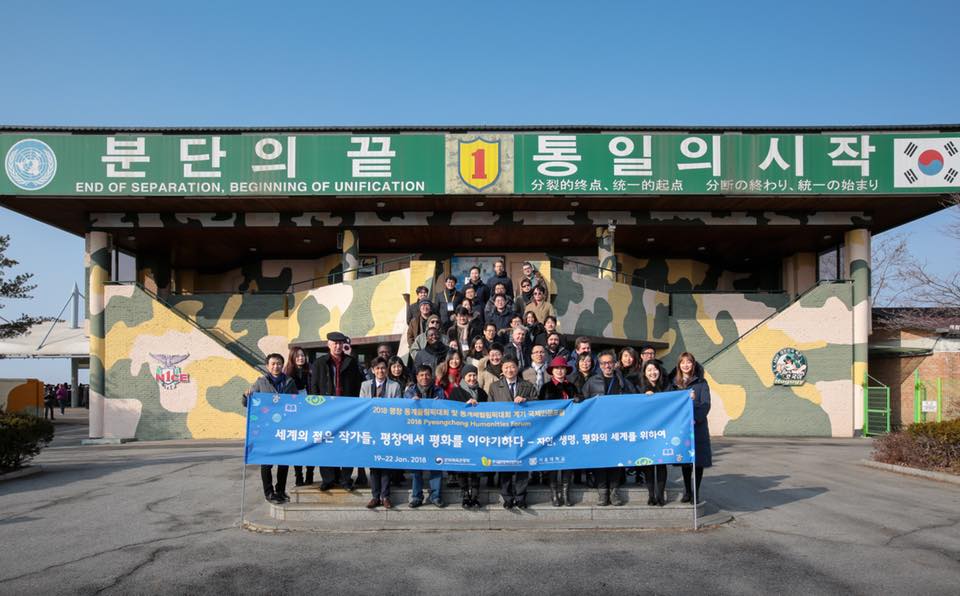
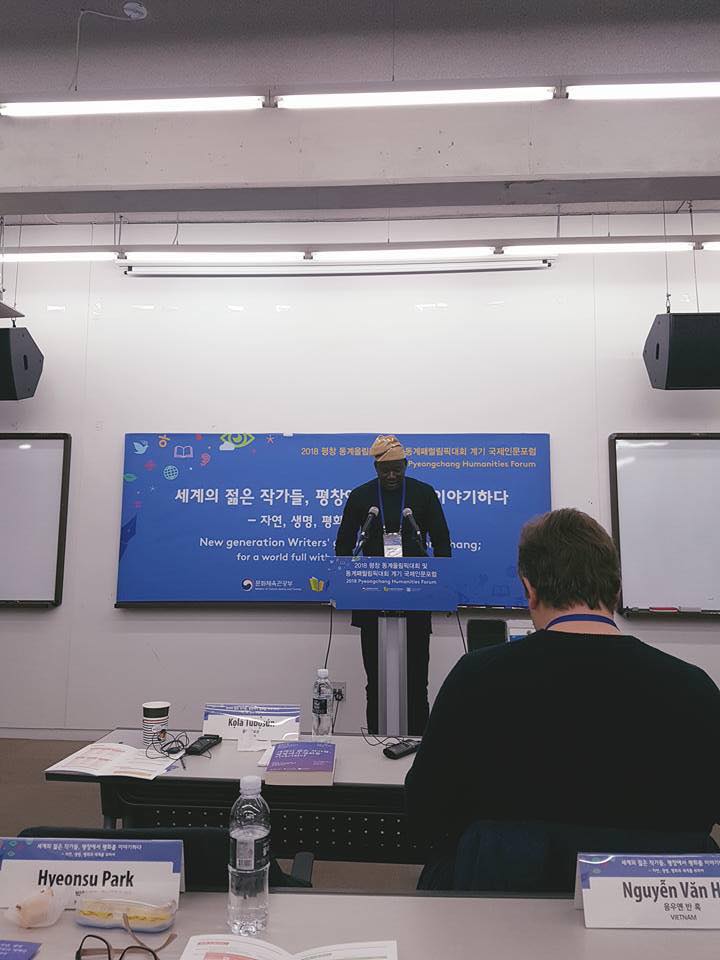
(Being a paper delivered at the PyeonChang Humanities Forum at the Seoul National University Seoul, South Korea, on January 20, 2018 by Kọ́lá Túbọ̀ṣún. The audio recording of the talk can be found here)


Ẹ káàrọ̀ o. Good morning. Annyeonghaseyo.

First of all, let me express my profound appreciation to the organisers of this event for choosing me out of many to be here, among all these important people from around the world, to give you my own perspective on an important discussion. These are precarious times. And to be here in this place at this time to give a talk on a topic that is dear to my heart, is an honour. So, thank you. As we say in my language, adúpẹ́. I bring you greetings from West Africa.

I am here to speak about poverty. But before you assume that I am going in a predictable direction you have been familiar with from watching cable news from your different parts of the world about Africa, let me advise that you set a different expectation. My talk is about a different kind of poverty, one caused by exclusion, and one relating to one particular type of exclusion: language.

I come from Nigeria, a country of about 170 million people with over five hundred different languages and cultures. It is a place that offers as diverse a landscape in terms of both viewpoint and attitude to life. On the one hand, binaries can be found: The north is mostly conservative while the south is mostly liberal. The north is mostly arid and desert while the south is mostly rainforest and humid. On the other, we have an assemblage of cultures and languages which range from mildly intelligible dialects to distinct languages with no discernable cognate, even when they live around each other. This has made my country, Nigeria, a country created from a British colonial experiment, a very interesting place. From what I have read, this is not the same as what obtains here on the Korean peninsula, where Korean is generally described as a “language isolate”, with no discernable genetic or genealogical link with any neighbouring tongues.

Human migration and mandatory inter-mingling of tribes ensured that we are all exposed, in some way or the other, to characteristics of each other’s culture. Through warfare, conquests, and other forms of domination, a number of us have also become subservient, linguistically, to some larger languages around the country, such that, before the British came to colonize the whole swathe that makes up the country Nigeria, a certain linguistic mosaic had emerged. A mosaic, because it was not just one language which every others must speak, but several big languages, and several small ones, each occupying a particular space in the society, fulfilling particular roles in facilitating contact.

I bring up the linguistic character of my hometown to create an image in your minds of both diversity and richness. Even many decades after the colonial processes that were set in place to create a homogenous society out of colourful and diverse peoples, the mosaic is still evident, though not in as bold a colour as was many years ago. The changes started with colonialism, and the prevailing mindsets of the invading strangers from Europe and newly “educated” Africans that our languages could be discarded without consequences. It was a gradual change, reinforced with every government policy, every textbook recommendation, every change in the educational syllabus, and every recommended dress code in government offices. Today, we are a people whose worldview is being conditioned and defined by competence in a new language, English, to the exclusion of our own.

Let me address an important irony: that which concerns the fact that I am presenting this talk in English and not in my own language. I have, after all, advocated that Nigeria’s president use his own language (Hausa/Fulfde) whenever he is out of the country. If I were the president of Nigeria in this instance, Yorùbá nìkan ni mo máa sọ. Aá fi sílẹ̀ fún àwọn ògbifọ̀ láti ṣàlàyé (I’ll be speaking only in Yorùbá, leaving it to the translators to explain). This is a suggestion borne out of my belief that the head of state represents the country and its multilingualism. His or her decision to speak the nation’s language outside shows a pride in the language and provides jobs for translators living in that foreign country while portraying a complexity of that country’s cultural landscape.

The irony comes because the purpose of my talk here is to advocate for a return to the local language use and support, and to explain why I believe that the poverty of imagination is equally as tragic as a poverty of the stomach. You, my hosts in Korea, don’t seem to have this dilemma. Your language is one (unless we discuss the widening gap that is happening between the version spoken here in the South, and that one spoken in the North). You don’t have too many dialects of the language, and citizens of this country do not have hundreds more competing for attention. But you are also lucky in another way. Even though English is spoken here as a second language, Korean still holds an important place as a vessel for the culture of the people. You can think in the language. You can conduct all your daily activities in it. It has a distinct writing style, and children are taught how to use it. And big technological giants care enough about it, and your buying power, that they carry it along with every new tool they create.

This is not the same for the languages in my country.

The problem, like I mentioned earlier originated in the over-simplistic tools we chose for dealing with diversity, and in colonialism. But it has also been carried along by an attitude of the population that rather than assert individual identity or spend valuable time developing each language through use in literature and other means of transmission, we might as well surrender and adopt English as the only “uniting” language. Don’t ask me how successful that drive for unity is. But the result is a gradual attrition of local languages. As at the last count, about twenty-seven languages in the country are either vulnerable, critically endangered, or severely endangered. It doesn’t look like the situation will improve anytime soon because unlike what obtained in the country a couple of decades ago, we no longer teach local languages in schools. The new students we produce from schools each year will only claim English as their first language. This doesn’t mean that they will be accepted abroad as first language speakers since the term “native speaker” is imbued with more than mere language competence, but with both political and cultural characteristics. I’ve spoken about this in other forums. This leaves us, Nigerians, and many other post-colonial outposts around the continent, at a terrible psychological, social, economic, and even political disadvantage.

A more noticeable example of this kind of poverty comes with technology, which is my current focus as a writer and linguist. In some ways, it will be proper to look at the progress of today’s modern inventions through the lens of colonialism, carried into every part of the world on the back of convenience. From my part of the world, where we consume technology much more than we create it, a pattern has emerged. The new technological tools created to make life better for us are monolingual in nature. For an environment where thousands of languages are spoken, this is grossly deficient. And there’s no poverty as great as one that prevents a person from interrogating life in the language with which they are intimately familiar.

When I was in the university between 2000 and 2005, I used to wonder why Microsoft Word underlined my name with a red wriggly line whenever I typed it. But the answer was simple: Microsoft simply didn’t recognize a Yorùbá name. As long as the name wasn’t an English name, the red wriggly line showed you that something was wrong. So when I wrote my long essay, I did it on a project called a Multimedia Dictionary of Yorùbá Names. It was my way of introducing Yorùbá names to technology. Ten years later, I expanded the project to a fully functional and crowdsourced multimedia dictionary to which people can add new names, and improve current ones. And I did this not just for Yorùbá this time, but under the umbrella of what we called the African Language Project, we want to document all African languages and other intangible cultural materials like names, customs, norms, and words. As at this moment, there is no multimedia dictionary of Yorùbá on the internet. None that Africans can access on their phones at a moment’s notice. We are trying to create one. If more Africans who do not speak English at all, or as a first language, cannot interact with technology in their own language, then they are being left behind in the progress of technology. And that’s a powerful kind of poverty.

Around Nigeria today, there is barely any ATM machines that one can use in a local language. This means that people who only speak a local language will not put their money in banks, since the process of getting it out is onerous. Because of this, they are excluded from the big economy and thus remain poor. In a part of Northern Nigeria, poor farmers who need to work with modern implements have to first learn English before they can understand how to read the manuals. I know a couple of my friends who are working on artificial intelligence applications that can help these farmers communicate in Hausa and get access to all they need in a language they speak. But these efforts are far in-between. There’s a lot of work to be done, not just with widening the access that technology provides, but also in reading and producing literature, in engaging with participating in and discerning the details of our politics, and engaging with our everyday life. Like we say in Yorùbá, ọwọ́ ara ẹni la fi ń tún ìwà ara ẹni ṣe (“we have to use our own hands to fix our own issues”).

There are different kinds of poverty, all of them damaging to the dignity of man. A deprivation of language is one that is more pernicious than the rest because it deprives not just the body, but also the mind. The world is a colourful and delightful place to be in because of the multiplicity of languages and culture. I do not want to live in a world where only ONE language is spoken. That is a world that has lost its storehouses of wealth. We are all richer by the experiences we share from participating in each other’s cultures, language, worldview, and way of life. By working hard, and fighting hard in my own part of the world, to make sure that the movement of technology does not leave us behind in our own languages, we attack poverty, and build a new and exciting future that better reflects the mosaic; the colours, and the realities of the African – and our global – existence.

Thank you for listening. Kamsa hamida.

More than Ashẹ́wó: Kalakuta Queens Remembered

by Ọpẹ́ Adédèjì


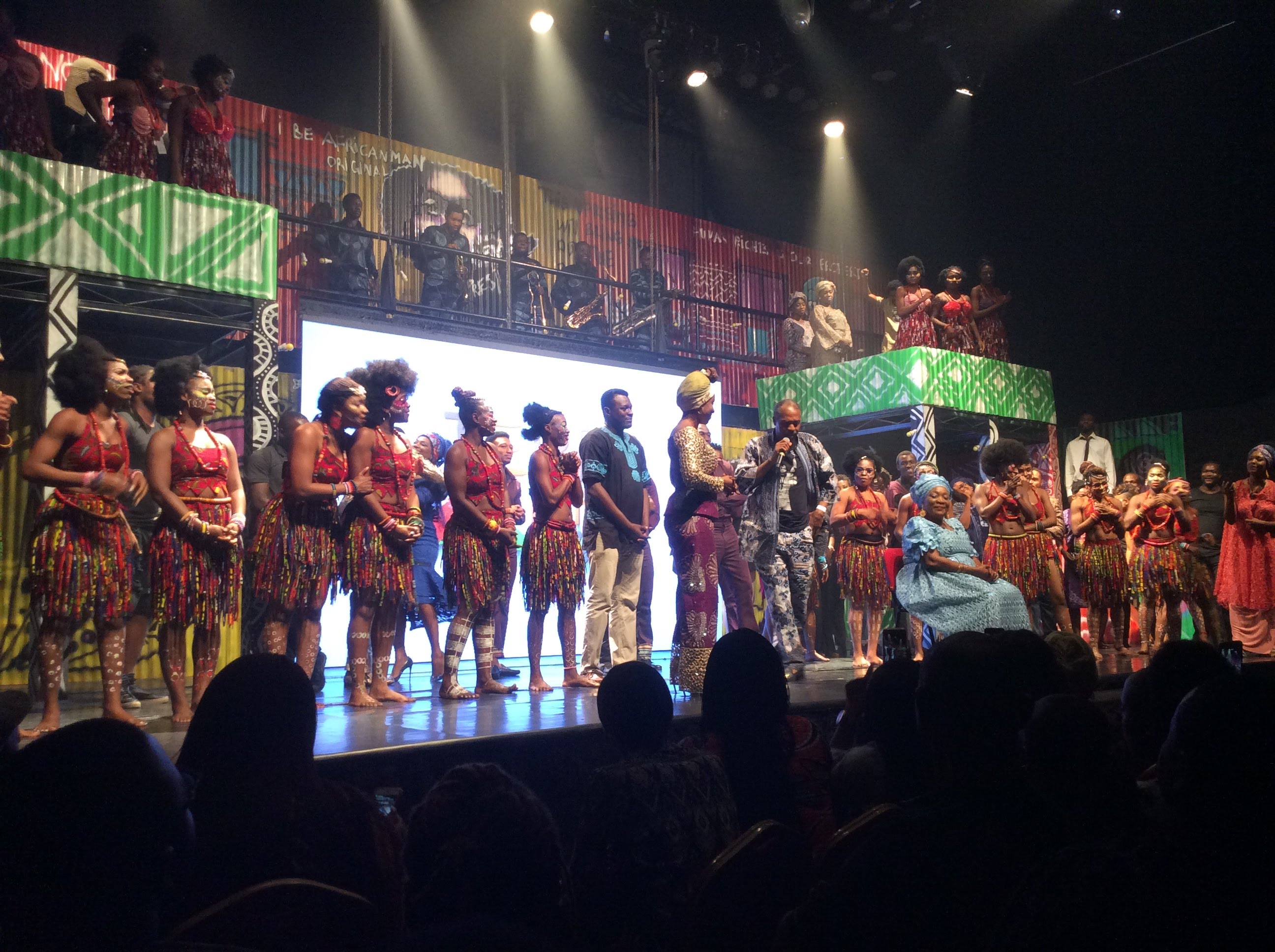
One of the living Kalakuta queens, Ọláídé is on stage with Fẹ́mi Kútì and Yẹni Kútì, two of Fẹlá’s children. They are passing the microphone around reminiscing about a time when Fẹlá was alive. They speak fondly of him, as if he stepped out of the room and would be back any minute. They are smiling. It feels like we know Fẹlá personally, beyond the music and stories we have read of him. Bọ́lánlé Austen-Peters looks tired. She stands by the trio who keep praising her genius and creativity. She has just explained to the audience that intense rehearsals had been on since October and that the show started airing in December. They have one last show before they come back in April during the Easter break. Behind them, the complete cast and crew of Fẹlá and the Kalakuta Queens stand, still in their beautiful costumes, smiling at the audience. In a bit, we are allowed to climb up the stage to take pictures with the cast.

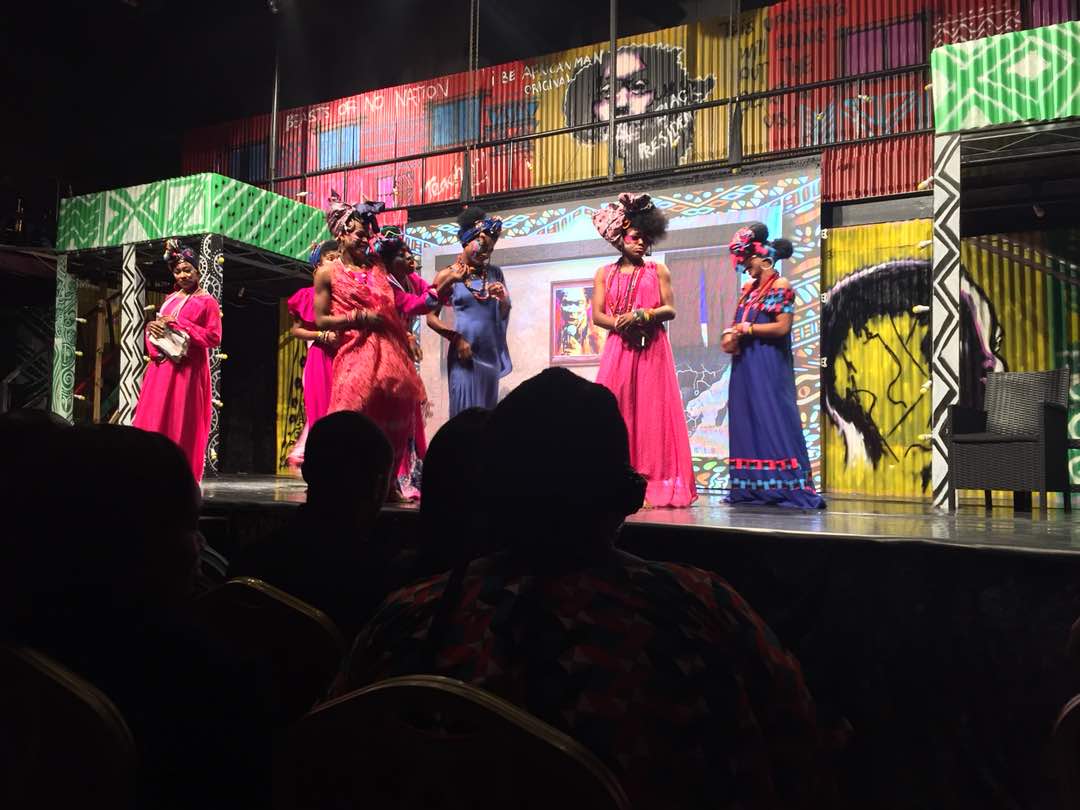
Ọláídé, one of the surviving Queens from Kalakuta Republic, seated to the far right in blue, while Fẹ́mi Kútì speaks and Yẹni with Bọ́lánlé Austen-Peters look on.

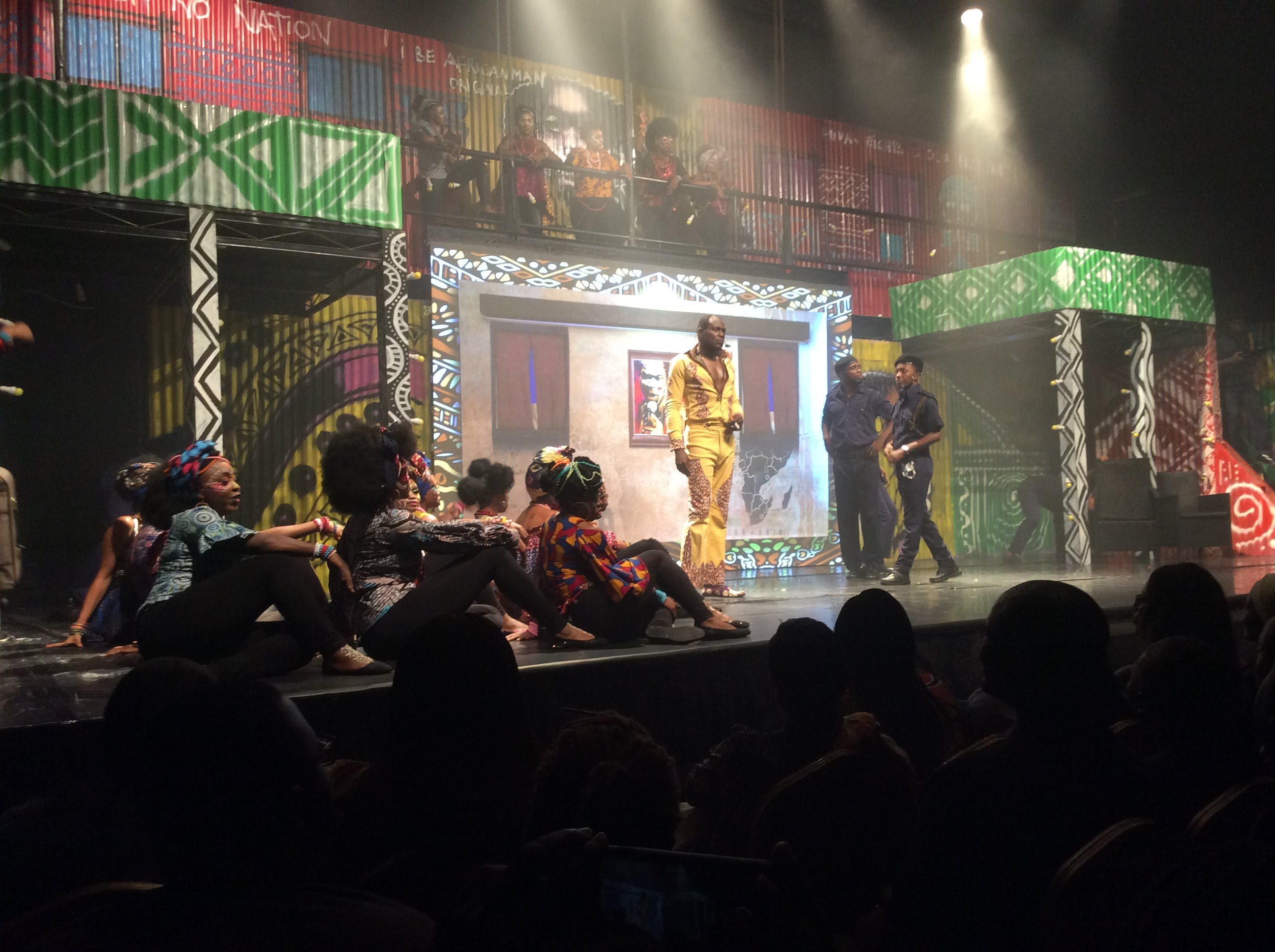
I particularly find the man who played Fẹlá – Ọláìtán Adéníji – intriguing. Apart from the fact that he did a great job with producing a close imitation of Fẹlá’s voice, mannerism, and movements, it is commendable that he has had no history or career in acting. He is an afro-jazz vocalist and saxophonist and prior to this time, definitely not an actor. The audience is awed when Bọ́lánlé says that his role as Fẹlá is his first acting role. Fẹlá, or rather Ọláìtán, smiles a modest smile. I take a picture of him. He is darker than the real Fẹlá but the resemblance is there.

On Terra Kulture’s website, they describe the event as a thrill of a lifetime. While I agree with this, I wish they had used a more adequate description. Fẹlá and the Kalakuta Queens was a thrill of a lifetime and more. It was a spiritual experience. I feel that this is the only way to capture its essence in a few words and evoke a true emotion.

In the wake of the #MeToo movement, the unveiling of several sexual harassment conducts against well-known members of the public and celebrities, especially in Hollywood, and the conversations around consent and feminism on social media, Fẹlá and the Kalakuta Queens is a timely production. It seems almost like Bọ́lánlé saw what 2017 had in store for women when she started preparing and doing research for the show a year ago. I can only imagine what extensive research and investigation she must have put into it because of Láídé and Fẹ́mi’s remark that the play is exactly what happened in real life. There is an emphasis on the ‘real life’. This leaves me short of words.

Bọ́lánlé explains that, while Fẹlá is continuously being praised for his incredibly unique music that has outlived him and promises to outlive us, no one ever talks about the women who stood by him. After his death, they sort of became relegated to the background, and their roles ignored. It was almost as if they had never existed in the first place. Every year in October, Felabration is celebrated widely in Lagos, and perhaps other parts of Nigeria, with musical performances, art exhibitions, stage plays, film shows and several other acts. But none of these acts recognize the 27 women who became his wives, who were an entourage of his band and more than anything, the inspiration behind some of his music. Bọ́lánlé’s introduction of this narrative to Fẹlá’s living story is brilliant.

The play details the scorn these women faced from being with Fẹlá. Láídé says this. She tells us some of the adventures she had with Fẹlá and the other queens. She narrates the story the way a grandmother would tell stories to her grandchildren. This is not to say Láídé is in any way an aged lady. She is merely in her 60s but looks at least a decade younger. It is almost impossible to imagine her as the troublemaker Fẹ́mi calls her. (In return, she calls him “Ọmọ-ọmọ Ìyá Àjẹ́” – a nickname that continues the moniker that used to be attached to Fẹlá himself: Ọmọ Ìyá Àjẹ, meaning “the son of the witch-godmother”. The witch-godmother was Fúnmiláyọ̀ Ransome-Kútì. Ọmọ-ọmọ means “grandson”). She tells us of the numerous times the police arrested her and the queens, of how the queens beat the Ghanaian police officers who had arrested them, and how they were eventually deported to Nigeria. She says this amidst our laughter. Many times during the play, the women were referred to as prostitutes – ‘ashẹ́wó’ the policemen often screamed into their faces. Láídé who has probably heard this one too many times in her life, reminds us blatantly and continuously that the queens were not prostitutes. ‘We were not prostitutes,’ she says. But the relevant question here is not ‘who were these women?’ The question is, ‘why were they so keen on supporting Fẹlá? They supported him to the extent that they were raped and beaten by police officers. Why were they so ready to give it all up, in order to stand with this rebellious musician? And why did Fẹlá marry all 27 of them?

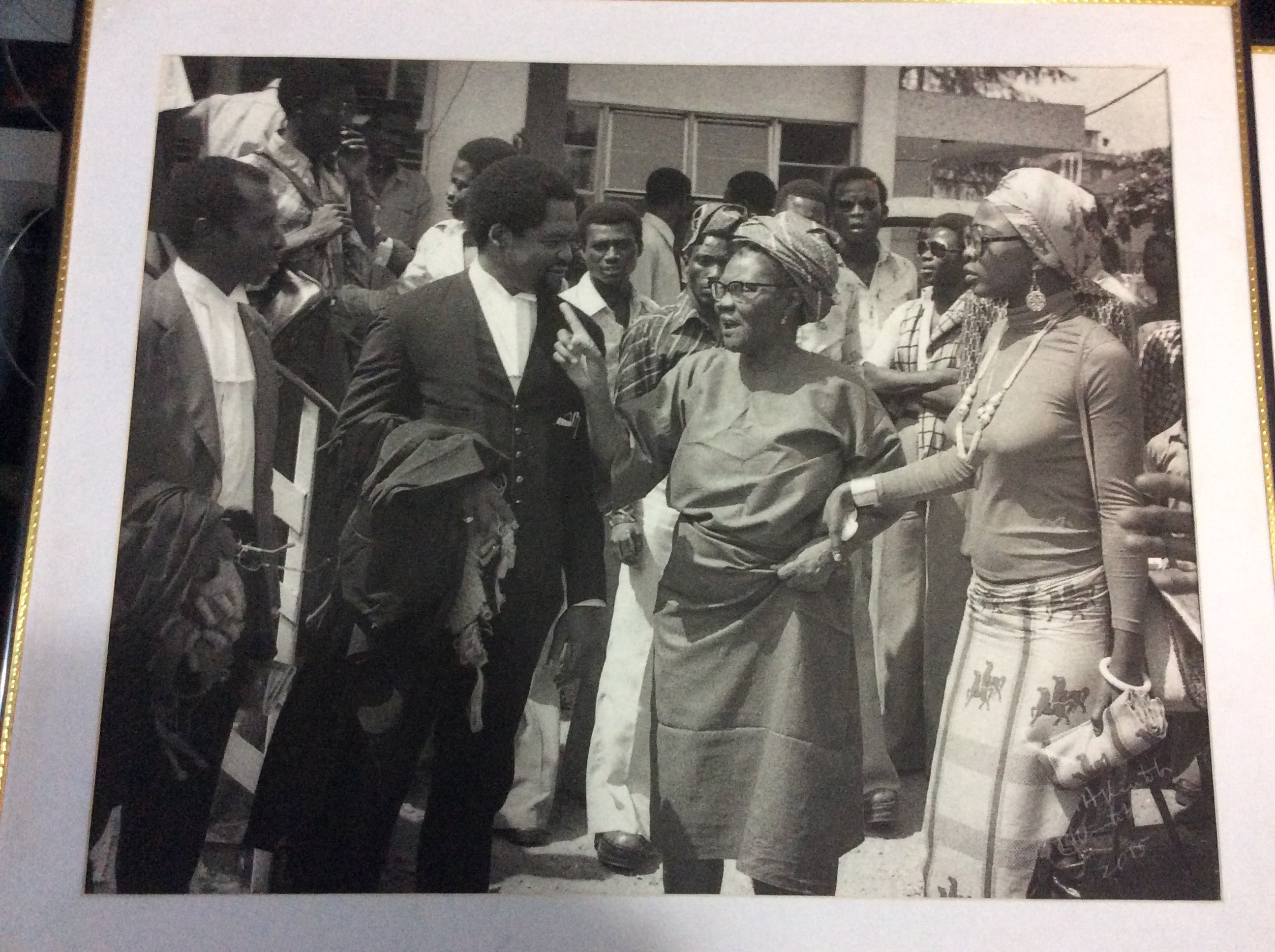
“Sister Ọláídé”(right), as many people in Kalakuta Republic knew her, was a close confidant of Fẹlá’s mother, Mrs. Fúnmiláyọ̀ Ransome-Kútì (middle). Both of them are pictured here with Fẹlá’s lawyer (left) during one of Fẹlá’s court appearances. <b>Photo credit:</b> Kalakuta Museum, Lagos.

Fẹlá Kútì was absolutely nothing without his queens. Ọládọ̀tun Babátọ́pẹ́ Ayọ̀bádé writes in the dissertation the ‘Women that danced the fire dance: Fẹlá Kuti’s Afrobeat Queens, Performance and the Dialectics of Postcolonial identity’ that the women were indispensable actors in the making of Afrobeat music as well Fela’s rise to prominence as a musician and activist. The author adds however that their collaboration with Fẹlá’s anti-government ideologies as well as their often-eroticized stage performances made them special targets of state-organized violence and earned them contempt from the Nigerian society. In this play we see state actors vis-à-vis Nigerian police officers continuously demeaning and harassing them. On why they have been ignored by history despite their critical role in elevating Afrobeat music to a global level, the author writes: ‘they have been imagined as indecent underclass women undeserving of Afrobeat’s collective memorializing or as collateral damage of Fẹlá’s political and personal excesses.’

The play ran for nearly three hours. Starting around past three, music from a live band serenaded us while the lights were still on and people networked, or caught up with old friends. The music gave off Yorùbá party vibes that I felt were just right. This set the stage for the play. But the Fẹlá vibes did not start here. At the entrance, there is graffiti and the words “Afrika Shrine” inscribed. In the ticketing area and beyond, you are welcomed by photographs of the Kalakuta Queens, of Fẹlá and some of his more famous quotes like “water e no get enemy.” This gives you goosebumps even before Fẹlá’s incarnate walks on stage. When it is time for the play to begin, the lights dim. A eulogy of Fẹlá opens up the show, intensifying the mystery and its spirituality.

There is a tendency to criticize Nigerian stage plays – at least the popular ones, as being too musical in nature. Critics ascribe the stunted growth of Nigerian theatre to this, poor plots and terrible acting.  Theatre critics also attribute the lack of growth to lack of theatres and other like spaces. While these concerns are valid, Bọ́lánlé Austen-Peters has carved out a niche in musical stage plays that continues to thrive. The construction of the new Terra Arena where Fẹlá and the Kalakuta Queens holds, further reduces the dilemma. Previous BAP productions: Saro and Wakaa the Musical held at the Muson Centre. Muson is a great space, but it is not necessarily homely. I find that what the less than spacious Terra Arena theatre does is to make things somewhat informal and yet attractive. Brymo’s concert in December attests to this. And this, I feel, is one of the reasons Kalakuta Queens was such a hit. Characters from the play sometimes walk from amidst the audience unto the stage. The audience itself is more often than not a part of the play in the way we raise our hands up in salutation to Fẹlá, sing along, and cheer with every performance.

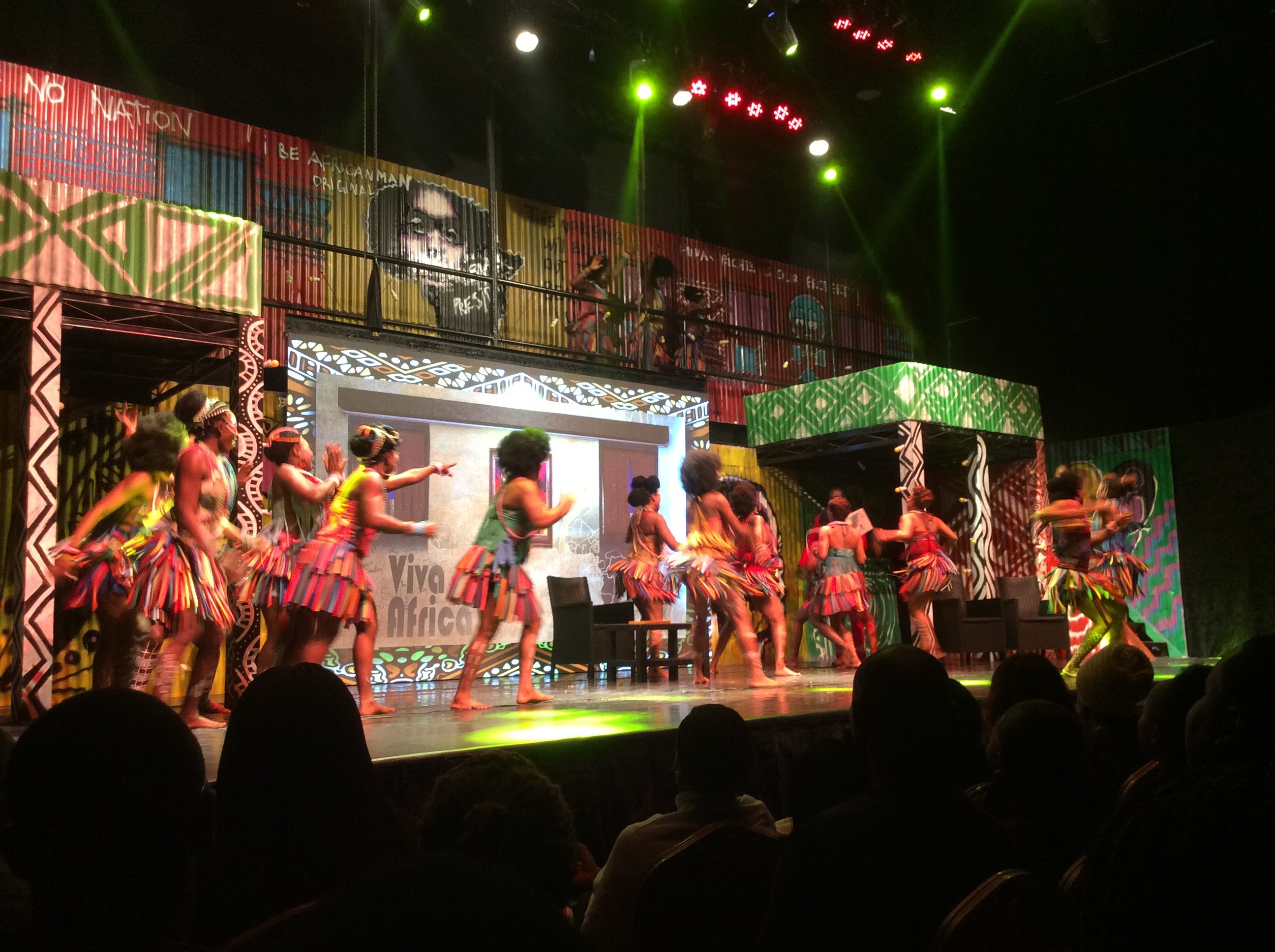
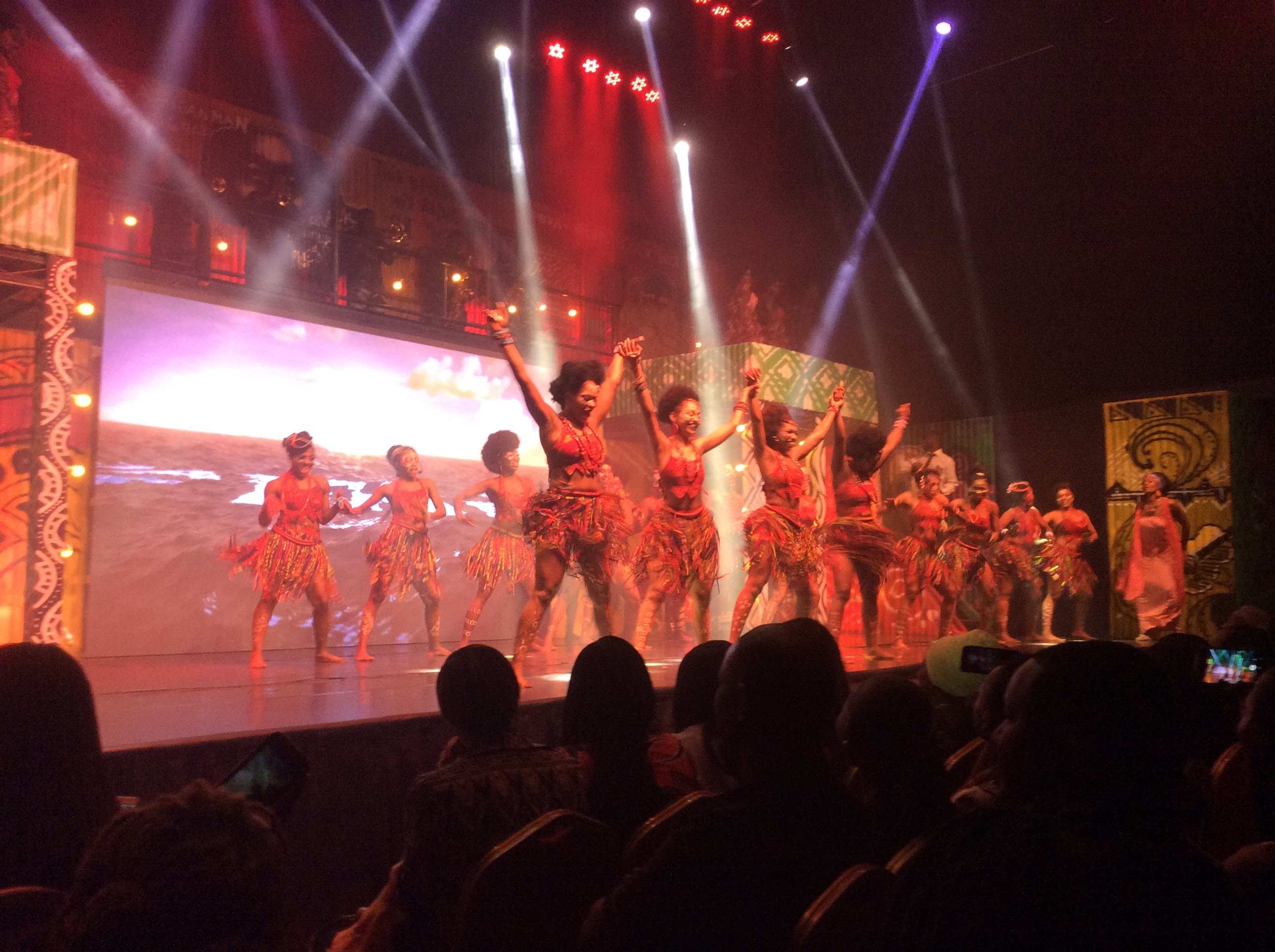
When they perform for the first time, they are dressed in white costumes their faces painted in different colors, shapes and lines. They dance in red light and other times in blue, green and yellow lights. Their entire look, from their natural hair wigs to colourful costumes and bead ornaments made the play authentic. It was increasingly important for me that the originality of the entire play went beyond Ọláìtán’s close resemblance to Fẹlá. I wanted to feel this same sense of originality with the other characters. BAP did not disappoint. In 1983, Bernard Matussière took some beautiful shots of the Fẹlá queens. In the main, their portrayal by the actors in this show hews as close enough as possible to a true approximation of their appearance, skills, and dance dexterity. Around the world today, several stylists and fashion icons have drawn inspiration from the bold makeup and hairstyles of Fẹlá’s wives.

The beauty in their choreographies and dancing cannot be overemphasized. Their moves certainly mesmerized the audience. Through the show, I imagined their motions being trapped into an art frame and exhibited like photographs. Though Fẹlá’s 10 to 20 minutes songs have a life of their own, the dance these women brought to accompany them gave a deeper meaning to what it means for a song to be alive. It is without a doubt that the dancing of the Kalakuta queens made Fẹlá’s songs a complete package back then, as they did on stage during the play. It was a whole new level of energetic, sensual and majestic.

The play is hilarious. Think of the way in which Lọlá Shónẹ́yìn’s Secret Lives of Baba Segi’s Wives is hilarious, the way in which it showcases a Nigerian polygamous home and is still poignant but not crude in the messages it passes. It is in this same way that Fẹlá and the Kalakuta Queens is hilarious and serious at once. The women struggle and compete for Fẹlá’s attention. They plot against and fight with one another, often using music and dance to pass on their messages. They find a common rival in the beautiful Malaika, the woman from London who says she has come to study Fẹlá and the queens, particularly the queens. They become agitated when they notice that Fẹlá has fallen for her, and that she has gained monopoly over the Kalakondo. As with when they stand with Fẹlá, they unite as one in order to throw her out of the Kalakuta Republic. It is interesting though, that while the women stand with Fẹlá when he is arrested, Malaika does not, further establishing her traitor-hood.

A particularly interesting scene is the court scene. After Fẹlá is arrested the first time, he is taken to court and charged with the abduction of the girls and possession of marijuana. He pleads not guilty and the judge asks the lawyers to present their case. The court clerk is a side-splitting character who seemed to overdo his role but still got the audience laughing. The claimant’s counsel presented witnesses who were emotionally inept at giving a clear and concise testimony. The first witness, Láídé’s mother, cries all through her testimony at the witness stand. The second witness is an aunt to one of the queens, Lará. Though she does not cry, she still presents a poor testimony in poor English. The two women stare at Fẹlá accusingly. While they can prove no clear case against the musician, there is another perspective when Lará’s aunt reveals that her niece is underage. On this count and on the count of being in possession of marijuana Fẹlá is convicted and sentenced.

The women call Fẹlá ‘king’, ‘Black President’ and ‘Abàmì Ẹ̀dá.’ He calls them his queens. He says, “I love all my queens. They are unpretentious and are ready to battle with me. Without them, I am nobody”.  When Fẹlá decides to marry the women, he does not do it for selfish reasons. He learns that his queens are unhappy because despite standing by him, despite being dancers, singers and activists in their own right because they are women, they would never do right by society. People would continue to mock them and refer to them as ‘ashẹ́wó’. So he felt the right thing to do would be to marry them. At first, people – his lawyer, Tunji Braithwaite inclusive – try to dissuade him from marrying the twenty-seven at once. He is told that he would be prosecuted for bigamy. But this does not move him. The women are delighted to hear he is going to marry them. In an article on She Leads Africa, Halima Bakenne writes, “Marriage offers some form of validation for women in Nigeria and maybe even other parts of Africa. It is believed that irrespective of what a woman achieves, she is nothing without a man.” This succinctly describes the motive behind Fẹlá’s marriage to the queens. A priest conducts the marriage ceremony. This is followed by a brief performance after which the show ends.

One of my favorite scenes in the play is Ihase’s performance. After the police destroyed their house and abused them, they were taken to the hospital. At the hospital, Ihase broke into soul-wrenching music. Her powerful voice reverberated across the quiet, still hall. In this same scene, Fẹlá is being treated on a gurney and behind him, in the projector, his spirit is depicted as coming out of his body – death and later on, as the music intensified, returning. Fẹlá Kútì later confirms that his father had mentioned that he once died and returned. This scene is also painful to watch. It reminds me of war-torn countries and daily domestic and street violations of women in Nigeria. It reminds me that sexual assault and domestic abuse are still endemic in our society, just as they were in the 80s. It reminds me that while most of the world has joined in on the #MeToo movement, Nigeria is still lagging behind.

There are so many take-homes from this stage play, like most stage plays and generally from Fẹlá’s life. Despite his many flaws and the seeming patriarchal nature of his relationship with the queens, he never disrespected them. He treated them equally. Their place in history has been reintroduced and there’ll hopefully be more public recognition and appreciation for their role in his life story as time goes on. When I climb the stage to take a picture with Láídé after curtain call, I smile at her and kneel beside her. I say to her: ‘thank you for sharing your story with us.’

___

The play/musical Fẹlá and the Kalakuta Queens ran from mid-December 2017 to January 14, 2018 at Terra Kulture Arena. It is billed to return in April 2018. Photo credit: KTravula.com, Tobe, and Kalakuta Museum.

___

Ọpẹ́ Adédèjì dreams about a lot of things but most especially about bridging the gender equality gap and working with the United Nations. If you do not find her writing, you would find her reading a novel. She is the co-founder of Arts & Africa.

Finding Chris Abani

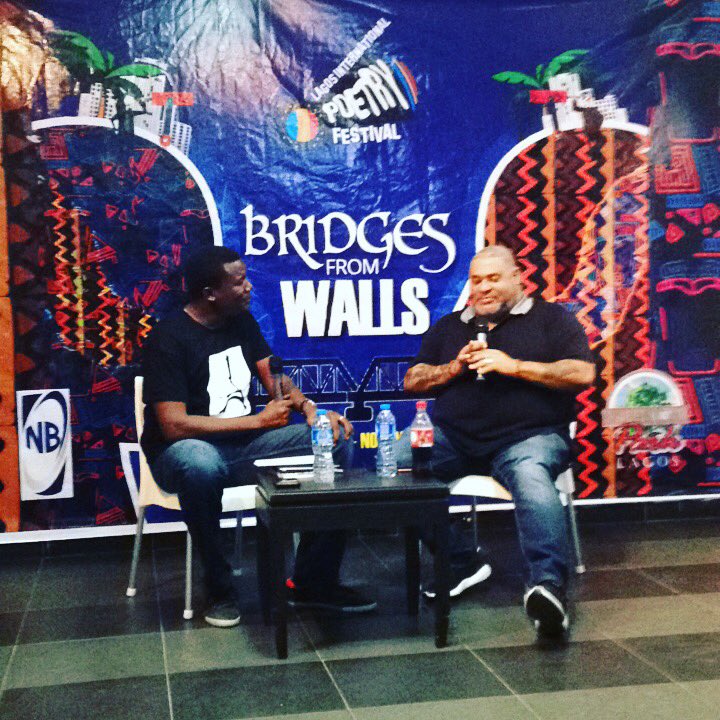
To know Chris Abani is to love him. I spent about an hour today at the Lagos International Poetry Festival interrogating the affable Nigerian/British writer about his life, his work, his vocations, and a few other matters. It was our first ever sit-down conversation about anything, although I had known and admired him for a while, read his work, and exchanged pleasantries when we’ve met at other literary events (last year at the Aké Arts and Book Festival, for instance).

But this time, at a formal setting, I had looked forward to being able to learn a bit more about what motivates him as an artist, and to do it within the stipulated hour. It turned out to be a conversation that was as enjoyable as it was challenging. His reputation, drive, and breath of literary production span an impressive and sometimes intimidating stretch. He is a full-time writer in California, but also an apprentice babaláwo, publisher (and curator of a number of poetry competitions and chapbooks with Professor Kwame Dawes), and author of many award-winning books including Graceland (2004).

There were a number of questions, but one of the most enjoyable parts of the conversation for me was a detour on the true definition of literacy in an African environment. Too often, we have defined literary competence, and even a state of being culturally literate, as merely being able to understand the translation of terms from one language or culture to the other. Whereas, what is true literacy is being able to successfully occupy the full extent of being in that culture and maybe another as well. He mentioned an example of listening to a performance either of the chanting of the Odù Ifá or a poetry performance in Afikpo, where he was born and raised, and being able not just to understand what is being said, but successfully occupying the spiritual and mental state in which the work was conceived and performed. The nearest familiar example from my end would be a literate Yorùbá citizen, listening to a cultural performance with a dozen other not-as-literate people, and having a better, more enhanced experience of the same work of art just because of a capacity to understand the meaning of each talking drum pattern played under each public chant. In Yorùbá traditional art, there are sufficient depictions, as a satire on the importance of this skill, of novice or despised chiefs or kings dancing glibly to a drummer’s feverish patterns without knowing that the drummer was actually insulting them through the delightful ambiguity that the tonal patterns of the Yorùbá talking drums provide.

Chris Abani is a truly literate and competent artist in this way, which greatly helped the conversation along. One hour suddenly felt like a few good minutes. But the writer, in spite of his many achievements, also carries himself in a way that is relatable – which is what you’ll expect of someone still intent on learning the very many ways of being, and of existing as a true and competent artist.

I may have ruffled him a bit with an elephant-in-the-room question about a once controversial portion of his biography relating to his imprisonment in Nigeria in the eighties which, a few years ago, put him in the crosshairs of some Nigerian writers who accused him of not just fraud but sabotage: he was portraying Africa in a horrible light for foreigners for his own artistic advancement, and deserved censure. It was an argument that played into the big contemporary hoopla about poverty porn and the perception of Africa in world literature as a nest of ills. In Abani’s response, he gave as strong a defense as one can find for the freedom to be private about elements of one’s life story especially in the face of what he thought was an unfair and relentless attack, and anger at those who he said had tried, though unsuccessfully, to damage his name and livelihood in their blood lust for his scalp through a witch-hunt disguised as a defence of autobiographical fidelity, or the country’s honour. It made sense to me, and I was glad to have given him a chance to defend himself on the topic in a public forum.

What he is known for today, along with his impressive literary output, is his work with the African Poetry Book Fund with Professor Kwame Dawes where dozens of new African writers are discovered every year and published in chapbook and box sets which are sold all over the United States and around the world. His explanation on the breadth of work that the Fund does was thorough and detailed. How he is able to cope with that work along with every other thing he does is one of the wonders of his impressive career.

In the end, I was greatly impressed by the writer as an artist, an important and talented voice in the African writing space, as well as a bearer of important stories.

On “The Heresiad” by Ikeogu Oke

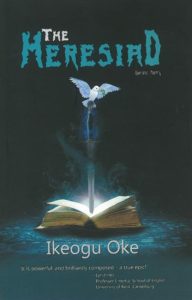
The Heresiad (KraftGriots, 2017) by Ikeogu Oke is, in my opinion, the most ambitious of the books on the prize shortlist this year. It is a book of what the author called “operatic poetry” (another way to put this would be “poetry in drama and song”) featuring one poem extended over a hundred pages. Yes, one poem. It is epic in its scale, ambition, and character (and even in the words of one of the blurbs. See it:

“It is powerful, and brilliantly composed – a true epic!” – Lyn Innes (Professor Emerita, School of English. University of Kent, Canterbury))

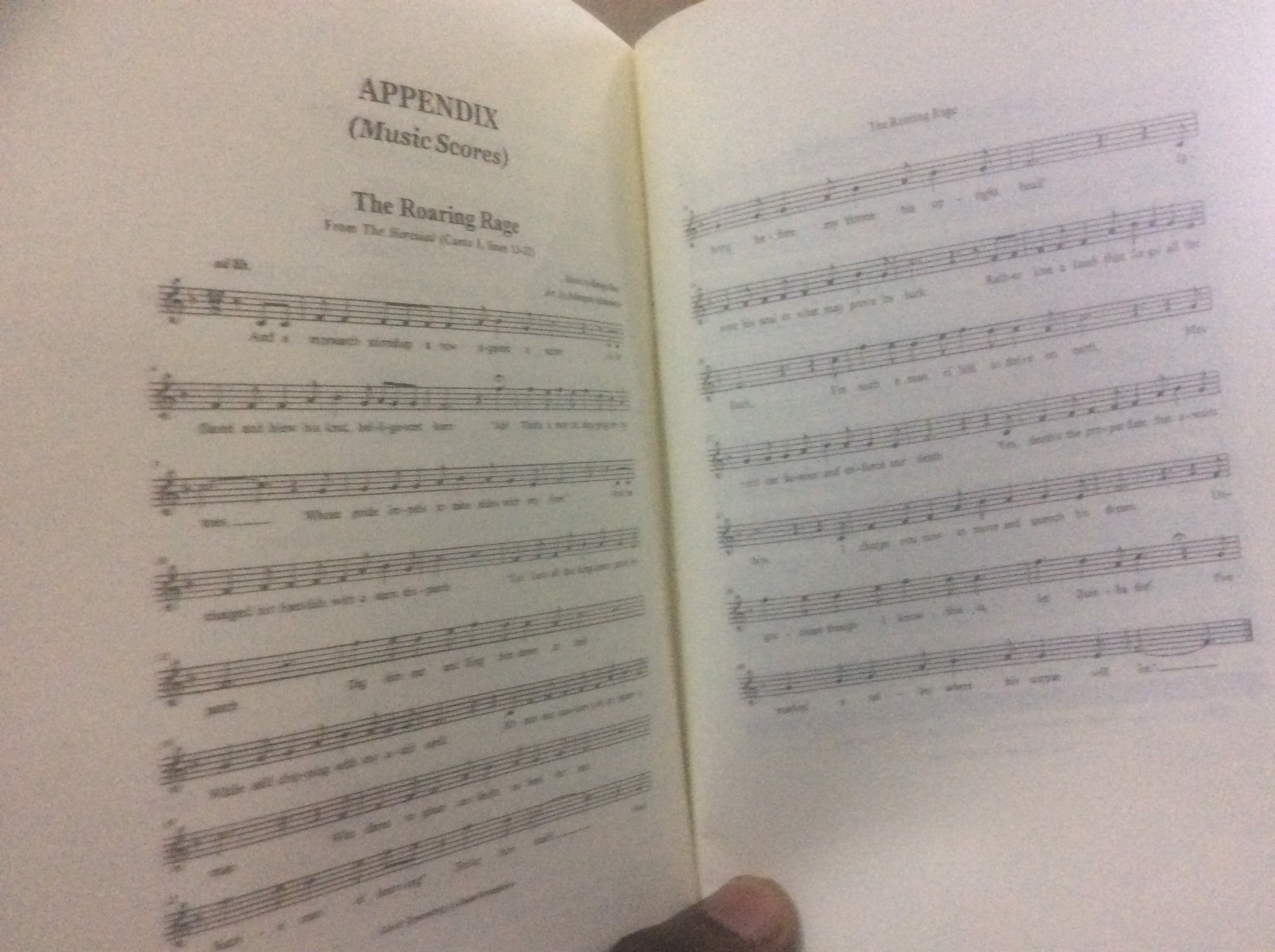
But seriously, the work packs within it a lot of history, philosophy, narrative, culture, allegory, politics, and tradition, rather unapologetically. Without the author’s name, one might confuse it for a work by Shakespeare of any of the writers of the old traditions defined by form, rhyme, and musicality. Only slightly, of course. References intrude from Nigerian (and African) socio-political issues enough to define the work as one addressed to a specific, even if global, audience. And to that idea of musicality, the author graciously provided musical notes with which the poem can be sung.

The name Heresiad, is derived from “heresy” just as the Iliad was derived from “Ilium” or Aeneid from “Aeneas”, as the author explains in the preface. But what needed defending, even more, was the style, operatic poetry, which Oke described as being deliberately crafted as “an art form that transcends verse and goes on to embrace song, music, and drama.” Previous works of this nature which have misled readers into expecting musicality through the use of “Songs of–” in their titles were singled out, from Turold’s The Song of Roland to Vyasa’s The Lord Song to Okot p’Bitek’s Song of Lawino. (He couldn’t have called out Tanure Ojaide’s Songs of Myself, the other book on the shortlist, because this serendipity of both their presence on the shortlist couldn’t have been predicted. But the juxtaposition of this factor in defining Heresiad as unique and better realized as practical literature does appear significant). By discounting the need for a titular nod to musicality and instead embracing it in true form, Oke admits to pursuing a grander ambition: to make written words sing, a homage to Ngugi wa Thiong’o, whose words to that effect was quoted as an epigraph.

Of the thematic preoccupation of the book, Oke says it is written “to make a case for unhindered intellectual and creative freedom… and for mutual respect and harmony between faith and thought, otherwise religion and intellectualism.” In my interview with him, he admitted that the idea of the book, and the first verses in the book, came in 1989 when “a famous writer” was condemned to death for the crime of heresy. He didn’t need to – nor wanted to – mention Salman Rushdie by name, but that connection became immediately apparent. In this book, the condemned author and narrator is Zumba, who was so censured for having writing a “bad” book. To enforce this sentence, and to save him from it, a few other characters, in the person of Reason, Doom, Anger, Sword, Machete, Axe, Stone, Panther, Care, Bluff, Smithy, etc, were introduced with fully-realized characters, compelling presence, and voice. In their thought processes and the unfurling of the curious plot, the poem realizes itself in full glory.

One of the limitations of traditional poetry, which can also become its most enchanting feature, is rhyming. It is a feature that I happen to love. But it is a feature fraught with a lot of risks one of which is the occasional trading of meaning for the benefit of a properly rhyming word, or the use of the immediately available rhyme instead of striving to find the perfect one. In Heresiad, some of these limitations show up, like when “bypass” is made rhyme with “pass”, “reproof” with “proof”, or “unwise” with “wise” (and in one unintentionally hilarious instance, when the native language interference pushes “blade” to rhyme with “head” (page 57). For a book of this type of ambition, it might be that those kinds of lapses are to be expected and tolerated. But for an unlucky book, they can become the flaws by which they are defined.

But when it works, though, it works quite beautifully.

I’m part of this misnomer, I confess,

And so are all you Faithfuls, nonetheless.

Or who among us Faithfuls can have read

The book for which we seek the author’s head?

Rhyming might seem like a trivial issue on which to spend critical time until one realizes that each couplet throughout the work sticks to this rhyming pattern on top of what Oke describes as “lyrical pentameter” (adaptability to lyrical utility). The realization that the author had spent countless man hours crossing all his Ts to achieve this kind of ambitious and thoroughly satisfying theatrical result is most impressive of all.

Now, the author’s plea had reached his ears,

A plea that dripped with anguish and with tears;

And Reason, yes, had pondered through a plan

To take help to the joy-forsaken man.

(page 36)

Equally as impressive is the realization that the book took twenty-seven years to write, over different iterations.

Now lift your voice; lift your voice and say;

Your voice, not mine, must rise and lead the way:

What now transpired among the rising five

Who wished our author more dead than alive?

What – the thought – that, of its own accord,

Changed their common tilt towards discord?

A love as yet profound inspires my choice

To be the human echo of your voice.

(page 52)

Speaking of theatre, when was the last time you read a book of poetry with accompanying musical notations? I certainly haven’t seen any. But here, on page 106-112, the author, with the help of Adéogun Adébọ̀wálé, helpfully guides the future theatre and/or musical director on what is the appropriate way to translate the texts into music.

During my interview with him, I asked whether he would be willing to sing some of the lines to me, and he graciously obliged. It was not as impressive as I’d expected it, but who expects an author of a work to always be its most competent performer? Not me. It is ironic, of course, that this musical characteristic of the work once became a point of risibility when a restless Facebook critic dismissed it as a gimmicky invention to win the $100,000 prize money. On the contrary, I think it is one of the book’s distinctive features, showing it as different as possible from the others on the shortlist in terms of ambition, inventiveness, interdisciplinary scope, and resolve. Now, to see it on the stage!

The author’s habit of including footnotes and references at the bottom of relevant pages irked me at first. They had appeared as an unnecessary usurpation of the critic’s role. But this wasn’t the case. They add a lot of value to the work in illustrating, where necessary, the writer’s influence, allusion, or research. Not one was superfluous.

From what I have observed of the pattern of choice by the NLNG judges, who have typically favoured works of formal and traditional forms in style and ambition (See: The Sahara Testament), I will predict that The Heresiad might take home this year’s prize. There is something about the work that speaks to an intense commitment to innovation, tenacity, joyful experimentation and social commentary in a way that provokes delight and engagement. It is doubly worthy, of course, for its successful bridging of the genres of poetry, drama, and music, while making a strong point, through allegory and an enchanting imagination, about the role of free speech and the responsibility of the writer in a modern society.

I’ll be surprised if the judges disagree, but such surprises are welcome when it’s not one’s work on the shortlist.

______

Find a link to the previous reviews here.

______

Update: October 9, 2017: Ikeogu Oke’s The Heresiad is the 2017 Nigeria Prize for Literature winner. Watch my interview with him here. Congrats to him.

On “A Good Mourning” by Ogaga Ifowodo

As promised, here is my take on the first book on the shortlist of the NLNG-sponsored Nigerian Prize for literature 2017. The book is A Good Mourning (Paressia, 2016) by Ogaga Ifowodo. Ifowodo is a poet and writer, who taught poetry and literature in English at Texas State University, San Marcos, USA. He holds the Master of Fine Art (MFA) in poetry and Ph.D from Cornell University, New York. He studied law at the University of Benin and worked for eight years as a rights activist with Nigeria’s premier non-governmental rights group, the Civil Liberties Organisation (CLO). Between 1997 and 1998, he was held in preventive detention for six months under the military dictatorship of General Sani Abacha.

I’m ashamed to admit that, until now, I hadn’t read anything by that poet with a striking physical resemblance to James Baldwin. But no matter where I have turned, his name had shown up there, from conversations on social media to arguments in closed listservs. Until recently, I also didn’t know that he had served in government in some capacity and that he once contested for (and failed to win) a House seat from his home constituency.

So, I approached his work with an open mind. The title of the book A Good Mourning carried a curious double-edged sword of meaning that intrigued anyone from afar. The cover conveyed darkness as does the paradox of the title itself. If it is “mourning”, how is it also “good”? And how does it contrast with what we have grown to expect when we hear the phrase, devoid of the physical surprise of the spelling difference?

The work does not disappoint. The copy I got was loaned to me by Doctor-Poet Dami Àjàyí to whom the writer had autographed it in 2016: “Good morning & poetry”. I hadn’t found a copy anywhere else that I had looked, inviting conversations to the recurring topic of accessibility of books to the general public before they are selected for the Nigerian Prize. (It is a ridiculous argument, to be clear. The prize is set up to reward excellence, not distribution savvy. But it does raise valid questions about why publishers in 2017 haven’t yet heard of the Kindle, eBooks, and an authentically Nigerian electronic book distribution system called OkadaBooks which can put the books at the literal fingertips of millions of people via their mobile phones).

A Good Mourning is an impressive book that is marked by competence, style, grace, and a distinct authentic voice. It is that competence that I intend to dwell on a bit more because some of the snide remarks about the shortlist had focused on what they regarded as substandard work on the shortlist. Thankfully none had mentioned Ogaga’s name in the diatribes. He is a competent voice whose work leaves no one in doubt of his facility with words, dexterity with decades of African and modern poetic traditions, and sincerity in the pursuit of his numerous truths and points of view.

The poems delight, inspire, provoke, entertain, and intrigue. They cover a range of themes that, contrary to the expectation that the poems in the collection will all be morose and depressing, excite and titillate. In one poem Ten Hours (page 8), the poet describes an appendectomy in a German hospital with such mischief and lexical dexterity that what one feels isn’t just breathless anxiety of a man hanging between life and death but a playful appreciation of the affectation of the doctors’ efficiency and their terrible grasp of English (one confuses “rupture” for “rapture”). He asks for the piece of his gut back, on regaining consciousness, and was told that it had been cut up, and it will no longer, as he had hoped, become

pickled in a beaker,

displayed in bookcase at eye-level

for breaking barren moments,

getting guests to know me inside out.

These kinds of unexpected levity litter the book in random places, turning what was billed as a melancholic take on national life into a delightful, thorough, and serious look at different issues in one citizen’s life.

In the following poem, a serious religious ceremony is gently mocked.

Once an alter boy, he pined for wine

and wafer, not communion with the Lord

Too young for the mysteries of eating God’s


flesh and drinking his blood, he prayed only:

Lord, let this cup pass to me!

The priest sent him out of the holy sanctuary.

You get the idea.

Actually, you don’t.

Ifowodo does this effortlessly throughout the work, especially in places where seriousness is expected. It almost seems like the whole book is an attempt at shattering gloomy expectations. Or else a practical interrogation of life as comprising of both gloom and levity, mixed in the right dosage, waiting to be teased out by the right inquisitor.

The title poem was dedicated to Chief Moshood Káṣìmawò Abíọ́lá. It reads like a recap of history, with snide barbs reserved for players and villains, living or dead.

The false-star general

was first to flee his stolen throne

seeking refuge in a hilltop mansion

built with stolen money.

Since the book was published in 2016, there will be questions about why the author chose now as a good time to write about the June 12 crises, and why the title poem takes about ten pages (37-46) to tell us what we already know about an event whose significance has now almost paled against the background of even more pressing matters. (I asked him about this in our interview. More on this later)

What won’t be asked is whether the work was well written – because it was. In four different sections, Ifowodo explores what it means to be human, with a diverse range of fascinating experiences over many decades and many geographical spaces. The poems are as experimental as they are traditional (though he notably avoids any attempt at rhyming). The book is described as the author’s “reflections on the intimacy of evil anchored in the brazen military annulment in 1993 of the will of the Nigerian people to self-representation…”. I will not argue here with his choice of description of his own work and aspiration, but the work appeared to me more like a nuanced mosaic of a yet unfolding, if rich and fascinating, life of the author himself.

The outward-facing and ambiguous appearance of the title and its however belated tribute to the memory of June 12 will be important in inviting in a curious reader, but won’t be what keeps them. That will be the delightful competence, playfulness, and dexterity of the writer’s voice. I will mark A Good Mourning down as a very strong contender for this year’s prize, but that’s not saying anything since it is already on the shortlist of three. A more specific compliment will be that it is certainly one of the stronger two on the list.

______

The video of my interview with the author can be found hereThe prize announcement will be made on October 9, 2017.