Browsing the archives for the Observations category.

Two Nights in Paris

Last week, I visited Paris as a guest of UNESCO’s International Conference on Language Technologies (#LT4All). It was a large gathering of language practitioners — from linguists to teachers to tech gurus and other executives — under one roof to share ideas, discuss obstacles, and showcase current activities in the sphere of language technologies. The theme “Enabling Linguistic Diversity and Multilingualism Worldwide” was part of the framework of the 2019 International Year of Indigenous Languages.

It was my first time in the city and in the country (since layovers don’t count).

At the Eiffel Tower during one of the conference breaks.

The conference was co-sponsored by Google (as a Founding Private Sponsor), The Government of the Khanty-Mansiysk Autonomous Okrug-Ugra (as a Founding Public Donor), UNESCO, Japan, France, and NSF as public donors, and others like Facebook, Systran, Microsoft, Amazon Alexa, Mozilla, IBM Research AI, etc, as regular sponsors. Team leaders from many of these companies were around to speak and share ideas from their ongoing work. It was a delight to be able to listen to many of them, and make connections. I met, for the first time, Daan van Esch, who leads Google’s GBoard global efforts, and with whom I’ve worked in some capacity on these efforts while I worked at Google on some Nigerian language projects. His presentation was about GBoard and how it has empowered more people to write properly in their languages on mobile devices.

I also made acquaintance with Craig Cornelius who has done some work for the consortium, but now works at Google as a Senior Software Engineer. This was during a panel on Unicode where I mentioned the fact that Yorùbá writing on the internet has suffered greatly because of Unicode’s inscrutable decision not to allow pre-composed characters. Because Yorùbá diacritics are usually both on top of the vowel and beneath it, one usually has to find so many different Unicode characters to match before one properly tone-marked character can be typed. Beyond the fact that this would be a nightmare for someone having to type a whole passage (or a novel — imagine!), it is usually often still impossible to find the right combinations. And when one manages to find the combinations, the difference between how one computer system or word processor codes its software often makes it impossible for the text to remain readable by a second or third party. I encounter this problem every day while working on the catalogue at the British Library where many of the Yorùbá books listed there appear in a variety of fonts in the BL system, some of which make the titles unreadable or with a different intended meaning.

Craig Cornelius (left), Mark E. Karan from SIL (middle), and a guest.

GBoard has mitigated some of these problems. In Yorùbá on the GBoard app, for instance, we now have pre-composed characters like ọ̀ and ọ́ and ọ and ẹ and ẹ́ and ẹ̀, etc, which can be inserted instantly without any secondary combinations. What we need, as I said during the subsequent informal conversation about the subject, is something like that for Unicode so that every new computer user does not have to spend valuable time doing diacritic permutations from the Insert>Symbol field. Or for browsers (Chrome, Explorer, Mozilla, Safari, etc), so we can stop waiting for Unicode to change its ways.

In 2016, through the Yorùbá Names Project that I founded, we created a free tonemarking software for Yorùbá and Igbo, for Mac and Windows, which has been very helpful in writing on the computer — and with which I have typed all the diacritics in this post. It still combines character elements, however, but it is software-keyboard-based, and a lot more intuitive.

The Yorùbá Names Project Keyboard, launched in 2016, can be downloaded at http://blog.yorubaname.com/keyboard

Its limitations show up when a document typed with the software has to be read with another program (like Adobe or Microsoft Word, then the cycle begins again). It would be helpful if the functionality of this nature already came with the computer so there is uniformity. Imagine if every computer sold in Nigeria already suggests to the user to flip the language as I do above so that the keyboard automatically allows for diacritic markings that can transmit across different programs. That would be great, won’t it? The conversation with these gentlemen convinced me that it is doable, but would take time, and different companies coming together to agree that African languages matter on these platforms. It has not always been the case.

Speaking with someone from the Woolaroo team, a Googler, who now lives in Australia and wants me to come visit.

One of the other language products that was showcased there was Woolaroo, created in conjunction with Google Arts & Culture, which is a crowdsourcing visual dictionary for a small Australian language. When publicly launched, users will be able to take photos, and then use that photo to submit words for items in the image, which is then sent to a database and shared with other users. For languages with few speakers, but whose speakers use the tools of technology, it is one way of eliciting lexical items without having to do the physical fieldwork that has characterized most language documentation efforts in the past. There is significance for this type of approach for languages in Nigeria, for instance, where old people who know the name of items are not literate to write, but can perhaps be made to use the visual aid of phones to contribute as much as possible while they are still alive.

How the Woolaroo app works. It will be launched in 2020, and its API will be made available so others can replicate it in many language communities.

There were other Nigerians, and Africans, at the conference. I met Dr. Túndé Adégbọlá of the African Language Technology Initiative (ALT-i), Àbákẹ́ Adénlé of AJA.LA Studios, Professor Chinedu Uchechukwu of the Nnamdi Azikiwe University in Awka, Nigeria, Professor Sunday Òjó, and Adama Samassekou (the founder of the African Academy of Languages), among others. It was a diverse group of people working in different aspects of language revitalization, technology, and documentation. Mark Liberman, whom I was also meeting for the first time, shared my concern about Unicode, having done some work himself in Nigerian languages, and been frustrated by the problem of finding the right diacritics in a simple and accessible way.

Dr. Adégbọlá and Prof. Sunday Òjó

Paris is beautiful at night — perhaps much better looking at night actually. The monuments are lit up, and the beauty of the city shines out from within the glow. The language of the city, naturally, is French, but the tourist who speaks not more than a smattering of the language doesn’t run into much of a problem.

It was cold most of the time, which made walking around a bit of an ordeal. It reminds me a lot of the other global city I once attempted to walk around in 2009. A day before I arrived in Paris, there had been a massive strike that paralysed the entire country and rendered public transportation useless. This could explain why Uber appeared a lot more expensive that I’d experienced elsewhere. Would have been nice to see how different the Metro was from the Tube in England. But the strike also meant that the city was less crowded — at least the usually touristic areas — and the public trash cans seemed always in need of emptying.

The Arc de Triomphe ahead, and a trash bag nearby.

I had got a travel grant of £1,011 to attend the conference — which covered my visa (~£295), hotel (~£270), food (~63), train (~£500), and Ubers (~£81.77) and was helpful and convenient, especially since I had to pay for the highest end of many of these things due to the rushed arrangement. My visa was issued on the 4th, so I was only able to attend the sessions on the 5th and 6th, leaving the city in the evening of the 7th. Still, it was enough to take in the fine city, sample the food, make connections, and make future plans to return for more adventure.

The benefit of the strike is fewer tourists, but more overflowing trashcans.

The train ride on the Eurostar from St. Pancras to Gare du Nord, which took just under three hours, is a story of its own.

Exploring the Luxor Museum

by Adrienne Chamberlain


In a land where the last remaining structures of the ancient world still stand, you might think that modern museums pale in comparison. However, the marvels of Egypt do not stop at the pyramids, tombs, and temples found across the country. In fact, plenty of the nation’s ancient, fascinating history is preserved in its museums, from excavated sarcophagi down to remarkable ancient relics. In fact, the country’s museums tend to be filled to the brim with thousands of these wonders, but such is not the case with Luxor Museum.

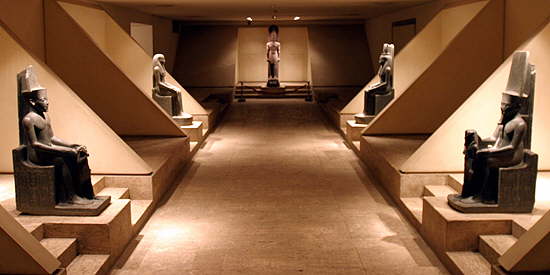
Standing on a corniche overlooking the west bank of the Nile River, the Luxor Museum was established in 1975 by the Egyptian Ministry of Culture. The two-story windowless building is only a fraction of the size of the country’s biggest museum in Cairo, but that’s okay — the Luxor Museum takes pride in the quality of its collection, rather than its quantity.

Image Source: EgyptianMuseums.net

Egypt Today notes that some of the best antiquities inside are the preserved mummies of Ramses II and Ahmose I. These are displayed without their wrappings in one of the museum’s newer wings. The first is regarded as the greatest and most celebrated pharaoh of the New Kingdom, while the second was the founder of the Eighteenth Dynasty. Both are located in a section dedicated to the New Kingdom, which marked a great period of imperial power for the country.

Image Source: EgyptianMuseums.net

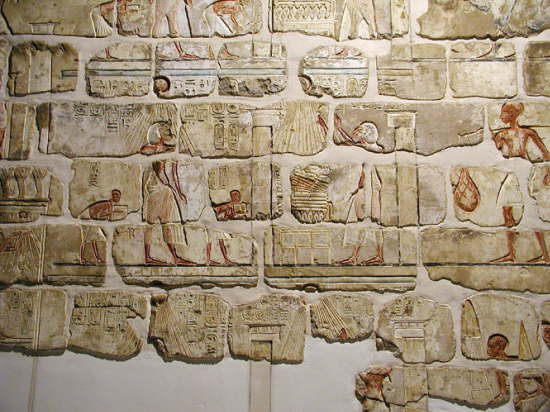
Another of the museum’s main features, this time located on the upper floor, is a reconstructed wall made up of 283 sandstone blocks from the Karnak temple built for Amenhotep IV. The wall illustrates residential and royal scenes as well as solar Jubilee scenes from the first Sed festival. This is a priceless exhibit, as very little of the actual temple remains in modern times.

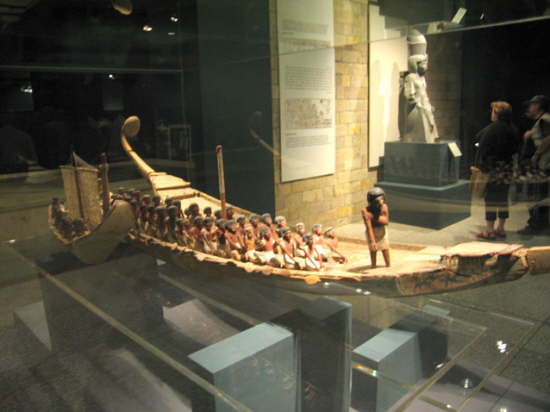
Some other of the museum’s highlights are the artifacts that have been gathered from the tomb of King Tutankhamun. Model boats, sandals, arrows, and figures of servants once decorated the area surrounding his resting place. Because ancient pharaohs believed in the afterlife and kept their most prized belongings close to their burial site in preparation, this is a major part of the museum.

Image Source: EgyptianMuseums.net

Indeed, the scale of the burial site was a major factor in the discovery of Tutankhamun’s tomb in 1922, which received worldwide media attention. It sparked a newfound interest in Ancient Egypt, a fascination that has stood the test of time. Egypt’s rich history is reflected in a wide array of modern media across the world. For instance, the fantastical film Gods of Egypt heavily draws inspiration from Ancient Egypt and even deviates from actual history in favor of creative interpretation. A more traditional depiction can be seen in a slew of video games, particularly in a collection of Egyptian-themed titles on Slingo Slots. Games like Cleopatra’s Riches, Temple of Tut, and Temple of Iris are a nod to the actual ancient history of Egypt. Though there are a few creative liberties, the images featured are more or less based on Egypt’s past — much of which resembles the surviving remnants of the ancient world housed in the Luxor Museum.

Recently, the Luxor Museum celebrated the 96th anniversary of the discovery of Tutankhamun’s tomb, acknowledging the event as a turning point in the country’s tourism and the world’s interest in it.

Fortunately, you don’t have to fly all the way to Egypt to catch a glimpse of its many relics. If you somehow find yourself in Turin, Italy, and are interested to know more about Egypt’s ancient past, you can also pay a visit to the wonderful Museo Egizio.

—-

Adrienne Chamberlain is a history enthusiast who is particularly interested in the mysteries of the ancient world. She mainly travels to see ancient structures (or at least what’s left of them) for herself. She’s already been to Egypt several times.

Chapter 11: A Reading Space in Lekki

By Anthony Azekwoh

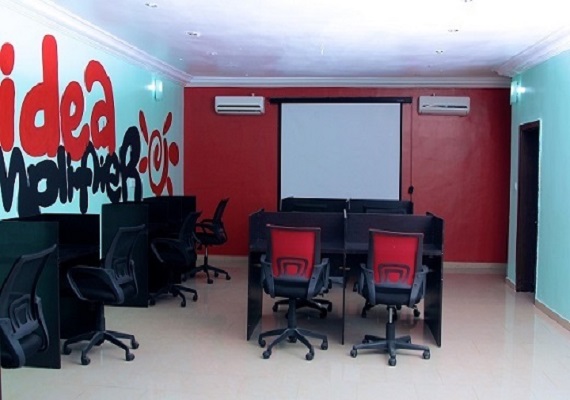
Perched comfortably on 39A Awudu Ekpegha Boulevard Street is Chapter 11, a workspace, training area and 24-hour library rolled into one.

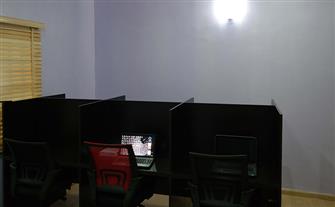
Walking in, I was immediately greeted by the warm atmosphere such a cosy space promised: air conditioning, brightly coloured furniture and secluded workspaces to allow people do their work in peace and privacy, not to mention the free WiFi. So basically, it was heaven. Getting a membership is also very easy, for three thousand naira (3000) a day you have access to all their facilities or you could opt for the fifteen thousand naira (N15000) a week plan or even the twenty-five thousand naira (N25000) a month plan. Annually, you can also get access for two hundred thousand naira (N200,000).

Met with their friendly staff, I was shown around their space. The largest room was a kind of lounge area where members could eat, drink, talk and basically relax. There were cubical seats arranged with spaces all around with work cubicles too. I was then brought to one of their workspaces equipped with pigeon holes and work areas, everyone with their head down focused on their work. There was also free coffee and other refreshments available so that was also a plus.

Being the only one of its kind around the area, Chapter 11 shines as a versatile and comfortable space for learning, working and resting. Shifting easily between its many roles and managing still to perform perfectly. Definitely, a place to be to get good work done fast.


Onward Aké – A Travelogue

by Torinmo Salau


I got to Oshodi few minutes past 7am, my plan was to take off from Lagos before 6:30 Am. Rather I found myself panting under the weight of the Khaki travel bag strapped to my back, frantic to get on the next vehicle en route Kuto, Abẹ́òkuta which finally set out few minutes to 8am.

The grey Sienna car was badly dented and its rear windscreen had a slight crack which ran diagonally across its full length. The vehicle moved swiftly, faster than I even envisaged and within 30 minutes, we were approaching the tollgate. With Ma Lo by Twa Savage and Wizkid playing quietly in the car, I tried to go through the Aké Festival program schedule on my Samsung tablet.

“Are you going to Aké too?” the husky voice who sat beside me asked, jolting me out of the thoughts which clouded my mind.

“Yes”. I wondered why he was smiling sheepishly and from the way the words rolled off his tongue, you could guess his name would either be Emeka or Ifeanyi. But I did not guess right, his name was Chike.

After conversing for some minutes, I discover that Chike is a lawyer but he daylights as a freelance writer and editor.

“Shit I forgot my drugs,” he said midway through the conversation, mumbling words I barely understood.

“I forgot my antidepressants, he continued, sounding more distressed with anxiety ripping slowly through his face. His anxiety was palpable as he shifted from left to right in his seat, visibly shaken from the reality which just dawned on him.

“Are you depressed?”

Then I realized that was a dumb question to ask, if he is not suffering from depression, then why is he is shaking like a crinkled leaf which has lost its moist to the parched harmattan wind.

“Yes, I am depressed. But I will be fine without the drugs, he said shrugging his shoulder limply. Then he turned his back towards me, looking out of the window and staring at lush green vegetation which lined the road.

We were way past Mowe-Ibafo and its environs, I knew this because there was no sight of human habitations along the road again, just signposts after signboards and signages which had rusted and were barely legible to read.

“Sorry to hear, you are suffering from depression.”

I said the word ‘Depression’ almost inaudibly, carefully curating every word I spoke like somebody walking on eggshells, eggshells which can crack just by the slightest omission of a letter.

“Please don’t be, Chike said looking away from the window, smiling, I guess he was trying to hide his disappointment.

“I get a little cranky when I miss my medication but I will be fine, it’s just for two days”.

This was the second time he was saying, “I will be fine” within the space of five minutes.

While he sounded fairly reassuring, I still felt worried. Worried by the fall in his countenance and the dark shadow cast over the bubbly persona he exuded at the onset of the journey. Wondering what the resultant effect of missing a pill or two could be, wondering why he had to repeat himself if he would really be fine?

Then the journalist in me kicked in.

“How long have you been feeling depressed?” I asked with my curiosity etched up, hungry to dig down the layers of this story, hoping it is not what I think it is.

“Two years thereabout”.

“Besides antidepressants medication, why didn’t you explore other means of managing this condition?”

“I did. I tried therapy first but it was quite expensive. Then I switched to a psychiatrist, the doctor placed me on drugs which have been more effective than therapy”.

“But contrary to what I am aware of, therapy works best, better than tying your daily existence to a bottle of pills?”

“Yes it does, for some people. But the antidepressants help to balance my moods, keeps me from bouncing from one end to the other.

“Are there any side effects to antidepressants?”

“Yes of course, especially the withdrawal symptoms which varies among individuals, ranging from anxiety, insomnia, nausea, fatigue amongst others. It can either be mild or severe.

Chike turned his back to me again, but this time, he wasn’t looking out of the window. Rather, just staring at the brown threadbare carpet on the floor of the car, which was caked with red sand. By then the song playing in the car was ‘Joromi’ by Simi, with light chatter from fellow passengers, some talking about the Spanish La Liga while others were lamenting the epileptic power supply across the country. But for few seconds, there was a transient suppression of verbal expression. The gulf of space between us was taken up by silence and it stood there for what seemed like an eternity.

Though I pretended to read a book, Chike’s words kept throbbing my mind. His mental health struggles mirrored exactly what I was going through but what I was also denying and the more I looked in, the more I saw a reflection of myself.

On some days, I am just floating through space, watching my life from a distance as my dreams and ambitions vapourize into thin air, without any drive to rescue them.  Though I feel sparks of euphoria and drift to a different time space with my heart clustered with sugary fantasies tickling my taste buds, it is not for too long. Reality always lingers and thoughts of pulling the trigger moonwalk across my mind often. I want to run away, yet I am too scared to die.

I was excited as the car approached the ‘Welcome to Ogun state’ signboard. I could feel its momentum rising to 120KM/H, as the driver drove past the Governor’s Office which was painted in the colours of the national flag, heading into town.

***

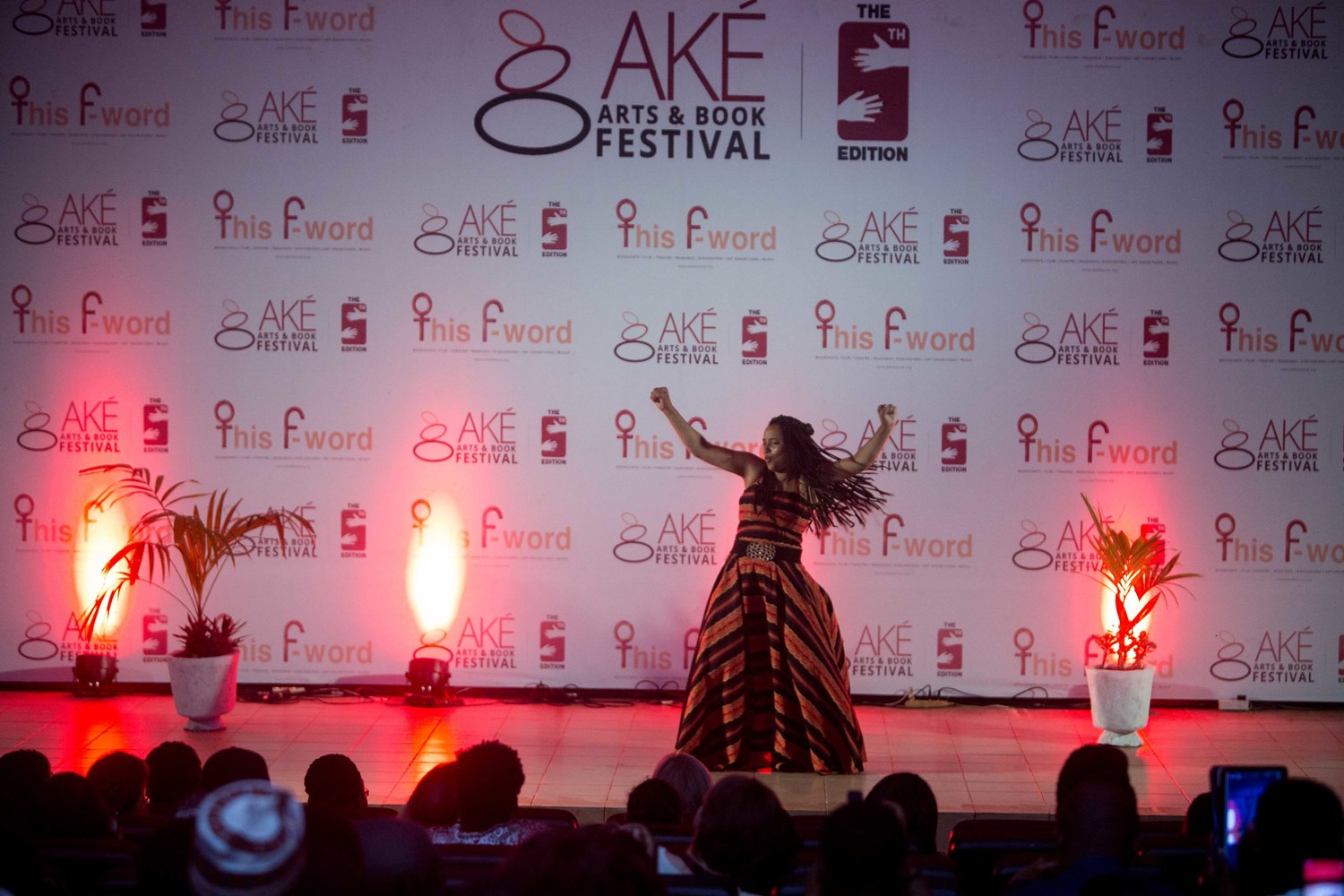
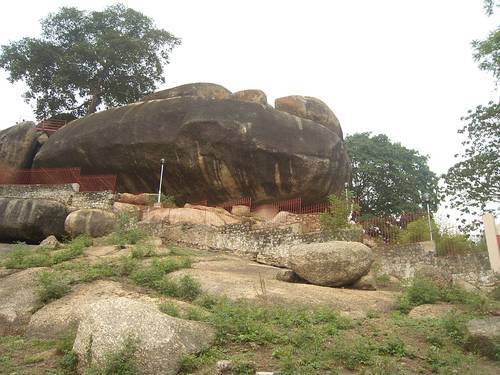
While this was my second visit to Abẹ́òkuta, the city of rocky hills within the space of a decade, it was my first time at the Ake Book and Arts Festival, the fifth edition of AKEFEST. An annual literary, art and cultural event which pools authors, creatives, writers, artists, musicians, activists to share their work and ideas. It is no doubt a booklover’s dream as it offers the opportunity to interact with some of the major voices in the contemporary African literary scene.

I found the theme for the 2017 edition of Ake Festival, ‘This F-Word’ really intriguing, this was undeniably a profound time to have this conversation and stanchly confront the issues revolving around it. But the big cherry on the cake was the headliner for the event, Ama Ata Aidoo. Renowned poet, novelist and feminist. My favourite amongst her books is Anowa, a Ghanaian play about a young girl who rejects suitors proposed by her parents and marries a stranger, Kofi Ako. Kofi is angered by Anowa’s attitude of being a modern women and asks her to leave when she could not conceive a child. But Anowa discovers later that her husband had lost his ability to bear children, so the fault was his not hers. This discovery of the truth forces Kofi to shoot himself while Anowa drowns herself.

The trip ended at Kuto, it lasted for about 90 minutes. As luck would have it, the location of the literary festival, Arts, and Cultural centre was situated right beside the bus park, along Ibrahim Babangida Boulevard, Kuto. Chike and I were the last passengers to highlight from the car, I mumbled a short prayer to the heavens, grateful for the miracle of surviving the road.

Though the literary festival was a weeklong event, precisely five days from November 14th – 18th, 2017, I arrived at AkeFest on Day 4, Friday, hoping to still maximize the best of the event within the last two days. Chike and I exchange phone number and parted ways, promising to stay in contact with each other. He wanted to hear Toni Kan speak but I ran off to the current session underway, Book Chat with Alexis Okẹ́owó and Dayọ̀ Ọlọ́pàdé.

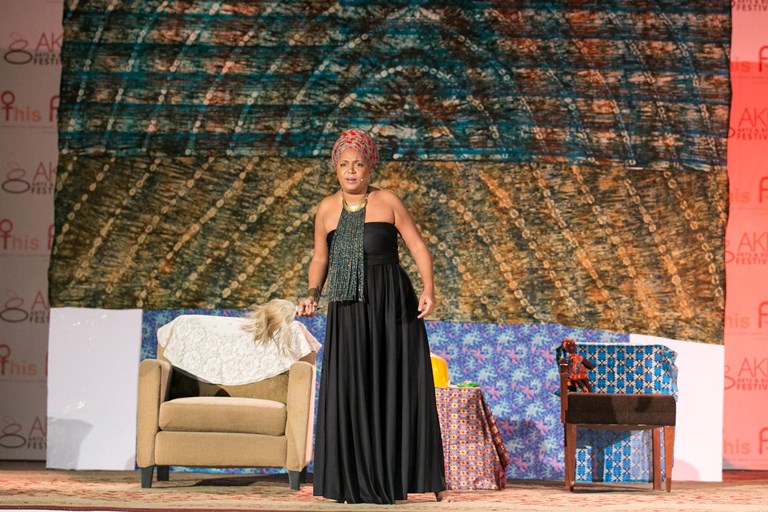
Storytelling with Mara Menzies on The illusion of the Truth was an enthralling moment as she told a Kenyan story of how Gikuyu women were not permitted to eat meat. Mara’s undulating body rhythm and the subtle tenor in her voice added more spice to the story. The fork in the road was one woman’s search for the truth and determination to fight the cultural stereotype which beleaguered women in her community. The day ended with a stage play by Yolanda Mercy on Quarter Life Crisis, a monologue which mixes expressions of spoken word and addictive baselines infused with a side dish of comedy. Most individuals go through a quarter-life crisis, but they don’t know it. Just like Alice, the main character in the story, we are swiping from left to right. Young, exuberant yet confused, not knowing what to do with the blank cheque called life, given to us. Though everyone around her thinks they know where they are going in life, the stage play which shows Alice trying to find ways to cheat growing up ends with a hilarious climax. However it doesn’t end without asking the audience with these two questions, ‘What does it mean to be an adult?’ and ‘When do you become one?’

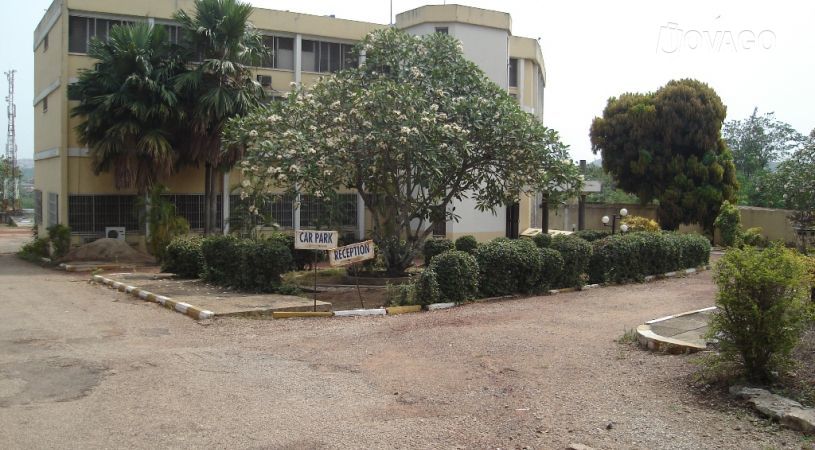
Dusmar Hotel

I retired for the night at Dusmar Hotel, situated next to the Art and Cultural centre which saved me an extra cost of commuting within Abeokuta to the literary event. The hotel’s reception struck me with a major throwback to the mid-90s, refreshing fragments of my memory littered here and there. The furniture and furnishings were quite antique. The windows, still the same old model fitted with louvres reminded me of an incident I did not want to remember and I would rather not talk about it. But I found myself wondering why a hotel bore this type of window fittings even in the year 2017, though mildly nostalgic yet largely traumatizing.

Day 5, Saturday, the event was winding down but more people were still pouring it. As the literary festival teetered towards its climax, everything became fast paced. People frantically buying discounted books and F-Word books from the bookshop. The flashlight of cameras everywhere you turned to, as people tried to seal the memories and friendships formed within the space of five days. There was a book signing spree, authors inking their thoughts on books purchased by readers and their fans which was consummated with the millennials’ trademark autograph, Selfies!

My highlight of the day was the Life and Times session on Ama Ata Aidoo. The renowned author who has been writing for over sixty years spoke liberally about her life, work and feminism. It was an emotionally charged atmosphere for many in the hall as she paid an emotional tribute to Mariama Ba, Flora Nwapa, Buchi Emecheta and other women pioneers of African writing.

“I hope you will extend the love and appreciation, you have shown me to my sister writers – living and past.” But what stuck with is the last line of one of the poems she read, “A girl’s voice doesn’t break, it gets firmer.”

***

I returned to Lagos on Sunday morning with a belly full of feisty aspirations, determined to change my misconceptions about feminism. Also to commit myself to unlearning and relearning, as the words of Mona Elthaway persistently rings in my ears, ‘Fuck the Patriachary’. Part of the main insights gained from the Ake festival is the universality of our experience as women whether black, white, or queer and why it is critical to challenge the elephant in the room, especially peculiar societal norms and beliefs which have repressed us decades.

____________

Torinmo Salau’s work has been published online and offline in literary publications, magazines, and anthologies.

My Korean Nostalgia

It has been about two weeks since I returned from the Korean Peninsula as a guest of the Ministry of Culture for the PyeongChang Humanities Forum, a culture Olympics of sorts, but my heart has remained in the country. It had dawned on me, long before I got on the plane that took me out of Incheon Airport, that this is a special place. From the first welcome, through all the stops at Seoul, Pyeongchang, Busan, and other places in-between, the country warmed itself (a curious word since it was freezing cold in the subzeroes for the duration of my trip) into my bones. And now, I realize that I will never be able to read any news story about the Korean crises without a personal pull.

There is a story in the Wall Street Journal this morning about a successful concert at the at the Gangneung Arts Center by the North Korean orchestra attended by an audience of South Koreans of all generations in which the prospect of peace and unification again came within reach, even if only sentimentally. While I was in Korea, we had taken a trip to the Demilitarized Zone and learnt through a television in the bus, right before entering the Civilian Control Line, that a delegation from the North had entered the country through the same entrance just a few minutes earlier. They had been sent by Kim Jong Un as an advanced team to prepare grounds for sending the athletes that the North had agreed to have participate in the Ice Hockey event under the same (unification) flag along with the South, and in the same team. It warmed my heart up. (This has happened, by the way).

Almost everywhere we visited in South Korea, but none more pronounced than the DMZ areas, there is a palpable sense of hope for an eventual unification of the two countries under peaceful terms. It sometimes felt too jarring when compared to the rhetoric I’d been familiar with, from outside looking in, about a prospect of war that appeared real almost every day and with every tweet from the POTUS. Almost everywhere at the DMZ had something about ‘unification’ or ‘freedom’. The road we were on was called Freedom Road. There was a house at Paju that had boldly written on it “End of Separation, Beginning of Unification” in English, Chinese, and Korean. It’s unlikely that any North Korean would see it from across the border a few miles from there, but it showed an attitude that permeates everywhere I looked. The people of the South would want nothing more than a chance to reunite with their long lost national siblings.

A question I’ve been asking since I’ve been back is not just the North feels the same way (we have seen many defections to know that some appetite for this exists) but whether the outside forces will let it happen. In this case, we have China on the one hand whose communist hegemony is threatened by a unified Korea under capitalistic/democratic terms, Russia (which, to my surprise at its enormous size, does share a national border with North Korea as well) on another who has formed an inscrutable relationship with Kim Jong Un and would want nothing more than another outpost with which to poke the US, and then the administration of Donald Trump in America who have done nothing more than stoke flames of war in a transparent attempt at shoring up support for their unpopular domestic and conservative agenda. Listening to the media tell us about the possibility of peace, it comes through an inevitable path of war or denuclearization where America wins and Kim Jong surrenders to the will of Mr. Trump. The latter seems improbable, leaving us only the possibility of war. But the situation on the ground didn’t seem to offer only this binary. Watching Koreans live their life as normally as anyone can, with nothing resembling the worrying anticipation with which others around the world look at the peninsula brings up the possibility that some other less inflammatory resolution to the conflict can be found. I don’t know what it is, but maybe we should ask the Koreans rather than saber-rattle from afar as we’re wont to do. By ‘we’, I mean Donald Trump and the US.

In any case, this was supposed to be a recollection of my fond memories of Korea, and not a rant on global politics. When I watch the winter games on television today, I will remember walking through the ski village in Pyeongchang, watching the workers prepare the venues for the athletes, and wondering why anyone will leave their house to come compete in such a cold weather. But I will also retain a hope for the eventual unification of the country on more favourable terms to those who live in it and whose futures are tied to its peace and security, away from the many competing interests of the global powers.