‘Better soup na money kill am’ | Good things don’t come easy
‘E don tey wey nyash dey for back’ | There is nothing new under the sun
‘Cunny man die, cunny man bury am’ | It takes a thief to catch a thief
‘Na condition make crayfish bend’ | Hard times encourage adaptation
 Over 500 languages are spoken in Nigeria today, according to most accounts, although many of them are dying, endangered, or extinct. Three major languages spoken more widely than others are Hausa in the north (with about 70 million speakers), Igbo in the east (with about 24 million), and Yorùbá in the west (with about 40 million speakers). Other languages include Edo, Fulfude, Berom, Efik, Ibibio, Isoko, etc. Because of the multiplicity of languages in the country and the need to communicate among different ethnic groups, English, or Nigerian English, has served as a connecting tissue, but only in formal circles: schools, government, courts, etc. In the informal sector, however, where most Nigerians function every day, in the markets, on the streets, at restaurants, Nigerian Pidgin (NP) has emerged as a crucial and important feature.
Nigerian Pidgin doesn’t have its roots in English, but in Portuguese. In about 1456, when the first Portuguese ship reached Senegal via the Gambia river, to Sierra Leone about four years later, and other parts of the region in due time, they made contacts with famous kingdoms like Benin, Ghana, Mali, Songhai, etc. Benin at the time, now in present day Nigeria, was said to be one of the oldest and most highly developed states in the coastal hinterland.
To trade with these kingdoms and establish a cordial relationship beneficial to both parties, a mutually intelligible language had to be employed. It is unclear what kind of Portuguese these sailors spoke, but it is possible (and even likely) that they spoke a crooked and unrefined one, also befitting of that societal class of illiterate seamen. The contact of that pirate-type ship-lingo Portuguese with the language of the coastal Africans resulted in what eventually became Pidgin, and later Nigerian Pidgin.
At the time, however, it was a mere contact language, retaining elements of both cultures, enough to facilitate communication along with hand gestures and other universal signs. But it got the job done and helped cement the relationship between the seafaring Portuguese and the West African kingdoms. So that when the British showed up hundreds of years later, they found it easier to communicate with the indigenes, through a later variation of this language which, likely, had undergone sufficient evolution. This later contact with the British, via the slave trade, missionary invasion and colonialism further improved the intelligibility of the language, with English words added to supplement the earlier Portuguese ones.
The use of the word ‘pidgin’ in identifying the language as it exists in Nigeria today has added some confusion to understanding its current state. To linguists, a language is a pidgin only in the initial state of its creation, when it serves as the lubricating vessel of communication between two strange peoples (in this case, between the early Europeans and Africans). After a generation of contact, the language begins to evolve, with words and phrases from either language and others, introduced to flesh out the skeletons and give the language a unique character. At this stage it stops being just a ‘contact language’ and becomes a living one. We call this stage ‘creolisation’.
The creolisation of Nigerian Pidgin happened gradually, with the adoption of the language not just as a contact lingo with Europeans but as a native language of contact and of trade with other ethnic groups in Nigeria. This is the characteristics of the language that helped it become the most used language in the country by the time it got independence from the British in 1960. By then, coastal communities, though with other native languages of their own, had adopted NP as a full native language and spoken it among themselves and to their children.
The syntax of Nigerian Pidgin is similar to the local West African languages than the European ones. That probably explains why it used to be called ‘Broken English’, or ‘Broken’ for short, when it was perceived to be a language of the unschooled, unsophisticated people, a language spoken by those unable to grasp the complexity of English. To say ‘I am leaving’ in NP, one would say ‘I dey go’, which is a lean and simple rendering of that basic action. ‘I will be right back’ is rendered as ‘I dey come’. This simple syntax, covered with the fleshing of English, makes it easy to use by Nigerians who eventually adopted it as a local language.
However, Portguese still has some influence. Words like sabi and pikin, which came from Portuguese ‘saber/sabir’ and ‘pequeno/pequenino’, words for ‘know’ and ‘little child’ respectively, have remained in NP, to mark the true origin of the language. So, for example, ‘You sabi dat pikin?’ means ‘Do you know that child?’ As you’ll notice, the pronunciation has also evolved as well, so that a ‘th’ is pronounced instead as a ‘d’.
There are also many different dialects of Nigerian Pidgin today, depending on where it is spoken. Because words are borrowed from each of the languages that have influenced NP – words like àbí (a question marker) and ṣé are more common in the west, while words like nna and unu come from Igbo in the east. The Niger Delta has the highest concentration of NP speakers and here the version spoken is widely regarded as the most authentic form, sometimes as a first language. Places like Sapele and Benin are regarded as norm-producing communities, where the language has the most root and influence.
And of course, because of the diasporic migration of Nigerians to other parts of the world, there are more refined NPs spoken today across the world, from Peckham to Chicago, Houston to Baltimore. They are not markedly different from the Nigerian versions, except in accent, influenced by their new environments and company.
It is estimated that NP is the most spoken language across the Nigeria today, spoken as a first language by over 30 million people, and as a second language by the rest of the country (about 140 million). However, the language has never enjoyed the respect of the country’s elites. It currently has no official status and is neither used in education, or governance. But in the early 60s, through the efforts of early Nigerian writers in English like Wọlé Ṣóyínká, Chinua Achebe, JP Clark, Ken Saro Wiwa, and Cyprian Ekwensi, fully formed Pidgin-speaking characters were introduced to Nigerian literature. This helped elevate the language a bit more into the mainstream.
In Nigeria today, NP functions in informal capacity, lubricating contact and communication between people of all classes, gender, ethnic groups, and educational status. It is the language of the streets, and of uneducated market women in cosmopolitan cities. The flavour infused in each expression from the speaker’s original ethnic background continues to enrich the character of each individual output.
Where NP has dominated, however, is in the informal sphere of television and radio entertainment, in Nollywood and the Nigerian music industry, which reaches not just all Nigerians, but also most Africans. Fẹlá Kútì, the inventor of Afrobeat, played no small role in mainstreaming Nigerian Pidgin through many of his hits like Follow Follow, Trouble Sleep Yanga Go Wake Am, Teacher Don’t Teach Me Nonsense, etc. On the streets of Nairobi, Johannesburg or Accra today, one is likely to hear ‘Wetin dey?’, ‘Wetin dey happen?’ or ‘How far?’, or any one of NP’s common greetings (meaning: ‘What’s up?’, ‘What’s going on?’, ‘How’re you doing?’) even in the mouths of non-Nigerians. This has happened through the influence of Nigeria’s entertainment industry.
 In 2009, a ‘Conference on Nigerian Pidgin’ at the University of Ìbàdàn proposed to drop the name ‘pidgin’ altogether, and call the language ‘Naija’, a nickname once reserved for referring to the country in an endearing way. This has not caught on beyond those academic circles, and it likely never will because of the tension between what the academic intervention represents (stiffness) and what NP truly is (dynamism). It is the jolly playfulness, accessibility and musicality of NP that continues to help convey the convivial spirit of Africa’s most populous country, along with colours and sound, to the rest of the continent.
________
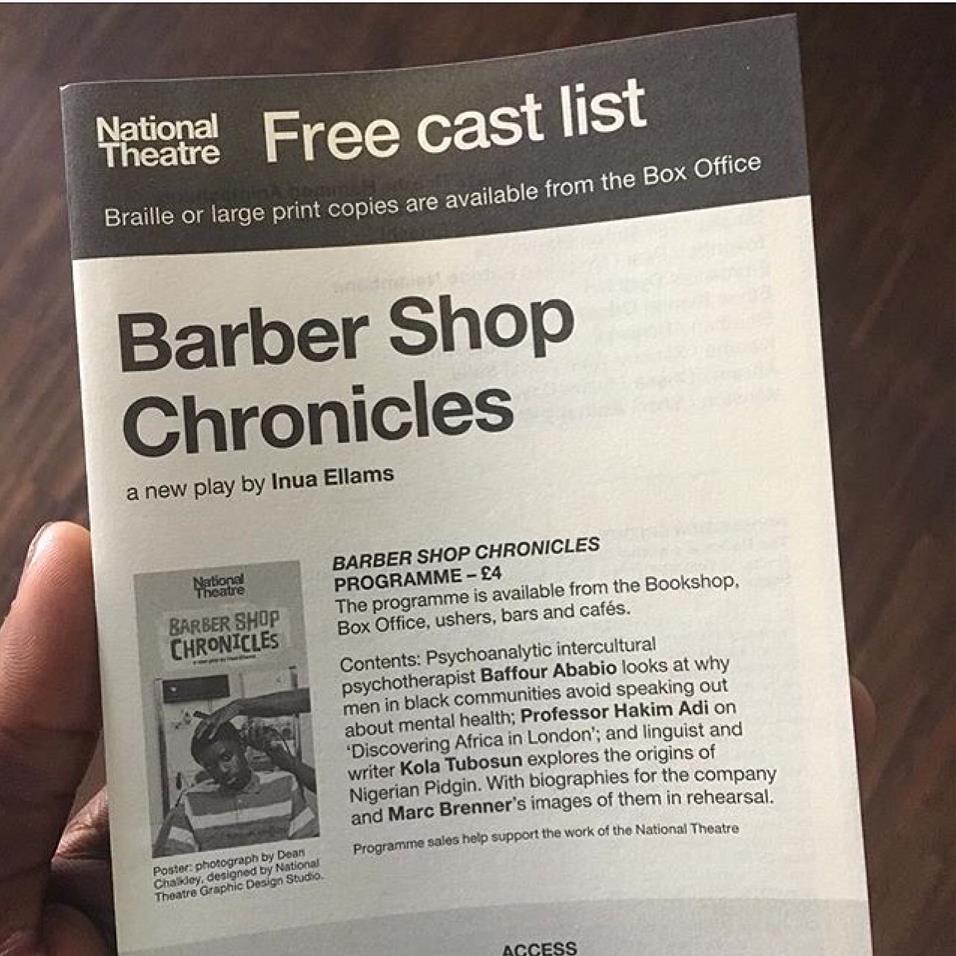
First published by the National Theatre, London, as companion to the play Barber Shop Chronicles by Innua Ellams, showing from May 30, 2017. The reference to Ken Saro-Wiwa and Fẹlá Kútì, added later, regretfully did not make it into the original text.
________
References
- Portuguese Explorations and West Africa https://www.cliffsnotes.com/study-guides/history/us-history-i/exploration-and-early-colonization/portuguese-explorations-and-west-africa
- “Benin Empire” on Wikipedia. The Portuguese in Africa, 1415–1600 http://www.metmuseum.org/toah/hd/agex/hd_agex.htm
- John McWhorther “Portuguese Pidgin That Never Died” http://itre.cis.upenn.edu/~myl/languagelog/archives/003935.html
- Merriam-Webster’s Dictionary
- Ethnologue.com
- NAIJA Proceedings of the “Conference on Nigerian Pidgin http://www.ifra-nigeria.org/publications/e-papers/conferences/18-naija-proceedings-of-the-conference-on-nigerian-pidgin