By Ikeogu Oke
(Being the Acceptance Speech for the 2017 Nigeria Prize for Literature)
The Way I Want To Go
What you do you must do on your own.
The main thing is to write
for the joy of it.
– Seamus Heaney, “Station Island”
Father has called and warned me not to go
The way I want to go:
“It is no life you spend among the trees!”
Mother as everyone at home agrees.
And good opinion says the trend of the era shows
That those whose pen must feed must write in prose.
“To write in verse,” they say, “is agony.
For poets,” they press, “do not make money.”
And I have given thought to what they say,
While alone and headed on my way.
The wisdom of the world and age apart,
The truly wise must listen to his heart.
And yet the poet should not deny his pain,
Or fail for lack to stress his fair bargain.
For if poets do not make money,
Then, neither does money make poets.
O World, Thou Choosest Not
O world, thou choosest not the better part!
It is not wisdom to be only wise,
And on the inward vision close the eyes,
But it is wisdom to believe the heart.
Columbus found a world, and had no chart,
Save one that faith deciphered in the skies;
To trust the soul’s invincible surmise
Was all his science and his only art.
Our knowledge is a torch of smoky pine
That lights the pathway but one step ahead
Across a void of mystery and dread.
Bid, then, the tender light of faith to shine
By which alone the mortal heart is led
Unto the thinking of the thought divine.
– George Santayana
Let me proceed by thanking all of you for honouring the invitation to attend this event, and the Nigerian Liquefied Natural Gas Limited without whose commitment to the growth of Nigerian Literature we might not have gathered here.
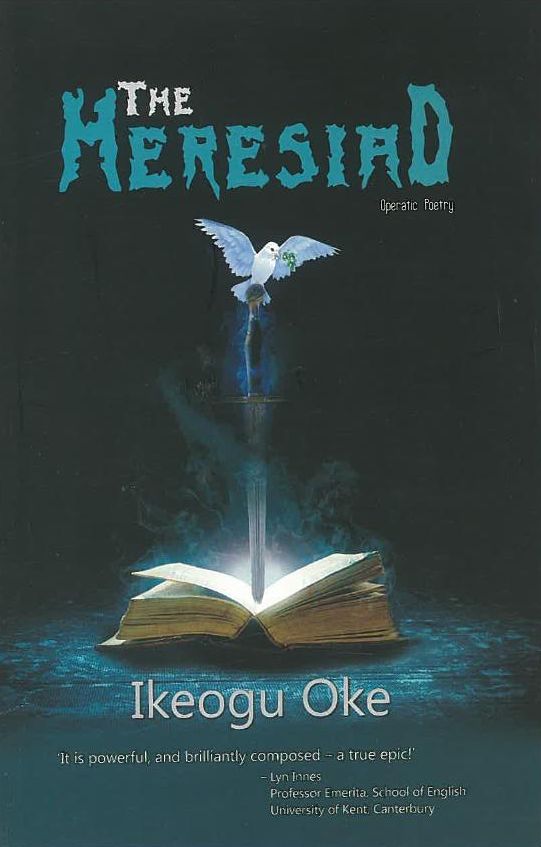
I am grateful to the panel of adjudicators for the 2017 Nigeria Prize for Literature for pronouncing my entry, The Heresiad, as the winner, vindicating my expectation. I believed the entry rule which stated that the adjudication would be based on merit. Merit is a value to which I am strongly attracted and cherish highly but which, alas, Chinua Achebe described as “quite often a dirty word” in our country. And I believe its entrenchment in the affairs of our nation, beyond such adjudication of literary prizes, can have far-reaching transformational effects.
In a world in which we do not always get what we deserve, and fortune does not always favour the most qualified or hardworking, I think we should all feel humble and appreciative for any success we achieve. This, besides happy, is how I feel as the recipient of this honour. To the Nigerian Liquefied Natural Gas Limited, the members of the Advisory Board of the Nigeria Prize for Literature, and the award-giving judges, I say, “An award-winning poet salutes you!”
I thank my publisher, Kraft, our chef of delicious books, for indulging my insistence on perfection. I thank my fellow poets for a great contest, especially my fellow finalists whose calls to congratulate me for winning was for me the hallmark of literary sportsmanship, a profoundly moving gesture. I thank my father, an unceasing fount of fond memories. He taught me the virtues of hard work, steadfastness, self-belief, self-denial and sacrifice. Without his lessons I might not have devoted twenty-seven years working on The Heresiad, running a compositional marathon and expecting no reward beyond the satisfaction, after crossing the finish line, that I had run a good race. I thank my family, especially my wife and children, for enduring the quirks of a restless poet.
The first of the poems I have furnished as an epigraph to this speech has served me as a literary manifesto since I wrote it about fifteen years ago, as a response to the concerns expressed by those who thought my career choice of poetry was a waste of time and tantamount to entering into a life-long pact with penury. Poetry is the only healthy narcotic on earth. I am happy to be addicted to it as shown by my refusal to be swayed by such concerns. I have invoked the poem here hopefully to arouse the contemplation of how one’s resolve to pursue one’s dreams in spite of such concerns is the best decision that can lead to a fulfilled life.
The second, a sonnet by George Santayana, is my polestar of inspirational poetry. I have invoked it here because I believe its cardinal themes of vision, faith, self-belief and resolutely acting on one’s dreams reinforce and anticipated similar themes in my own poem.
That way, we can all see that if I were to say, as part of the use to which I wish to put this historic opportunity to speak to you, that vision, faith, self-belief and resolutely acting on one’s dreams are virtually all one needs to attain one’s purpose in life, and perhaps inspire those among us who still have the courage to dream dreams, especially the young, I would not be a solitary voice in some poetic wilderness.
So you can see that some master, far wiser than I, had said it before me. And that the veracity of his words, even when subjected to logical scrutiny, is proof that the poet does not lie whether he speaks for faith or reason, or in any circumstance whatsoever. And that he perhaps deserves our attention more than we are currently inclined to give it to him – in our own interest.
And need I, as one of such other circumstances of proof that the poet does not lie, point out that the experience I relate in “The Way I Want to Go” regarding my family and “good opinion”, took place only in my imagination, even though it hints at real behaviours? My family members will disavow it if their idea of truth is confined to the literality of events, and infer that the poet lied, and if they lack the understanding that the truth as spoken by poets may be but need not be literal, in the sense of being a rendition or reflection of a physical occurrence or phenomenon.
 In the wake of my announcement as the recipient of this honour, I spoke with someone who shared with me the challenges he is facing in becoming a successful writer. From our conversation I drew a hint – I believe rightly – that he would like me to lead him into the secret to success in the literary vocation.
I have also been asked repeatedly, “What kept you going all these years?” by various individuals, some of whom are interested in becoming writers. I believe the question seeks to elicit a similar response from me to that of the acquaintance who shared his challenges about succeeding as a writer with me.
Unfortunately, I do not know the secret to success. Nor do I think that writers would have a different secret to success from the rest of humanity. If I knew such a secret, I would readily reveal it to end the difficulties we all face as human beings in making our dreams fructify. And, not knowing any such secret, I offer these admonitory words, drawn from the depths of my personal convictions, in lieu of my ignorance.
Believe in yourself. Commit to a dream only you have the last say in its survival, so you may not despair even if you must stand alone in its pursuit, ignored by the rest of the world. If they tell you that your dreams are impossible, ignore the first two letters and move on with your dreams. Give all you have to what you do and love it with all your heart. Do it with your whole heart, with integrity, seeking first the kingdom of excellence for which other things should be added to you. But still plan to end up only with the satisfaction of having laboured for the love of your vocation, in case nothing more is added to you. Time is too precious to waste doing something you do not love even if it brings you fortune.
In life you will meet people who will try to snuff out the candle of your dreams. You will meet people who will help to keep it burning. I have been fortunate to meet more of the later type of people and I hope that becomes your lot too. But you have the final say as to how long the candle of your dreams will keep burning, regardless of what others tell you. And never forget that the fruits of vicious dreams often harbour the bitter taste of comeuppance.
There is no greater mission in life than making others genuinely happy, bringing them healthy joy. You are a success however you are able to accomplish this. Those you bring true happiness will ensure your success by patronising the means by which you do so.
Never accept the circumstances of your birth as a limitation to the realisation of your dreams, even if they are more fraught with lack, more underprivileged, than mine. From the age of twelve, in secondary school, I was constrained to earn all the money I paid as school fees from menial jobs because my parents, though responsible and firm in their resolve to give all their six children a good education, could never have earned enough to do so owing to inhibitions imposed by their own underprivileged backgrounds.
I can even say that I am proud of my heritage of an underprivileged background for teaching me the invaluable lessons of self-denial, of delayed gratification, and the transcendence of hard work, far better than I might have been taught had I come from a privileged background. And these, in my view, are important lessons for success.
And if, in spite of the privation associated with being lowborn, I can arrive at the privilege of being the recipient of this extraordinary honour, so can any child born of poor parents, any parent in fact. It can be any child who can set forth at dawn1, set their goals and priorities right, pursue them with single-mindedness, and be ready to crack their palm kernel if no benevolent spirit2 shows up to crack it for them. It can be any child who understands that, as Thomas Carlyle said, “Perseverance is the anchor of all virtues.”
Also, that I stand here today disproves the charge that Nigeria does not reward merit, excellence or hard work. My experience that culminates in this event is proof that it does, that it is actually a land of possibilities in which even improbable dreams can come true in spite of the crying need to make it “a more perfect union” as the former Unites States President, Barak Obama, once said about his country.
It is an experience more sour than sweet, more painful than joyous. It includes waking up one morning about sixteen years ago to realise that my severance benefit from my first job from which I was retired prematurely and placed on pension at thirty-three years, after fifteen years’ untainted service, had been trapped
– and it remains trapped – in Savannah Bank, following its closure for an alleged breach for which the depositors who bore the brunt of the precipitate closure by the authorities were not responsible. It includes being persecuted out of several jobs by bosses averse to propriety in the workplace.
But what does my current experience say? The same land that can rip hope out of your breast can restore it in manifolds if you will not give up on it.
I have a story,
I shall tell it without vainglory,
A story to inspire,
And light men’s souls with fire.
The primary role of the poet is to create beauty with words, like other types of artists whose primary roles are to create beauty through their various mediums of expression. Yet, we know that art is hardly, if ever, unalloyed with functionality. That it is almost always applied and hardly pure. That even its affective function implicates inherent applicability, if utilitarianism. That it is hardly ever strictly an ornament.
And, as poets and other forms of artists, I think we should never cease to ask ourselves if we should be satisfied with merely creating beauty through our work in a world in which ugly occurrences constantly threaten such beauty. To pose it as a question: Should we plant gardens and allow them to be overrun with weeds, or adorn our world with our work and overlook its being blighted by injustice and other ills that may threaten its peace? Or, put differently, can we not be cultivators of beauty as well as what Niyi Osundare calls “the eye of the earth,” using our work to police the earth against harm, while engaging in other possible activities to improve its lot and cultivate its wellbeing? If we say yes to the former and no to the latter, which should be surprising especially for the former, then why do we praise Pablo Neruda’s Spain in Our Hearts3? Why do we commend Pablo Picasso’s Guernica? Why do we acclaim Nadine Gordimer’s My Son’s Story, Wole Soyinka’s A Play of Giants, and many more of such remarkable works of art which meld their originators’ love for creating beauty with their interest in championing a better world? A Stradivari violin, an Amati, are beautiful objects. But from that beauty we extract music, and our world is better off for it. Art is basically an instrument for transmitting aesthetic pleasure. But it can transmit more. And artists can consciously make it transmit more for the betterment of our world.
If permitted a singular use of metaphorical license, I would describe The Heresiad as a mirror of a poem as a dreamer and pacifist, among other germane inferences that may be drawn from the work. For while defending the various freedoms I think we should all uphold as humans, those freedoms that form the bedrock of liberal values, especially freedom of expression, it urges their exercise with sensitivity to the legitimate feelings and interests of others. And even in the face of an offensive breach of such sensitivity, it encourages supporters of the offender to pacify the offended by acknowledging the offence. It then urges the latter to show leniency, as in the last of its following couplets spoken by one of the loyalists of Reason seeking to prevent the execution of the death sentence pronounced on the author accused of heresy in the poem as an aftermath of his exercising one of such freedoms:
And though I have the will to face their five,
And help our protégé to stay alive,
I’ll rather urge their anger, just but high,
To view his error with a lenient eye.
(Canto II, lines 197-200)
And even in the face of an imminent armed confrontation, the poem creates a hero, Reason, who makes a personal commitment to pursue his interest in saving the author without recourse to arms. Thus:
And Reason, mounted on a higher ground,
Waited, as his anxious thoughts unwound,
And while he waited muttered to himself
(As he focused on a granite shelf):
“I still think that strife cannot be proper;
No weapon fashioned for my use shall prosper;
I’ll go, unhurried, with the one they seek,
Though his hope may now be worse than bleak;
If the power of thought cannot avail,
Then the force of strife must not prevail;
If persuasion cannot help our cause,
Nor, I think, can any lethal force.
To explore the argument of grace – I go,
And take my thoughts for arrows and for bow!”
(Canto III, lines 607-620)
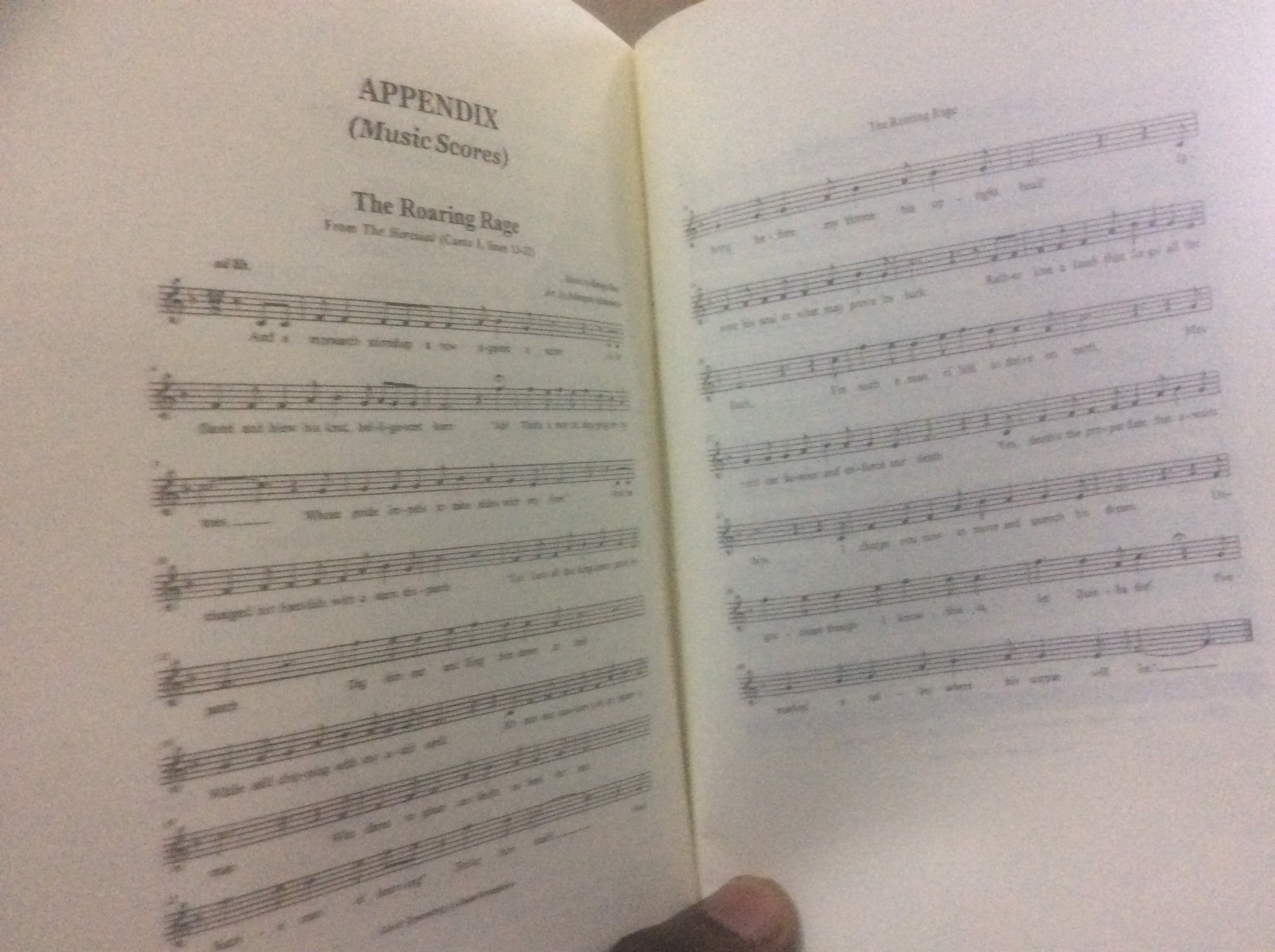
Here, then, lies the essence of the poem as a dreamer and pacifist: its simultaneous envisioning of the de-escalation of conflicts strictly by conciliation and their resolution through personal commitment to eschew the use of arms. In fact, it offers these, within and beyond the bounds of verse, as general principles for engendering peace in the world. They are also reflections of my belief that, though as artists we must fulfil our primary obligation to create beauty through our work, we can also make art more useful by using it to stimulate the evolution of a more liveable world. The poem does the latter by promoting peace (in a context that integrates respect for life) among countless options of such engagement open to artists across the world. And I have tried to do the former by creating such a book-length poem whose every line can be sung and set to music, making it a book-length art song, a musical epic in four cantos that may also be described as a literary symphony in four movements. I call it operatic poetry, a new genre of poetry intended to open new frontiers for its enjoyment. For I consider its action, drama and music primed for realisation – and to be realisable and awaiting realisation – as opera. And I clearly anticipate the materialisation of this artistic vision like the world which, as Santayana reminds us, Columbus found without a chart.
I might not have entered for let alone won this prize but for a friend and fellow writer who read the manuscript of The Heresiad and asked me to submit it for the prize, describing it as “a magnum opus”. Though flattered by the description, I hesitated, explaining that it was unpublished and needed more work before I would consider it publishable. He later wore down my resistance with his gentle insistence. Would we have been here today, I on this side of the proceedings, but for his special encouragement? I doubt it.
To this inspiring friend, Wale Okediran, I dedicate this prize, and to many others like him who offered various forms of encouragement for the twenty-seven years I worked on The Heresiad.
“We must always give back,” Nadine Gordimer, my friend and mentor, said to me at our last meeting before her demise in 2014. To this friend I have given back a token of a poem, entitled “Goodwill and Destiny”, that is also a song. But I have modified it to the following lines for the purpose of this speech and have had it set to music, which I consider the worthiest companion of poetry.
I crave your indulgence to rise and join me and let us read and sing it as believers in the value of goodwill, friendship, gratitude, and as a song of universal brotherhood, and to the glory of the Nigerian Liquefied Natural Gas Limited, my Muse, the Ebony Pearl, and Nigerian Literature, addressing the fourth and sixth lines respectively to the male and female next to us as we read and sing:
 We are what we are because of others
With whom the heavens steer our lives like rudders.
And may the heavens gift your life a rudder
Like this brother from another mother;
And may the heavens gift your life a rudder
Like this sister from another mother.
________
Footnotes
- The phrase “who can set forth at dawn” alludes to a title of a memoir by Wole Soyinka entitled You Must Set Forth at Dawn.
- The phrase, “ready to crack their palm kernel if no benevolent spirit shows up to crack it for them”, alludes to a remark by Chinua Achebe in Things Fall Apart about those whose palm kernels have been cracked by a benevolent spirit not knowing that the cracking of palm kernels is hard.
- A translation of Espana en el Corazon (Spanish), the original title.
_______
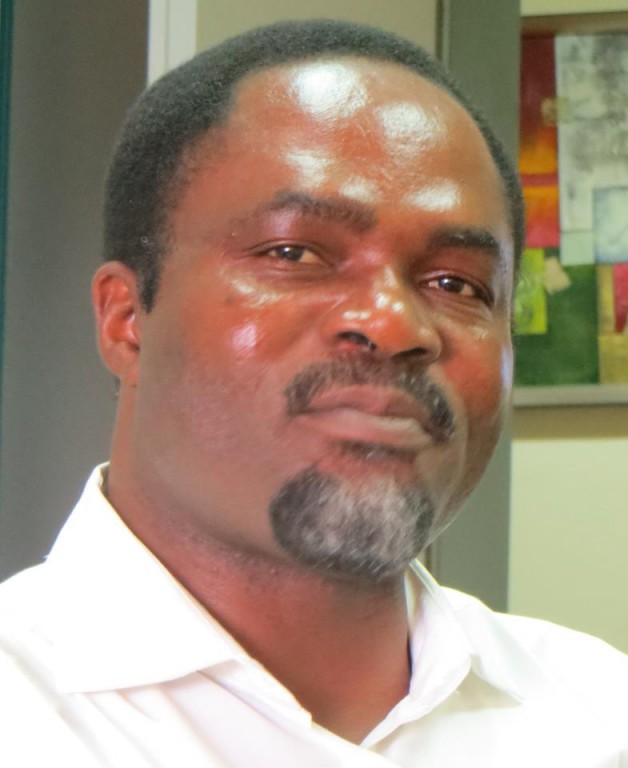
Ikeogu Oke is the winner of the 2017 Nigeria Prize for Literature (Poetry) for his volume The Heresiad
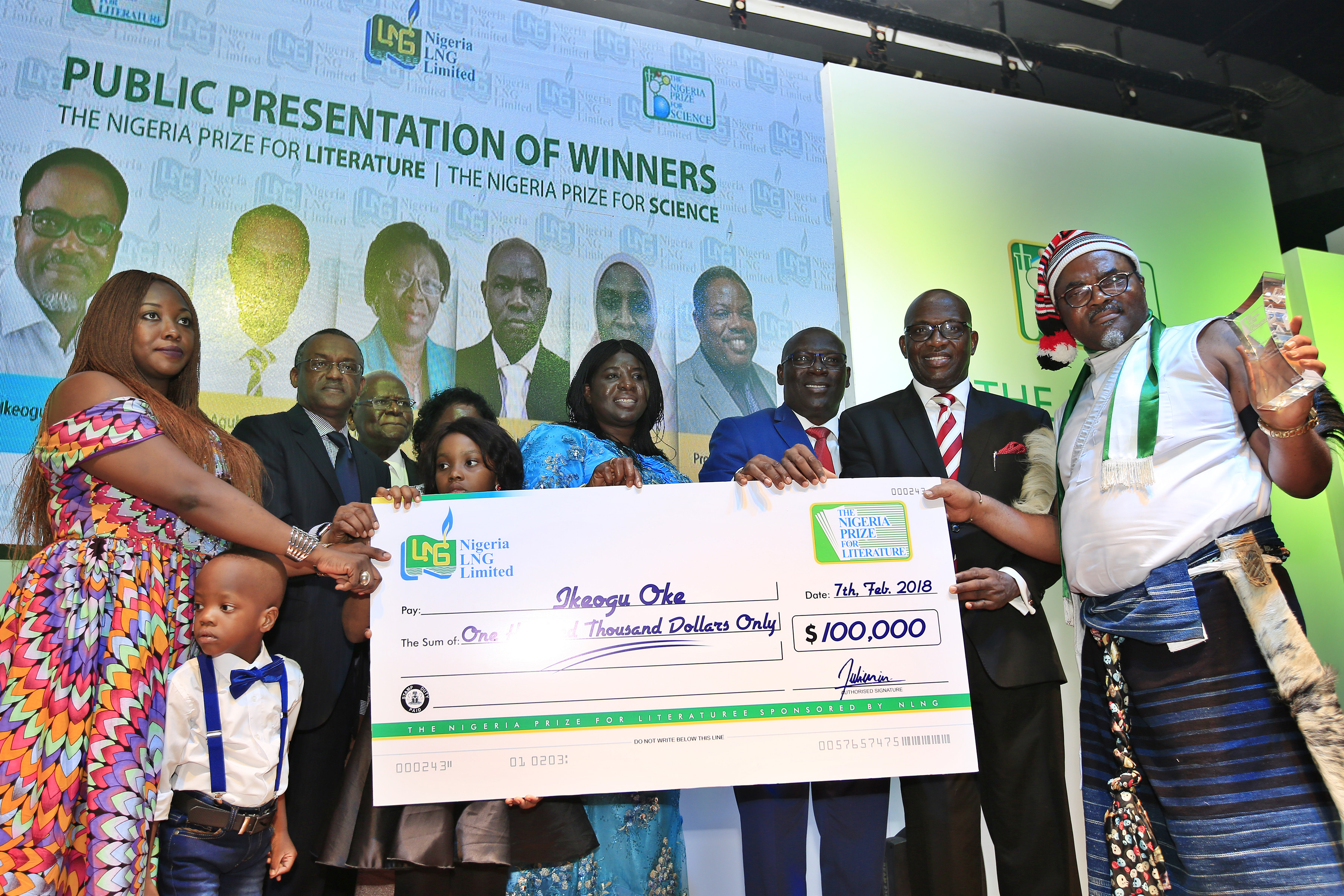
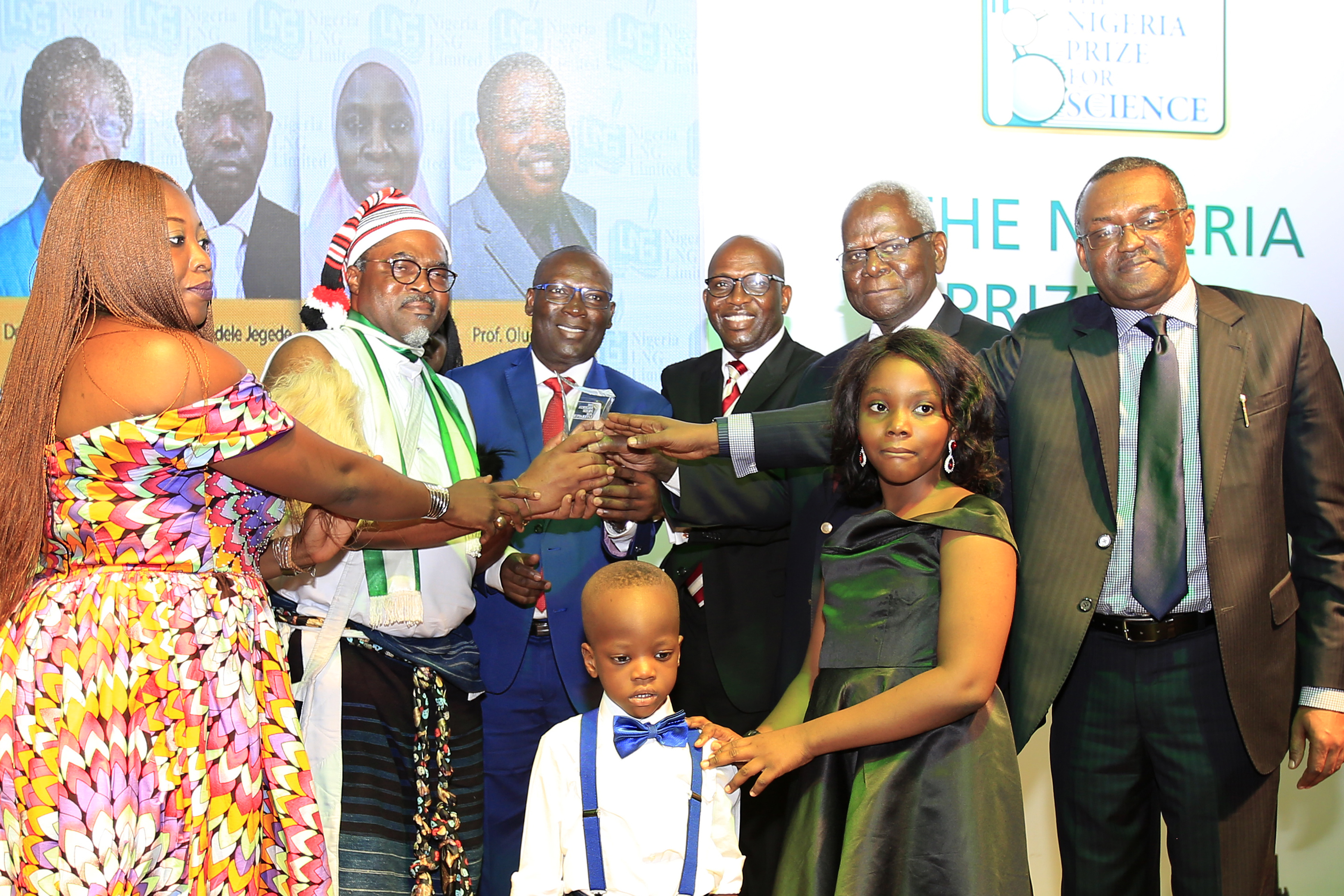 Nigeria LNG (NLNG) Limited, yesterday at a Public Presentation in Lagos, formally presented The Nigeria Prize for Literature and The Nigeria Prize for Science, which come with a cash prize of $100,000 each, to four winning entries that emerged from the 2017 cycle.
  The Nigeria Prize for Literature has since 2004 rewarded eminent writers such as Abubakar Adam Ibrahim (2016, Prose) with Season of Crimson Blossoms; Sam Ukala (2014; Drama) with Iredi War; Tade Ipadeola (2013; Poetry) with his collection of poems, Sahara Testaments; Chika Unigwe (2012 – prose), with her novel, On Black Sister’s Street; as well as Adeleke Adeyemi (2011, children’s literature) with his book The Missing Clock.