By Obinna Udenwe
 Imagine yourself being driven in a car, early in the morning as rain drizzles. Imagine that you are travelling along a well tarred road, with woods all around you and a huge mountain stretching far into the horizon in front of you as the drizzles forms a mist that clouds the sky and makes the whole environment foggy. Imagine that the car’s wiper is swish- swooshing and slashing at the little drizzles of rain that drops on the windscreen as you travel with few others to climb a famous rocky mountain.
Having resided at the Ebedi International Writers Residency, in the serene town of Iseyin in Western Nigeria for over four weeks as a writer-in-resident, we decided, my fellow residents and I, to visit the famous Okeado Mountain. It was on Saturday, the 2nd of August 2014. Early that morning it drizzled so much that if formed a mist separating every other objects before us from the vehicle. We drove slowly from Iseyin town till we got to Ado-Awai, the town housing the rocky mountain.
On approaching the town, we could see rocky hills with green vegetations looking so beautiful that one would be tempted to build a tent on them, we brought out our cameras and phones and began to take pictures excitedly – but because we were in a moving vehicle, the pictures were distorted. Our guard, who is a teacher in one of the schools in Iseyin town, advised us not to rush leaking a hot soup, since the soup belonged to us – we were going to climb the main mountain itself, he argued, so we needn’t worry about taking snapshots of the offshoot hills.
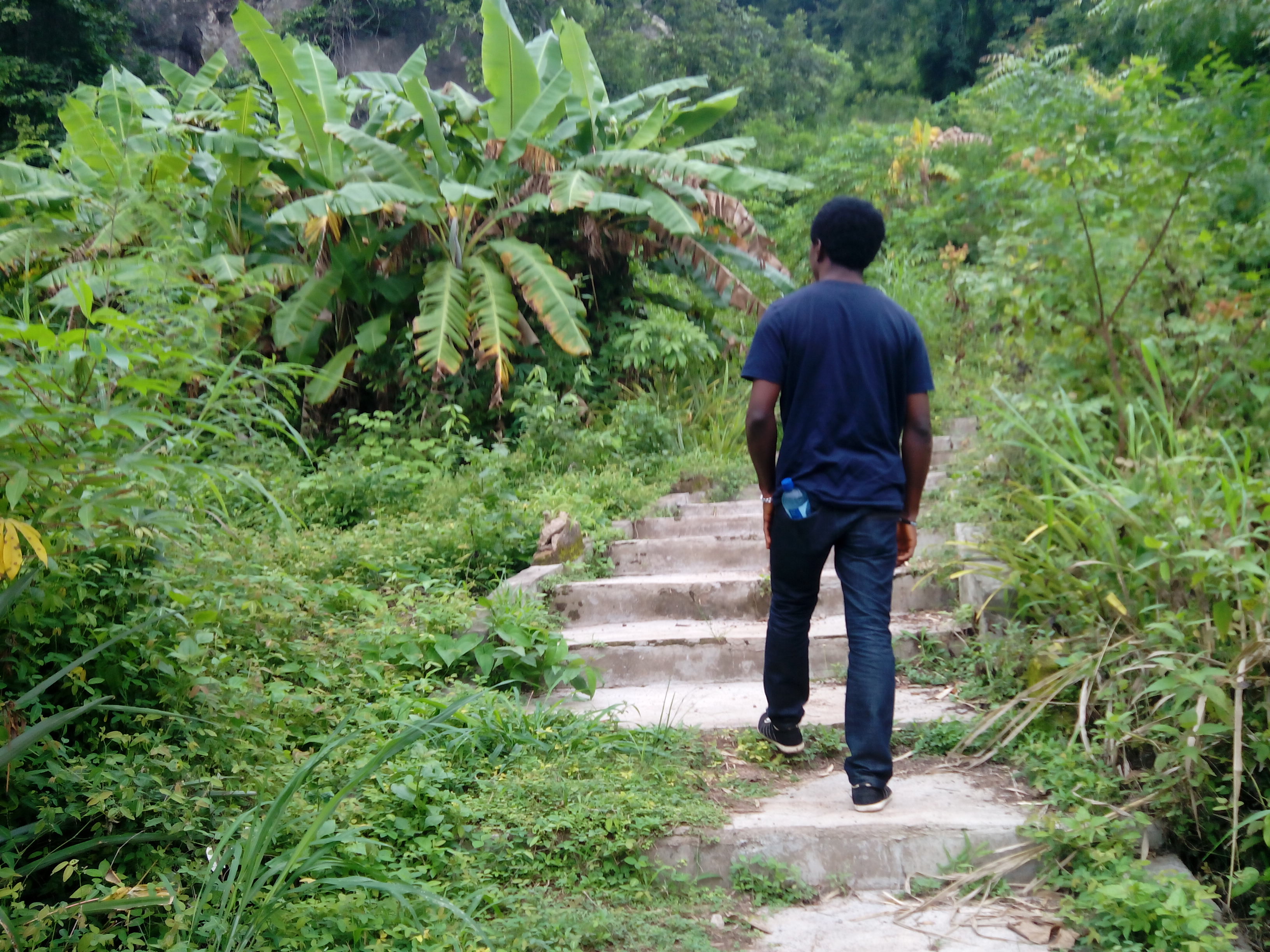 Okeado Mountain sits in between the two villages of Ado and Awai which together forms the community Ado-Awai. As we drove through the village, we saw few petrol filling stations already opened for business. There were women seated by the roadsides frying akara balls even though it was drizzling. We saw customers who had lined up waiting for the fried grounded beans mixed with fresh pepper and oil. There were shops scattered all around the village and people walking about, attending to their businesses. Our driver who is a friend of Mr Kofi Sackey, the Residency’s Admin Manager, drove into the park that leads to the mountain.
The park had green lawns and a primary school with dilapidated structures in front of it. There were massive trees that had lived more than twenty years each – jacaranda plants, azaeirachta indica, mangoes and other varieties of trees that we had never seen before. We alighted from the vehicle: Paul Liam a fellow resident writer and I, Mr. Sackey, the driver and his friend, the teacher who was to serve as our guide, with his son – a boy of about eight years old. We marvelled at the beauty of the forestry surrounding the foot of the mountain. There were huge bulldozer tyres at the foot of the trees where visitors could sit and rest before climbing the over one thousand steps built to ease access to the mountain top. There was a European style bungalow with dilapidated windows where the mountain administrator lives, with flowers and trees surrounding it.
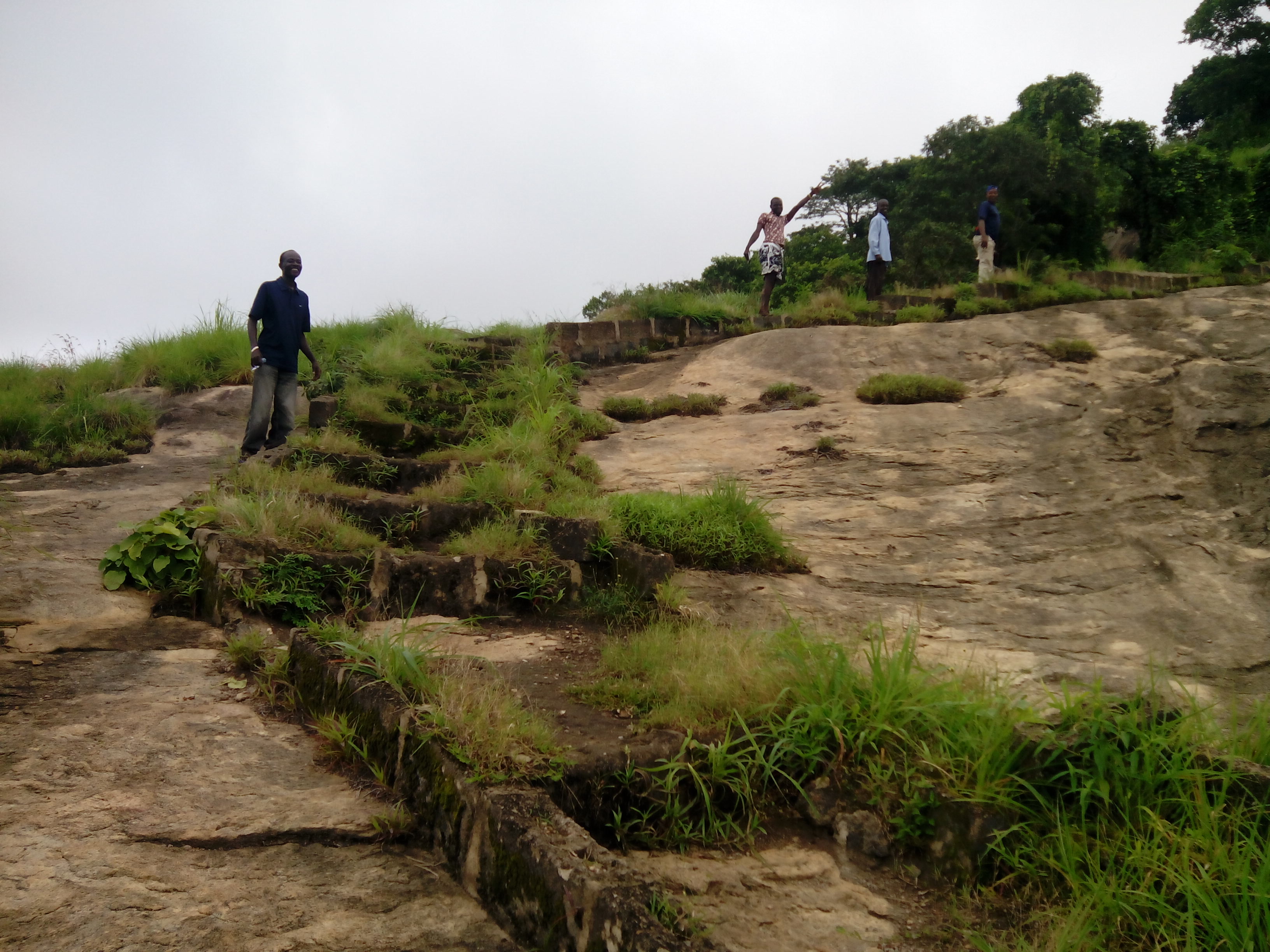 From the park we could see the foot of the mountain and the high-rise stairs that leads to the top. Without the steps, which was built few years earlier, when a native of the community became the Deputy Governor of Oyo State, it would have been very difficult to ascend the Okeado Mountain. The cements and blocks used in constructing the steps were wearing out. And the rise and fall of the steps were so tall that one would have to raise their legs very high to access them – which made the climb very daunting – but nonetheless a blessing because without the steps the mountain could only be accessed by professional climbers.
We were all eager to begin the journey up the mountain top. As we ascended the stairs we were brushed this way and that by grasses and leaves from various unidentifiable trees that merged their blossoms to bless us with nice fragrances. It continued to drizzle as we made our way up the stairs to the first hill. Up there we were amazed by what we saw – a vast table rocky area that could accommodate car parking spaces and buildings, with various rocks that were formed in very amazing shapes. Our breaths ran away from us and we were stunned when we beheld the Isage rock – one would never believe this, but the rock was about eight feet tall, and about six feet in diameter, standing on another flat large rocky area on the hill, without any support whatsoever – we wondered how the Isage rock had managed to stand for thousands of years on its own without any support and not falling off. We marvelled at the gift nature had given to man. The rock had a white silky cloth material wrapped around it, and when we met the Mountain administrator later on – an elderly man who could probably be in his late sixties, he explained that the cloth material wrapped round the Isage rock was sent always from a by a wealthy Nigerian who lived abroad, whose mother was named Isage, after the rock – he explained that the man’s mother was probably birthed after her parents had prayed before the Isage rock for the gift of a child.
 The teacher who served as our guide explained that people from all over climb the mountain to pray and pay obeisance before the hanging rock. We continued our climb. There were no steps for the ascension was less difficult. We were informed that hundreds of years earlier, the villagers had lived on top the Okeado Mountain, because it was safer to live up there and avoid brutal attacks from enemy villages – up in the mountain they could easily ward off any attack, by rolling down rocks on their enemies as they tried to climb up. We were told that the best strategy the ancestral dwellers employed was to cook very slimy soup like the local ewedu in large quantities before an enemy attack or war. They would pour the soup on the rocks making them slippery and difficult for enemy warriors to access.
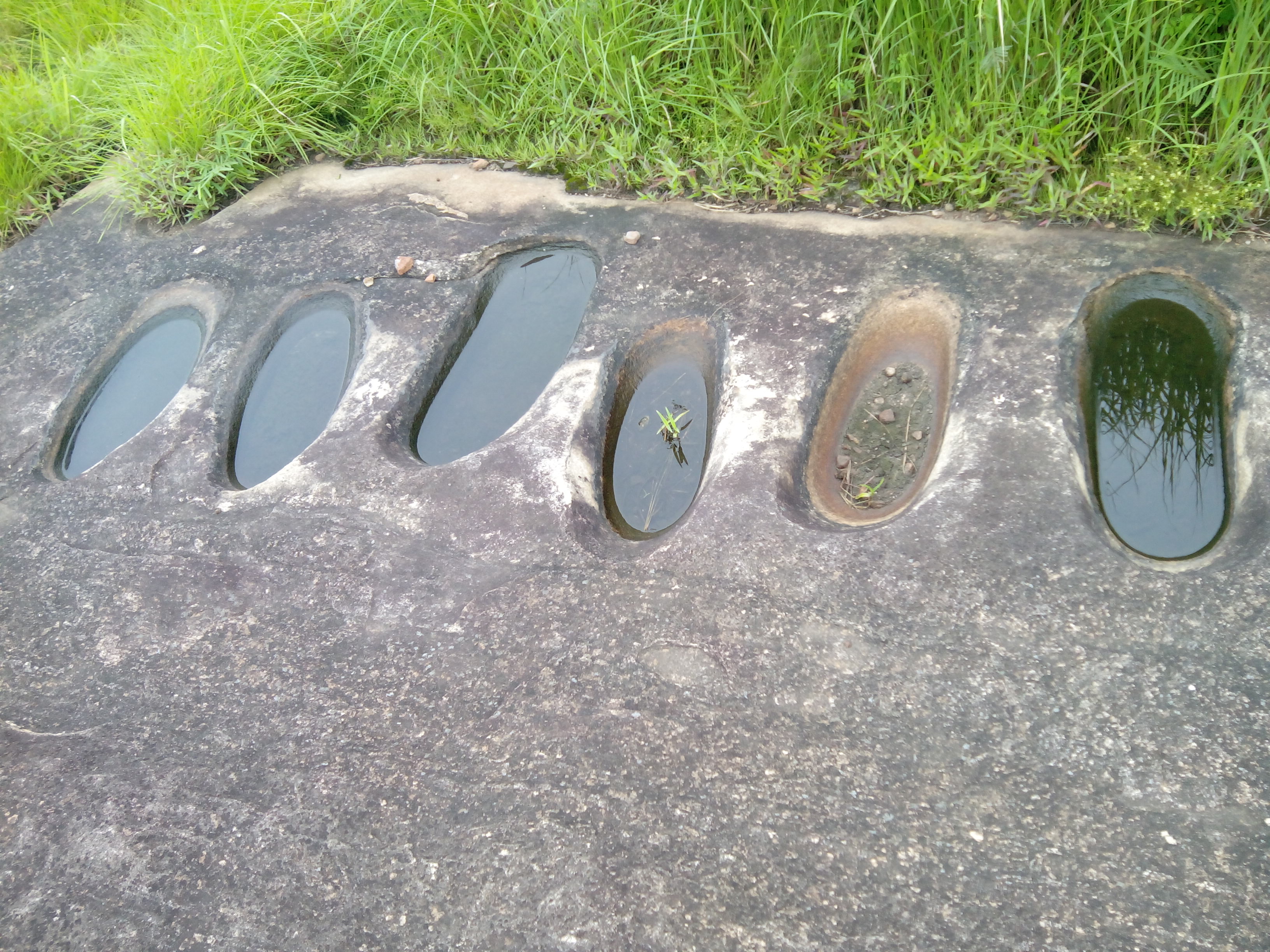
Soon enough we were walking along flat rocky parts – it amazed us as we noticed that the whole mountain was rocky after a kilometre walk from the Isage rock area, only a few places with formation of valleys had plenty trees and grasses. We were shown a kind of valley where the villagers lived. It was a large land area surrounded by rocks and hills with green vegetations and various trees hundreds of years old. The land area could accommodate over one hundred huts. We continued our walk down the rocky hill travelling on a rocky level area. On the rocks we were amazed to see various uncountable rectangular holes indented on the rocks that our guard explained to be made by elephant footsteps many years earlier. He explained that the holes collected water in them and the villagers when they lived up their scooped the water in the mornings – not long after this explanation we saw various holes on these rocks containing water. The holes looked so beautiful and magical such that one needed no explanations to understand that actually they must have been made by large footsteps of something that could be bigger than elephants or if not so, like scientists would explain, formed soon after the lava from the volcano that formed the rocky mountain had settled and cooled.
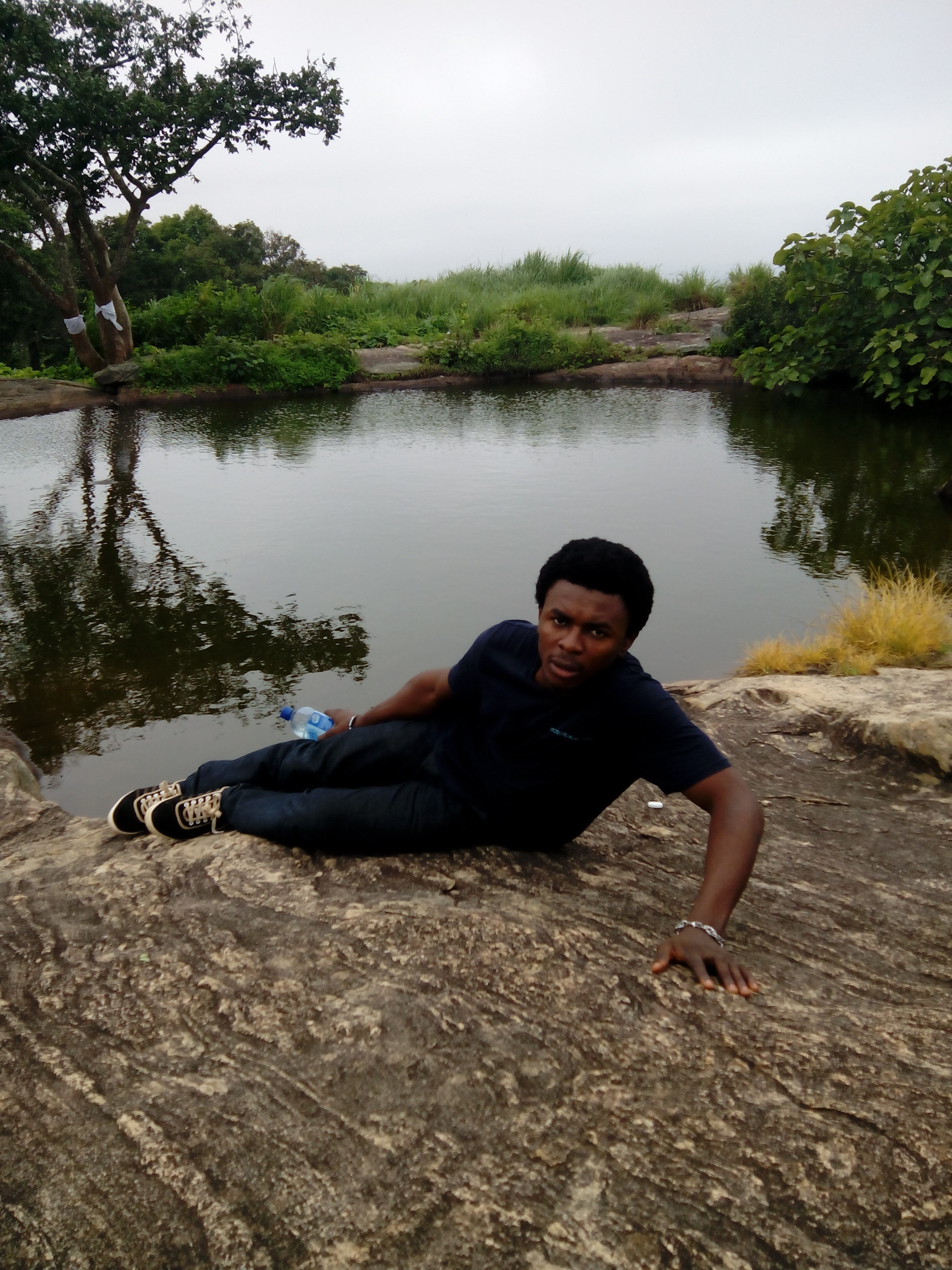
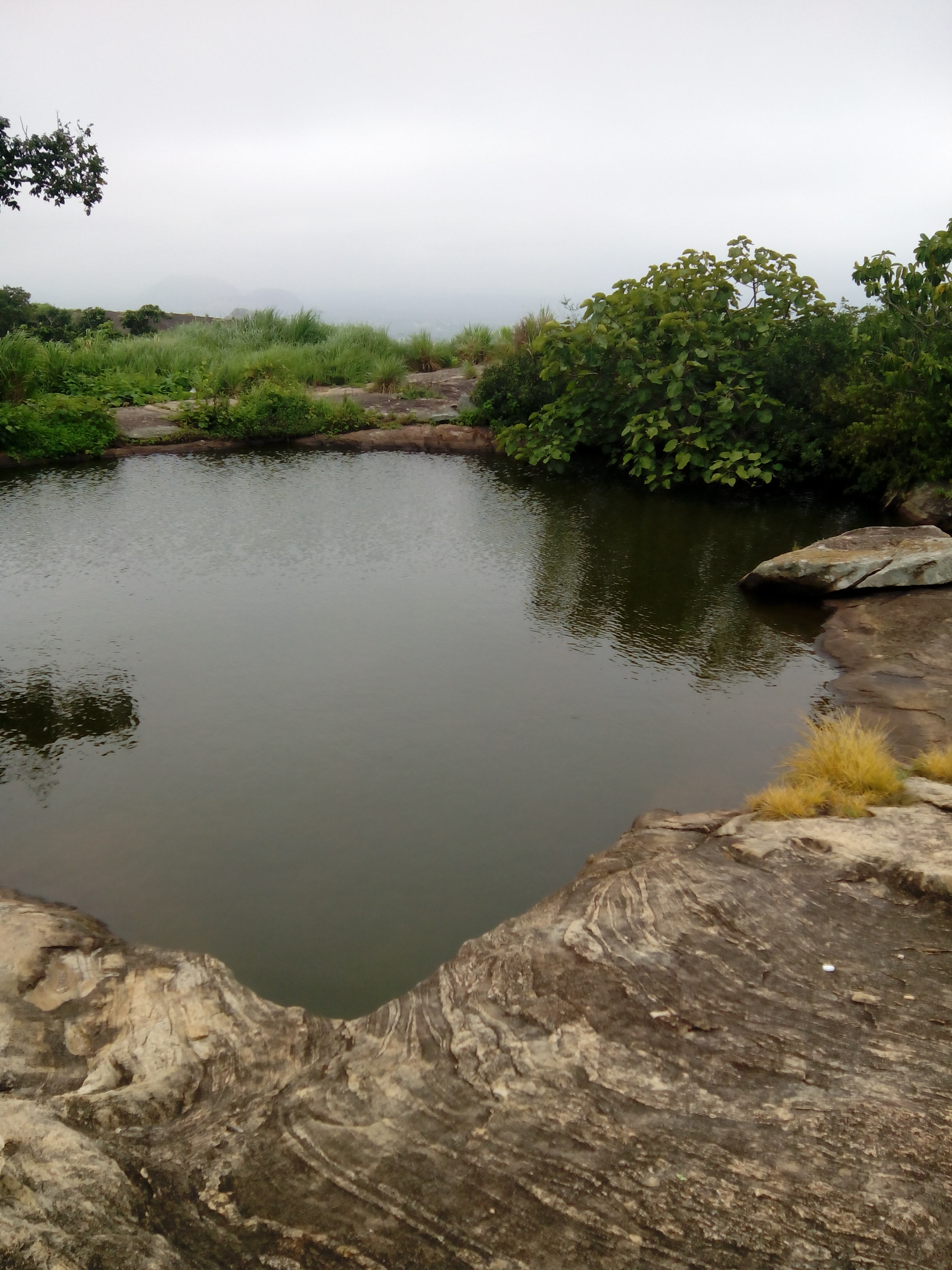
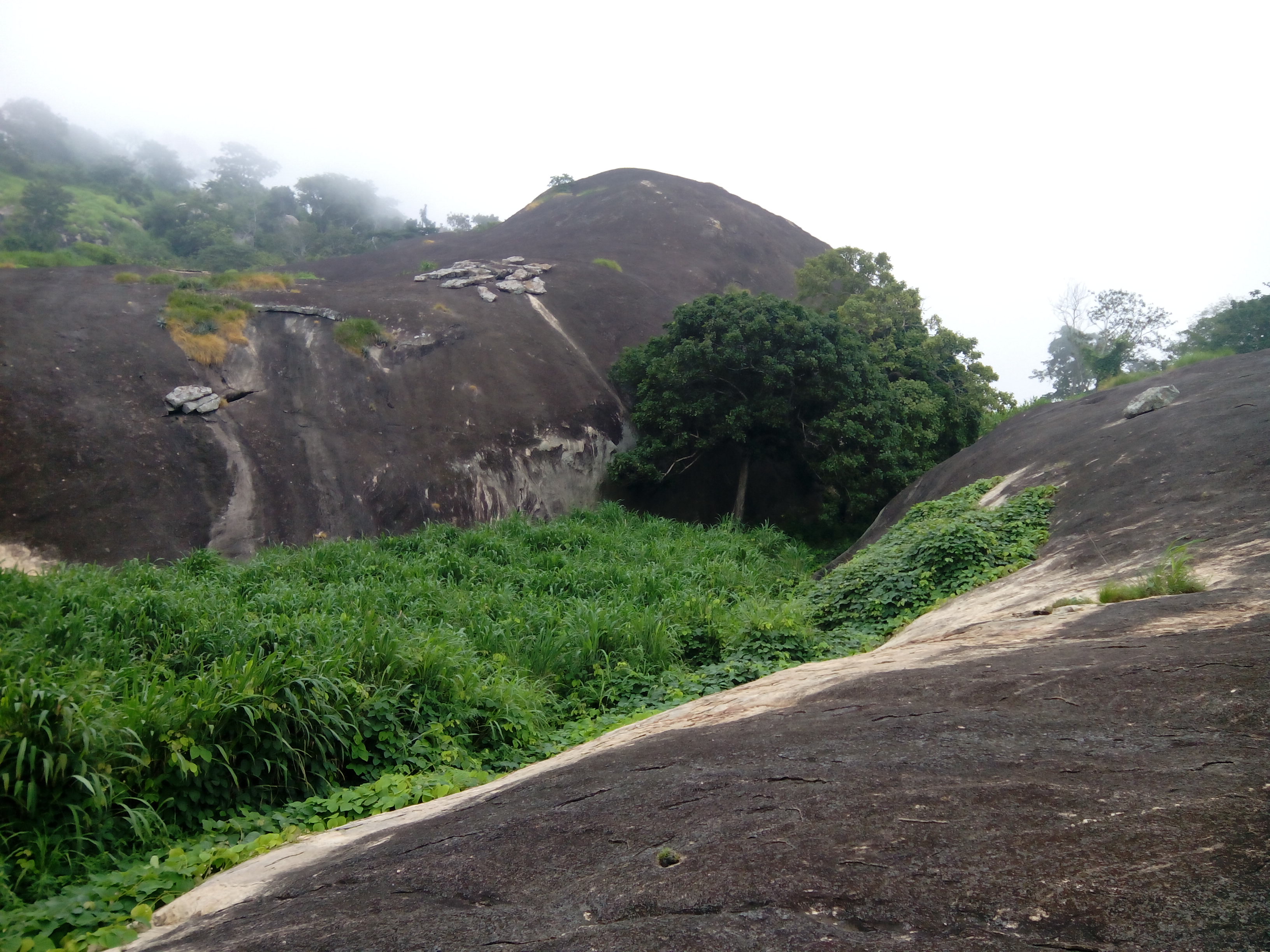 We travelled few miles, giggling, laughing, running and lying spread eagled on the rock to take snapshots and shouting into the empty space. From the rocky Okeado Mountain one could catch a glimpse of villages, rooftops looking as tiny as mosquitoes – as if watching a town from an aircraft far in the sky. We walked down the rocky terrain farther down the hill till we met what we had actually travelled to admire – the famous suspended lake. The suspended lake is named Iyake. It sat like an obese woman at the centre of a very large smooth rocky hill. The rock where the lake was seated was so large that it could accommodate over two hundred people at a time. Our guide informed us that members of some Celestial churches dressed in white garments visited the lake to drink from its water, pray before it, hold vigils for many days and sleep all around it. We admired the rocky beds surrounding the lake. On these rocky beds there were countless pieces of papers with inscriptions. These papers were held to a place against the winds with stones. We bent and read some of the inscriptions – a woman asking for fruits of the womb, another asking for a husband, a man asking for wealth, favours, another asking for child, and some asking for protection. We read and mulled over various supplications, our guard explained that the villagers held an annual event beside the lake, and it was during this annual ritual that people came to ask for favours. And if one’s favours were granted by the spirits that reside in the Iyake Lake the beneficiary would come with gifts to pay obeisance. He informed us that people visit the lake to make prayers everyday and collected the lake water in cans that they drank for various reasons. There was a small tree some feet away from the lake with a silky white garment tied round it.
 It was still foggy up in the Okeado Mountain – the wind was soft and gentle, and created ripples of crests and troughs on the Iyake Lake – the ripples lured one to step into the lake that looked like a huge swimming pool but we were warned that if one entered the lake they would never show up. We were told the story of a white man who visited the suspended lake in the 1930s and tied a chain around his waist, asked his friends to hold the end of the chain and plunged into the lake to seek the source of the water and never came out till date. We were told of a teacher who came with his students on an excursion, entered into the lake and his body floated the third day, he was long dead.
Our guard narrated the incident he witnessed – few years earlier, he told us, he had visited the lake with other teachers from his school and their school principal drank from the lake, which people often drank from to cure various ailments but no sooner had he drank the water than he started vomiting. When they took him to the hospital and he couldn’t respond to treatments they took him to the custodian of the lake, a chief priest who explained that the ill-fated man had committed an abominable act prior to visiting the lake. The Principal admitted that he had slept with another man’s wife a night before he visited the lake, the priest gave him a concoction to drink and he became well there and then. We marvelled because the story wasn’t a fairy tale, our guide experienced it himself and mentioned the name of his school Principal to our driver, his friend.
He told a story of two men who were contesting over a child many years earlier. The elders brought them to the suspended lake and took an oath that if they threw the child into the lake and it floated out to where any of the men stood, he would take the child. The child was thrown in and it never came out, but few days later, the child was seen floating alive in a water-well close to the home of one of the men.
 We marvelled at this magic and respected the spirits inhabiting and guarding the suspended lake. When we had taken enough pictures we walked down the rocky path. There were people’s names inscribed on the rocky ground, registering their presence on top the mountain like spacemen in the moon. We saw some abandoned cooking stuff which our guard explained where used to prepare ritual meals during the last ritual at the lake – he informed us that during the rituals every meal that was cooked and not finished would be poured into the lake. We saw gun powders on papers placed at various places on the rocky hills, used by hunters at nights as bullets for their local guns to hunt animals.
After less than a kilometre walk we came to a valley in between two massive rocky hills, with green and beautiful vegetation where we were told that the kings lived years earlier. We were shown the area around the valley where warriors positioned to guard the kings against intruders and enemies.
We were told that some white tourists would visit the mountain with their tents to picnic and relax– but aside those that came for recreation, when we climbed down the mountain, a task that was almost as daunting as the climb up, we were told by the administrator about the Celestial white garment church members that held long retreats around the lake, bathing people with the lake water and singing and dancing to God-knows-what. The administrator informed that those churches, did not worship God but some evil spirits who they came to seek on top the mountain. He explained that around the waists of the leaders of those churches he would see various charm beads. He informed us of men seeking wealth and who had been directed by various spirits to climb the mountain and sleep there for days without food or water. The administrator explained with nostalgia his fears – that as he climbed the mountain up to seven times daily, he would nurse some fears because of young people desperate to make wealth who might seize him for rituals and he feared sometimes, members of the Celestial churches and various countless people that had access to the mountain on daily basis.
The elderly man who looked very young because of the daily exercise he engaged in – climbing the mountain regularly, explained that the suspended Iyake Lake was far more potent now than it was at the time of his ancestors – that almost every time people would visit to pay obeisance and offer gifts because their prayers before the lake came to fulfilment, others, he explained would come to thank the suspended lake for its waters had cured one ailment or malady. He said that he had informed the Ministry of Tourism that they should erect a barricade around the suspended lake so that it could limit access to it except if he authorized that after careful scrutiny of the people seeking to access it.
True to his words, as we climbed down the mountain, we had noticed two elderly men with big plastic cans climbing up the mountain to access the lake water. When the men had seen us, they had said ‘Well done, may your prayers be answered.’ We knew that they thought we had gone to pray before the lake.
______________
Obinna Udenwe is the author of ‘Satans & Shaitans’ – a conspiracy crime fiction on terrorism, jihad, politics and love to be published in the UK, in October 2014. His creative non-fiction works have appeared severally in the Kalahari Review. His other works have appeared in Tribe, Fiction365, Brittle Paper and Alariwo etc.

 In a few minute the opening event began. Bishop Mathew Kukah spoke to the schoolchildren about books, played with them, danced with them and answered questions from them; a troupe of kids in adire came on stage and delighted the audience; the poet Oyinkansola, a girl of 10, came on stage and read her poem; Tolu Ogunlesi and Bishop Mathew Kukah discussed the bishop’s new book and its concerns with the theme of the festival The Narratives of Conflict.