Losing a Faith You Never Had – A Review of “Miracle”

This week, as part of my five-week blogathon on the five shortlisted stories in the 2013 Caine Prize, I present some thoughts on the second story: Tope Folarin’s Miraclefirst published in the Transition Magazine Issue 109, an excerpt from the forthcoming novel The Proximity of Distance. Read it at http://www.caineprize.com/pdf/2013_Folarin.pdf

___

The plot of Miracle is a very simple one, a familiar story told however in a deliberately slow fashion that builds expectation from the beginning to a deft crescendo finish at the end: an infidel (also, a realist) gives faith a chance in public at one vulnerable moment, and is disappointed. I have experienced it, however in a different fashion. Most people who grew up in the pentecostal socialization process of southern Nigeria have experienced it in one form or the other. In the beginning, there is doubt, then there is a little benefit of the doubt, which leads to a “leap of faith”, and then a final denouement that sends the accidental believer headfirst into the bosom of disbelief, and reality.

My first thought on Miracle is that is is well written, well-edited, and well presented on the page – credit to the author, and to the Transition Magazine editors. And although I spent much of initial time reading the story wondering where it is headed, it is one of those stories where patience is rewarded at the end. The initial aimless wandering gradually morphs into a recognizable direction, and the reader is satisfied. Or is he/she? If you are a devout pentecostal church-goer, you would probably force your laptop close as soon as it is all over, and head to church for a confession of sins, or a needed exorcism for the sin of indulgence. Tope Folarin has just eased you into empathizing with a churchgoer whose faith wasn’t strong enough to set him free, who laughed at the pastor’s theatrics even as he wished that they would yield fruitful results, and who in the end relapses into the ways of the flesh to deal with carnal troubles. If you are reading the story on a sheaf of papers, and as soon as you read the last sentence you crumple the sheets and throw them as hard as you can against the nearest object, you might be a Nigerian Christian.
IMG_2323

A “Nigerian Christian” is not the same as a Christian who happens to live in Nigeria. No. He/she is one to whom the word of the priest/pastor/prophet is law and holy; one whose first response to an irreverent joke is to either cross himself/herself, give you a dirty look while praying for the salvation of your soul, or to walk away with a loud hiss while reminding you of your place in the hottest part of hell. They are not peculiar to Nigeria either. In the US, they may also go by the name “Social/Religious Conservatives” or “Evangelicals”. I love Miracle because the universality of the short episode that makes up the story is one that many people would recognize, whether they be devoutly pious folks, or resigned agnostics to whom miracles are television advertisements to church services and bountiful offerings. Replace the old pastor in the story with a chief priest in an Ifa shrine, and the hero of the story with one visiting a shrine for the first time in pursuit of some advertised miracle, and you have the same story. A human story of effort, of a “leap of faith”, and disappointment.

It is a familiar story because many people we know, if not ourselves, have experienced it before. It is familiar in fiction too because it has also been told before, sometimes though through foreigners experiencing the evangelical brand of faith for the very first time. In this case, the hero is a Nigerian in a foreign country. The situating of the story far away in the United States when it could have worked just as well in Nigeria is a curious one. I find no justification for it other than the added dramatic effect of the diversity of backgrounds, which makes the agnostic reader’s bewilderment at their followership, and complete acceptance of faith and miracles even more enhanced. Written for “Nigerian Christians”, it is trash literature assaulting the belief of devout Christians. In the hands of more discerning faithfuls however – those not afraid of having their faith questioned and challenged – it is a fascinating parable illustrating the benefit of faith and work, as the bible itself recommends. Muslims, or people of any other faith (or disbelief) who read it should see beyond the caricature of pentecostal church service, to the simple problem of the conflict of expectations, peculiar to many more circumstances than the house of worship. Even the brightest teacher of economics might not always succeed in converting a student most conditioned to writing poetry.

Here is my favourite part of the story:

I begin to believe in miracles. I realize that many miracles have already happened; the old prophet can see me even though he’s blind, and my eyes feel different somehow, huddled beneath their thin lids. I think about the miracle of my family, the fact that we’ve remained together despite the terror of my mother’s abrupt departure, and I even think about the miracle of my presence in America. My father reminds my brother and me almost every day how lucky we are to be living in poverty in America, he claims that all of our cousins in Nigeria would die for the chance, but his words were meaningless before. Compared to what I have already experienced in life, compared to the tribulations that my family has already weathered, the matter of my eyesight seems almost insignificant.

Right there, in the acceptance and celebration of the little blessings in his life, with or without any further additions in form of a miracle wrought in the presence of an anticipating crowd, is contentment, is nirvana, is a kind of inner peace that the nominal public miracle the crowd so wished onto him may not even have provided. Hence unfortunate, any commentary that dismisses the story solely on the basis of the final, absolutely necessary, embrace and celebration of pragmatism.

There is only one question left to be asked: Is this an important story? My answer is “yes”, without a doubt. It might help explain (or at least describe) why many people throng to churches: chasing miracles. It beautifully illustrates the mindset of the agnostic/realist, and shows today’s churches as less than a homogeneous body of like-minded people. It gives an insight into the level of religious and spiritual development of today’s Nigerian (and Nigerian/African immigrants abroad), and can be pointed to one hundred years from now as a record of one part of that cultural, religious, movement. Every culture went through one. And as far as Nigerian/African religiosity is concerned, this is certainly not one of its most ferocious archetypes, but it’s it’s one of the most relatable. It will also rank as one of my favourites.

Having known how the story ends, I may not read it again, except as part of the longer novel from which the story was culled. However, that initial process, and the little perks of re-reading parts of it, carry a certain premium that I now wish on all my pious friends.

_________________

Also reproduced on the Nigerianstalk LitMag

The Children of “Bayan Layi”

As part of my five-week blogathon on the five shortlisted stories in the 2013 Caine Prize, I present some thoughts on the first story: Elnathan John’s Bayan Layifirst published at http://www.percontra.net/issues/25/fiction/bayan-layi/.

______

Bayin Layi is a story of street children, located this time,IMG_8916 unlike those in Olufemi Terry’s Caine Prize-winning Stickfighting Days, in a real and defined city. The violence they experience is situated in recognizable political landmarks and scenarios, but like in Terry’s work, the scourge they in turn infest on themselves and the society is portrayed in isolation from the children’s personal stories. Who are they? Why are they here? Who are their parents? We are to assume that we know, because they are almajiris, merely hapless homeless urchins forced to survive.  And survive they did, these children, aggregated from different defective backgrounds from around town, finding themselves without anyone else but each other, decide to live by rules they made up, egged on by a selfish and enabling society. Their presence in these larger crises in turn destroys society, and the cycle continues.

I approach the story from the familiar. A similarly sounding small town in Plateau State, called Barkin Ladi, was close to the little town of Riyom where I spent a year in 2005 as a “Youth Corper”. And through the rough year, living hundreds of kilometres away from home, one constant worry was a threat of sudden violence by aggrieved youths pursuing a social, political, or religious cause. By the time the NYSC was over, there were at least five nationally-reported cases of violence around Plateau, sometimes very close to where we were, where many people lost their lives. Compared to what is going on in the Plateau today, and Northern Nigeria in general, those were the more peaceful times in the state.

The similarity with Terry’s work are many: the kids fought a lot, they used hard drugs, they killed when necessary to survive in the harsh and brutal life they lived, kids fighting to survive on their own without any redeeming lifeline from the world of adults. Thematically, the author should prepare for these comparisons although the placing of the kids in an abstract reality in Terry’s work insulates it almost successfully from the problem of verisimilitude. At least it affords us more opportunity, than Elnathan’s work does, to suspend disbelief.  He should also expect unflattering comparisons to style.

Here’s an excerpt from Stickfighting Days:

I’d dreamed of a killing blow, the single cut that cleanly ends life, but I’ve done that already, with Tauzin earlier. It was sweet. But now’s not the time for precision. I swing and thrust, mindlessly raining blows, and Markham is with me, shares my aim for we club at the judge’s head with no thought for accuracy. Even when he no longer moves, Markham and I swing for some minutes. Then I stop.

while the following is from Bayan Layi:

I hate that he was hiding like a rat, fat as he is. I strike behind his neck as he stumbles by me. He crashes to the ground. He groans. I strike again. The machete is sharp. Sharper than I expected, light. I wonder where they got them from…

The man isn’t shaking much. Banda picks up the gallon and pours some fuel on the body. He looks at me to strike the match. I stare at the body. Banda seizes the matchbox from me and lights it. The man squirms only a little as the fire begins to eat his clothes and flesh. He is dead already.

The sentences in both work are short and reasonable, with apt and vivid depictions of violence. In Elnathan John’s story at least, we come to expect that anything could happen.

In one short and frightening scene, the boys could not repress an ethnic blood lust that led eventually to a lynching when a boy suspected to be Igbo gave his name as Idowu, a Yoruba name. Sophisticated enough to know which name sounded Igbo, or which sounded Yoruba, they still gave the poor victim a beating which led to his death later in the day, away from the triumphant mob. “He had the nose of an Igbo boy,” we heard the mob say, and one’s blood boiled. As is the case with an actor getting into character to play an extremely dark role in a movie enough to elicit hate from an audience so believing of the portrayal, the writer succeeds in getting us into the children’s heads, and want to get out as soon as we can.

In another scene, a man escaping from a fire is referred to as dan daudu or “effeminate/homosexual” just before he was struck down and set on fire. We know from reading this that it is no exaggeration, that bigotry lives healthy and strong in many parts of the country, even on Facebook, that we fought a 30 month civil war over a series of crises that involved acts of genocide stemming from ethnic affiliation, and that in the hands of those to whom a sacred duty to purge the world has reputedly been granted from on high, this is a moment of cathartic orgasm. But the story is not one of that kind of balance, or political retribution, or justice. It is one of participant observation and reportage in a horrible scene. Anyone seeking redemption, or an artistic righting of that emotional assault somewhere in the story, would not likely find it.

According to Leila Aboulela, one of this year’s judges of the Caine Prize, in a piece discussing her process of choosing the stories, “nearly every submitted story reflected the economic, political and social difficulties of life in Africa.” In the case of this particular story, we glean the factors that enable child soldiers, child election riggers, child urchins, child thieves, and even children terrorists and suicide bombers: neglect, hunger, and immaturity. Does this reflect the “economic, political and social difficulties of life in Africa”? Yes, in many cases. Is that the whole story? No. But Leila continues: “The writers did not shy away from sensitive issues or gruelling realities.”

But serious subject matters do not guarantee a good story.  There are other qualities that are more important – creative imagination, skills, the ability to invoke delight,  plough depth, stir drama and chart connections, a sense of place, history and culture,  characters who intrigue, an individual vision.

I will leave to the judges the decision on how this story meets the other criteria, or at least reserve my overall comparative judgment until I’ve read the other four shortlisted stories. As a creative treatise on the cause and effect of election violence, stolen childhood, and life on the streets however, it is an affecting story, but not a fresh intervention. The universality of the story and its premise makes it at once easy to relate to and understand, and to abuse.

Those interested in resurrecting old debates about the audience of our stories will have a field day with Bayin Layi. Addressed to a Nigerian audience, the line between good and justifiable evil not being clearly delineated might turn the text in the hands of a less-discerning audience into a justification for evil.  The hero of Bayan Layi is no hero at all, but a victim. We feel sorry for him in the end because the authors made us do it, but we are not sure that he – the character – is thus totally purged or cleansed from the conditions that created him (or his kind) in the first place. At the end of the story, he is fleeing, but there is no indication that it is a permanent one. How long until he returns in company of others to wreak violence? We don’t know. There is no redeeming factor. In the hands of a foreigner, the story plays into the caricature of the African experience as a cycle of meaningless violence, and the escape is romantic, redemptive, and cathartic. Not to me. Yet I suspect that it is the foreign audience for which the story is written. After all, many of the Hausa phrases in there are translated immediately afterwards.

Don’t get me wrong, the story is well-written. It is an important piece in the understanding the mosaic of violence now in the age of Al-Qaeda and Boko Haram. It barely tells us anything new though (and by us, I don’t mean aliens just arriving in the world and meeting Nigeria – or Northern Nigeria – for the very first time). It does however create an affective interest in a flawed character, and makes us care for him as if he were one of us – which he is. This, for me, might be the story’s greatest strength. Across from the government secondary school where I taught English language as a Youth Corper was the country home of a popular Berom politician who once hosted us young graduates in his home to talk about politics, policy, and developmental issues. Sometime in 2012, after he had been a member of the Nigerian Senate, he was dead, killed in a sporadic (or, who knows, planned) attack on his convoy somewhere in the city of Jos, by warring tribes of suspected Fulani fighters. This depiction of the reality and root of violence (as inevitable results of neglect), though familiar, designates Elnathan’s work as a cautiously important one.

****

A glossary of the Hausa words in the story: Lambu means “garden”. Kuka means “cry” or a “Baobab tree”. Bayin Layi means “toilet” or “the next street” depending on context, while Gobedanisa is a proverb which means, literally, “tomorrow is far” or “tomorrow maybe late”. Acishuru (mistakenly written phonetically at least once in the story as Ashishiru) is a type of dwarf bean seeds, Ladadi is the name of a female born on Sunday, while Tanimu is a name given to a male born on Monday. Dantala, our character’s name, means “born on a Tuesday”. Sabon Layi is a “new street”. Dan daudu means “effeminate” or as usually used as a form of extreme insult, “homosexual.”

_________________

Also reproduced on the Nigerianstalk LitMag
The 2013 Caine Prize Shortlist

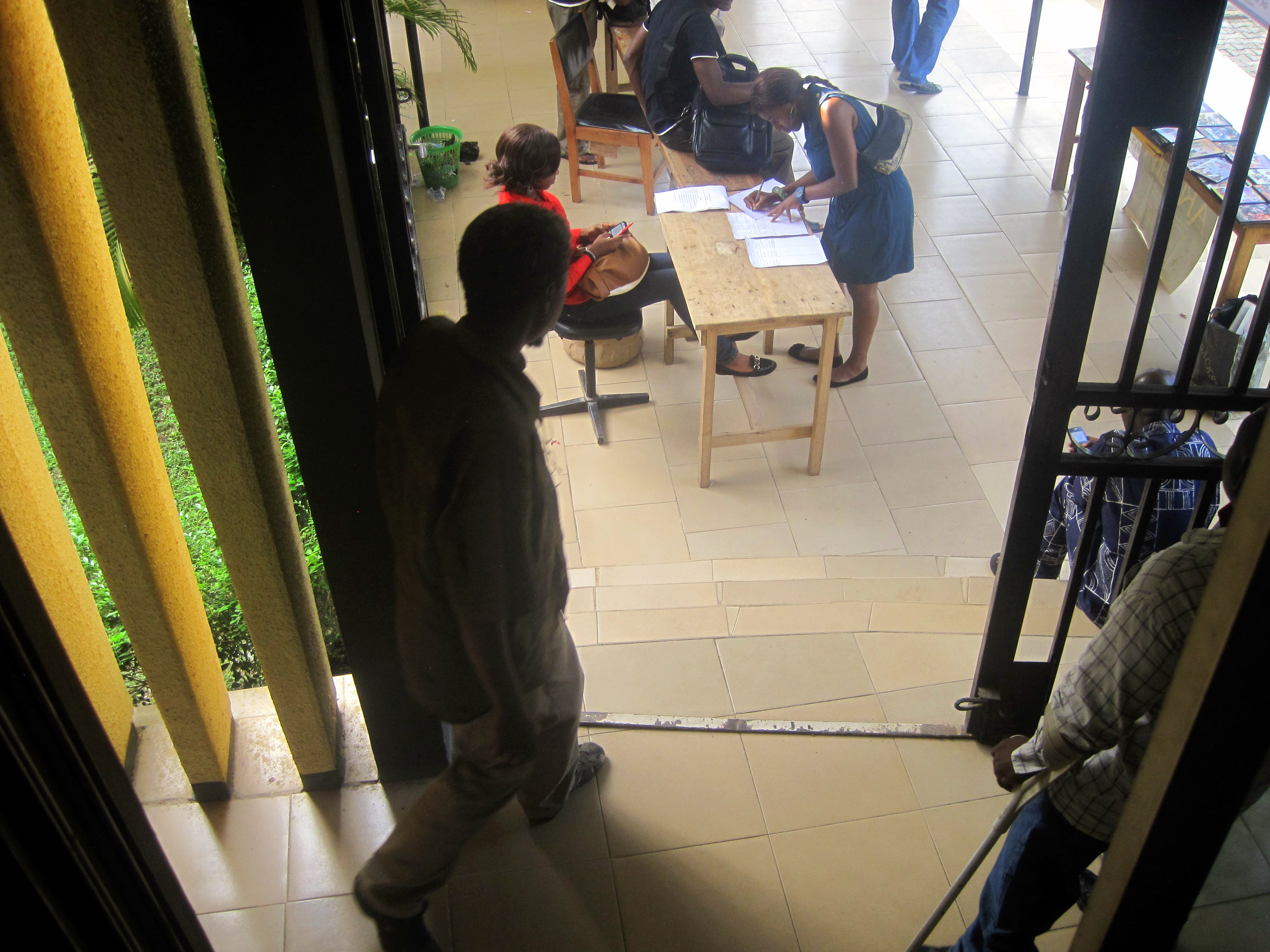
Out of this year’s five shortlisted stories for the annual Caine Prize for Writing, four of the stories are from Nigeria. This is unprecedented in the history of the organization. According to the announcement on the Caine Prize website,

“The five contrasting titles interrogate aspects of things that we might feel we know of Africa – violence, religion, corruption, family, community – but these are subjects that are deconstructed and beautifully remade. These are challenging, arresting, provocative stories of a continent and its descendants captured at a time of burgeoning change.”

The shortlisted stories are:

  • Elnathan John (Nigeria) ‘Bayan Layi’ from Per Contra, Issue 25 (USA, 2012)
  • Tope Folarin (Nigeria) ‘Miracle’ from Transition, Issue 109 (Bloomington, 2012)
  • Pede Hollist (Sierra Leone) ‘Foreign Aid’ from Journal of Progressive Human Services, Vol. 23.3 (Philadelphia, 2012)
  • Abubakar Adam Ibrahim (Nigeria) ‘The Whispering Trees’ from The Whispering Trees, published by Parrésia Publishers (Lagos, 2012)
  • Chinelo Okparanta (Nigeria) ‘America’ from Granta, Issue 118 (London, 2012)

Like many literary-minded bloggers did last year, I intend to participating in this year’s pre-award review of the five short stories for the reading and critical public. Keep a date on this blog for a review of each of the stories, one for each week that passes between now and the announcement of the winner.

A review of Elnathan John’s Bayan Layi will be up here and on the Nigerianstalk LitMag  in coming days.

“Emerging Aesthetics in Nigerian Literature”

As a symposium participant in an event at the Draper’s Hall, University of Ibadan, at the weekend to celebrate the work of Rotimi Babatunde, winner of the 2012 Caine Prize for African Writing, I made a few points regarding the distinguishing features of Rotimi’s work, and the opportunity it offers for emerging writing. More importantly, the way it conforms to the already established trends in great storytelling.

In craft, Bombay’s Republic distinguishes itself by being able to re-tell a story already told in a longer form in Biyi Bandele’s Burma Boy in a different form, and from a different angle. This is not an easy feat. As a contribution to history, the work also moves between fiction and real life in a way that is not only authentic, but also affecting. Like Eleshin Oba in Wole Soyinka’s famous Death and the King’s Horsemen, and Okonkwo in Chinua Achebe’s Things Fall Apart, the main character in Bombay’s Republic lived at a crossroads of a certain time in history and automatically assumed the perils and rewards of such serendipitous existence.

As a contribution to language, I made note of my most fascinating discovery, made close to the end of the story, that the author had not used quotation marks at all throughout the text of the short story. That I discovered this towards the end of the piece only added to the interesting point that unlike what prescriptive grammarians would have us believe, our brains usually process text in chunks rather than as individual pieces of written information. Quote marks, as good as they are, and as aesthetically pleasing their presence on the page might me, fade in significance if a story can still be told, brilliantly as was in this case, without any use for their now rather annoying presence.

The event was hosted by a Committee of Friends, including Yomi Ogunsanya, Ropo Ewenla, Benson Eluma, Iwalewa Olorunyomi, et al. Other participants included Sola Olorunyomi (Author of Fela: Afrobeat and the Imagined Continent), Benson Eluma, Tade Ipadeola, Niran Okewole, Jumoke Verissimo (Author of I Am Memory), Biyi Olasope, Remi Raji (President of the Association of Nigerian Authors, and poet), Ayodele Olofintuade, and Olisakwe Ukamaka Evelyn.

An Evening With Icarus

EMERGING AESTHETICS IN NIGERIAN LITERATURE –

A CELEBRATION OF ROTIMI BABATUNDE WINNER OF THE CAINE LITERATURE PRIZE 2012.

Dear All,
This is to draw you into the circle of friends who are planning an event in honour of our dear friend ROTIMI BABATUNDE for his success in winning the Caine prize for African Literature 2012. Our intention is to use this forum to not only celebrate one of our own, who has been acknowledged as one of the best by others, we also feel strongly that this forum would provide an avenue for us to widen and further our discussion on the passion we share as writers, performers and as literary and culture advocates with Babatunde’s Bombay’s Republic as pointer.

The spectrum of discussants would be:
a. Deji Toye,
b. Benson Eluma,
c. Jumoke Verissimo
d. Iquo Eke
e. Niran Okewole
f. Kola Tubosun
e. Peter Akinlabi
The committee directly responsible for the organization of this event is constituted as follows:
a. Benson Eluma,
b. Kayode Adeduntan,
c. Adebayo Mosobalaje,
d. Kola Tubosun
e. Ayo Olofintuade
f. Ropo Ewenla and
g. Yomi Ogunsanya
The following writers will also read from and have their works discussed works on that day:

1. Emmanuel Iduma, author of Farad
2. Ayodele Olofintuade, author of Eno’s Story
3. Olisakwe Ukamaka Evelyne, author of The Eye of the Goddess
4. Funmi Aluko
5. Imasuen Eghosa, author of Fine Boys


Date: Saturday, November 3, 2012

Venue: Drapper’s Hall, Institute of African Studies, University of Ibadan, Ibadan


For further information/clarifications, please contact:
Yomi Ogunsanya
08023904112/ogunmaren@gmail.com
Organizing Secretary