

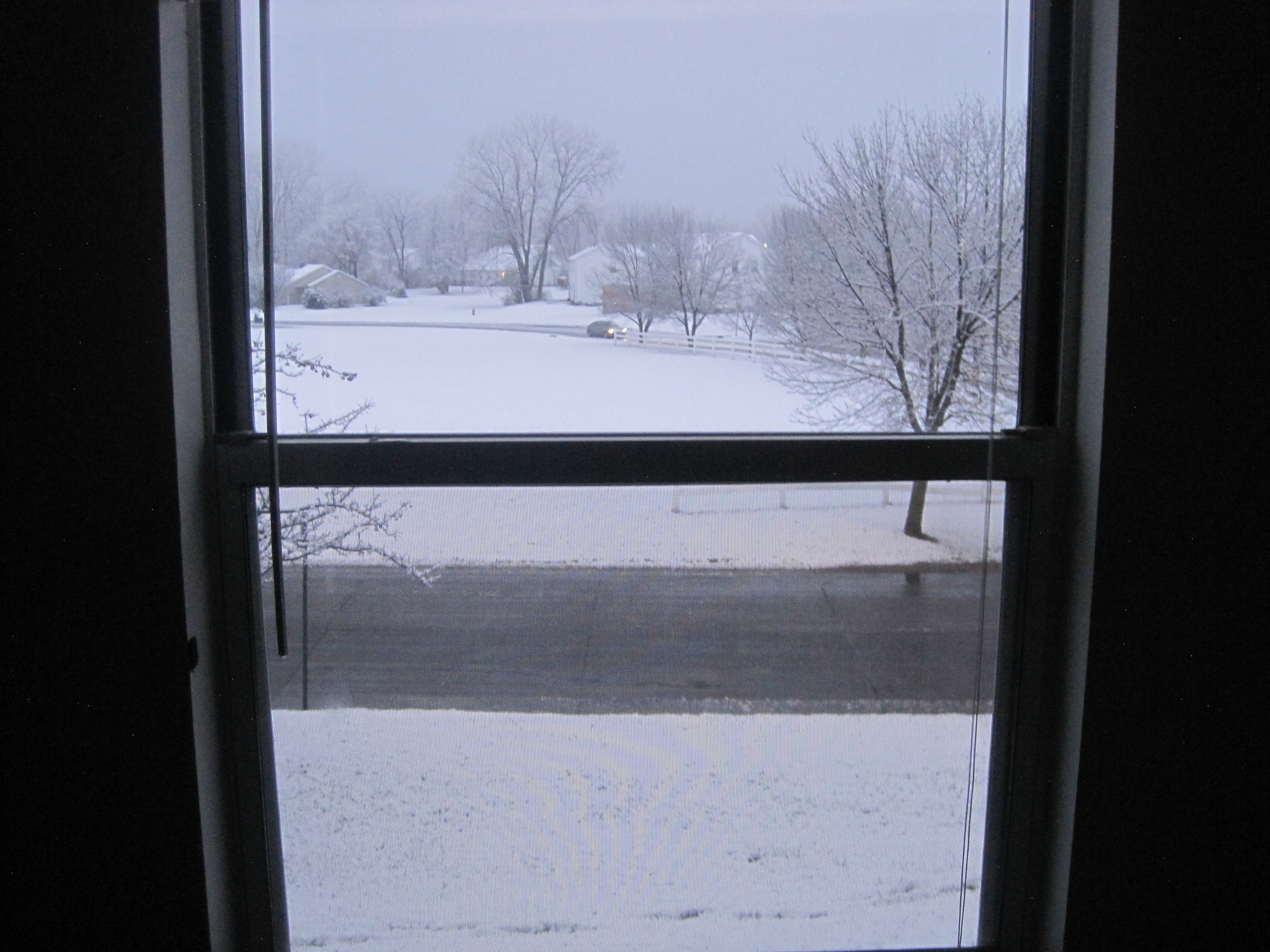
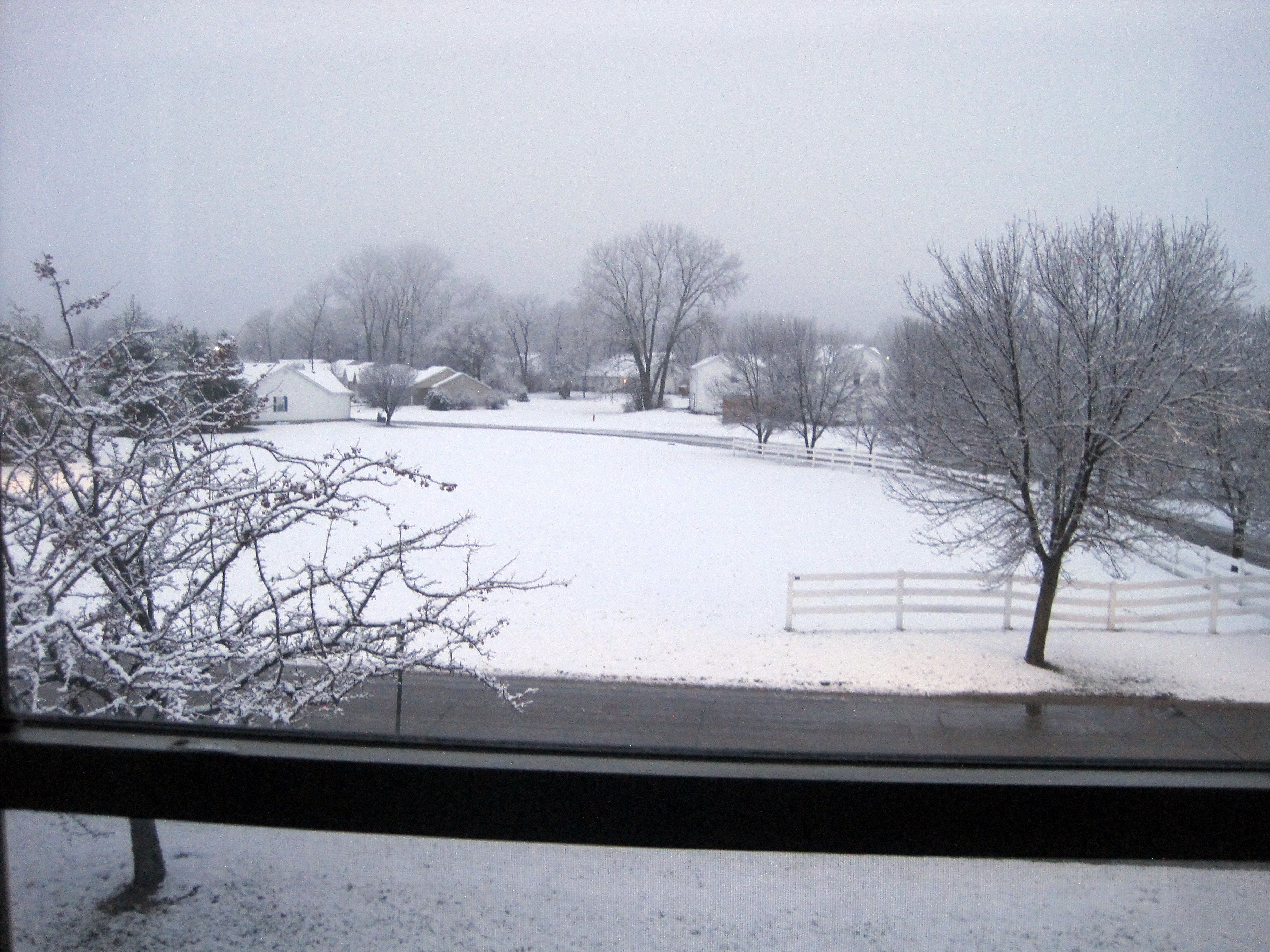
 Two days late still, but, yes! Winter is here.
For your readership from the beginning of the year, for comments, word of mouth compliments, blog/twitter/facebook following, and support, here is wishing you a very happy holiday season, Merry Christmas, and a happy new year in advance.
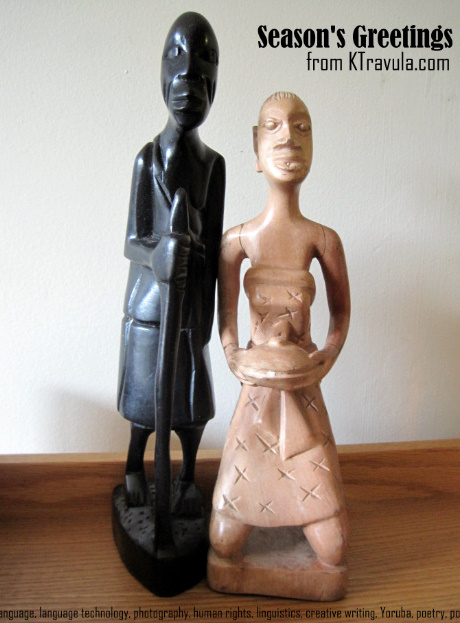
The card was made from a picture of the first two carvings I brought with me to the United States in August 2009.
Out of a need to save lives in Nigeria today comes this new idea called the One Percent Project. Nigeria, a country of over 160 million people, still gets by with a crippling healthcare system and a large portion of its population without access to adequate emergency care. 25% of maternal mortality today is due to unavailability of blood. The current blood donation and distribution system is poorly regulated and coordinated. Hospital based blood collection leads to a highly inefficient and fragmented system.
The recent UN bomb blast in Abuja is a case in point. Within minutes of the attack, the National Hospital in Abuja ran out of blood and many patients lay there, waiting to die. A bleeding trauma patient is said to need more than 100 units of blood. Blood usage today is growing at 3 times the national population growth and there is no other known substitute for human blood. The Nigerian Ministry of Health estimates that 10% of HIV/AIDS infections in the country were caused by the use of unsafe blood. That is: 1 in 10 HIV positive people in Nigeria were infected because of unsafe blood transfusion.
 The One Percent Project seeks to bridge this gap between blood donors and recipients. It is estimated that if one percent of all Nigerians (1.6 million people) will be willing to give blood when needed, much of the problem will be solved and over 13,500 lives of pregnant women and thousand others in need will be saved. With a need of about 1.5 million to 2 million pints of blood annually, the project hopes to recruit young voluntary non-remunerated blood donors. These donors will only have to sign up with One Percent, and share their location in the country. This information is then shared – as need be – with the National Blood Transfusion Service in Nigeria, and other hospitals, at their moment of need. With a database of 1.6 million people, there hopes to be at least one person near every emergency around the country who will show up when called upon to fulfil his/her pledge to donate blood when needed.
I’m involved in this project (along with a few other dedicated health professionals) and very passionate about its success. You should be too. If one percent of Nigerians to donate blood (3 times a year for women and 4 times a year for men), the problem is virtually solved. If you are reading this and you are a young Nigerian between the age of 17 and 65, or you have lived in the country for more than five years, please take a moment to complete this survey right now. It will take about five minutes. Then check out the website foronepercent.org. Follow the organization’s twitter account to get updates on the project and hear about blood drives coming near you. The organization also needs an army of volunteers to get the project working from the ground up in Nigeria. If we all will sign up to be called upon whenever a hospital near us needs blood to save lives, and we will heed that call, we can make a difference, one volunteer at a time.
(Please share this post on your networks)
Browning tar, a rote of car zoom noises around my window. The sun sets in a distance, a lot earlier than before, to a now conditioned amazement. Afternoon and night share a neighbourly block on the street of a dying year. Tick, tock, the clock hand counts the moments again in memories of times gone before. At a different time but in a similar pose, time counted down. The geese quacked. The refrigerator hummed creaky tunes in the middle of night. Ice formed into layers of sweat balls around the glass, and everything else stayed still.
The world has not changed since then, or has it? Many months of movements follow each other in steps of ease, and texts, and work, and revolts. And here we are, another winter, another dark evening at four o’ clock. It is a short remove from those quiet times, just two years ago, in the sober remove of a rustic village, but here it is. A year winds down with the last paces of its easing rote, crank and all.
The outrage that greeted Republican front-runner Newt Gingrich’s recent comment about poor people stemmed mostly from his condescension, and not from the fact of his assertion. Speaking at a campaign in Iowa last week, two weeks after he had called the labour laws in America “truly stupid”, Mr. Gingrich said:
Really poor children in really poor neighborhoods have no habits of working and have nobody around them who works. So, they literally have no habit of showing up on Monday. They have no habit of staying all day. They have no habit of ‘I do this and you give me cash’ unless it’s illegal.
Coming from a middle-class background and growing up in Nigeria’s lousy economy of the 90s, I relate with much of what he said with regards to the habit of working. The disingenuity of the argument he makes, however, is in the way it casually omits the truth in a similar argument for the other side. Read below:
“Really rich children in really affluent neighborhoods have no habits of working and have nobody around them who works. So, they literally have no habit of showing up on Monday. They have no habit of staying all day. They have no habit of ‘I do this and you give me cash’ unless it’s for partying.”
Did you see what I did there? I substituted the words “poor” for “rich” and other “negative” equivalents for “positive” ones. Does that little trick change the truth in the assertion of Mr. Gingrich? No. The problem however is that he did not make this balanced claim. By focusing only one side and demonizing poor children, he pits himself on one side of the argument, and thus muddles the issue he was supposed to be solving. If the focus of his comment was to breed a culture of working, is there a particular reason why it should focus only on poor children?
Let me make a second example, also from Mr. Gingrich’s attempt at political commentary. While speaking with a Jewish television last week, Mr. Gingrich said that Palestinians are, after all, “an invented people” who didn’t exist as a nation until after the exit of the Ottoman empire. Of course, he was right. The people now referred to as the Palestinian people, now craving for a state of their own, are just Arab people living in the middle east. However, so are the Jewish people as well! The Jewish State of Israel (at least as we know it today) was just as well “invented” in self-determination after the Second World War. So why did Newt Gingrich not state the second equivalent truth of his assertion? Because it is not politically expedient, and – like other Republican candidates – all he wanted to do was to sound Pro-Israel than the incumbent president whose job he seeks.
Now, to my final two examples on this matter, this time on race. I found out to my chagrin that the most popular post on my earlier wordpress blog (before moving to this domain) has remained this one where I wondered if oyinbo – a Yoruba word for “white person” was a racist word. I knew it wasn’t, but I was interested in reader perspectives on the way a word conditions the way we look at the world and other people. I got feisty, energetic responses. But what struck me earlier this morning however is a fact that I had overlooked for too long: that more than half of what is considered racist – even here in the United States – were anything but. Here are two quotes, the first by Donald Trump: “I have a great relationship with the blacks,” said a few months ago to public outrage, and Ann Coulter’s “Our blacks are so much better than their blacks” – a reference to African-Americans in the Republican party as opposed to those in the Democratic party.
It is easy for me as an African to take umbrage at each of these statements (as I undoubtedly did for a few days without being able to lay my hands on why the statements seemed so jarring). A few months removed from the uttering of those words however, I finally got it. It took a short memory trip back to the sociopolitical environment of my home country. “I have a great relationship with the whites” would not have elicited such a public umbrage in Nigeria but it would have raised eyebrows of social awkwardness. There is a consensus that there is something awkward with a citizen who felt the need to associate himself with a particular race for political advantage. “Our whites are so much better than their whites” would have elicited a similar response of awkwardness, albeit with a heavy dose of scorn and derision. It definitely would take some self-loathing and inferiority complex to make such a public proclamation. Implicit in these statements however is the acceptance of the “otherness”, and thus the problem. In Nigeria, this “otherness” is accepted, considering our colonial history The “whites” are not one of us. In America, it is not, because of the country’s history of slavery and civil rights. The “blacks” are also Americans, and undeserving of such “otherization,” thus the outrage. If Mr. Trump had said “I have a great relationship with the Nigerians”, or Ann Coulter, “our Nigerians are better than their Nigerians,” no one would have taken notice.
There is something to be said for double equivalents. Some things don’t make much sense until we put them in front of a mirror of polar equivalents. Some don’t make sense at all, eventually, of course, but it sometimes helps to pare them off all their political overtones. Mister Trump and Miss Coulter get a pass from racism but not from bigotry, and Speaker Gingrich gets all the blame he very well deserves.