End of Classes, and More

My presentation in class on Wednesday was my last in this Master’s program (baring a thesis defense, of course). It focused on a hypothetical lesson plan for second language teaching in a foreign country. One of the advantages of such assignment that allows for creativity is the chance it gives the student to make conjectures on things that may actually become future research areas. I am a teacher of English language in a high school in Kigali, Rwanda. That country emerged just a few years ago from a brutal civil war that tore the country into many ethnic parts. It has now adopted a policy of English language (over French and Kinyarwanda) in order to forge a more united country free of a colonial past, and with a view to a more globalized future.

What problem does such a job pose for both the student and the teacher, even beyond the usual problems of language acquisition? Socio-cultural attitudes of parents still hung up on ethnic and cultural identities and resistant to change? Government bureaucracy and a typical political gamesmanship that might deny funding for much of the initial experimentation that could amount in success? A problem of communication between teacher and student? (It’s hard enough for students to be learning a new language. If the teacher offering guidance for such teaching does not even share the linguistic identity of the students, the baggage of his “otherness” might be a little hard to overcome). What else? There are actually far more positives to the experiment, one of which is the delight of sharing cultural similarities and differences while at the same time sharing the knowledge of a connecting international language. Cultural exchange is after all always an learning stimulant.

I have good memories of my first major teaching experiences in the Nigerian middlebelt as a Youth Corper. Students delighted in their ability to communicate in Hausa and Berom even in our English classes. It was a battle that I struggled with all through the year, frustrated that the purpose of English education is defeated when students choose instead to resort to local codes at every moment of convenience. Other linguists working in the area of Second Language Acquisition have argued that there are positives in this model of acquisition where the pressure to always be right is taken off the shoulder of students and they are allowed to subconsciously acquire the second language. The problem in the application was the reluctance of the students themselves to even try since their mother tongues provided an easy alternative. (But then, a prominent educational research in Nigeria, particularly the Ife Six-Year Primary Project of 1989, showed that students taught in their mother tongues performed better in learning other subjects).

I find Second Language Acquisition extremely fascinating, and the prospect of teaching English in another country equally enticing. Rwanda presents a fascinating example of such intervention because it combines education with social work. A country willing to ditch a dividing legacy of multilingualism for a second foreign language presents a fascinating study. One of the best rewards for teaching – as I have realized from my years of involvement – is not just in the knowledge that the teacher brings into the class, but the ones he takes out of his interactions with his students. I believe that in the next century, the language of the world will not be this English language as we know it, of course, but something richer, encompassing the form and world-view of all the peoples through which it has passed. There is something to enjoy in the process of bringing that to existence.
On Poetry as Science

One piece of prose floating from the fading memory I have from reading Czeslaw Milosz’s Visions from San Francisco Bay occasionally come back to haunt me in my still moments. It asks amidst a whole lot of other questions what the purpose of words are beyond their ability to convey meanings. In one recent interview with Stephen Colbert, Astrophysicist Neil deGrasse Tyson compares the inconsequentiality of our presence on this planet to that of a billion (and some) bacteria living in the walls of our intestines whose number is equal to almost three times the number of all human life that ever existed and died. Like those bacteria, he suggests, who live without the mental capability of understanding the dimension of their inconsequentiality when compared to six billion other intestines walking the earth (with the multibillion units of bacteria they carry in them), we may not possess the mental flexibility to understand our insignificance (along with our equally possible random relevance as evidenced by our current existence).

Milosz asks as if to himself what makes it so that words, in their utmost insignificance beyond immediate use, lends themselves to entendres, rhyme and poetry. Did there exist on some magical plane a predestination for the word “apple” to become the symbol of ultimate taboo, pleasure and sin? In which realm of serendipity did “gain” and “pain” acquire the paradox of their rhyming complementarity. Sure computers may not write poems now (and I have no doubt that this is false), but the lexical matrix of today’s world endows us with a gazillion ways of expressing thoughts in inventive ways. The order in which I have written the last couple of sentences in this post (with almost a 100% certainty) is an order in which these words have never ever been arranged and never will anymore by anyone else. There is something to that. The process of writing poetry, for me, taps into the science of this randomness. The art resides in the chance of success – that moment when meaning, form, and words meet at the tip of the writer’s hands. See below:

I balanced all, brought all to mind,

The years to come seemed waste of breath,

A waste of breath the years behind

In balance with this life, this death.

from W.B. Yeats’ An Irish Airman Foresees His Death

This concise beauty, and an underlying deceptive simplicity that wows, has always defined for me one of writing’s unreachable bars; the place where science, art and meaning collide with the earnest needs of the present.

Conversations with Neil deGrasse Tyson

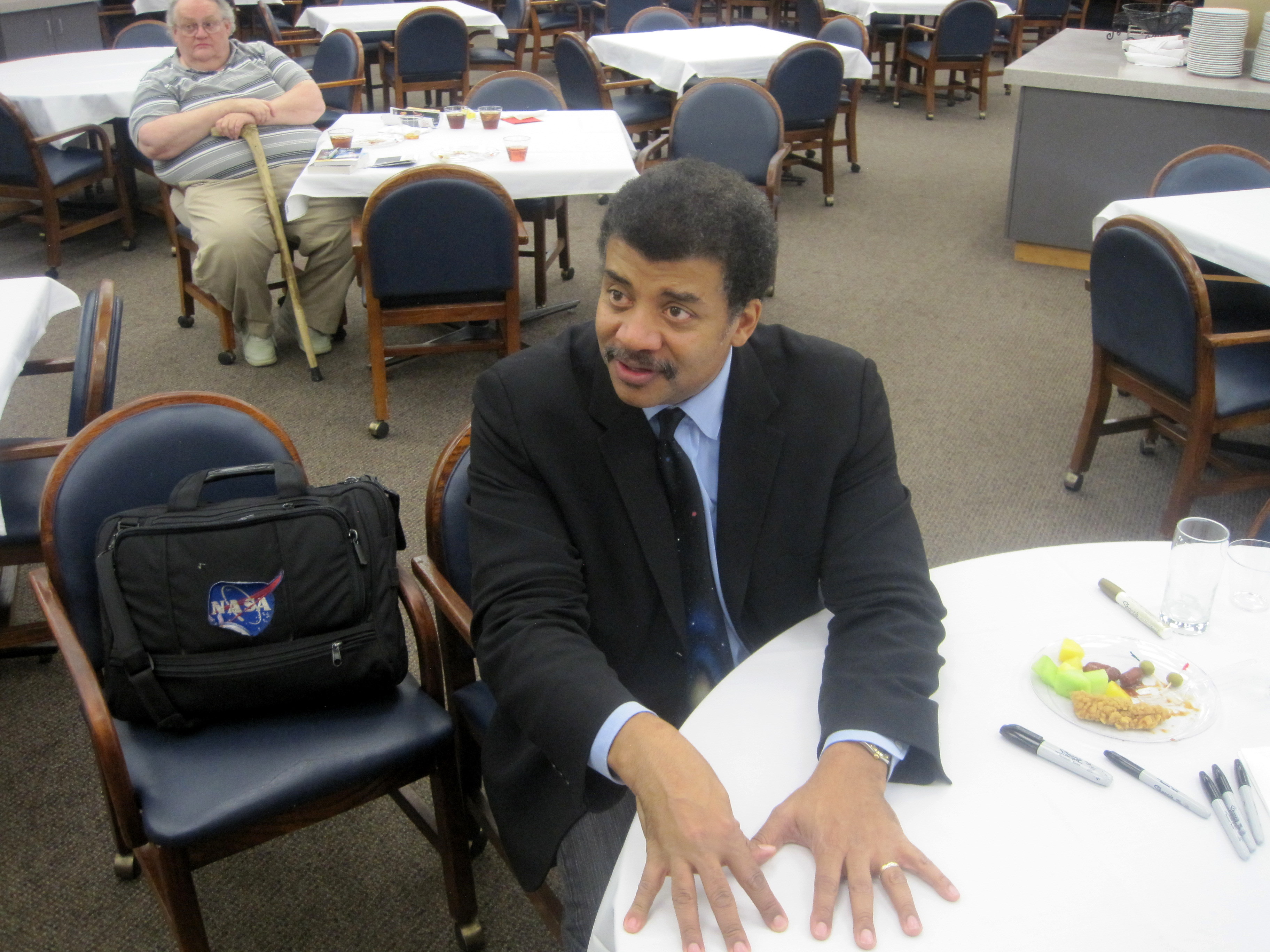
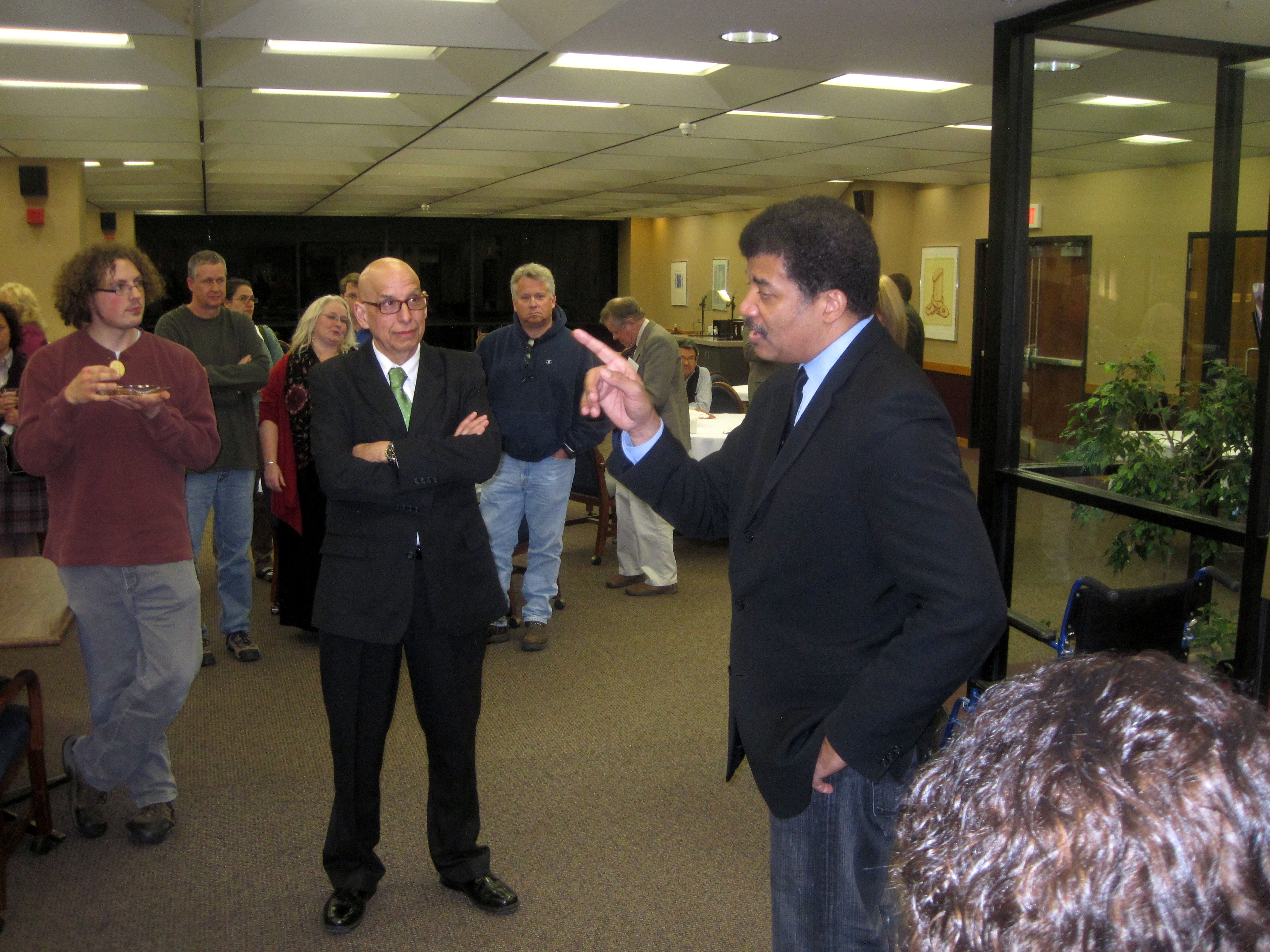
America’s most famous astrophysicist dropped by campus today for an event of the SIUE Graduate School. Dr. Neil deGrasse Tyson is the director of the Hayden Planetarium in New York City and the recipient of the NASA Distinguished Public Service Medal, the highest award given by NASA to a non-government citizen. He is also the author of The Pluto Files and Death by Black Hole (and other Cosmic Quandaries).

His talk, titled “Our Past, Present, and Future in Space” focused on the regression and eventual end of the US space program, and the contribution of public and political apathy to this end. Those who have heard him talk will already be familiar with his worldview: a passionate defense of imagination and a unified, inspiring public policy for science. The end of the space program, according to Mr. Tyson, is one of the worst things to have happened to America in a long time not only because of the now total absence of motivation among young people, but also because of how the general apathy has now negatively affected the status of the country in the world. In a preview to the visitor’s speech, Dean Aldemaro Romero of the Faculty of Arts & Sciences had this to say: “While I was growing up in Venezuela and told my parents that I wanted to be an astronaut, they told me ‘You have to be either an American or a Russian.’ Now, many decades later, as an American citizen, I have found out that to go to space, I’d either have to be Chinese or Russian.”

There was a lot more. The maps of the world, when plotted on a chart on the basis of resources spent on science (and, on another chart, on the basis of scientific progress/development in the last decade) shows the African continent virtually invisible. What concerned Dr. Tyson however – as well as the members of the audience – was the shrunken shape of the American map as well. Even Brazil, and Japan, on this map showed far more encouraging progress, to the dismay of all who have previously believed this country as being on the farthest frontier of future advancements. Many things are wrong, among which is the absence of a political will and imagination.

At the reception party arranged for him, I asked for his opinion on the absence of scientific advancement in Africa, and whether the frontier had irrevocably moved westwards. He disagreed, opining instead that like every great civilization had come and gone, the continent would have its turn again at some point in time. There is a particular initiative at the moment in South Africa, he said, where scientists have begun training young high school students in order to be able to produce the next big scientist (of the stature of Albert Einstein) and a Nobel Prize in Physics from the African continent. What did he think of Physicist Richard Feynman? “He’s as brilliant as he has been described,” he replied.

Known among young people in America today as the man who relegated Pluto from the status of a planet to that of a mere floating astral rock, Neil has contributed to the progress of modern science and astrophysics in popular culture than most people in the world today, and continues to do so. It was quite an enlightening event. His autograph on my copy of his book simply read: “To Kola, welcome to the universe.”

His book, The Pluto Files details in a fun manner the arguments and debates surrounding the relegation of the former planet Pluto, including also letters from angry young children and cartoons from the media weighing in on the many sides of the relegation debate.

Previous guest speakers at the Arts & Issues events here include Maya Angelou, Ken Burns, and the Basie Count Orchestra. I recommend this video, by the way, Dr. Tyson in conversation with Stephen Colbert. (H/T @loomnie)

A World In Intolerance

Saturday evening found me in a bar downtown Edwardsville for a quick drink. One particular conversation with a mere acquaintance present there with a few other friends eventually turned to discussion about careers, mine, and about what I would like to be doing as soon as I’m done with a Master’s degree. It then returned to him and what he was doing at the moment. He’s studying to be a health scientist and he would one day love to work on the African continent. “I would have gone to Ghana in the summer,” he said, “but I didn’t have the money”. “Great,” I replied. “I know a program called the Global Health Corps which sponsors interested health workers/scholars from the United States to parts of Africa in order to make a difference doing what they love. It’s fully funded, and it’s perhaps precisely what you need. As a matter of fact, my fiance lives in Uganda at the moment because of this program.” He was immediately enthusiastic for one second, and then stopped. “I can’t go to Uganda, Kola. They’d hang me there.”

It took me about two seconds, and then I got it. He is gay. This was my first time of hearing this admission directly from him. He was apparently already familiar with the laws in many states on the continent today demonizing that kind of difference. I recovered from my double-take and tried to assure him. “You’re a foreigner. Foreigners are usually more protected especially when they’re volunteering… Maybe your presence in local communities saving lives will be enough to help change minds… Or maybe you don’t have to wear the tag on your forehead…” No, he said. He doesn’t have anything to hide and would never live where he is forced to deny who he is. The conversation went on for a little while more with me asking a few more questions I’d always wanted to know from a self-declared homosexual: How long has he known? Has he ever kissed a girl and loved it? Has he ever had sex with a girl? etc It was surprisingly an open conversation without any awkward moments where the young man opened up with his fears, hope, dreams and pain at the kind of society that demonizes difference. I expressed my empathy to him, just a few seconds before I informed him that he wouldn’t be able to live in Nigeria either.

A few days ago, last week, a  new law was passed by Nigeria’s Senators penalizing “homosexual activity” for up to 14 years in jail, and up to 10 years for those who support, conduct or witness homosexual marriages and association. Many things make this law stupid, but this makes it curiously draconian: there has never been a clamour for homosexual union/marriage in Nigeria. If anything, the derisive societal attitude has been previously enough to keep those with same-sex attraction in the closet. Societal acceptance – if it ever happened – would have been a very big leap forward. Many pundits have already written about this, and the conversation about the scourge of this state-sanctioned intolerance has already taken centre stage in the media, which is good. Looking through the various arguments put forward by citizen for the support of this legislative measure has however convinced me of the long way that society still need to go to overcome intolerance.

Back to America, at around the same day, Congresswoman Michelle Bachman of the United States House of Representatives was telling a group of voters that she has no problems with homosexuals or lesbians getting married, as long as they get married to people of the opposite sex. Read it here. Here is the summary then: If you live in Nigeria or in the US as a gay person, you risk being criminalized except you get married – to the people you are not attracted to. If you live in Uganda, there’s one step further, you may be brutally murdered by a mob of intolerant activists (as was the case of the human right activist David Kato). There is much more to say about the hypocrisy of these expressions of sadistic intolerance, but I will end this post here – a minor contribution to the dialogue. There are a lot more we can do to bring peace to the world than spending time demonizing other people because they are different from us. A lot more things we can do with our conscientious energy.

For Biafra – FYI

There’s a call for universal observance of a week of mourning in memory of Gen. Emeka Odumegwu-Ojukwu beginning on Thursday December 1.

In the spirit of reconciliation, use the Flag of the Republic of Biafra as your Facebook profile picture from December 1-6 or at the very least, on Thursday, December 1.

Even if you’re using his photograph now, swipe it for the flag on Thursday.

Remember, Ojukwu was not an Igbo chieftain or warrant chief, never mind all that “Dim Gburugbu” stuff.

He was an illustrious Nigerian soldier and administrator, and a battle General and Head of State of a multi-ethnic, post-colonial African nation whose Ahiara Declaration remains a visionary blueprint for full post-colonial self-determination. As some have pointed out here lately, he was also one of our unique Nigerians, born of parents from both the south and the north: born in the north, raised in the west, and fated to destiny in the east. He spoke all three major Nigerians languages, lived in all three regions, and served Nigeria as proudly before the war as he served Biafra during the war.

Whatever your position on the Biafra war, let’s bid Ojukwu farewell by hoisting this flag one more time. Like America continues to honor Gen. Ulysses S. Grant, let’s join together and honor his memory.

Share this with your friends and on your group walls and listservs. Let’s paint Facebook red, black and green with half of a yellow sun, in one rare moment of unity, and not discord. Thursday, December 1.

Olu Oguibe