Browsing the archives for the Uncategorized category.

How are Yoruba speakers using Twitter?

KT: Same as everyone else. Code switching with English or whatever language soothes their need at the moment. This is fine. I think it’s important to mention that our intention at the start of the Tweet Yoruba project was not to turn every Yoruba speaker on twitter to monolingual Yoruba tweeters. No, it was to encourage use and improve the current attitude to indigenous language use anywhere. Yoruba just happens to be the language I’m most familiar with. I am interested in (and always encouraged by) indigenous language use anywhere/everywhere, even along with other international languages, until the attitude that one of them is inferior on the basis of the number of speakers is discredited.

Excerpt from my interview with (Egbunike Nwachukwu 0f) Global Voices. Read it here.

An e-Book is a Book – Conversations

For anyone interested in literature, and literary development, this is a good time to be alive, not just because of the quality of output and the zeal of the participants, but also because of the presence of new media and the dynamism it has allowed for the production of new forms, and new ways of expression. We have a new generation of writers doing great things in the face of tremendous odds. We are doing well. Last year’s Caine Prize had four out of five Nigerians (Five writers of Nigerian descent, if you consider Pede Hollist). Teju Cole, Chimamanda Adichie, Chika Unigwe, Igoni Barrett are doing great out there, and new ones are coming up behind them: Emmanuel Iduma, Dami Ajayi, Ukamaka Olisakwe, Ayodele Olofintuade, etc. The Booker also has Zimbabwean NoViolet Bulawayo, who might as well win it. I think we’re doing well.

I hope, of course, that new media eventually gets its pride of place in the mainstream of literary appraisal. It already does well in consumption and reach. Until the Booker, the NLNG, the Orange, or any other major prize rewards someone whose platform is mainly online, then we haven’t reached there yet. I don’t advocate for the death of the book, just like inventors of the automobile didn’t go ahead and shoot all the horses. But judges of prizes need to start looking at the quality of production in the new media, and begin to pay attention to them. It is the future. We may as well get used to it.


From an interview I had with Nwachukwu Egbunike of Global Voices, a few days ago, in which I discussed among other things, writing in indigenous language, my contribution to the TweetYoruba Project, and the state of writing in the world today.

Excerpts from the interview made it into Andrew Sullivan’s blog, discussing writing and other matters.

Google ni Yoruba!

I came across this encouraging (though thoroughly belated) news a few days ago, on twitter and elsewhere, from a friend familiar with my work, advocacy, and interest in facilitating the use of African languages, particularly Yoruba, in today’s world, particularly in Information Technology. Google is opening up its famous Google Translate machine to include a number of populous African languages.

This is encouraging for a number of reasons:

Google-Translate-Banner1First, I have spent the last two years petitioning Twitter to include Yoruba as one of the languages in which the platform is being currently translated, without much luck. It has however led to an annual Tweet Yoruba Day – a day set aside in March of every year to document trends in the use of the language on electronic platforms, advocate/encourage continuous use, and celebrate the rich depths that the language brings to the world. Having Google take this step without a major public petitioning is heartening.

Secondly, the Google machine is a worldwide platform with reaches into the farthest corners of the earth. Having Yoruba join the league of other world languages, famous and non-famous, in which thoughts and opinions can be transmitted through translation is something to be proud of. I am proud of it. I am also glad that I am here to witness, and contribute to its development. (More on this later).

And third, the sample translations given on the page created by Google for freelance translators towards this project shows that – though very far from perfect, Google has put a lot of efforts into the initial work. That is admirable. Long before the project was announced, word-to-word translations for a number of Yoruba words were already sourced and documented. They will not suffice as far as the final translation engine is concerned, but this is an encouraging start. As the current state of the machine shows, the syntax is far from perfect. I’ll rate all the translations “poor”.

The next step now is to build a larger corpus that includes more than just word-to-word associations, but phrases, proverbs, aphorisms, colloquialisms, songs, and a number of other culturally relevant communicative utterances that make Yoruba a uniquely rich African language. Then, run them through different tense and aspect variations present in the language, and have translators/linguists tweak it until it is as close to perfect as possible. This will take a lot of time, a lot of effort, plenty texts from different levels of complexity in Yoruba speech (from poems to novels), and a number of dedicated people. However, this start is an important step.

I applaud, and will keep my eyes – and fingers – on it.

The 2013 Caine Prize Shortlist

Out of this year’s five shortlisted stories for the annual Caine Prize for Writing, four of the stories are from Nigeria. This is unprecedented in the history of the organization. According to the announcement on the Caine Prize website,

“The five contrasting titles interrogate aspects of things that we might feel we know of Africa – violence, religion, corruption, family, community – but these are subjects that are deconstructed and beautifully remade. These are challenging, arresting, provocative stories of a continent and its descendants captured at a time of burgeoning change.”

The shortlisted stories are:

  • Elnathan John (Nigeria) ‘Bayan Layi’ from Per Contra, Issue 25 (USA, 2012)
  • Tope Folarin (Nigeria) ‘Miracle’ from Transition, Issue 109 (Bloomington, 2012)
  • Pede Hollist (Sierra Leone) ‘Foreign Aid’ from Journal of Progressive Human Services, Vol. 23.3 (Philadelphia, 2012)
  • Abubakar Adam Ibrahim (Nigeria) ‘The Whispering Trees’ from The Whispering Trees, published by Parrésia Publishers (Lagos, 2012)
  • Chinelo Okparanta (Nigeria) ‘America’ from Granta, Issue 118 (London, 2012)

Like many literary-minded bloggers did last year, I intend to participating in this year’s pre-award review of the five short stories for the reading and critical public. Keep a date on this blog for a review of each of the stories, one for each week that passes between now and the announcement of the winner.

A review of Elnathan John’s Bayan Layi will be up here and on the Nigerianstalk LitMag  in coming days.

Lagos Morning Surprise

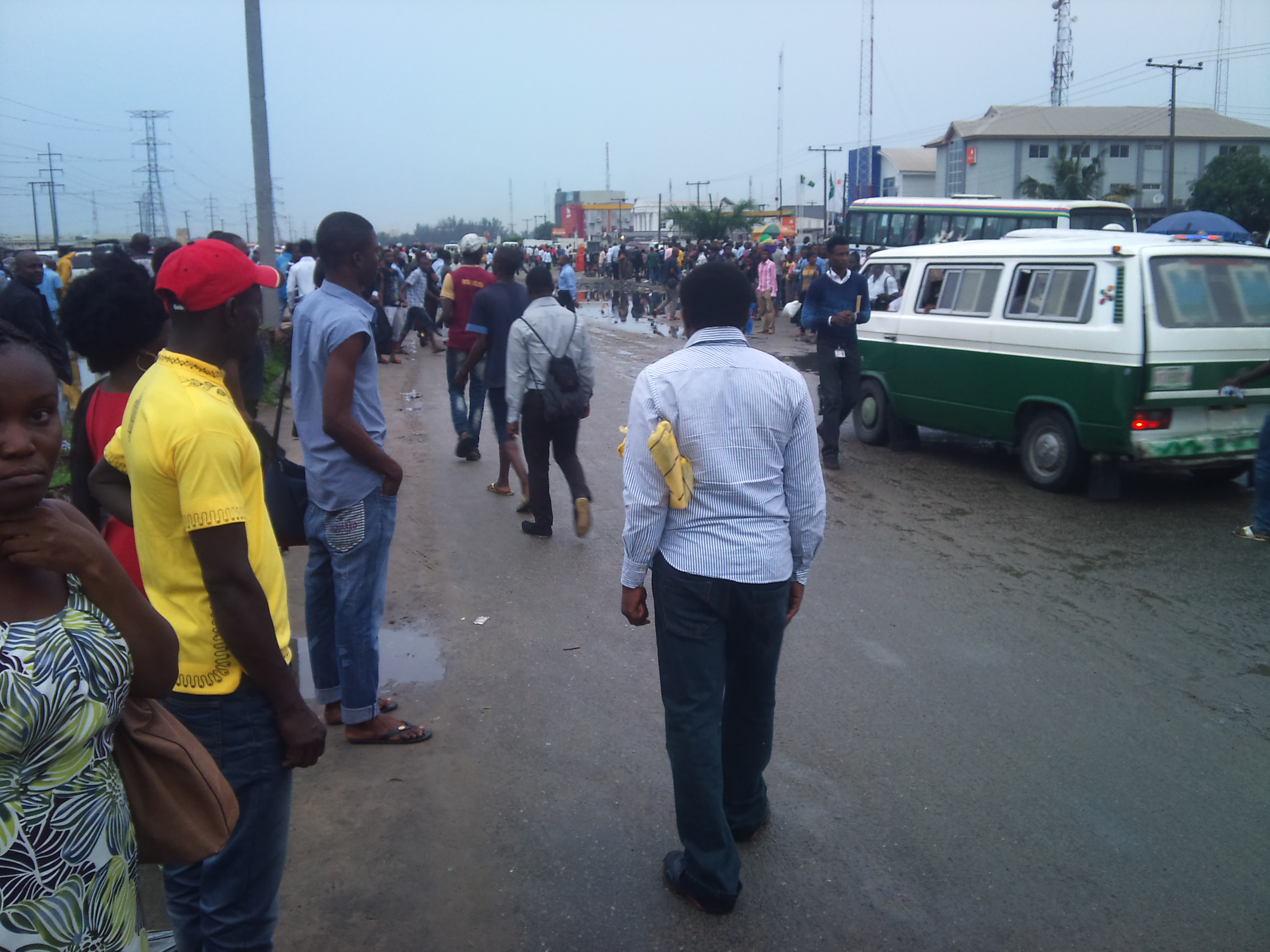
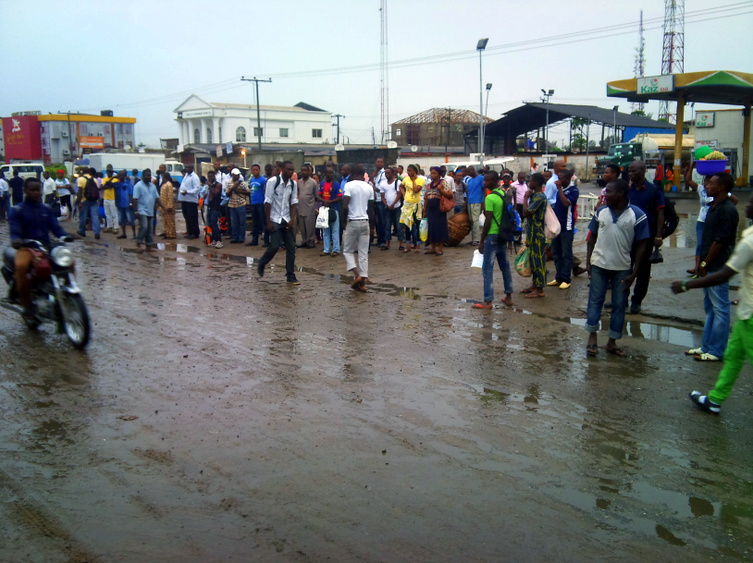
It’s a Monday morning in Lagos, after a sustained night rain, and the city – for the very first time – showed an uncommon character the like of which might never be seen again.

The sewers had opened up their wares, with dung floating to the surface and onto the many streets in the flooded island. With sleeves and pant legs rolled up to keep wetness to a minimum, commuters and pedestrians saunter onto the road, most of them an hour later than they ordinarily would. The transportation buses had left the roads early enough – perhaps the only regular feature of the city’s uncertain character – and commuters who got to the road at anything after 6am had been left stranded now, praying for a miracle to get them to their places of work on time. That was when it happened.
DSC_0284A police van heading to its patrol point in the city parked by a throng of people at one bus stop, and asked folks to come in. They were at first surprised, and then – realizing a once-in-a-blue-moon chance – rushed in and filled the back seating area, saying “thank you” as often as they could. The cops merely smiled, started the van, and moved on. As if on cue, another car stopped, this time a Prado Jeep driven by a young woman of around 32, likely the employee of a bank, or any other high-paying job. “Aren’t you going?” She asked no one in particular, as a few more people paced briskly towards it and sat themselves in comfortable positions in front, and at the back. “I am late to work too,” I heard her say impatiently. “Get in and let’s go. I can drop you off anywhere between here and Law School.”
Fullscreen capture 5132013 45702 PM.bmpThe sky remained dour and drizzly as one fancy car after the other stopped at each bus stop to pick up passengers many of who were usually stunned at first that such private drivers could really have intended for them to get into the cars. In one instance, a passenger refused to give into the driver’s constant entreaty that he would, indeed, give him a ride for free and drop him off wherever he would be getting down. “I don’t get it,” the man said to himself. “Lagos rich people are never this considerate.” The driver drove away, perhaps stunned by the resistance of a helpless passenger in the face of help on a rainy day.

For the next one hour, Escalades, Sorentos, Four-Wheelers, Land Rovers, Land Cruisers, small saloon cars, a BMW, a station wagon, a church bus, another police van, a school bus, two empty BRTs heading to a repair shop, a couple of small tricycle scooters, a soldier on a motorbike, a Mercedes Benz, and a number of other new and rickety vehicles, each otherwise empty except for their drivers (and sometimes one other passenger), stopped by all crowded stops to pick up passengers stranded there and late for work. It was a surreal, almost eerie, sight on a Lagos morning. Humanity came alive in a way never before seen and would never be believed by anyone else not there to witness it. There is hope for this country after all, I thought to myself as I concluded my morning stare at the bus stop,  finally accepting an offer to ride with a middle-aged lady in corporate wear who driving her 10 year-old kid to school.

All of this is fiction, of course. You can tell.