Browsing the archives for the Literature category.

Three Days of Madness at the University of Lagos

By Péjú Láyíwọlá

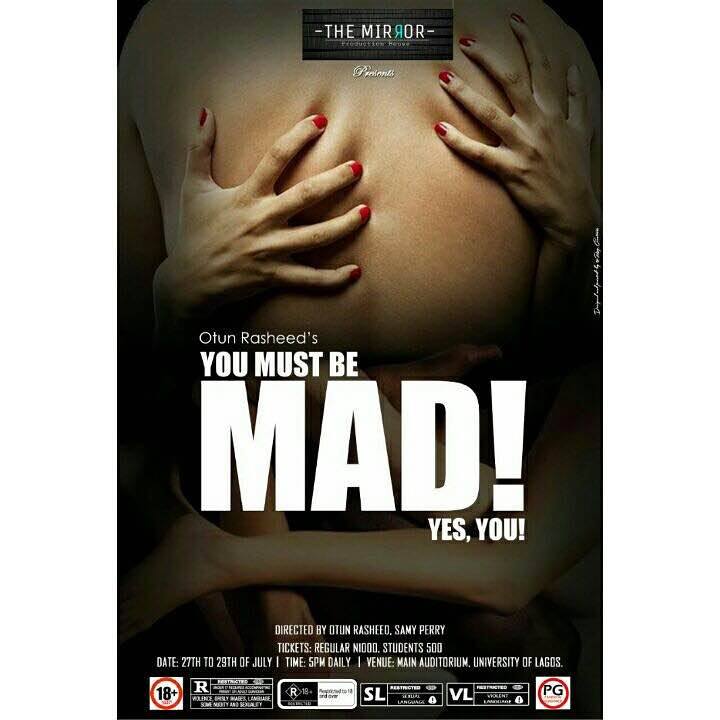
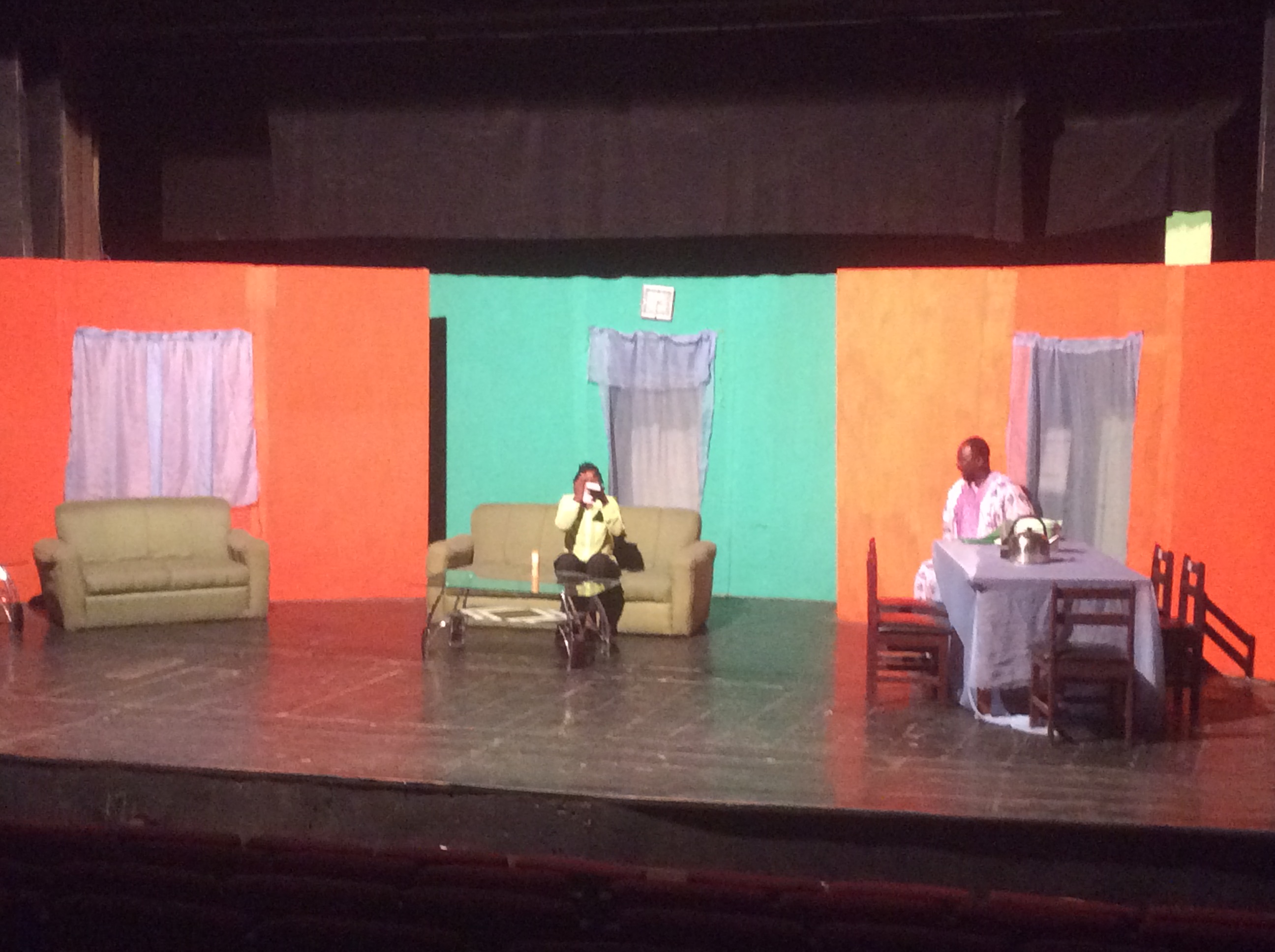
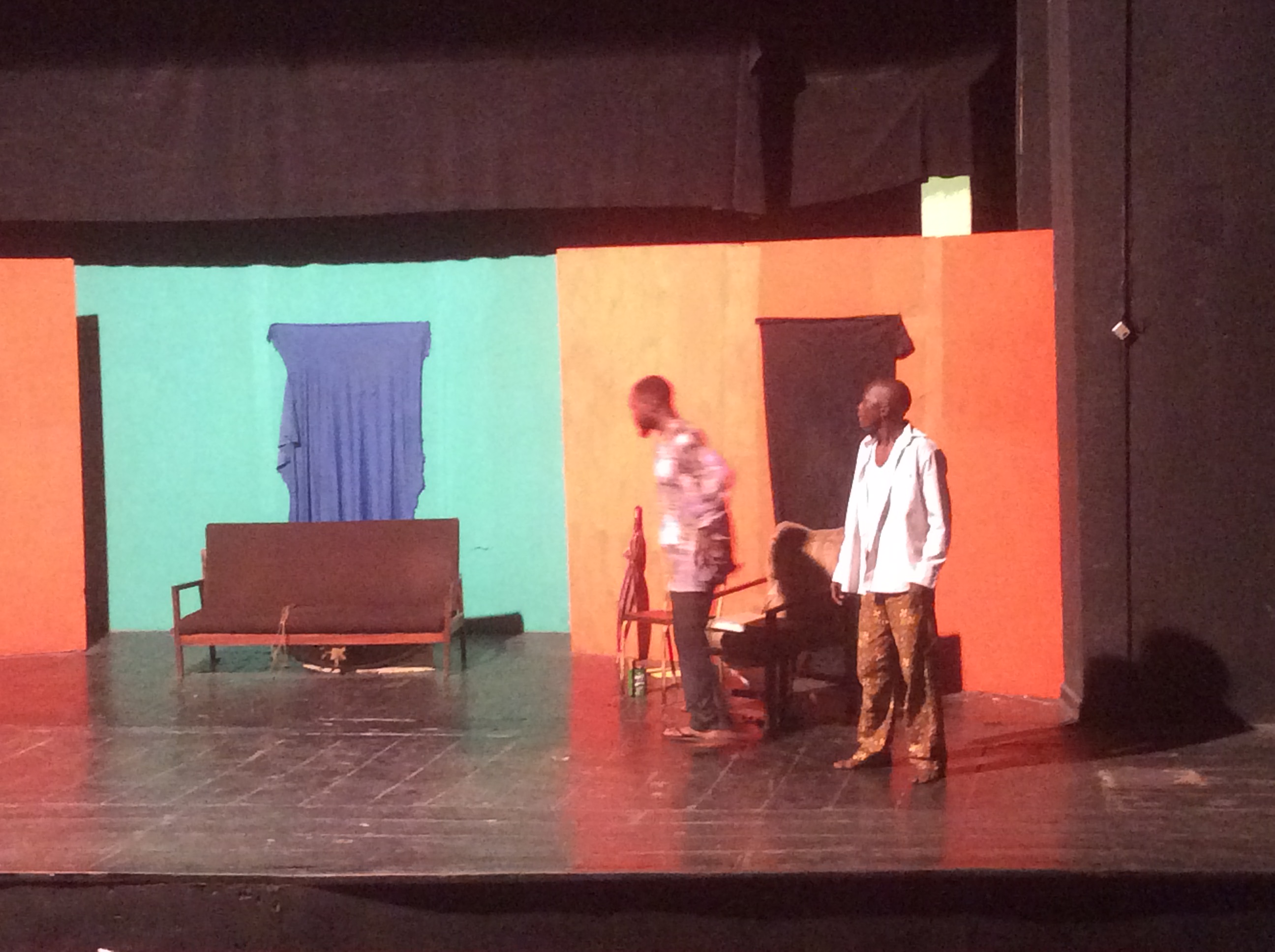
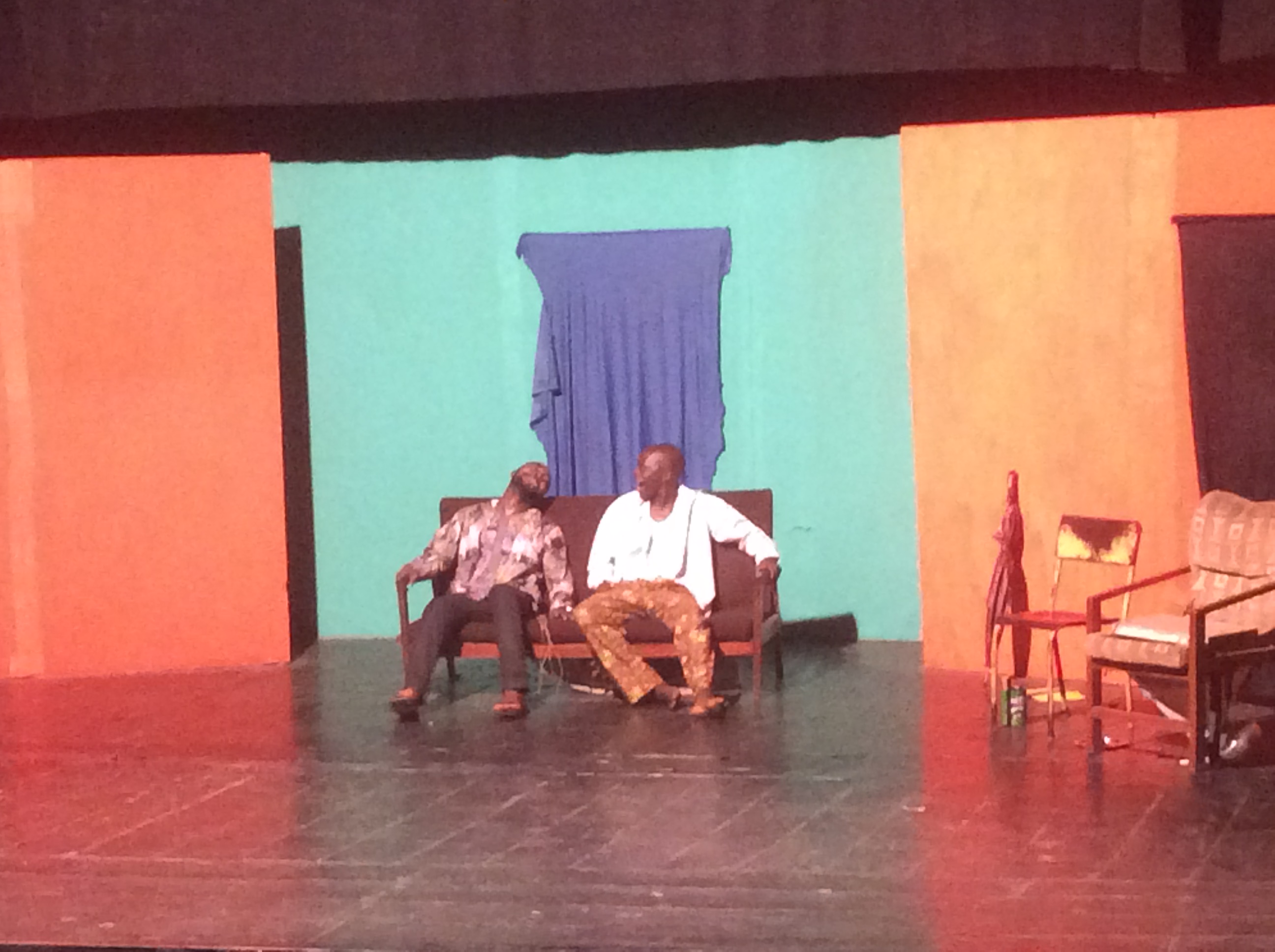
madI was first captivated by the posters and then I was warned not to watch the play because of the high level of vulgarity shown on stage. I braved it and opted to watch it on the second day of the three days that it was shown at the Main Auditorium, University of Lagos. Truly, if you survive the first few minutes of the play, you are likely to sit through this very captivating and bold attempt by a talented young playwright, Otun Rasheed, to shock, provoke, challenge, incite, and stir all manner of emotions through this breathtaking 70 minitues play. Given the very diverse critique of this play, one thing remains clear: sex is a tabooed topic in Nigeria. People prefer to talk about it in private spaces and not see themselves on stage.

You must be mad, Yes You! is the title of the play. While some might quarrel with the title, I think it is apt because really we live in a very mad world! It is a world full of paradoxes. The play was laden with foul language. The stark show of sexual pleasure and the rigorous scenes of obscenity and eroticism would make you cringe! But the message is loud and clear at the end: the level of promiscuity in the Nigerian society is high but largely ignored. Parents delude themselves by thinking their children are ‘holy’ and would not indulge in sex in this highly virtual and visual world of the internet. Infidelity, fornication, incest, pornography have become the order of the day. The level of incest within families is so high that you would be shocked. A few years ago, I attended a popular monthly camp meeting. When the altar call was raised, I was shocked at the number of people involved in incestuous relationship come out for prayers.

The cast comprised students of the Department of Creative Arts. Otun Rasheed is a lecturer in the department. What great mentorship! But does he represent the views of the Department or does he make any reference to it in any way? No! It is unlikely that such a play would see the light of day were it presented as an academic project. It is also not likely to receive a research grant. Yet, the academy should be a crucible for such phenomenal thinking.

Many thoughts crossed my mind while watching. Some of these discussed below reflect, in part, views of some of my colleagues when we discussed.

Why are people more likely to accept visual images of eroticism rather than a play with a similar theme? What role does sound and movement play in accentuating a message?

A bit of diversion: About eleven years ago there was a half nude life-sized female figure in the courtyard of the Visual Arts unit of the department. She was bare chested and wore a very well sculpted g–string that had a butterfly as motif on what I would consider the most significant part. A former Head of Department (also a visual artist) could not understand why that work should have been made. We all lived comfortably with the work for a long time. Over time there were signs of wear and tear on the nipples and lips of the figure. Several months later, the work collapsed. When I asked the students what happened they jocularly said. ‘She was raped and murdered last night and the case had been reported to the state CID’. Investigations are still ongoing till now.

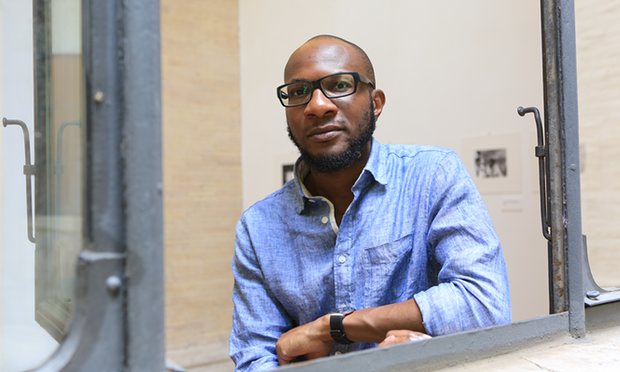
Ọ̀tún Rasheed. Photo taken from Encomium Magazine

Ọ̀tún Rasheed. Photo taken from Encomium Magazine

Religiosity and fanaticism becloud our judgment. I was told that some of the staff in solidarity rushed to watch the play only to run out after five minutes. They couldn’t handle it. Jesus! Armageddon! This is Satan at work! The devil is a liar! This playwright must be mad! Yes, Otun Rasheed is mad! We were told in our elementary theatre class that theatre is make-belief. Yet, there is a meeting point between reality and fiction. Outside the performance, can I look at the most vulnerable of the cast without casting my mind back to the acts of violation on stage? Perhaps the change of cast for each production helped mitigate this.

Tunji Sótimírìn is concerned about the very graphic scenes and the perception of parents who are only just accepting theatre arts as a field of study. Are parents likely to allow their daughters study theatre arts after seeing such a play? As a former Head of Department, I have come to realize that the passion for some of these students far outweighs the choices of parents. I have seen students cry when offered courses other than theatre arts. Every new entrant into the Theatre Arts Department believes, and rightfully so, that he/she would succeed and surpass the achievements of former alumni and alumnae of the department. Several of them abound – Moceda, Stella Damassus, Fẹ́mi Brainard, Mercy Aigbe, Dáre Art Àlàdé, Fẹ́mi Oke, Wọlé Òjó, Helen Paul, Ọmọ́wùmí Dàda, Sambassa, Sẹ́gun Adéfilá and others too numerous to list. The successful careers of their forbears in the entertainment industry looms larger than the sentiments expressed by some parents. We are thankful for such great mentorship since the days of cultural studies. Both students and lecturers have enjoyed such great tutelage from Prof Ẹ̀bùn Clark, Prof Dúró Òní, Prof Àbáyọ̀mí Barber, Prof Délé Jẹ́gẹ́dẹ́ , Prof Alagoa, Prof Anthony Mereni, Prof Bọ̀dé Osanyin, Alaja Brown and Túnjí Ṣótimírìn. It is from this tradition that Otun Rasheed has emerged.

Many questions arise, a number of which I cannot answer: What role does theatre play in the society? What was the message of this play. Was it meant to be a corrective measure? Must theatre always have a message? To whom was this play directed? What binaries does this play throw up.

There are many points at which this play succeeds:

a. The use of space was amazing. Like an owl, the audience found themselves turning three sixty degrees. Many of the cast were seated amongst the audience and the audience were literally brought onto the stage. The stage could not contain the depth of actions Otun Rasheed offered. I also like the use of light and the special effects on the stage particularly in the opening scene.

b. Great publicity. Every day was a new message urging you to watch the play. The t-shirts and posters added pep to the show. The visuals were simply amazing! Social media aided publicity for this pay. Gone are the days when crude publicity was done by hiring a rickety university based cab with speakers mounted on it, while announcement are made round the campus through unfiltered microphones.

c. There was great synergy between members of the theatre unit and the students in bringing this idea to fruition. For this, I congratulate both students and staff of the theatre unit. Otun entertains much as he shocks his audience. His main aim is to call for the censorship of plays just like it is done with films. His personal experiences of taking his under aged children to watch adult plays without knowing it inspired this work. You must be Mad, Yes you! was rated 18+. Tickets were not offered to underage undergraduates, but a few still managed the gain entrance. That is the very point this play tries to address. How careful can parents be in bringing up their kids? What should be told them and what should be left for them to discover on their own?

The play lasted for three days. In my mind, it lasts forever. The final day had the main auditorium full to capacity. My only regret was that the madness was not sustained for a full week. Much as I like this work of art, I would like the directors to temper some of the violent scenes, particularly those couched within the audience area.

Peju-LayiwolaI salute your courage Otun Rasheed for bringing this play to the university environment. I look forward to watching it over and over again. I hope it would be viewed in a more pubic theatre and receive the sort of commendation it deserves. Did I hear you say condemnation? It is left for you to decide because you must be the only sane person in this very crazy world.

_________

Péjú Olówu Láyíwọlá is an artist, painter, and sculptor. She lives in Ibadan. Full text culled and edited from her Facebook page, with permission.

NEWS: Artmosphere to Host Two Nigerian Writers

IMG-20160710-WA0013

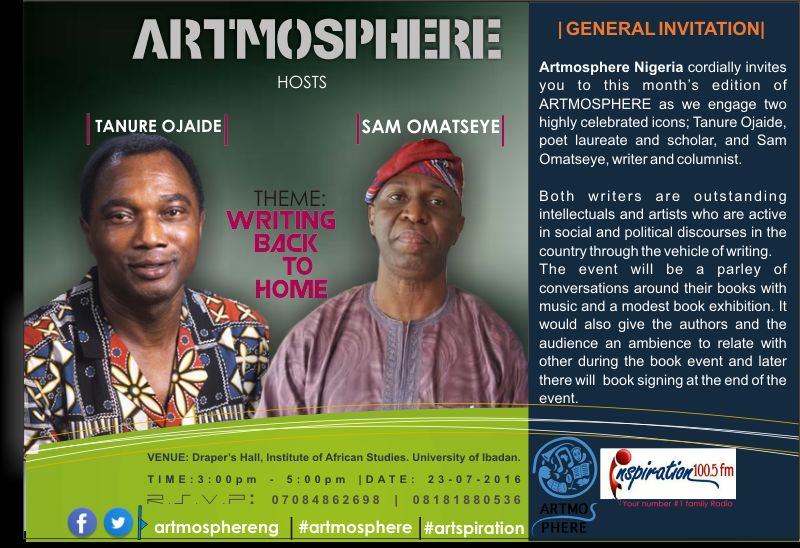
Artmosphere, one of Nigeria’s leading culture, music and literature events, will host Tanure Ojaide, Poet Laurete and Winner of the 2016 Folon Nicholos Prize, and Sam Omatseye, writer, columnist and Honourary Fellow of the Nigeria Academy of Letters. The event will engage the authors on their most recent works-‘Song of Myself’ by Tanure Ojaide and My Name is Okoro by Sam Omatseye. Other works written by these authors will also be discussed at the event.

‘Song of Myself’ is an offering from the Udje poetry tradion and the stylistic vision of the poet laurete, it talks about a myriad of themes including love, culture, politics, environment amongst others.It also speaks to the history of destruction of the cultural values of the Niger Delta. My Name is Okoro is an alternative narration of the Biafran war from the point of view of the Niger delta. It is the 49th anniversary of the Nigeria civil war,  and yet it remains a ‘no go’ area in national discourse, the novel prods us to take a look at our nation and negotiate the ethnic relations of our landscape.

The event will hold at the Institute of African Studies, University of Ibadan on Saturday, 23rd of July,  2016 by 3pm. It will be moderated by Femi Morgan, curator of Artmosphere and Adémọ́lá Adéṣọlá, a public intellectual, literary critic and book editor. Entry is free. 

Artmosphere is curated as a social enterprise since 2011. It is a book,  arts, music and culture event that has engendered artistic and intellectual, social and political conversations and creating a community of readers and writers. It has hosted the likes of Niyi Osundare,  Victor Ehikhamenor,  Efe Paul Azino,  Túndé Adégbọlá, Chuma Nwokolo,  Aýeọlá Mabiaku, Tádé Ìpàdéọlá, amongst others and has organised creative writing workshops in the city of Ibadan.

NLNG Releases a Shortlist of 11 for 2016

According to the Advisory Board for The Nigeria Prize for Literature, led by Emeritus Professor Ayo Banjo, 11 Nigerian authors have been shortlisted for this year’s Literature Prize for Prose Fiction, worth $100,000. This initial shortlist was drawn from 173 books.

Here are the authors (resident in the country and outside) and their work in the shortlist:

  • Chika Unigwe (winner of the prize in 2012): Night Dancer (2014).
  • Ogochukwu Promise (author of over fifteen novels): Sorrow’s Joy
  • Yejide Kilanko (a writer of poetry and fiction): Daughters Who Walk This Path.
  • Ifeoma Okoye (a writer and author of children’s literature): The Fourth World
  • Sefi Atta (author of Everything Good Will Come): A Bit of Difference
  • Abubakar Adam Ibrahim (writer and journalist): Season of Crimson Blossoms
  • Ifeoluwa Adeniyi (radio broadcaster): On the Bank of the River
  • Elnathan John (lawyer and writer): Born On A Tuesday
  • Aramide Segun (winner of an ANA Prose Prize): Eniitan Daughter of Destiny
  • Maryam Awaisu (radio presenter): Burning Bright
  • Mansim Chumah Okafor (author of two previous books of fiction): The Parable of the Lost Shepherds

The list was presented by the chairman, panel of judges for this year’s prize, Prof. Dan Izevbaye, well-respected literary critic and a professor of English Language at Bowen University, Iwo. Other members of the panel of judges include Professor Asabe Usman Kabir, Professor of Oral and African Literatures at Usmanu Danfodiyo University Sokoto and Professor Isidore Diala, a professor of African Literature at Imo State University, Owerri and first winner of The Nigeria Prize for Literary Criticism.

“The Nigeria Prize for Literature has, since 2004, rewarded eminent writers such as Gabriel Okara (co-winner, 2004, poetry), Professor Ezenwa Ohaeto (co-winner, 2004, poetry) for The Dreamer, His Vision; Ahmed Yerima (2005, drama) for his play, Hard Ground; Mabel Segun (co-winner, 2007, children’s literature) for her collection of short plays Reader’s Theatre; Professor Akachi Adimora-Ezeigbo (co-winner, 2007, children’s literature) for her book, My Cousin Sammy; Kaine Agary (2008, prose) for her book Yellow Yellow; Esiaba Irobi (2010, drama) who clinched the prize posthumously with his book Cemetery Road; Adeleke Adeyemi (2011, children’s literature) with his book The Missing Clock; Chika Unigwe (2012, prose), with her novel, On Black Sisters Street; Tade Ipadeola (2013, poetry) with his collection of poems, The Sahara Testaments and Professor Sam Ukala (2014, drama) with his play, Iredi War.”

Two Plays in Ibadan

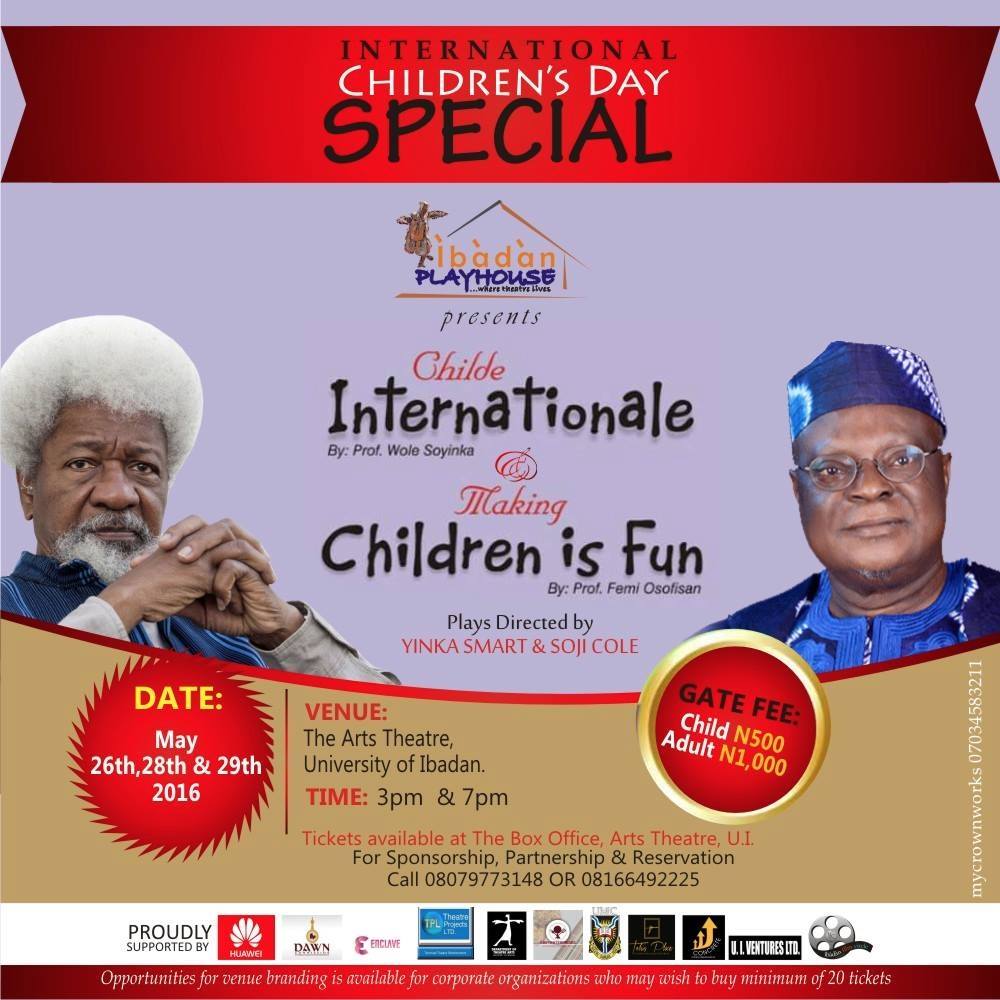
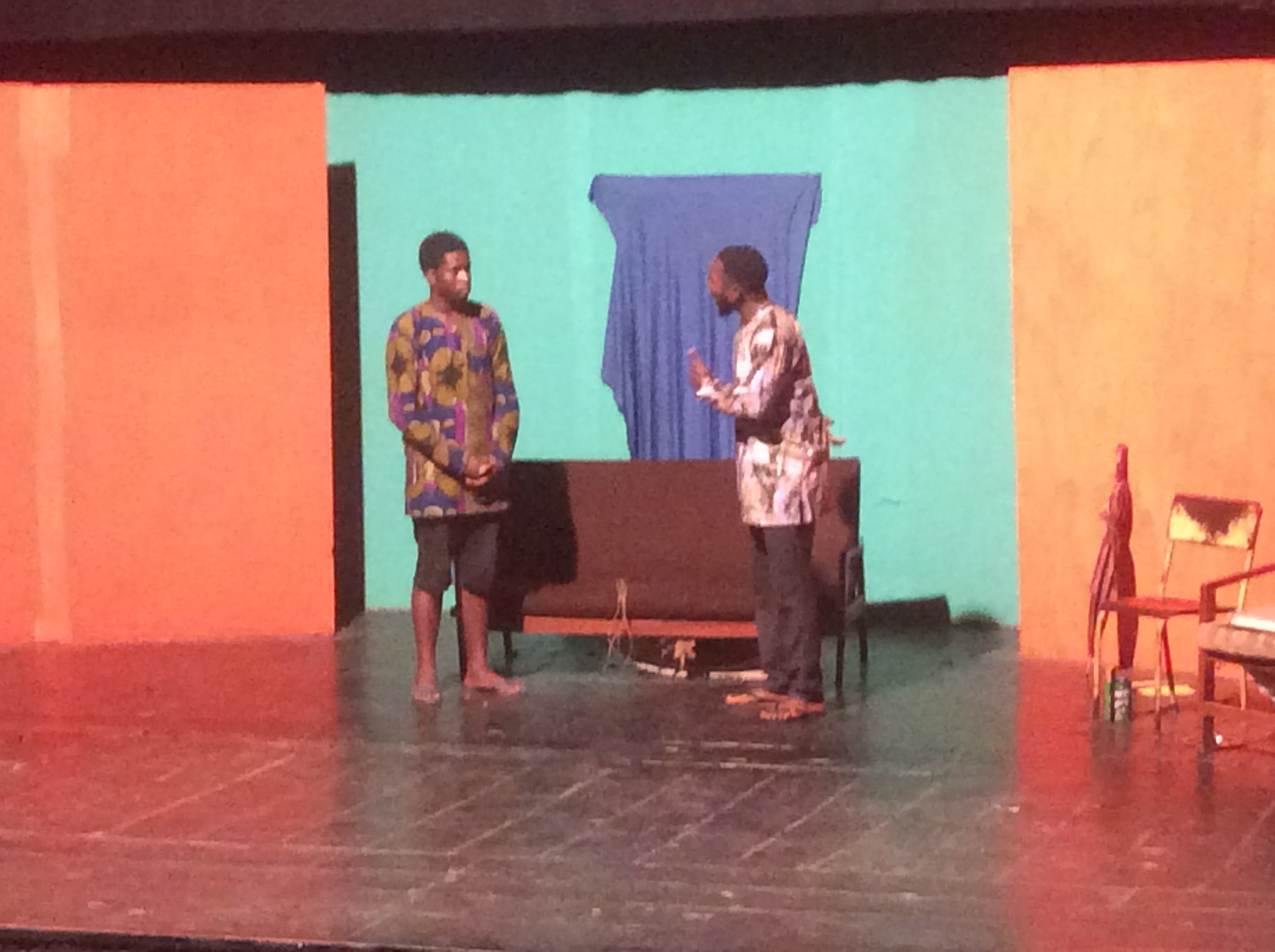
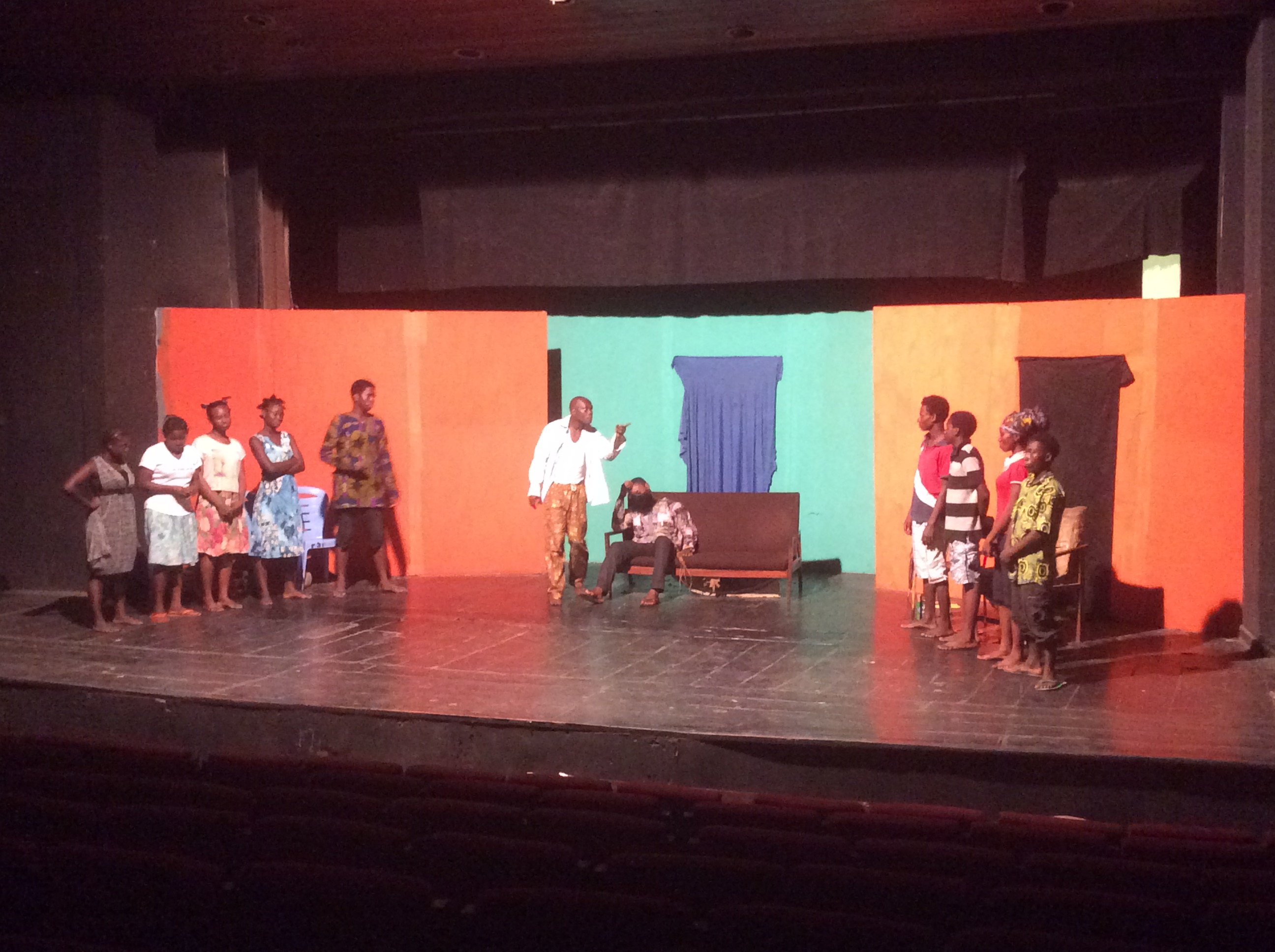
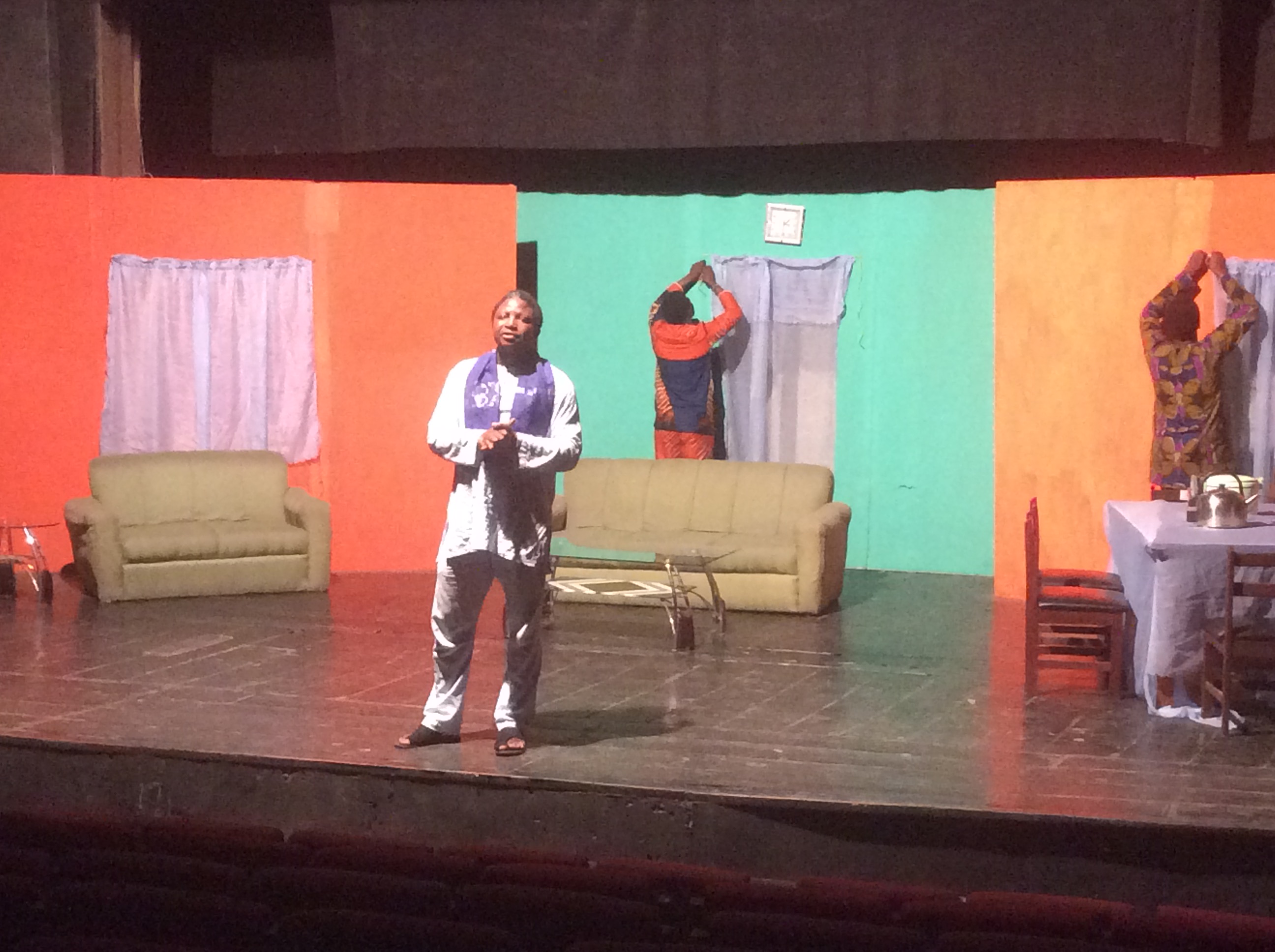
Ibadan PlayhouseI was at the University of Ibadan’s Arts Theatre last weekend to see the staging of two children-oriented plays by two of Nigeria’s best playwrights Wole Soyinka and Femi Osofisan. The plays were Soyinka’s Childe Internationale and Osofisan’s Making Children is Fun. The selection was in honour of the International Children’s Day, and was performed by the Ibadan Playhouse, a theatre company based in Ibadan, and directed by Yinka Smart and Soji Cole.

Both plays are unique in that they show their writers in their most accessible (and playful) format. This applies more to Soyinka than to Osofisan, but the duration of each play (less than forty minutes each) marked both works as more of skits/sketches and short interventions than heavy and serious work. But that notwithstanding, the works addressed serious social, political, and cultural issues of today and of the time when they were written.

IMG_5393 IMG_5398 IMG_5403 IMG_5405IMG_5395 IMG_5396Speaking in-between the plays, as well as when the show was over, the director of the company, Mr. Ropo Ewenla, expressed appreciation for the presence of the audience, while speaking about the mission of the theatre company. Not only was it created to recreate a culture of theatre-going in Ibadan and around the country, the company is also on a mission to bring plays of significance to the audience at affordable gate fees. But more than that, he spoke about a mission to use the vehicle of drama to reach the less advantaged in the society.

Children from orphanages around Ibadan are invited regularly to attend command performances and martinées for free. Secondary school children are also invited to watch performances at reduced rates, and the theatre company hopes in the future to go out regularly to perform in Nigerian prisons as a way to humanise the inmates and workers. Definitely something to laud and to support.

My experience at the University Arts Theatre both as a student and as a regular visitor to the university has always been a fun and stimulating experience, and this was no different. I strongly commend what the Ibadan Playhouse is doing. They can do with even more (corporate, moral, financial) support.

173 Authors vie for the 2016 Nigerian Prize for Literature

According to the press release from NLNG today, there are 173 entries for the 2016 NLNG Nigerian Prize for Literature. This year’s edition is focused on the Prose Fiction genre. More from the press release:

NLNG-Prize-for-Literature--330x218“The entries were handed over to the panel of judges by the Emeritus Professor Ayo Banjo Advisory Board for Literature. Other members of the Advisory Board are Emeritus Professor Ben Elugbe and Professor Jerry Agada. The panel of judges is led by Professor Dan Izevbaye, a professor of English Language, at Bowen University, Iwo. Other members of the panel of judges include Professor Asabe Usman Kabir, Professor of Oral and African Literatures at Usmanu Danfodiyo University Sokoto and Professor Isidore Diala, a professor of African Literature at Imo State University, Owerri and first winner of the award for Literary Criticism. The International Consultant is Professor Kojo Senanu, Professor of English at the University of Legon.

The last winner of the literature prize in the Prose Fiction category was Chika Unigwe in 2012 who beat 213 authors to the prize with her book On Black Sisters’ Street.

This year’s award for prose fiction will run concurrently with NLNG’s prize for literary criticism for which only two entries were received. Introduced in 2013, the literary criticism prize is a yearly award and carries a monetary value of N1 million.”