We shall be seeing this in class…
For balance, you may also want to read this review, The Balance of Stories.
What do you think?
Browsing the archives for the Academic category.
We shall be seeing this in class…
For balance, you may also want to read this review, The Balance of Stories.
What do you think?
A recurring question in my mind every day I go to class to teach my students Yoruba is “What exactly can they do with this knowledge?” Surely, like Ralph Waldo Emerson said, “there is no knowledge that is not power,” but when I look at these young students – the youngest of them being nineteen years – and look at the Yoruba language, I can’t help but wonder if there is anything particularly useful that they can do with their knowledge of it. The last few classes have featured questions and answers mainly about the people and cultural practices, as well as about language. So assuming that by the end of this semester, I am able to give them a basic knowledge, as well as give them sufficient motivation to learn more about the language, culture and people, then what?
Language is a medium of thought, but it’s also an abstract wealth, mostly without tangible value. An African language might be viewed with even more skepticism, especially from an American perspective. Besides the possibility of ending up like Austrian Suzanne Wenger in a Yoruba town with enormous artistic influence on a people’s belief, or as British Karin Barber in a University as a European authority on the language and grammar, what else is there to do with these little snippets of knowledge that we share every week in class? I cannot answer the question, and I would not be asking the students to do so.Yet.
We have learnt about Suzanne Wenger, Wole Soyinka, Karin Barber, Toyin Falola, and a few other literary figures. In the last class, I tried to dispel some more common genralizations about the people and perceptions. Students seem always to have new questions each time, and I love it. Had I seen that video of Chimamanda speaking at a Ted.com event, I might brought it along to class. I definitely will consider doing so in the next class, just after our test on Monday. I hope that in the long run, there is something of value being exchanged between us every time we gather in class to discuss.
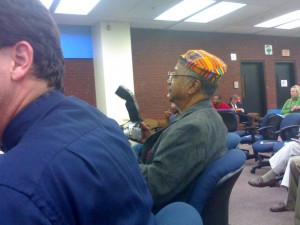 I stumbled onto a photo exhibition on campus on Wednesday, after a very stressful day of two classes. If not for a chance meeting with retired Professor Eugene B. Redmond as I headed home from Pizza hut, I definitely would have missed out. I had first met EBR last in Ibadan in 2003 or so when he visited the University campus there on an exchange programme, and to present new editions of DrumVoices Revue – a quarterly publication of poems from all over the world. I was with him and another professor from Ibadan when he visited the palace of the Ooni in Ife – which was the first time for me at the time. I have not been successful in getting him to grant me access to my digital copies of those photographs. Maybe they will end up in an exhibition someday. It will definitely be a pleasure to see them for the first time in over five years.
Eugene Redmond’s reputation doesn’t always reflect on his regularly meek appearance, but he has travelled far, met notable people, and contributed so much to the development of the arts and the African-American culture. On Wednesday, he was in a kente jacket and a matching cap, covered with an dark coat. He is most likely to be seen with at least two cameras on him at all times. Till date, he is reputed to have taken at least 150,000 photographs of people from all over the world. He was named the Poet Laureate of East St. Louis in 1976, and he boasts of a long time of frienship with very many leaders of the Black Movement, past and present, in literature, music and the arts, from Henry Dumas to Toni Morrison, Wole Soyinka, Katherine Dunham, Oprah Winfrey, Amiri Baraka and Maya Angelou, all of whom he has captured with his camera lens at one time or the other.
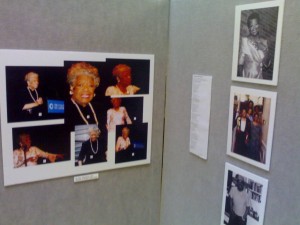 The exhibition was titled “Eighty Moods of Maya”, and it features eighty of the pictures taken of the poet and novelist Maya Angelou over several decades, and in many moods, some serious, some trivial, some private and relaxed, and some public and tense. Eugene Redmond has worked as a poet, journalist and photographer as well as a critic, academic and publisher. He first attended SIUE as a student. He was a student journalist with a camera at the 1963 March on Washington as an editor of The Alestle, a student publication here on campus. He has also taught many times at SIUE before he retired a few years ago. On retirement, he donated a collection of his photographs to the SIUE Library, and thus became a patron of the institution.
The exhibition which took place in the library also featured little speeches, food, and conversations among all present. We all knew we were waiting for Maya Angelou who is coming to campus later this week. The exhibition was just a teaser. There will be a long crowd on campus on October 4th to listen to the 81 year old poet and novelist who made history when she read “On The Pulse of A Morning” during President Bill Clinton’s Inauguration in 1993. In my case, I look forward to presenting to her something (I won’t tell you what) that I brought from Nigeria, getting a book signed, and getting a nice picture in my camera. Wish me luck.
On Wednesday, we spent much of the hour discussing the third chapter of a book of fiction titled “A Mouth Sweeter Than Salt” by 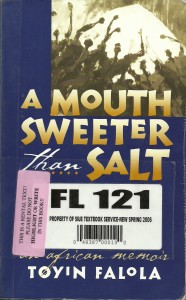 Toyin Falola which is our second class text. In many ways, the book is much like Wole Soyinka’s “Ake”, in style, content, and value, especially in the clever turns of phrase, eloquence, and reference to recognizable landmarks in the history of South-Western Nigeria before independence. The chapter is set when the author was nine years old, and the whole work is written in a way that makes it seem that we are listening to a child talk, even though we know that it is an adult relaying his many interesting experiences from childhood.
The third chapter dealt with the author’s first train trip in the 1950s from Ibadan to Ilorin, and his adventures on the streets as a beggar’s boy. He had started school, yet he could not resist a chance to ride on a train which was then a novelty in town. In the end, even though he didn’t have the train fare, he found himself in the belly of the electric “snake”, as he called it, delighting at the wonder of the European invention. As soon as he was discovered to have been riding without a ticket, he was dropped off somewhere along the way, and he found that he was in Ilorin, all the way from Ibadan, and he was loving it. Soon he became a “beggar’s stick boy”, holding the stick for one of the many fake blind men on the streets of the town who begged for alms in lieu of decent work. That job, which provided him with stipends on which to survive, and plenty adventures on the street, ended on the day he mistakenly spoke in English to a postman, wondering if he could send a letter home. Even though he was dirty and looked totally ragged, his grasp of the language shocked both his fake “blind” boss who immediately dropped his end of the stick, and fled as far as he could so as not to be arrested, and the postman who immediately grabbed the boy, and promptly drove him back home to Ibadan to the arms of his bewildered parents and neighbours. It surely reminds of some parts of Soyinka’s “Ake.”
I am convinced that the reason why this book is a recommended text is because of its many descriptions of Nigerian, nay Yoruba cultural life, especially before and during colonial times. The author was born in the 50s, and he grew up in a less educated environment than, say, Wole Soyinka(who was born in the 30s, yet had a whole library of books to read before he even went into school for the first time.) But in the end, there were so many questions raised than could be answered in that one class even though we tried very hard: Why did the boy find the train strange? Why did the postman take him home instead of to the police? Why was a boy not immediately embraced when he got home, instead of being suspiciously viewed by family and neighbours as some form of emere who was born only to torment his folks? Did children beg for alms a lot on the streets of Nigeria? How much of human sacrifice did the Yoruba believe in? Do they still sacrifice people to make money? What is the punishment for such a crime? What is the Justice system like? Do they hang condemned criminals in public or not? Do children have toys to play with? Do you have Amusement Parks in Nigeria? Do you have Six Flags in Nigeria? How come some people do not know/remember their dates of birth? Do you know yours, Traveller? etc.
Every day, I discover new reasons for the perceptions and misconceptions (many of which are justified) about Africa and it cultural practices. Every day, I learn new things about the influence of literature, and the power of words. And every day, I find new reasons why this programme is one of the best, and most useful projects of the American government, in helping us to understand better the world in which we live.
It was mentioned almost in passing in our last Wednesday class by one of the American students that whenever I mentioned Yorubaland, as I always inevitably did while telling them about that part of Nigeria (and Benin Republic), it always sounded to their ears and imagination as some sort of a fairytale kingdom. “Like Disneyland?” I asked, and they all shouted, “Yeah”.
Seriously.
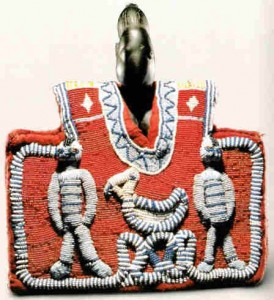 “Do you still have kings there?” Another one asked.
“Yea,” I replied, but their function is mostly ceremonial, like that of the British monarchy.”
“Do they have rituals of coming-of-age, like public circumcision dance and festivals, like we’ve seen in some movies?” A different student asked.
“Well,” I replied, thinking, “there are some cultures in Africa that has those festivals for boys when they get to a particular age. But not the Yorubas. They cut their male children’s foreskins immediately after birth, and don’t wait at all.”
They seemed to be very impressed, but I was sure that they still retained some exotic ideas about the famed “Yorubaland” or “Yoruba Kingdom” that reminded them either of a Disney Movie or an animated flick, so I dimmed the lights in class, put on the projector, and logged onto YouTube to look at some Yoruba movies and clips. Luckily, there was Baba Wande and a few other actors there who I could point to as archetypes of Yoruba men and women in dressing and mannerism. I typed in “Lagos” and one of the first results there was a documentary about the Megacity project in which Wole Soyinka and a few others were interviewed for the camera. In the end, I felt I’d given a balanced view of life in Western Nigeria. They saw what a typical Yoruba house and street look like. They saw cars and people going about their daily lives, and I wondered if I’m able to help them reconcile that general city look with the many eccentricities that some of our cultural practices present as evidence of another kind of social life that is not seen on the streets.
For future classes, I have promised them a session of reading short stories of the tortoise from Nigeria. Luckily, I have brought along with me from Nigeria a book of many folk stories that captured our imagination as kids growing up in places in Yorubaland. And from the twinkle in their eyes, I see excitement, and I’m equally thrilled by the prospects of being the storyteller in a class of young students in the Western hemisphere, travelling back into a magical kingdom of animals, and folk wisdom from the Yoruba elders. This too will be an experience of a lifetime.