A few minutes ago, I concluded a chat with a French student in this University (on a different but similar international programme) who told me that I had done the abominable by putting my red wine in the refrigerator. “If you were in France,” she said, “you’d be thrown out of the country by now!” Oh, the French!
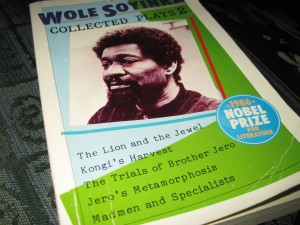 Checking my post mailbox this morning, I found an envelope postmarked from Pennsylvania. Since I wasn’t expecting anything so soon, I was surprised to discover in it Wole Soyinka’s Collected Plays 2. I had indeed ordered it a few days earlier from Amazon alongside books by George Carlin and William Shatner. That was fast delivery! The book wasn’t new, but it was in very good condition. Back in Nigeria, Amazon was never my friend since I didn’t have a credit card, and they won’t ship goods to Nigeria anyway. The book contained The Lion and the Jewel, Kongi’s Harvest, The Trials of Brother Jero, Jero’s Metamorphosis and Madmen and Specialists, that last one being an all-time favourite.
Today we saw the Chimamanda Adichie TED video talk in class for the first time. As I remarked to a Nigerian friend afterwards, the video was lovely, but in the end it wasn’t spectacular. I think I must have expected too much a response from the students, although in the end, I’m sure they were able to understand and appreciate Ms Adichie’s valid points in a way that they found interesting, and in a way to which they could relate. My own initial response to the talk, which was pride and exhilaration the first time I saw it, was – as I realize it now – because I’m Nigerian and, seeing her speak to such an international audience filled me with such pride. Why it did so, I can’t explain now. She hasn’t said anything new, but she has used many new ways to illustrate it. And that’s always a good thing.
Later in class, as I was about to receive a usb flash disk from a student who wanted to submit her Yoruba audio recording assignment, I felt an electric spark when I collected the disk. I was alarmed, until the other students told me it’s normal, calling it a “static” current. (Wikipedia calls it “the buildup of electric charge on the surface of objects” which is either bled “off to ground or are quickly neutralized by a discharge”). A few minutes later when I gave the flash disk back to her, it happened again just as our hands made contact, and I “freaked out”, to use American colloquial expression of shock and disbelief. That was one thing I have never experienced before, but I have no doubt that it exists, perhaps even in Nigeria, and all over the world, but I’ve never heard any personal stories. According to a few more people that I’ve asked, this is a rather common phenomenon in America which comes into play when one of the contact persons has spent much time making bodily friction with the floor with their feet or body, they are indeed capable of conducting electricity. I find that strange. I’m surely not touching anyone again soon. Time to go back to receiving assignments through email.
I miss home!
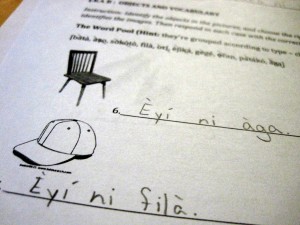 The test of students’ progress is not always as tricky if one is lucky to have listened to the students beforehand and to have understood what they are used to and what they are not. In most cases, as long as the teacher knows that his purpose in the test is not just to surprise and attack but to monitor his own progress, there would be less tears and heartbreaks when the day is over.
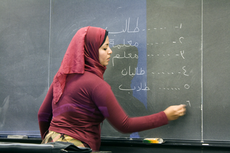
 Today, I went to the Principia College, Elsah Illinois with two professors from SIUe and another international student from here. Retired Professor Wilson had been invited to give a talk on diversity to a few students in the University, and it turned out to be a nice experience. The campus of the College (called University in Nigeria) is located at a site off the river road and overlooking the great Mississippi River. No words can describe the grandeur of the river as seen from the road while driving. I’m much convinced that it would look and feel so much better while on a bicycle. According to Prof Wilson, Mark Twain the writer used to come over to the river to get inspiration. Oh well.
 The journey to Principia took a little over thirty minutes from the SIUe campus, and we had to pass through a few small towns including Alton and Elsah, each with a repertoire of historical information, especially about the Native Americans that made the area their habitation for many years before their forceful dispersal. Alton has the famous Clark Bridge, and the even famous painting of a prehistoric piasa bird on the face of the cliff also overlooking the Mississippi river. According to Wikipedia, Alton has “its steep-sloped streets filled with silos, railroad tracks, and brick commercial buildings”, and it counts among its famous former residents Miles Davies, the legendary trumpeter/musician, Elijah Lovejoy, an abolitionist who was murdered in 1937 for his role in anti-slavery movements (and after whom the Library at SIUe is named), and James Earl Ray, the murderer of civil rights activist Martin Luther King Jnr.
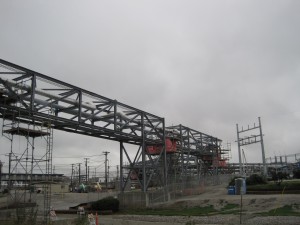 One of the notable sights on the way from Edwardsville are the many oil refineries in Illinois that litter the way. “Those refineries refine the crude oil from Nigeria”, the professor quipped “before they are sold in the United States at different rates.” The crude oil is brought from different parts of the world – and indeed from Nigeria – in large ocean vessels, are refined, and sold as “gas”. What he didn’t know until I told him was that the finished petroleum products are also sold back to Nigeria – like chocolate products – at exorbitant prices whenever the steam engines of Nigeria’s refineries go down and the continent’s petroleum giant finds it hard to refine its own products. Passing through those areas of Illinois that I’ve never been before only reminded me of Nigeria’s Niger Delta: plenty smoke in the air, and plenty smell of gas – a depleting environment under serious gas pollution.
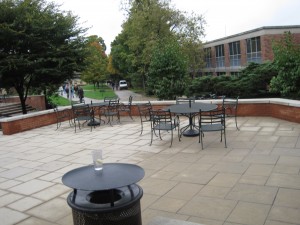 The Principia College is an institution for
 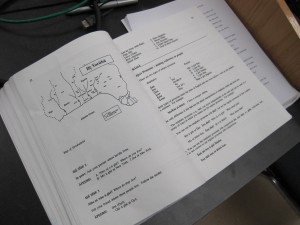 “In Nigeria,” I said, half in jest, “students are not given to this much indulgence as you American students.” Back home, teachers take it upon themselves to surprise students in whichever possible way. Students would go into class one day just to discover a surprise test, with no way of knowing what to expect from the teacher. Do not get me wrong, this is not always a good thing. But here in America, not only did I have to give them the “areas of concentration” as we called it back home, with details of how I expect them to answer the questions, multiple choice or not, I was also made to promise that there would be at least a few more “extra credit” questions, set to help everyone get a chance to come out in good grades. To be clear, I do not have any problem with this. The students have worked so hard to overcome all linguistic and phonetic obstacles of learning Yoruba. It is only fair that the examination be made to test their knowledge, and not to punish their ignorance. Therefore, there would be multiple choice questions. There would also be fill-in-the-blanks, as well as questions requiring long and short sentences.