Browsing the archives for the Academic category.

Class Sessions 6

It was fun to be in class again on Wednesday, and revise the many words, phrases and expressions that we had learnt since the class began five weeks ago. Somehow, we all seemed to have grown on the Yoruba expressions and they don’t sound any strange as they probably did to the ears of the new students when I first walked into the class on that first day.
220920091368Yesterday, we had class practices of oral conversations. The students were paired with each other and they took turns to display their knowledge of conversation techniques by dramatizing the scenario of a chance meeting by two previously unfamiliar strangers meeting on the streets of Osogbo or any other Yoruba town.

Speaker A: Káàro o.

Speaker B: Káàro. Sé àláfíà ni?

Speaker A: Dáadáa ni/Adúpé/Àlàáfíà ni o. Ìwó nko?

Speaker B: A dúpé. Kíni orúko re?

Speaker A: Orúko mi ni Títilayò. Kíni orúko tìre?

Speaker B: Orúko mi ni Babafemi. Níbo lo n gbé?

Speaker A: Mo n gbé ní Collinsville. Kíni orúko àbúrò re?

Speaker B: Orúko àbúrò mi ni _______/Mi ò ní àbúrò. Ìwo nko?

Speaker A: Orúko rè ni _________. Ègbón mélòó lo ní?

Speaker B: Mo ní ègbon méjì. Ó dàbò.

Speaker A: Ó dàárò. Inú mi dùn láti mo é.

…and other short phrases improvised for conversation.

As far as elementary knowledge of the language is concerned, we have not done badly so far. Our areas of improvement include pronunciation. Many students still found the word “GBÉ” hard to pronounce, even though they could pronounce the English word “RUGBY” quite effortlessly. Can someone tell me why? In the next class, we will be in the computer lab to do get these expressions on tape, voiced by the students themselves. It is going to be a fun experience.

PS: According to the result of the web poll on the right side of this blog, I need to spend more time talking about my class sessions more than I talk about myself. I will keep that in mind as I go on, but I will occasionally have to share my personal experiences as they relate to my appreciation of the programme as a whole. Thank you for voting. I will appreciate as many more votes as possible. This is a chance for me to know what thrills you and what doesn’t. If you haven’t voted, you can still do so. The poll is on the right side of the blog homepage.

How Does It Feel?

Q: How does it feel teaching young Whites (students) Yoruba language?

A:  It feels great. It’s challenging to me as it is to them and I like the experience. I could connect with them more because they are young people like me, and they are quite eager to learn and discover new things. The experience also gives me a chance to see myself through the stranger’s eyes. I’ve recently asked them to read up a particular short story on Yoruba culture and write what they find strange and different about the people, and what they find equally similar with their culture. These exercises give me an insight into what they see when they look at me. But over all, it is a very fulfilling experience.

In response to an interview question on Bookaholic Blog two days ago. The full interview is here.

The Fifth Class

My fifth class was short, but only because it never took place. I’m blogging about it only because it has taught me another important lesson in my American experience: be punctual. But first, I should tell you why my sleeping pattern has become so irregular. Two words: time zones.

By the time it’s midnight in Illinois and I’m ready to sleep, a chat box beeps open on my laptop and someone in faraway Nigeria has woken up and wants to talk to me. It is six am their time. A little “hi” gradually turns into long phrases and sentences, and by the time my eyelids start closing by themselves, they somehow get the idea, and we part ways. It is not their fault but mine, for staying up beyond eleven pm when I should just shut down the blooming laptop and close my eyes.

"Good day class!"In today’s case however, it was none of the above reason. I was working on a translation task that took much of my time. I slept at twelve, woke up at two and slept again at five thirty. By the next time I woke up, I was thirty minutes late for my teaching class. I have never rode by bike as fast as I did today, and I got to campus panting like a deer. And silly me, I was still expecting to find the students waiting for me in class. I met only one of them the lobby, and I hurried up into the class to find an empty set of seats. Perfect. Back to the lobby, there was Bre reading, and waiting for her next class.
“Hey, where’s everyone?” I asked.

“We left.” She replied. “You weren’t there, and so we left.”

It was as simple as that.

It was another sharp reminder for me to wrap myself around the fact I’m no longer in Nigeria where students have to wait until the end of the hour for the teacher to show up in class.

The Fourth Class

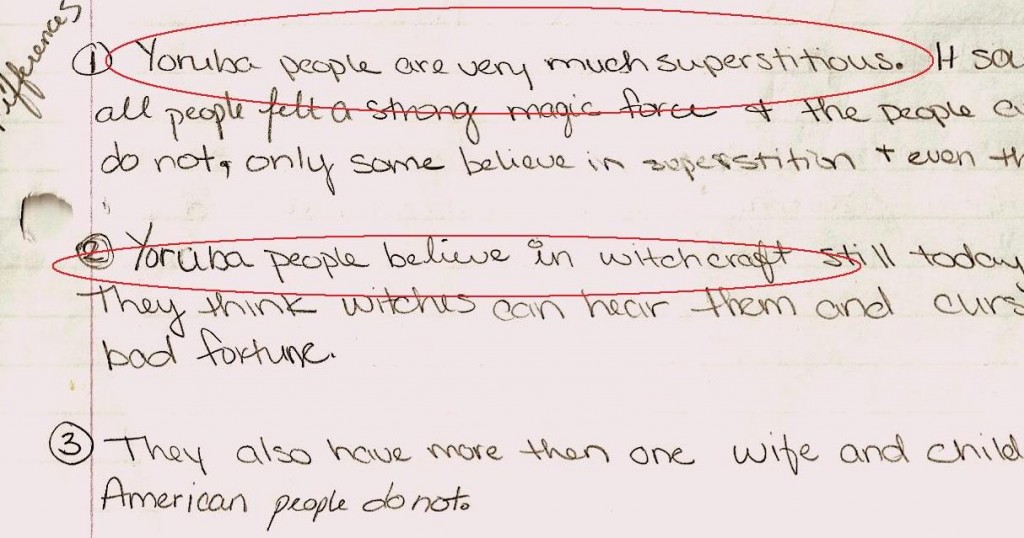
When I was in Kenya in 2005, I remember that one of the most recurrent observations I received from Kenyans was that Nigeria is a place filled with people who believe in witchcraft and practice it in their daily lives. We all believed in juju, they said, and none of the women I spoke to would dare to marry a Yoruba person for fear of one day having to deal with a mother-in-law that could turn them into a piece of metal at the slightest provocation. I have since discovered that this is a very prevalent perception of Nigeria, mostly obtained through our home videos that have been ranked third in the world in terms of output. Is there practice of witchcraft and a prevalent belief in it in Yoruba land today. The answer is yes. Does everyone believe in it. Erm, I would say yes to this as well, but with very few exceptions of the skeptics.

Cut to my fourth class, where I had asked my students to read a short story titled “Why Atide Is Taking To A Coin”, written by a German friend, student of Yoruba and a current PhD student at SOAS. I first read the short story in 2004 while it was still being written, and I got to contribute a few ideas to its storyline. So last week, when I asked my students to list ten things they found strange, new or memorable about the Yoruba culture from the story, and five things that they found similar to their own culture, I was trying to get them more interested in reading and discovering new things. It was also a way for me to get into their minds and see what they see when they look at me through the prism of Yoruba culture. The result amazed me. Of all the answers given to the first question, one was common to all the ten students in the class: They were surprised that a belief in witchcraft still exists/persists in some cultures of the world, particularly mine. They couldn’t understand why people ascribed occurences they couldn’t explain to the evil forces in their family, and they couldn’t understand why somebody who is Christian/Moslem would go to a Babalawo to get help with something that was bothering them.A Class homework

Now, I could have easily said that it was the fault of the writer of the story for painting the Yoruba people in such a light, but when I look around Yorubaland today, I find not one but many leaders and public figures who would take their supporters or followers to shrines so as to get them to swear and take oaths of allegiance. Recently there was a case of a prominent state governor, and a lawmaker whose naked picture was taken at a shrine where he had gone to perform rituals. The fact is, belief in rituals are still as strong today in Yorubaland as it was before the British came. Whether this is a good or a bad thing is beyond my scope to say, but it took me some time of readjustment to deal with the truth, being a little lost to the effect such disclosures might have on the impressionable minds of my brilliant students, and their ability to see this somehow as a positive attribute of such a people with a complex culture and outlook on life.

Are we a modern society in Yorubaland, or are we still attached to the deep vestiges of the past? If the texts of our literature, the lines of our poems and the plots of our dramas are anything to go by, the answer might be far from what we always like to believe.

The Third Class

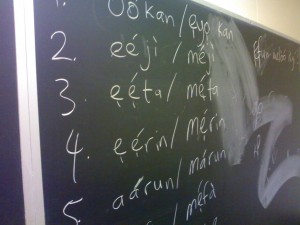
By now we can greet. By now we have mastered the basic expressions that express intent.

By now we can ask the questions:
“Kíni orúkọ rẹ?” “Orukọ mi ni…” “Orúkọ ọrẹ mi ni…” “Orúkọ babá mi ni…”
“Kini èyí?” “Èyí ni bàtà.” “Èyí ni asọ.” “Èyí ni gègé.”

By now, we can count from one to ten in Yoruba. By now, we can also express number.
“Ọmọ melòó lo ní?” “Mo ní ọmọ mẹta.”
“Asọ melòó lo ní? “Mo ni asọ méjì.”
“Àburò mélòó lo ní? Mi ò ní àbúrò kankan.”

090920091230

Or express satisfaction with the teacher’s explanations:
“Sé ó yée yín?”
“Kò yé wa.”
“Ó yé wa.”

On Wednesday, week 4 will be over, and we would have had seven classes so far, each with its own challenges. We have somehow managed to get over the pronunciation challenges, one step at a time. It is not yet uhuru as far as recognizing and being able to correctly pronounce tone marks are concerned. And you can’t blame us. It was a relief for the class to know that there are some authentic speakers of Yoruba in Nigeria today who can’t stand the tone marks nor correctly identify it. The challenge before us is to become better than them. And better than them we shall be. We’re taking it one day at a time.