The Origin of “Oyinbo”

I have come across the  most convincing story yet of the source of the word oyinbo. Of all the previous stories about the source of the word, the current entry in Wikipedia makes use of cognates and probable historical anecdotes. See below:

it… means “white person” generally used in the country, which originates from Igbo Language . The first “White people” to settle in Nigeria as colonial masters were the English people. In Igbo language demonym takes the form ” onye + the place of origin” of the person, hence, and Igbo person is called ” Onye Igbo”. A Yoruba person is called ” Onye Yoruba”. A German is “onye Germany”. Thus the first white people were called “onye ocha” for singular and “ndi ocha” for plural meaning “white person and white people” respectively. This was because the Igbo people of those days did not know from where the white people came. Interaction between the Igbos and the white people resulted in the white people trying to refer to the Igbos with a name similar to what the Igbos called them, but there was problem in pronouncing Igbo words due to presence of double lettered alphabets which involve nasal pronunciation,in some of the consonants such as ‘ch’, ‘gb’, ‘gh’, ‘gw’, ‘kp’, ‘kw’, ‘nw’, ‘ny’, ‘sh’. These were not present in English language hence the difficulty in the white man’s effort in giving the Igbos similar demonym as the Igbo people had given to him, instead a name resulting from a mutilation of Igbo words was produced “Oyi ibo’ instead of ” onyi igbo’ meaning ‘Igbo person’ just as he ‘the white man’ was called ‘ onye ocha’ meaning ‘white person’. It was this ‘oyi ibo’ that the Igbos later started referring to as ‘white person’ in a way of mocking the white man for his inability in saying “Onye Igbo”. This would later be adopted by other Southern Nigerian tribes as the standard name for the white man and coupled with dialect variance one obtains different pronunciations such as “Oyinbo’ in Yoruba and other western Nigerian tribes…

As a linguist, this makes more sense than any other story that breaks the word down as “oyin + bo” or any other permutation.

Will Yoruba Survive?

To @MrBankole, who asked:

I’d like a brief comment, if you don’t mind… (on) your thoughts about the future of (Yoruba’s?) cultural legacies and how they interact with evolving mediums of expression. Do you think they’ll erode…or will they be preserved? Living, breathing, or digital fossils.

I’ve heard many versions of this question before, but this one is about whether the new means of communication (with their inherent tendency for language imperialism) will (or not) send Yoruba, or perhaps any other language with such limited use off the map completely.

I believe, of course, that they will survive. The question however (always) is “in which form?”

IMG_6968The Yoruba language lives today in Candomblé, a religion in Brazil, and in Cuba as Santería. Some of the cultures of the old Gold Coast have remained in Jamaica and some other parts of the Caribbean in sometimes recognizable bits, or sometimes in totally evolved forms. This is the inevitable fall-out of language and cultural transposition. As dead as Latin is, it still lives on in science and in the Catholic Church. The point is that even in the worst case scenario, there will still be a recognizable part of the language left.

So, if in a couple of hundred years, Yoruba survives only in this (electronic) medium through the use by those who remember particular registers from their own childhood and nothing more, we may be left only with that: a Yoruba customized for a medium and a particular kind of audience. An e-diolect, if you will. Over time, as it happened in Brazil and Cuba, the chasm will increase and the distance between the original Yoruba from root and the e-volved Yoruba that lives on in the medium will increase to perhaps an unbridgeable length, with few exceptions.

Or not. (We never really know. Language is dynamic and their survival/destruction is often subject to other issues than just mere technological advancements. Maybe a war will take place and destroy all Yorubas in Nigeria, and the only surviving bits of the language will be those spliced with English and all the other acquired languages we’ve imbibed.) But these are hypotheticals.

I don’t believe that the original Yoruba from the motherland/hinterlands will ever completely disappear from the earth (just like English never will as well). But I believe that all things being equal, they will evolve, differently in speed – of course, depending on their medium of transmission (and the types/number of people that use one kind over the other).

Thank you for the interaction, Lord Banks.

PS: The Speak Yoruba Day on Twitter is still March 1, 2013. It is a chance to showcase the facility of the mother tongue and its relevance to the 21st century.

Another Short Digression on Tone

Whenever I’ve told people that my thesis is on L2 tonal acquisition, except for folks with sufficient familiarity with the field, the first question usually is – “what is tone?” or “what is a tone language?”, followed by “so what exactly are you trying to find?” I therefore spend the first five minutes explaining to them what tone languages are (and that about 70% of all world languages are tone languages), and then tell them a few more details of the direction of my work. I found myself in this direction by chance – though I don’t tell them that – but after taking the patience to explain why in the absence of sufficient research materials on the process of L2 tonal acquisition I find it fascinating to be involved in discovering all that can be found there, they usually look enlightened suddenly, and then give me a look of “well done.” I feel better, although I know that a good number of them are just happy to be done with the conversation.

Having taught Yoruba at the university level for a while here in the States, it was natural to be interested in phonological and pedagogical dimensions of the language acquisition. Then I took a course on Second Language Acquisition with all its arguments on the critical period hypothesis that implies that language learning becomes difficult or impossible after a certain age. It all coalesced at some point in my head, and here I am. The data gathering part of the work itself is almost done, and the writing is halfway done already. I have discovered very many fascinating things, and encountered enough data to advance into a few more research directions in the future. One of the main things, of course, is that nothing at all prevents anyone from learning and acquiring tone or any language at any age whatsoever. There are influences of first language, to be sure, but they don’t pose enough challenge to prevent a subject (even those above the so-called critical period) from acquiring the form.

Just last week, I helped another colleague conduct a shorter research than mine on the questions of tonal perception among American English speakers. The results were equally interesting regarding which tones were easier to learn in isolation and in context, and whether tones are generally easier to learn in context or in isolation. I have been busy. In a few weeks, all of this should be over, and I should have some time off to myself. What to do with that time is another matter. There seems to always be something. What I will take away from this research (and the whole Masters experience) would be the fascinating unpredictability of results, along with a few frustrations of disobedient subjects and other constraints of time, space, and materials. Somewhere in there will also be an appreciation for the Graduate School here – along with my ever patient supervisors – for the small research grant that has made the whole exercise worthwhile and less exacting, and my supportive family and friends.

The commencement is on May the 5th. I shall have become a master in something (else).

The Light in Double Equivalents

The outrage that greeted Republican front-runner Newt Gingrich’s recent comment about poor people stemmed mostly from his condescension, and not from the fact of his assertion. Speaking at a campaign in Iowa last week, two weeks after he had called the labour laws in America “truly stupid”, Mr. Gingrich said:

Really poor children in really poor neighborhoods have no habits of working and have nobody around them who works. So, they literally have no habit of showing up on Monday. They have no habit of staying all day. They have no habit of ‘I do this and you give me cash’ unless it’s illegal.

Coming from a middle-class background and growing up in Nigeria’s lousy economy of the 90s, I relate with much of what he said with regards to the habit of working. The disingenuity of the argument he makes, however, is in the way it casually omits the truth in a similar argument for the other side. Read below:

“Really rich children in really affluent neighborhoods have no habits of working and have nobody around them who works. So, they literally have no habit of showing up on Monday. They have no habit of staying all day. They have no habit of ‘I do this and you give me cash’ unless it’s for partying.”

Did you see what I did there? I substituted the words “poor” for “rich” and other “negative” equivalents for “positive” ones. Does that little trick change the truth in the assertion of Mr. Gingrich? No. The problem however is that he did not make this balanced claim. By focusing only one side and demonizing poor children, he pits himself on one side of the argument, and thus muddles the issue he was supposed to be solving. If the focus of his comment was to breed a culture of working, is there a particular reason why it should focus only on poor children?

Let me make a second example, also from Mr. Gingrich’s attempt at political commentary. While speaking with a Jewish television last week, Mr. Gingrich said that Palestinians are, after all, “an invented people” who didn’t exist as a nation until after the exit of the Ottoman empire. Of course, he was right. The people now referred to as the Palestinian people, now craving for a state of their own, are just Arab people living in the middle east. However, so are the Jewish people as well! The Jewish State of Israel (at least as we know it today) was just as well “invented” in self-determination after the Second World War. So why did Newt Gingrich not state the second equivalent truth of his assertion? Because it is not politically expedient, and – like other Republican candidates – all he wanted to do was to sound Pro-Israel than the incumbent president whose job he seeks.

Now, to my final two examples on this matter, this time on race. I found out to my chagrin that the most popular post on my earlier wordpress blog (before moving to this domain) has remained this one where I wondered if oyinbo – a Yoruba word for “white person” was a racist word. I knew it wasn’t, but I was interested in reader perspectives on the way a word conditions the way we look at the world and other people. I got feisty, energetic responses. But what struck me earlier this morning however is a fact that I had overlooked for too long: that more than half of what is considered racist – even here in the United States – were anything but. Here are two quotes, the first by Donald Trump: “I have a great relationship with the blacks,” said a few months ago to public outrage, and Ann Coulter’s “Our blacks are so much better than their blacks” – a reference to African-Americans in the Republican party as opposed to those in the Democratic party.

It is easy for me as an African to take umbrage at each of these statements (as I undoubtedly did for a few days without being able to lay my hands on why the statements seemed so jarring). A few months removed from the uttering of those words however, I finally got it. It took a short memory trip back to the sociopolitical environment of my home country. “I have a great relationship with the whites” would not have elicited such a public umbrage in Nigeria but it would have raised eyebrows of social awkwardness. There is a consensus that there is something awkward with a citizen who felt the need to associate himself with a particular race for political advantage. “Our whites are so much better than their whites” would have elicited a similar response of awkwardness, albeit with a heavy dose of scorn and derision. It definitely would take some self-loathing and inferiority complex to make such a public proclamation. Implicit in these statements however is the acceptance of the “otherness”, and thus the problem. In Nigeria, this “otherness” is accepted, considering our colonial history The “whites” are not one of us. In America, it is not, because of the country’s history of slavery and civil rights. The “blacks” are also Americans, and undeserving of such “otherization,” thus the outrage. If Mr. Trump had said “I have a great relationship with the Nigerians”, or Ann Coulter, “our Nigerians are better than their Nigerians,” no one would have taken notice.

There is something to be said for double equivalents. Some things don’t make much sense until we put them in front of a mirror of polar equivalents. Some don’t make sense at all, eventually, of course, but it sometimes helps to pare them off all their political overtones. Mister Trump and Miss Coulter get a pass from racism but not from bigotry, and Speaker Gingrich gets all the blame he very well deserves.

Discoursing Translations

I spent a few hours last week in the house of an American colleague, Tom Lavallee, who teaches Chinese here. He had invited me and a few other friends for an evening of Chinese food and conversations in his St. Louis home. His partner is a Chinese woman who works as a writer as well as a translator from Chinese into English.

The conversation soon turned to the matter of writing, and the challenge of translating from one language to the other. What is lost in translation? What remains? How authentic is that product of translation in representing the original thought of the writer? Who makes the call of how translations should turn out? How much is taking too much liberties with original ideas? Where does translation end and improvisation/adaptation begin? They were interesting questions for me not only because I’d considered them many times myself before, but also because I discovered, a few years ago, that the translation of George Orwell’s classic book Animal Farm into German was not uniform because the translators belonged to different ideological camps during the cold war. I have spent countless moments pondering the literary tricks that would be needed to render something so clearly anti-socialism (or at least anti-leninism) as anti-capitalism. But then, that is the power of translation – which thrives on running an original idea through the conduit of the mind of a removed second reader-writer.

I’ve read a few Chinese literature in English. We discussed the ideas behind Soul Mountain, the famous novel by Gao Xingjian, translated by Mabel Lee into English. It is a travelogue of some sort incorporating elements of soul-searching autobiographical non-fiction, fiction, vignettes, ethnographic writings, musings, jottings, poetry, and story fragments. One of the challenge of translating from Chinese must also include rendering an idea of communality into an English-speaking culture of individualism. But therein lies the pleasures of translation – a special brand of serving that is not totally belonging to one culture, and not totally transformed into the other. In language learning, that would be a sort of “interlanguage” – a language that is neither the first nor the second language. What we read when we read something translated into English from Greek or Latin, or Arabic, is neither those languages, nor is it English. The ideas are most times successfully conveyed in the target language, but not enough to prevent literary/language purists from a snobbery that insists on the original as the most authentic standard bearer. And they are sometimes right. Yet, the “interlanguage” of translation carries in itself an original and yes authentic voice.
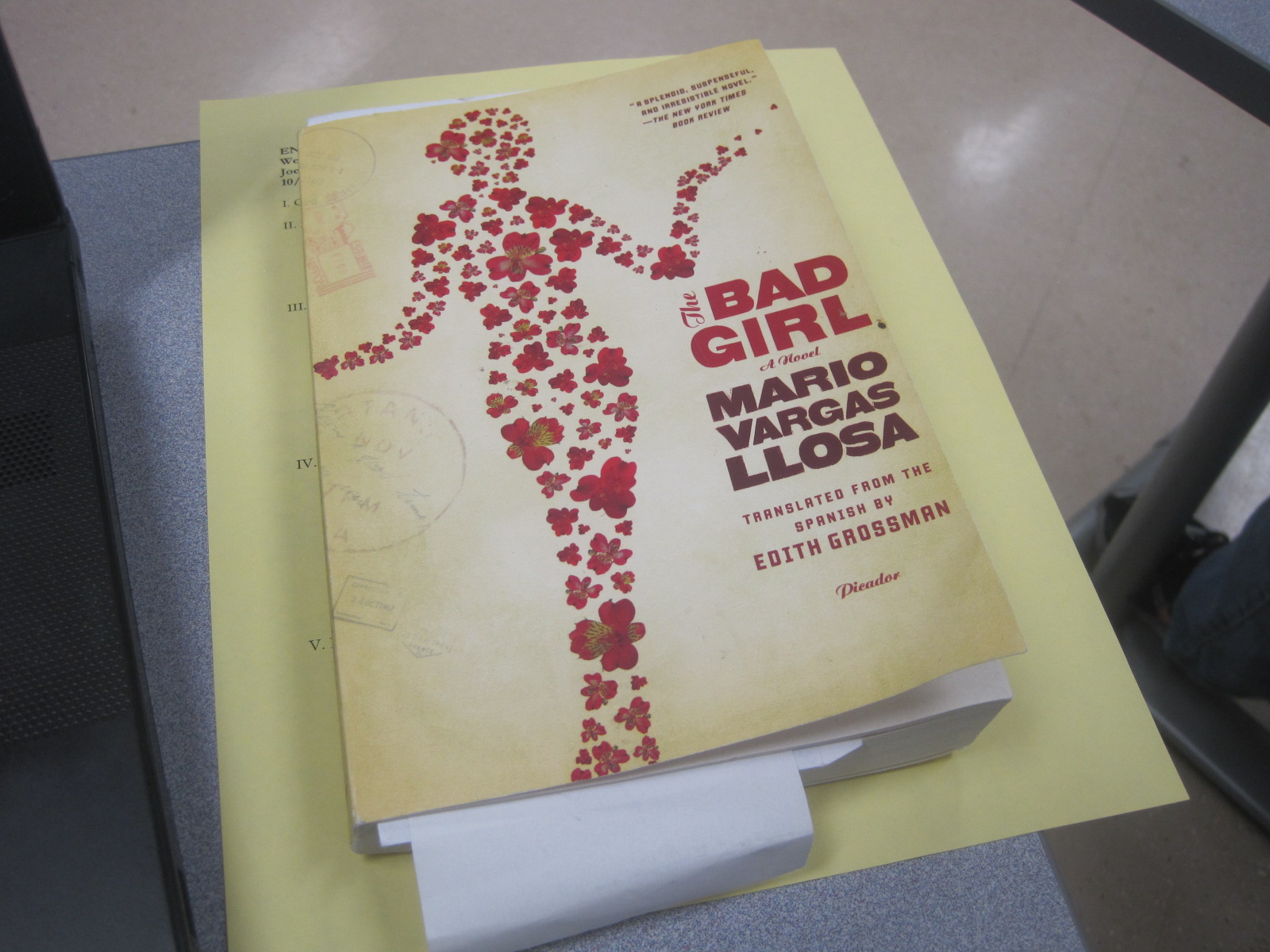
Garcia Marquez is famous in English speaking Africa even though we don’t speak Spanish. Vargas Llosa will be too soon enough, for good reason. How much did we lose if we did at all reading in English? Does it ever matter? Does my friend from Morocco have a better and richer literary experience than me because he speaks Tamazight (his local language), Arabic (his national language), and French (his country’s official language) and English and is thus able to read many more literature in original languages? If I read Naipaul in English and he reads it in French, what have I gained that he hasn’t? Does an Indian reading Naipaul or Rushdie (in English) gain something more? After all, they are co-sharers in the cultural conditioning that produced the texts? If I read Onitsha by JMG Le Clezio in French, do I gain any more or less than those who do it in English? After all, the writer is French. But then, after all, I am Nigerian, and the story in the book are based on the writer’s adventures in the Nigeria of the 60s. For those who have read George Orwell’s 1984 in German, or in Japanese, how does the writer translate words like “newspeak” and “thoughtcrime”. Does it make the same compact sense as it does it in English?

I first read Plato On the Trial and Death of Socrates in the early 2000s and what struck me the most was how beautifully it was written. It was a translation. Plato did not write in English. A few of the other plays we read as undergrads The Frogs by Aristophanes, Oedipus Rex by Sophocles, and Wole Soyinka’s notable translation of D.O. Fagunwa’s classic novel into The Forest of a Thousand Daemons all struck me as bearing very distinct literary styles that stand in their own stead as authentic study of thoughts in translation. The last time I read Plato On the Trial and Death of Socrates was late last year in Edwardsville, and I was greatly surprised at how insipid it read compared to the one I read back in Ibadan. The conversation on the dinner table went back and forth within these many areas of literary translation and I learnt as much as I grubbed. By the time the evening was over, all I wanted was a financial grant to go live in a small house by river and complete all the pending translations I have been working on for many years.

The last time we conversed, I sent them a long Yoruba to English translation of some of my father’s poetry. Half insecure in my experimentations (I’d completed the translation in 2005 and haven’t worked on it since then), and half wondering if any of the beauty of oral literature is lost when they become text, I was pleasantly surprised to read as a response to it, an email from my colleague: “That is a lovely, rich and absorbing poem,” it read “I have read it twice and found myself drawn in so many directions, wishing I could climb its hills, listen to its music more closely and roll around in its musky earth – love is a vast world, mysterious and ordinary and always full of pungent flavors and astonishing depths and heights.  I would like to read more.” See? Maybe all that is lost to translation should be the expectations we bring to it from our knowledge of the depths of the original. A few hours later, he sent me a work-in-progress Chinese to English novel translation excerpt that he and his partner (the writer) had been working on. I found it a delightfully splendid read. And I don’t speak Chinese.

Good literature will always speak out, in whatever tongues it finds.