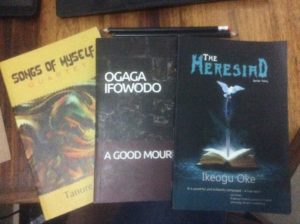
Songs of Myself (KraftGriots, 2016) is a collection of poems by Tanure Ojaide. It is the most personal of the three on the shortlist of this year’s Nigeria Prize, the most introspective, and also the one most (even if inadvertently) expressive of the melancholic aspiration I had prematurely expected from Ogaga Ifowodo’s A Good Mourning because of its ominous title.
Ojaide has published poetry since 1973 and has published twenty collections of poems many of which have won prizes, local and international, like the Commonwealth Poetry Prize (1987), All Africa Okigbo Poetry Prize (1988, 1997), the BBC Arts and Poetry Award (1988), and poetry awards of the Association of Nigerian Authors (1988, 1994, 2003, 2011). The new work is approachable and deceptively simple, like thin ice over a frozen lake. More on this style later.
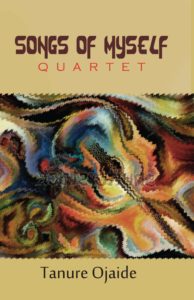
The title of the book invites us to approach the collection as work about the author to varying degrees: songs of myself. But in the foreword (which I had personally considered superfluous in a poetry collection, except in a notable instance like in The Heresiad, an exception which I’ll explain in my review of the book), the author explains his approach as incorporating “some of…aspects of oral poetic genre”, particularly of the great Udje poets of Urhoboland, which “deals with self-examination and the minstrel’s alter-ego” in the work as a way of attempting to know oneself with “self-mockery that justifies mocking others.”
This intention changes how I eventually approach the work, not as Ojaide himself recounting his thoughts and opinion on a number of relevant political and social issues alone, but as the voice of an invented poet-persona using a traditional poetic form to interrogate himself and thus the society. The Udje, as he explained it to me in our YouTube interview, are traditional Urhobo griot-poets who work carry social and political significance, and are present as conduits for commentary on the public condition.
So what is this condition? In the book, it is both personal and societal. The poet is both an old man (Gently; page 14) and a young adult (We Have Grown: 155). He’s both the country (Self-Defense; 91) and an individual (On My Birthday; 26). He is a happy observer of the passing of time (For The Muse of Peace) as a cynical record keeper of slights and injuries (Masika; 47). He’s a parent (They Say My Child is Ugly Like a Goat; 107), and a son (Family Counselor; 85); a hopeful lover (Secret Love 147) and a self-critical poet (Wayo Man; 87). The issues addressed are as disparate as they are familiar. Nigeria, the country and the government, is an ever-present villain in most, as are other social issues which the author addresses with sardonic candour.
If I were to ask my people
what they wanted the most,
they would definitely choose money over every other thing,
iincluding good health and peace
that I know there’s a dearth of
because of oil and gas everywhere
that by right should bring us wealth.
(Page 132)
From afar, especially with a misconstrued intention of the writer’s narrative angle, most of the poems appear conditioned into a tried-and-tested style of political and social protest poetry through this staid and resigned voice. But on close contact, especially against the background of its traditional dimension of style, they reveal themselves as both original and intentional, carrying an unflappable tone couched in the simplicity of cynicism. Who is a poet – I ask myself a few times – and what makes a good poem or poetry collection? Is it a successful deployment of inventive gymnastics of modern conventions that appeal to sophisticated palates, or is it an honest recounting of home-grown truths directed at a selected audience even if in a least colourful, or less popularly accessible voice?
So many questions I can’t answer.
After all the birds fall silent in the delta,
how can there be Rex Lawson
with the polyrhythm of weaverbird, sunbird,
carpenter-bird, solos and ensembles?
(page 134)
The question is important in judging the language choice that Ojaide deploys in this work which many times doesn’t read as elevated as one typically expects of offerings of this kind of ambition. Against the background of his stated intention, however, possibilities can be suggested of this character of theirs being defined both by the limitation of translating the cultural and linguistic cadence of Urhobo poetry into English and, less charitably, the author’s helplessness in the face of this challenge. The answer will be resolved by the judges of the Nigeria Prize in a couple of weeks.
When I asked him about his use of language and the idea that the use of English as a conduit for African poetic traditions can be a limiting factor at best and a catalyst for the extinction of those languages, he was less acquiescent. “You must know that there are many Englishes,” he said, to which I say yes, as long as each different variant is able to successfully carry to fruition the stated intentions behind its use, and reach new audiences. In this case, I am not as sold as I should have been, not about the homage to traditional oral poetry, which other authors (and perhaps this one in previous works) have done to great success; but about its seamless and effective deployment. Maybe I have been spoilt.
In many of the poems, the writer includes footnotes, like in the first poem on page 15 where he explains that Dede-e dede-e is an “onomatopoeic expression of ‘gently’ in the Urhobo language.” Of this incursion, there are strong arguments to be made, especially in this work, for doing away with them totally. Footnotes are often distracting, and – to return to contemporary arguments about the audience of our literature – needless. Those who value the work enough to engage with it will do the work needed to unlock much of its secrets. The counter-argument, of course, is that a reader like me who is approaching the work on short notice for the purpose of a review would not have figured out that Aridon is a “god of memory and song/poetry among the Urhobo people” (page 17). That same argument, though, fails in the face of less justifiable ones like “NDDC” on page 133, or “ICU” on page 24. If I did not know that ICU meant “Intensive Care Unit” either from the context of the work, or from having lived in modern society, then the writer hasn’t done his work or I need to return to school.
These kinds of conflicts show up in other places too, springing up the question of who exactly is the poet’s audience in this case. Since his last five books, Ojaide has started publishing his work first in Nigeria before re-issuing them with foreign publishers, a reversal he said was conditioned by his renewed sensitivity to his role as a poet primarily addressing an African (nay, Nigerian) audience. The justification for this almost “reclusive accessibility” of his literary voice will depend on those to whom the work is addressed or the successful domestication of the reader’s mind to the traditions from which the experiment emerged. It could be that the author isn’t “speaking English” at all, but Urhobo, just barely accessible to us through a shared common lexicon.
They mock me because of my child
whom they say is ugly like a goat.
Don’t mind them who see nothing good.
My pickin fine pass goat.
Where are the mockers when my child
fetches water and runs errads for me?
(page 107)
There are about 91 poems in this collection, making it the bulkiest of the three on the shortlist. In four different sections, the poet bares himself to the world like a local minstrel, under different guises and situations, in an outlook that is mostly dark, self-critical and confrontational in equal parts. The subject matter, a look at the world through a personal self-reflection, is certainly an important addition to current social and political conversations. The language is simple, accessible, and direct. It is a collection that anyone can pick up and enjoy. The prolific nature of the writer’s career and the breadth of this work’s take on Nigeria and Africa’s social and political issues makes it an important presence in the shortlist. And even if I will quibble with the inclusion of some of the poems there for not being strong enough to represent such an accomplished poet on such an important list, I’ll still rate Songs of Myself as an important peek into Ojaide’s poetics, experimentation, and voice. The potential for impact of this type of language and style direction, however, will be subject to practical, and more verifiable, manifestation.
_____
My interview with Tanure Ojaide can be found here. Find a link to the previous reviews here.