As promised, here is my take on the first book on the shortlist of the NLNG-sponsored Nigerian Prize for literature 2017. The book is A Good Mourning (Paressia, 2016) by Ogaga Ifowodo. Ifowodo is a poet and writer, who taught poetry and literature in English at Texas State University, San Marcos, USA. He holds the Master of Fine Art (MFA) in poetry and Ph.D from Cornell University, New York. He studied law at the University of Benin and worked for eight years as a rights activist with Nigeria’s premier non-governmental rights group, the Civil Liberties Organisation (CLO). Between 1997 and 1998, he was held in preventive detention for six months under the military dictatorship of General Sani Abacha.
I’m ashamed to admit that, until now, I hadn’t read anything by that poet with a striking physical resemblance to James Baldwin. But no matter where I have turned, his name had shown up there, from conversations on social media to arguments in closed listservs. Until recently, I also didn’t know that he had served in government in some capacity and that he once contested for (and failed to win) a House seat from his home constituency.
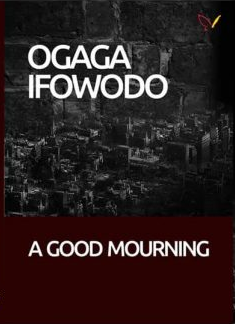
 So, I approached his work with an open mind. The title of the book A Good Mourning carried a curious double-edged sword of meaning that intrigued anyone from afar. The cover conveyed darkness as does the paradox of the title itself. If it is “mourning”, how is it also “good”? And how does it contrast with what we have grown to expect when we hear the phrase, devoid of the physical surprise of the spelling difference?
The work does not disappoint. The copy I got was loaned to me by Doctor-Poet Dami Àjàyí to whom the writer had autographed it in 2016: “Good morning & poetry”. I hadn’t found a copy anywhere else that I had looked, inviting conversations to the recurring topic of accessibility of books to the general public before they are selected for the Nigerian Prize. (It is a ridiculous argument, to be clear. The prize is set up to reward excellence, not distribution savvy. But it does raise valid questions about why publishers in 2017 haven’t yet heard of the Kindle, eBooks, and an authentically Nigerian electronic book distribution system called OkadaBooks which can put the books at the literal fingertips of millions of people via their mobile phones).
A Good Mourning is an impressive book that is marked by competence, style, grace, and a distinct authentic voice. It is that competence that I intend to dwell on a bit more because some of the snide remarks about the shortlist had focused on what they regarded as substandard work on the shortlist. Thankfully none had mentioned Ogaga’s name in the diatribes. He is a competent voice whose work leaves no one in doubt of his facility with words, dexterity with decades of African and modern poetic traditions, and sincerity in the pursuit of his numerous truths and points of view.
The poems delight, inspire, provoke, entertain, and intrigue. They cover a range of themes that, contrary to the expectation that the poems in the collection will all be morose and depressing, excite and titillate. In one poem Ten Hours (page 8), the poet describes an appendectomy in a German hospital with such mischief and lexical dexterity that what one feels isn’t just breathless anxiety of a man hanging between life and death but a playful appreciation of the affectation of the doctors’ efficiency and their terrible grasp of English (one confuses “rupture” for “rapture”). He asks for the piece of his gut back, on regaining consciousness, and was told that it had been cut up, and it will no longer, as he had hoped, become
pickled in a beaker,
displayed in bookcase at eye-level
for breaking barren moments,
getting guests to know me inside out.
These kinds of unexpected levity litter the book in random places, turning what was billed as a melancholic take on national life into a delightful, thorough, and serious look at different issues in one citizen’s life.
In the following poem, a serious religious ceremony is gently mocked.
Once an alter boy, he pined for wine
and wafer, not communion with the Lord
Too young for the mysteries of eating God’s
flesh and drinking his blood, he prayed only:
Lord, let this cup pass to me!
The priest sent him out of the holy sanctuary.
You get the idea.
Actually, you don’t.
Ifowodo does this effortlessly throughout the work, especially in places where seriousness is expected. It almost seems like the whole book is an attempt at shattering gloomy expectations. Or else a practical interrogation of life as comprising of both gloom and levity, mixed in the right dosage, waiting to be teased out by the right inquisitor.
The title poem was dedicated to Chief Moshood Káṣìmawò Abíọ́lá. It reads like a recap of history, with snide barbs reserved for players and villains, living or dead.
The false-star general
was first to flee his stolen throne
seeking refuge in a hilltop mansion
built with stolen money.
Since the book was published in 2016, there will be questions about why the author chose now as a good time to write about the June 12 crises, and why the title poem takes about ten pages (37-46) to tell us what we already know about an event whose significance has now almost paled against the background of even more pressing matters. (I asked him about this in our interview. More on this later)
What won’t be asked is whether the work was well written – because it was. In four different sections, Ifowodo explores what it means to be human, with a diverse range of fascinating experiences over many decades and many geographical spaces. The poems are as experimental as they are traditional (though he notably avoids any attempt at rhyming). The book is described as the author’s “reflections on the intimacy of evil anchored in the brazen military annulment in 1993 of the will of the Nigerian people to self-representation…”. I will not argue here with his choice of description of his own work and aspiration, but the work appeared to me more like a nuanced mosaic of a yet unfolding, if rich and fascinating, life of the author himself.
The outward-facing and ambiguous appearance of the title and its however belated tribute to the memory of June 12 will be important in inviting in a curious reader, but won’t be what keeps them. That will be the delightful competence, playfulness, and dexterity of the writer’s voice. I will mark A Good Mourning down as a very strong contender for this year’s prize, but that’s not saying anything since it is already on the shortlist of three. A more specific compliment will be that it is certainly one of the stronger two on the list.
______
The video of my interview with the author can be found here. The prize announcement will be made on October 9, 2017.