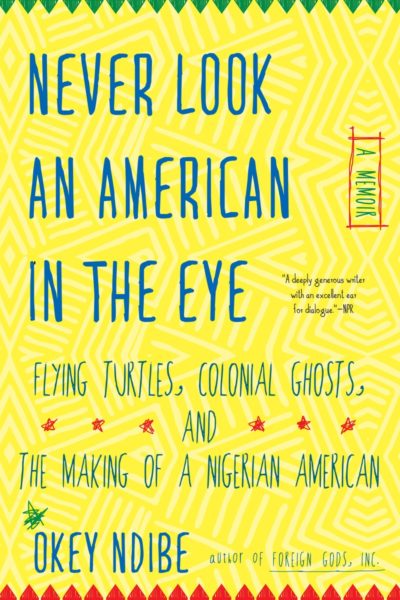
“Never Look An American In the Eye”

In my last book review, I lamented the dearth of travel writing books by African authors. I have since been scolded for failing to reference a number of other old and new works that tackle the subject matter, so I’m currently looking for Isaac Delano’s The Soul of Nigeria, Babatunde Shadeko’s The Magic Land of Nigeria, Noo Saro Wiwa’s Transwonderland, and Eavesdropping, a collection of essays and travelogues in America by Deji Haastrup.

But one of the example works I pointed to as examples of contemporary works detailing honest and intimate travel experiences of travel was Okey Ndibe’s Never Look An American In the Eye (Soho Press. October, 2016). I have now finished reading a review copy of the work and I can say that it was a thoroughly delightful experience. Having lived in America for a while myself, I am always interested in reading accounts of others who have lived in the country, experienced in ways similar to or different from mine. But with this book, except that both of us had entered the United States for the first time at twenty-eight years old, the experiences could not be any dissimilar, which added a lot of excitement to its reading.
okey

Out October 11, 2016

The title comes from a piece of advice given to the author by his uncle in the village. He, the uncle, not having experienced America in any other way except from the plot of Westerns shown on Nigerian screens where eye contact was the ostensible cause of major conflicts that resulted in lots of gunfire, decided that his nephew on the way to America needed such a good prep. As we know now, from our experience with Americans, the opposite turns out to be true. This leads to a number of awkward, interesting, and hilarious scenarios, one including contact with law-enforcement.

The book is a collection of connected stories about the author’s life in Nigeria and his migration to America. Okey Ndibe is currently a columnist for a number of Nigerian publications. He is also the author of two well-received novels Arrows of Rain (2000) and Foreign Gods Inc (2014). He had arrived in the United States first as a maiden editor of a new international magazine, in the late eighties, before he achieved these later successes, but during which time he was already an accomplished reporter for a major Nigerian publication. In the US, after his stint as an editor, he became a student, and later, a reluctant but ultimately appreciative citizen. The book covers all these periods in his life with tales that paint the picture of an individual with an expansive curiosity and a healthy sense of humour towards misfortunes and uncertainties. The stories follow each other in an unsual order which was slightly disorientating, but ultimately successful in pushing the story forward towards a fitting end. Read to find out why.

As a memoir, it’s an engaging work filled with optimism, written in a style that is neither pretentiously grand nor mindlessly plain. As literature, it is clever in its deceiving simplicity. As travel writing, it is a welcome addition to a trove of like-minded works by Africans traveling around the world. It is a work accessible without being insipid, serious without being morose, and honest without being overexposing or patronising. The handling of his contact and relationships with legends of African literature Wọlé Ṣóyínká and Chinua Achebe deserves credit for its normalcy and honesty. We see them both as humans, chasing human pursuits, and vulnerable to human frailties and human disappointments.

It balances an important narrative about migration, culture, disappointments, love, and restlessness with an outlook that is both sunny and measured. I don’t want to say “circumspect” because that presupposes an unwillingness to take risks. What the work is is the opening of doors into a time in the life of its author which also coincides with a significant time in the life of a country he was leaving behind and the one he eventually adopts. There was no risk to be taken or avoided as far as the writing goes. The story needed to be told well, and it was.

___

The hardcover is 224 pages long, but doesn’t feel like it. The book will be released on October 11, 2016 and can be pre-ordered here. I will be speaking with the author in a public Book Chat in the next Aké Festival in Abẹ́òkuta this November. If you’re in the area, do drop by to hear him answer a number of questions I’m deliberately keeping away from this review :). Go buy/pre-order the book.
Ibadan Memories

In advance of a live twitter interview with the folks at @thinkoyo on my memories and opinion of Ibadan at 8pm (Lagos Time) this evening, let me list a few things I remember from growing up:

A serene quasi-communal neighbourhood in Akobo. A sprawling house in the middle of a bustling neighbourhood, we lived with everyone in the area in mutual respect and love for family. We played ball on the dust fields, played ping-pong at evenings, and did all normal young people did during idle, hot, afternoons. I remember crafting a Christmas firework at some point out of the cap of a motor plug, a small nail, and a piece of wood. You added crumbs of fire powder from the tip of a match, hit it against a wall, and heard the loudest sound you can ever make.

IMG_9696A pretty moderate traffic situation on the city’s many roads. Today, there are more roads (due to increase in population) but the traffic situation on major roads have got far worse. I went back to Akobo a few months ago, and I was shocked at how many people now live there. The distance from IDC to Anifalaje used to disappear in minutes under the small steps of my rubber sandals. Now it looks farther than I remember, and the last time I walked it (just a few months ago), I returned home panting for air. And yet, I may have got a better deal than the people who remained on the road, in their cars – to slightly exaggerate the congestion that the place now faces because of traffic.
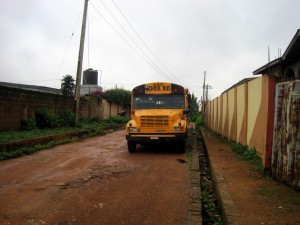
Things that have not changed: rickety buses. Many of them are now more beautifully painted in the colours of the state, but the terrible state of the automobiles that provide commercial transport services is heartbreaking. (And maybe that would explain the reason for more private cars). More things that haven’t changed: Orita Bashorun. Slightly changed in outward appearance for reason of season, the basic layout remains the same. The radio/tv complex (where I once worked as a teenage broadcaster) still lay sprawled across the centre, while a tiny shopping “mall” flanks it on the right, and then a few more blocks until we get to the main Bashorun Market itself. None of it seems to have changed. St. Patrick’s church and school are on the other side of the road. At Christmastime, all the premises of the broadcasting corporation becomes a large trade fair grotto for holiday fun lovers.

A few names I remember: Dele Tomori (who eventually went to Osogbo as a radio presenter), Bade Ojuade, Sade Ogedegbe (my producer), Folusho Taiwo, Femi Daniels Obong, or FDO as he used to be called then (now a Lagos sports broadcaster), Sola Kayode, Prof (from a popular tv soap shot at BCOS), Folake Ladiipo, Papa Demmy, DeeJay Big El, DeeJay Freeze, Dapo Aderogba (who died), Dapo Adelugba (from the University), Kola Olawuyi (at Radio Nigeria, before he moved to Lagos), Larinde Akinleye (at the University, and his house in Sango), Lawuyi Ogunniran (a constant presence around the house), Yinka Ayefele (a lanky figure before his first hit album), Subuola Gandhi, Bamiji Ojo (and his crew on that Ombudsman show on Sundays), Yemi Ogunyemi, and a number of others whose names and faces have now become a blur. If I ever get to write a book about what I remember, I must title it Name Droppings.

UPDATE: The interview, storified, is here.

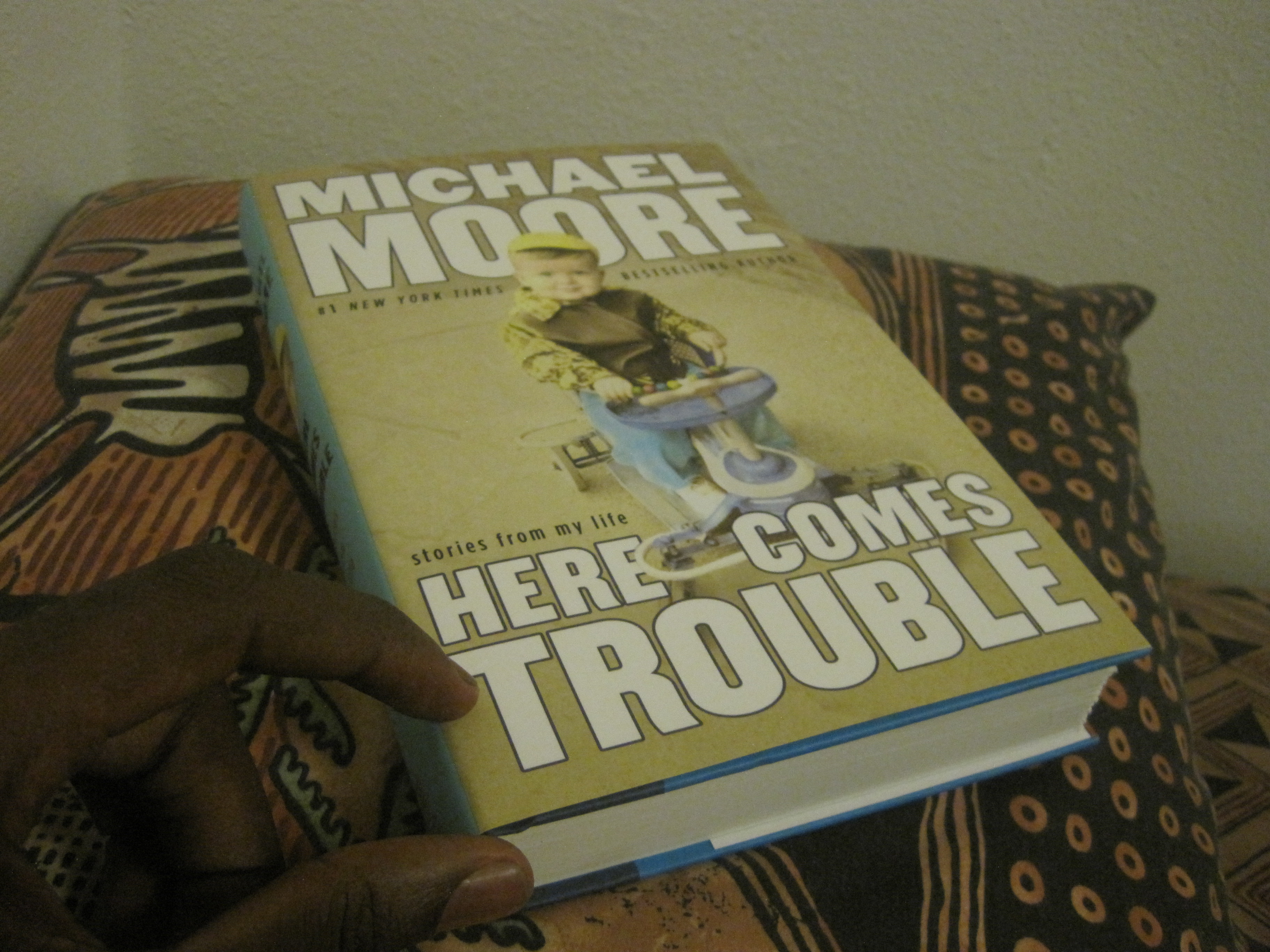
Here Comes Trouble

Michael Moore’s new autobiography follows the sometimes ordinary, sometimes extraordinary, life of one of America’s most controversial commentators. His movie Fahrenheit 9/11 is the highest grossing documentary of all time. Aptly titled Here Comes Trouble because of the perception of the author and movie maker during the first few years of the George W. Bush administration and his war in Iraq. He describes in great detail and with sufficient personal reflection what it felt like to criticize the administration on live television during his first Oscar win acceptance speech, and the turbulence of his life after he became public enemy number one.

The memoir-writing style of American writers (mostly public figures) has often amazed me in their ordinariness. No attempt at lyricism or any special verbal sophistication. Just facts, told sometimes with a flourish, and with humour. Not much with any real attempt at literary brilliance. This commentary of mine is ironic, of course, because the straight-forwardness of the narrative makes it a fun and light-hearted read. But it ends there. I’ll remember the facts in the book more than the beauty of how the facts were told. In short, it doesn’t challenge me even though the recollection surely delights. I’m sure this makes some sense.

Michael Moore is a controversial figure, and holding his book with me around campus has already got me a few stares. We no longer live in a George Bush America but it is still fascinating the kind of response his name elicits. A few minutes ago, a student saw it on my desk and asks what I thought could be a tricky question: “So you like Michael Moore, eh?” “I like his work,” I replied. It seems like the safest answer to give given the circumstance. As the book shows, he is however a man bold enough to take risks, and who because of those risks – and some other coincidences in life – has lived a truly remarkable life.

Secondary School Days

It was always cold and dry in November towards the end of the school year, and the season always came with a certain bubbling feeling and restless feet. School was at Agodi, a stone throw from the governor’s office, and the state prisons. It was bordered by a military housing project/barrack which had some of the best eating shacks we had ever encountered. It was also the only place where we could go have burukutu in the after hours with the little money we could save. Fufu at Barracks was the best, for some reason. It was rock solid, and filling. It was just as well since the majority of the customers of the eating joints were military people expected to be tough, filled, and healthy.

The broadcasting corporation was about two miles away. It had a very large fenced compound where at this time of the year an exhibition was held. It was called an exhibition because it was conceived as a carnival for the Christmas season. In time, it became a spot for gaming, alcohol and peppersoup and not much else. It was the ultimate taboo spot of escape from school, and we took the liberties many times daring the always looming risk of being apprehended by state law enforcements sent out to find school children loitering the streets during school hours. The best way to get to the broadcasting corporation from the school without getting caught was to walk through a winding short-cut road that went through the Officer’s Mess of the Second Mechanized Division located just across the road. I see it now, a quiet living estate with fancy houses and barking dogs. Three, and sometimes four, young school boys in blue checkered shirts trekking across the land under a sometimes scorching sun. In their pockets are a few coins each, and some roasted groundnuts tied in transparent nylons.

The excitement at the exhibition grounds never always justified its anticipation, but it almost always compensated for gloom of confinement that the walls of our school represented. Dry harmattan Novembers on the streets of Bashorun as pesky loose cannon truants from a faraway place looking for a lost piece of their precocious childhoods… were good times. They also featured really dusty feet in rubber sandals.