Analyzing Spoken Discourse

Someone, I think, warned me here at the beginning of the semester that Discourse Analysis will turn me into a cynic. Now towards the end of the term, I’m beginning to see the point of the observation. Thirteen weeks spent looking at the way language and speech work to serve plenty communicative purposes is enough to rewire a previously harmless brain into looking at the world differently. Or not.

Billions of texts are generated everyday from online and telephone conversations, and the work in ethnography of speaking/communication seeks to plow through the relevant portions of them to make generalizations. It is fun. It is also a consciously empowering one. The skills to be gained from learning to analyse discourse include a more analytical approach to making generalizations. It also builds the ability to use specialized language to refer to what can already be understood by someone not in the field of linguistics. What we see when we study discourse is not new, but what we acquire are new ways to look at it and explain it to ourselves, and the world.

I spent the weekend reading up on the work of Derrida and Barthe and the influences of their post-structuralist ideas on linguistics and the way we interpret language use. A recent article by Deborah Cameron exposes the danger of coming to analysis with our own ideas conditioned by societal expectations. I think my class project will be interesting. I just have to come up to the table with a critical angle to analyse a few of my own long-held preconceptions, then tear them to the ground. You can see that I haven’t yet become a cynic.

Fingers Crossed

If given a 12 weeks opportunity in a research institution in Virginia this summer, all expenses paid, and a chance to develop my own linguistics ideas and projects, what will I do? I just got off the phone a few minutes ago with a recruiting agent from a popular language and linguistics research institution/company  recruiting for summer internships for graduate students. I had been contacted as one of the people being interviewed for one of the three open slots for this coming summer.

I’m half ecstatic, and half perplexed because I realize the limitations or improbability of research openings for Yoruba language development for technology. Or not. In the area of research and development, I am limited to a choice between working on a scope of already tried theories on grammar, and developing new ways of making the language relevant in the new century. I’ve always been more inclined to the latter though it is not altogether possible without the former. My undergraduate project was a Multimedia Dictionary of Yoruba names, and I’ve written a few articles on language translation which is my favourite subject. What I wish to go further into however is examining the interface between machine translation and human translation with a view to improving what already exists. I’m talking about lexicography and research into finding new words to cater for new ideas not already represented in the language.

How much this research facility is willing to put their bet on a language spoken only by over 30 million people and is constantly being targeted by new technology (like Nokia, Samsung, Microsoft and others) is up for guessing, but I hope that I put up a good interview. I already enjoy the thoughts of sitting in small quiet campus thinking up new ideas to further bring an already capable language into more modern-day capability. The winners will be linguists, translators, research institutes, schools, student and new language learners all around the world. Fingers crossed.

Why Nwaubani Was Wrong

Many commentators have already responded fittingly to a recently published op-ed in the New York Times by Nigerian writer Adaobi Tricia Nwaubani. (One of them was Carmen McCain in this blogpost). In “The Laureate Cause” which you can read on NY Times or on 234NEXT, Ms. Nwaubani argues a faulty logic that implies that having new authors write in local languages is detrimental to national unity and cohesiveness and thus bad for literature. To momentarily ignore the fallacy in assuming that writers write so as to further nationalistic goals rather than to justify their creative potential by creating using whatever means they have, the argument she makes insults intelligence. Language diversity is one of literature’s best assets as well as one of its most assaulted elements. It doesn’t need anymore drawbacks.

With an array of opinions and ideologies as many as the tools of translation available to linguists, it is already difficult to prevent one work from misinterpretation. (Orwell’s Animal Farm was translated into two different ideological interpretations in East and West Germany respectively during the cold war.) However, the pleasure of being able to read works written in the native thought and tongue of the writer has aways been unquantifiable, as can be seen from the feting of writers like Gabriel Garcia Marquez, Naguib Mafouz, Gunter Grass, Mario Le Clezio and very many others including recent Mario Vargas Llosa who have all written in their local languages. If Ngugi Wa Thiong’o had won the Nobel this year, he would have been deserving of it, not just for the depth of his creativity, but for his contribution to the development of Gikuyu by choosing to write in it. We can only hope for more of those kind, and not less.

Many of the books I read as a child were in Yoruba and I can’t say it enough how much it helped my appreciation of English and all the other languages I have learnt to use. If tomorrow I choose to write in Yoruba – which I have certainly considered, I would represent an important a voice in literature as someone who decides to do it in Igbo or Swahili without care for English as an international language as long as I stay committed to the craft and say something new (or even something old, in a new voice and style) and say it well. We’ll have literary translators to do the rest. To make the case for English as the only medium of creative process is easily the biggest one of the many flaws of her essay, and a disingenuous take on the African literary present and future.

Cross posted at Nigerianstalk.org.


In Africa, the Laureate’s Curse

Side Effects of Syntax

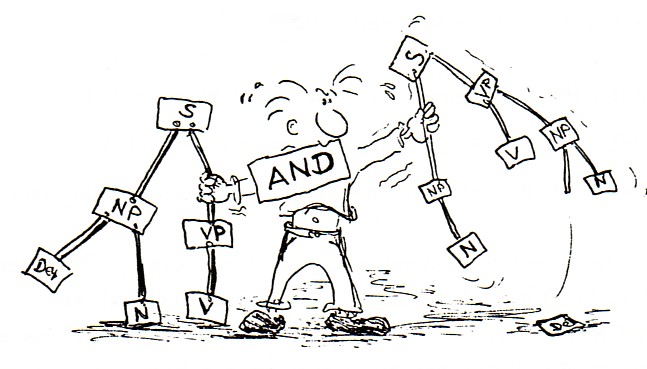
There is a long and heavy sigh that now usually accompanies the end of another painful attempt in class to win her heart. Every other fallout from that – including sleeplessness, irritability and crankiness, and an inability to update blog as necessary shall be called the sytax syndrome. Who would have thought that I would find a formidable opponent in her after more than seven years of a painless mutual separation. A mutant demon just slightly different from the X-bar and Transformational Generative Grammar models of that undergraduate life has now returned in my American class, and the result is not pretty. Add that to the annoying schedule of activities that lap up all the waking moments of my week, and you have a little glimpse into the direction of my life at the moment. Underneath all sentences and utterances of English (and every other language of the world, in fact) lies this very benign-looking but really mischievous virus. It looks like network of trees and sticks from a microorganism when looked at under a lens. Unfortunately, everything else in the appraisal and understanding of language derives from its bosom, and there is no escape.

What I’ve been doing then in an attempt to strike back is a diligent and thorough approach to its challenge. It involves sleeplessness and excessive eating, denial, and plenty tree diagram exercises among others. It is not proving to be an easy one, especially because of the pressure from two other equally demanding classes on pedagogy and teaching assessment. Whoever said the life of a graduate student is easy hasn’t been studying linguistics. And whomever said there’s no “i” in team hasn’t been studying phonetics either. In this curious battle between the tormented mind of a young linguist and the gigantic demon that is syntax and its ramifications, the “i” in team, just like its phonetic equivalent, is a long and lonely one, sandwiched between two formidable consonants. Meanwhile, here is (more than) a week long break for eating, travelling, fun and merrying in my hands that is about to yet again be intruded upon by syntax and generative grammar. What to do? What to do? If I can just admit to myself that much of my present resentment comes from a reluctance to now engage this familiar adversary on its own terms, maybe I’d actually do better. Or maybe not.

At least if I lose my mind now, I’d know who is to blame. Right now, all I see are trees branching in different directions, upside down with thin black branches. Hello sytax. We meet again. How can we engage so that we part on good terms this time, and for good?

(Image from http://www.elloandfriends.uni-osnabrueck.de/wikis/1/show?n=syntax.syntax)

Protected: Saving the Words

This content is password-protected. To view it, please enter the password below.