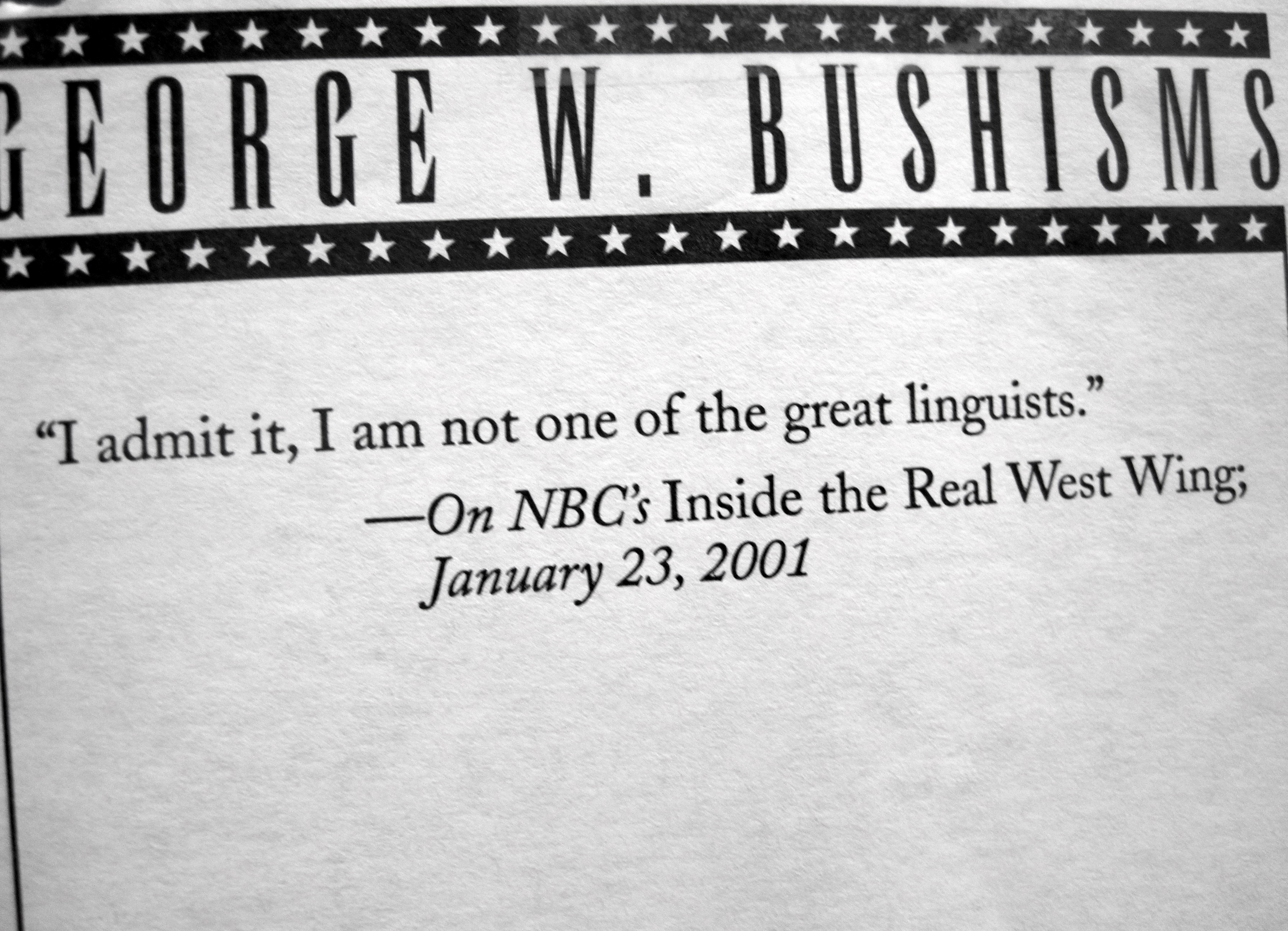
“I admit it, I’m not one of the great linguists,” he said.
Yea right?
I found this on the office door of my Linguistics professor.
“I admit it, I’m not one of the great linguists,” he said.
Yea right?
I found this on the office door of my Linguistics professor.
I received this article this morning about how to thrive or survive as a department of foreign languages. It’s long, but for those interested in the topic of teaching foreign languages, especially in a depression economy, it is worth reading.
http://www.insidehighered.com/news/2009/12/29/languages
NOTE: It was just a few days ago that I was talking with friends who expressed surprise that a language like Yoruba is taught in an American institution. “French or German, yes, but Yoruba?” they wondered. “How is it ever useful to anybody anywhere?Who would use it? Everyone (including the Yoruba people in Nigeria) speaks English anyway.” they said.
Apparently, it is still hard to sell the idea of learning a foreign language that doesn’t come with a “sophisticated” appeal like Spanish or Russian to most common people anywhere in the world. My interlocutors were one American and one African. A day earlier, another friend – this time a Nigerian on the chat messenger – had expressed similar sentiments. He even added a twist of the absurd by insisting that I was working for the CIA. That was the only way he could rationalize a scholarship that affords me the opportunity to teach my language in the United States. He also could not understand why foreigners could be interested in the language.
I think this attitude is a result of a fundamental ignorance of the purpose of learning anything at all, which is simply to gain knowledge. And there is no knowledge that is not power, as that writer Ralph Waldo Emerson puts it. Learning a foreign language gives one access to new ways of looking at the world, no matter how small the number of people who speak the language is. But the Yoruba language is spoken by over 30 million people, and has a culture that has survived hundreds of years and has influenced countless other cultures all over the world from the Carribbeans to the United States’ African American population, and produced one Nobel Laureatte. What is there not to learn about its culture, and language, and people? The lesson for me – if any at all – is in learning more about the importance of linguistic, language documentation and cultural studies. It helps to have something to say while being challenged about the use, or uselessness, of what one does.
What do the word “simian” and the name “Simeon” have in common, aside from a similar pronunciation? You guessed it – nothing at all, unless Simeon lives in the cage in a zoo or on a display plinth in a museum of extinct apes. If I were named Simeon, I would be very sad indeed if anyone were to laugh out loud every time they mentioned my name, especially if the person is a native speaker of English.
I remember my Kenya days, reclining under the mango trees on the grass lawns around the Margaret Thatcher Library on the campus of Moi University, Eldoret, discussing words and languages. All of us were guys, men, so the topic inevitably led to the risqué. All I wanted really was a chance to gather knowledge about the Kiswahili language to add to my vocabulary, and until then, everything was going smoothly. I would come out in the morning, lay on the grass while my informant, Ng’ash, a photographer (whose name also rhymed with nyash) did his work and dealt with my endless list of questions at the same time. After going through a list of over four hundred words in Kiswahili with him and his other equally fascinating and mischievous co-photographers in that spot of the campus, I found that ngozi meant “skin”, pole pole meant the same as pele pele (go gently), kiboko meant “buffalo” whose skin is used to make what we called koboko (the whip), Mungu meant “God” and jana meant the same as àná (Yoruba for “yesterday”), among many other amazing similarities. I also found out that kuma meant “vagina”, and that moto meant “hot”. The joke Ng’ash liked to make was that the first time a Kenyan found himself in Japan, he could not get his mind off the fact that the institution he was enrolled in was called the Kumamoto University. Kuma in Japanese is a popular name for children, meaning “bear”.

And so in Washington DC in December, I found myself on a dinner table with half a dozen Tanzanians who dared me to prove to them how much of Swahili I spoke. I did, starting with the everyday ordinary words. But they kept egging me on and I told them that I had actually learnt the private words first while I was in Kenya, and that I still remembered them even though I found a dinner table the least appropriate place to discuss such things. They would have none of it so I said, “I know that mbooro is for penis. Do you believe me now? I know that one for females but the point is proven, no?” The boys looked surprised, and the girls kept giggling mischievously, now resolved not to let me off until I gave voice to their body parts as well. It was an embarrassing almost awkward moment. But I did, and then shared the joke about the Japanese University. What else I found out afterwards was how easier to mention the word for privates in another person’s language. When asked to tell them what they were in my language, I could only tell them the word for penis. For vagina, I referred them to the Nigerian women in the hall, and as I correctly guessed, none of them took up the challenge to ask.
What I also learnt at the table was that the Nigerian name “Uche” in Tanzanian Swahili also meant the same as kuma, and that every time they heard the Nigerian name while watching a soccer game, they were giggling aloud not for the style of his dribble or the grace of his feet. Since I found out in Kenya in 2005 that Titi means breasts (as in matiti in Swahili), and “titties” in American English, I’ve always wondered what my name means in all the languages of the world if there was a way I could go on and find out. In American English, it means “a dark carbonated drink with a secret formula bottled in cans and bottles.” Not bad. What does it mean in Chinese, Malay, Emai, Nepali, Farsi, Akan, Ikaan, Uwu or Arabic? Maybe I should ask Reham about the Arabic part. I hope the meaning would not be too x-rated for her to tell me. I also remember one of my class sessions last semester when we were discussing colours. I had written the Yoruba ways of expressing colour on the board, and it included pupa for “red”, bulu for “blue”, funfun for “white” and dudu for “black” among many others. By the end of the class, I was told by the students why of all the colours we learnt that day, they would most likely remember dudu for a longer time to come. In American English (slangs), the word doo-doo refers to excreta, they said. Talking with my Swahili friend recently about these, she told me that dudu in Swahili also means “a large insect”, in addition to being the word now used to refer to the HIV/AIDS virus. Very nice. So now, although eniyan means “person” in Yoruba, all of a sudden, I am never going to refer to myself as an eniyan dudu ever again! Not in America, and definitely not in Kenya.
A recurring question in my mind every day I go to class to teach my students Yoruba is “What exactly can they do with this knowledge?” Surely, like Ralph Waldo Emerson said, “there is no knowledge that is not power,” but when I look at these young students – the youngest of them being nineteen years – and look at the Yoruba language, I can’t help but wonder if there is anything particularly useful that they can do with their knowledge of it. The last few classes have featured questions and answers mainly about the people and cultural practices, as well as about language. So assuming that by the end of this semester, I am able to give them a basic knowledge, as well as give them sufficient motivation to learn more about the language, culture and people, then what?
Language is a medium of thought, but it’s also an abstract wealth, mostly without tangible value. An African language might be viewed with even more skepticism, especially from an American perspective. Besides the possibility of ending up like Austrian Suzanne Wenger in a Yoruba town with enormous artistic influence on a people’s belief, or as British Karin Barber in a University as a European authority on the language and grammar, what else is there to do with these little snippets of knowledge that we share every week in class? I cannot answer the question, and I would not be asking the students to do so.Yet.
We have learnt about Suzanne Wenger, Wole Soyinka, Karin Barber, Toyin Falola, and a few other literary figures. In the last class, I tried to dispel some more common genralizations about the people and perceptions. Students seem always to have new questions each time, and I love it. Had I seen that video of Chimamanda speaking at a Ted.com event, I might brought it along to class. I definitely will consider doing so in the next class, just after our test on Monday. I hope that in the long run, there is something of value being exchanged between us every time we gather in class to discuss.