WRITER HENRY LEE DUMAS (1934-1968) Turns 80! (July 20)

FUNK
The great god Shango in the African sea
reached down with palm oil and oozed out me.
                                Henry Dumas, “Knees of a Natural Man” (1989)

Dumas’ Rebirth in Word-Deed

Awake as a quake, dreamin’ Henry wrought

Hank into “Ankh,” Dumas into “Samud.” Named

his poems “sabas” & “ikefs,” his friends

“Headeye” & “Jonoah,” his settings “Sweetwater” &

“Harlem,” his vessels “afro-horn” & “soul-

boat,” his heroes “Probe” & “Sun Ra”

& his brothers “Fon” & “cosmic arrows.”

                        Eugene B. Redmond, “Arkansippi Memwars . . .” (TWP 2013)


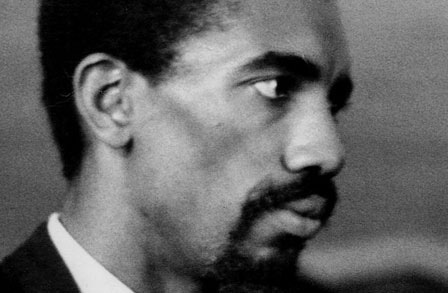
henry-dumasWriter Henry Lee Dumas (1934-1968)–whose posthumously published works include “Ark of Bones,” “Jonoah and the Green Stone,” “Knees of a Natural Man” (poems) and “Echo Tree”–would have been 80-years-old today (July 20). Born in Sweet Home (Arkansas), and raised in Harlem from the age of 10, he was a teacher at Southern Illinois University’s Experiment in Higher Education (East St. Louis).

Among his colleagues at EHE were Katherine Dunham, Edward Crosby, Joyce Ladner, Oliver Jackson, Hale Chatfield and yours truly. As literary executor of the Dumas estate (with the consent of his widow, Loretta Dumas), I have received invaluable support from Toni Morrison, Amiri Baraka, Maya Angelou and James Baldwin (among scores of others) over the past 46 years. Morrison, who called Dumas “magnetic” and “a genius, an absolute genius,” published his works while an editor at Random House, noting that a “very deserved cult” had grown up around him. One “cult” member, the late Jayne Cortez, referred to collective efforts to keep his work before a reading-listening-studying public as “the Henry Dumas Movement.” The Henry L. Dumas Foundation, whose goal is to create a namesake Library and Cultural Center, has been established in Sweet, Arkansas.

HD is patron saint of the East St. Louis-based EBR Writers Club which turned 28 this year. –EBR

Becoming an Artist

Once upon a time, a young man obtained a camera, and the rest is history. I have talked about my photography for a while now, but not how it all began. Maybe that is a story for another day, but one recurring memory from childhood is one in which Uncle Bola, the family photographer, lied to us about the presence of a special bird in the flash light of his camera. His most perplexing trick however was not that the blinding flash light looked nothing like a bird, but that our poses – deliberately worked to look our best for the photograph – never quite made it into picture form. “I’ve not yet developed it,” he usually said. Eventually, we figured out that he was only having fun at our expense and stopped falling for the trick.

My motivation for taking photographs then must have been a subconscious need to capture beauty through my own eyes. My first camera was a rickety hand-held that used a 32-exposure film reel. Luckier siblings who grew up in the 70s knew the Polaroid devices and the wonder of its instant production. I only heard of those times, and saw few square products of those times, some of which had my image on them as a little boy. You took a picture, mother said, it came out blank, and you quickly swiped it in the wind like a hand fan until the image showed up. That must have been fascinating. Needless to say, the first products of my hand-held camera were terrible. I had – in my stubborn curiosity – managed to have exposed the films to light.

Sometimes in 2002, I met poet Eugene B. Redmond on the campus of the University of Ibadan who took pictures of everything. Everything! He had two cameras, one of which was digital. Even at that time, I couldn’t figure out why anyone still carried non-digital camera. (Well, there was also Olumide who also had one slung on his neck around the campus). But who takes pictures of everything, from empty landscapes, to walking students, to idle pedestrians, to buildings, to dancing poets, to loose trash lying around the courtyard? On our way to the airport in Lagos while he was heading back to the United States, he kept his camera on hand taking pictures of road signs while discussing the nostalgia of his experience living in the city in the 70s. He was also the Alestle student photographer at the 1963 March on Washington. The only thing in my head watching him at the time however was, What kind of beauty do road signs represent to this visiting American. In 2009, he donated his collection (including thousands of photographs taken over his decade of teaching, travelling and writing) to SIUE.

I have just returned from the Edwardsville Arts Centre to sign the Exhibitor’s Agreement for the upcoming exhibition, an exhilarating experience. Two of my photos will be part of the EAC 2nd Juried Show taking place between February 17 and March 16. The photos were both taken more than three years ago and have never been shown in public. I spent the whole of yesterday fretting over little details of size, price, and whether (and where) to include my signature on the art itself. I have never done this before, but it was easy to accept that this has occupied some part of my subconscious for a very long time. My artist statement included a little of my motivation for the theme of movement. Since meeting that poet in Ibadan in 2004 and later in 2005, I have taken a special interest in the photographic arts. My presence on campus in Edwardsville throughout 2009 must have appeared to those who saw me taking pictures of almost everything something similar to what that poet appeared to those of us who observed him back then. This exhibition then, for me, is a first and important validation.

The venue is now being prepared. A man on a ladder moves words around on a while wall. Pat Quinn – the curator moves around the studio showing visitors the already displayed art. In one other room down the hall, three people sort through artist contracts and exhibition posters. It promises to be a good outing. There is some delight in this coming out: unveiling for the first time what had merely languished in electronic storage. This journey began a very long time ago, and what a journey it  has been.  You are all invited.

East St. Louis (Illinois) Sesquicentennial: Ten Talking Points

by Eugene B. Redmond, February 23, 2011 . . . Re: 150th Birthday Celebration, April 1.

1.         we arrive, we arrive

we cross-fertilize

we derive, we survive

2. For a thousand years, Native Peoples (“mounds” builders) inhabit both sides of the Mississippi River. In “Illinois,” these “Mississippians” build the largest city in “America” (circa 1250 AD)—with a population exceeding that of London at the time. (Fast Forward: “Native” culture survives/pervades Metro East today via mounds, namesakes (sports teams, rivers, streets) museums (lectures/tours), conferences and annual pow wows.)

3. 1600-1800: After French Jesuits settle in “Cahokia” (late 1600’s), other Europeans follow, including Captain James Piggott, who operates the first Mississippi River ferry business (1790’s). A few hundred Africans are among settlers. (Fast Forward: During the 20th Century, ESL’s “Piggott” Avenue nurtures Scotia Calhoun Thomas (entrepreneur), James Rosser (college president) and Jackie Joyner-Kersee, among others.)

4. 1800-1860: Flood of Immigrants. Belleville incorporates as a city (1850). ESL, evolving through name changes, social and economic processes, is overwhelmed by flooding and a tornado at mid- and late-century. City becomes industrial/commercial center. Fledgling “Negro” self-help groups, one-room schools, churches and settlements (like Brooklyn and Quinn AME Church ) are created. (Fast Forward: Brooklyn is renown for its Harlem Club where Duke Ellington, Shirley Brown and Albert “Blues Boy” King perform.)

5. 1861: From “Illinois City” to “Illinois Town” to “East St. Louis” . . . the “Village” is born on April 1.

(Fast Forward: ESL, criss-crossed by railroads, is second after Chicago in RR and meat packing industries.)
6. 1861-1900: Civil War begins. U.S. transitions from agriculture to industry, driving a commercial-industrial revolution in ESL. 1871: Creation of National Stock Yards. Eads Bridge opens (1874). First mayor, John Bowman (1865), is assassinated in 1885. Centennial of St. Clair County is celebrated (1890). Captain John Robinson leads battle for schools (for “coloreds” plus Lincoln and Garfield); “Negro” lodges, churches (Macedonia, Mt. Olive, St. John A.M.E.) and professionals increase. ESL’s population rises to nearly 30, 000 (with several hundred African Americans). (Fast Forward: During 19th and 20th Centuries, ESL is “transfer” point for goods and soldiers. John Robinson Elementary School and Homes open on Bond Avenue. As a “ premiere avenue for Blacks during the 1920’s,” according to Jeanne Allen Faulkner, Bond is also home to mid-20th Century Lincoln High School and the Cosmo Club where Chuck Berry’s career is launched.)

7. 1900-1925: More flooding. Meat packing industry moves to town of National City on ESL’s northwest end and, like Monsanto (Sauget) on the southwest flank, incorporates as a separate entity, depriving ESL of a rich tax base. In 1917, a gumbo of social, political, economic and racial factors causes the Race Riot. (St. Louis [MO] Chapter of Urban League is formed the year after the Riot.) Of U.S. cities with populations of 50,000-plus, ESL is the second poorest. Even so, it is among fastest growing cities in the country: Its population doubles every 10 years (reaching 75, 000 in 1930). 1924: ESL NAACP chapter is organized.

8. 1926:  Miles Dewey Davis III is born in Alton (IL). The Davises move to East St. Louis in 1927.

9. 1926: In sympathy/empathy re: victims of the Riot of 1917, Duke Ellington co-writes/records “East St. Louis Toodle-Oo.” … The song later appears on a Steely Dan album, Pretzel Logic. [Throughout 20th and 21st Centuries, movies, TV shows, books, ballets/stage plays (like Katherine Dunham’s Ode to Taylor Jones III and Frank Nave’s East Boogie Rap) and publications, such as Drumvoices Revue, focus on ESL.]

10. 1926-present: After struggles for jobs and freedom, equal housing and education (Black-based and citywide schools); after “Miles/tones” and “Negro firsts” like the Paramount Democratic Organization and Dr. Aubrey Smith’s election to the Illinois House of Representatives (1930’s); after creation of “Negro” newspapers, being named an All American City (1940’s-1960’s) and more floods, the rest is history . . .

_________

Eugene B. Redmond is the poet laureate of East St. Louis founder of the EBR Writer’s Club and a retired professor of English from SIUE.
An Old Book

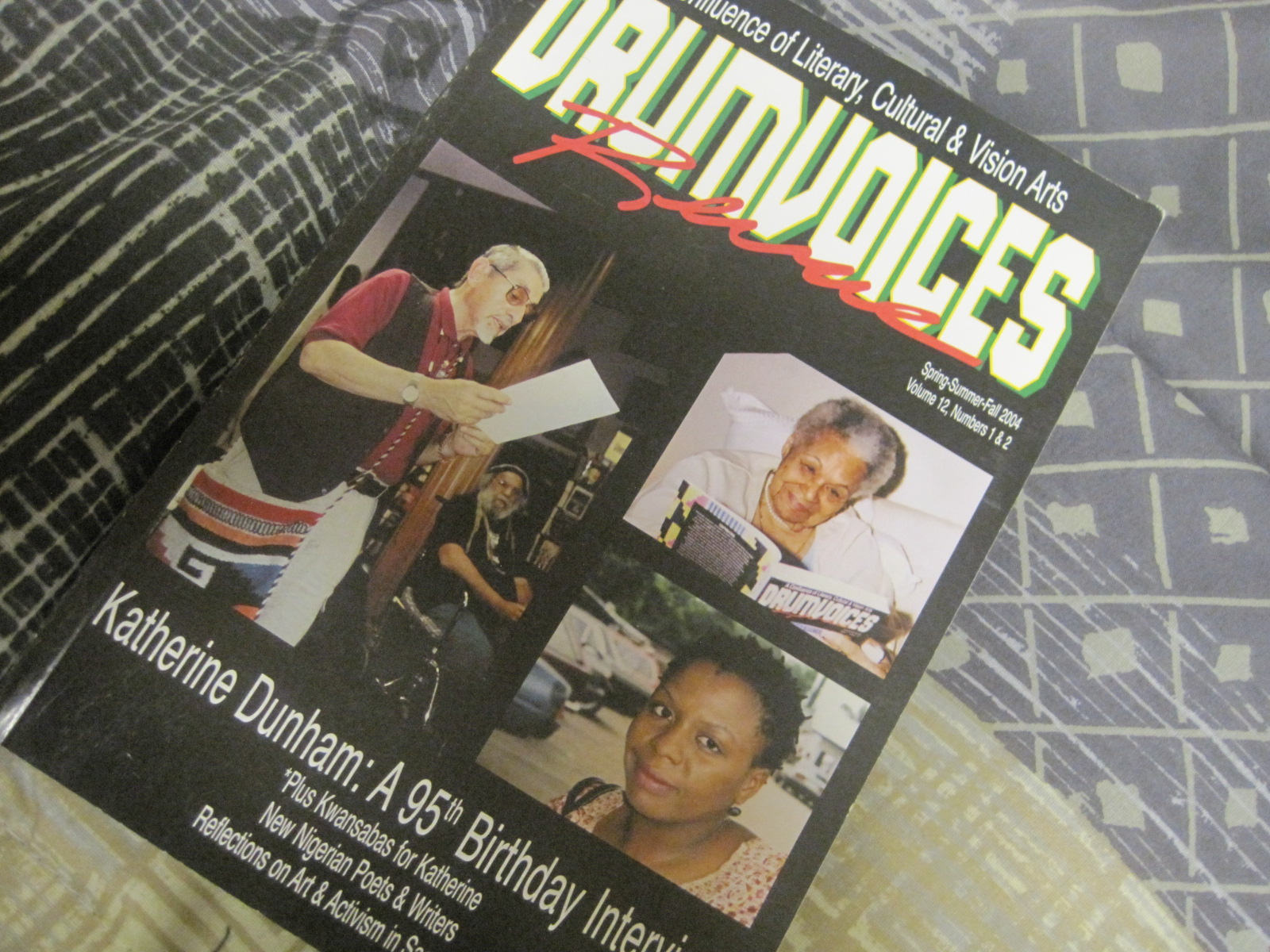
I came across this in the shelves of my professor’s library a few hours ago. It is a special edition of Drumvoices Revue (Spring-Summer-Fall 2004) that featured a set of Nigeria’s Third Generation writers. Introduced by Nigerian poet Remi Raji who was then in the United States, the section in the publication was a result of earlier collaboration between this University and the one in Ibadan. Even the cover said as much, with Lola Shoneyin taking a choice spot in the corner. Other writers featured in it were Toni Kan, Tade Ipadeola, Francis Egbokhare, Toyin Adewale-Gabriel, Unoma Azuah, Obi Nwakanma and Angela Nwosu.

Drumvoices Revue is a publication of the Eugene Redmond Writer’s Club and edited by Eugene B. Redmond itself. I’m going to find out if they still publish works. Those were good times when Eugene came to Ibadan seeking new voices around Nigeria, and seeing the book brought back good memories.

One word: nostalgia.

“Break Word” with EBR Writers Club

Southern Illinois University Edwardsville/Eugene B. Redmond Writers Club/East St. Louis Higher Education Center: 618 650-3991; eredmon@siue.edu

TO: All Media; Art, Dance, English & Music Departments; Poets & Writers

November 17, “2009”: “Break Word” with EBR Writers Club & Friends . . .

East Saint Louis, IL—“2009: Reflections & Projections in Poetry, Dance, Jazz, and Visuals”—a feature of the Eugene B. Redmond Writers Club’s annual “Break Word with the World” program—will be held on Tuesday, Nov. 17 at 6:00 p.m. in Bldg. D of the SIUE/East St. Louis Higher Education Center, 601 J.R. Thompson Drive. The public is invited to this free event.

Featured Poets/Performers will include members of the Soular Systems Ensemble— Roscoe Crenshaw, Susan Lively, Charlois Lumpkin, Darlene Roy, and Eugene B. Redmond—along with these rich voices: Michael Castro, K. Curtis Lyle, Patricia Merritt, Jeffrey Skoblow, Lena J. Weathers, and Treasure Williams. “2009” will also feature an open mic segment.

The “2009 Experience in Dance,” offered by SIUE/ESL’s Center for the Performing Arts (directed by Theo Jamison), will also be presented, along with “Michael’s Magic, Miles’ Smiles, Motown’s 50th, Michelle’s Show-&-Tell & Other 2009 ‘Milestones,’” a mixed media exhibit of “festivals & funerals.”

Curated by Alfred Henderson II, an SIUE graduate student and special assistant to Eugene B. Redmond, the exhibit will feature photos, posters, newspapers, magazines, art work, book and (LP) album covers, t-shirts, and other memorabilia from the EBR Collection.

Rounding out “2009,” will be “Jazz to the 2009th Degree,” an eclectic repertory from the East St. Louis Senior High School Concert Band, directed by Delano Redmond.

The Eugene B. Redmond Writers Club, founded in 1986 and named for East St. Louis’ Poet Laureate, is enjoying its 23rd year. All writers are welcome to meetings, held at the SIUE/ESL Center on the first and third Tuesday, September through May. Club Trustees include Maya Angelou, Amiri Baraka, Avery Brooks, Walter Mosley, Quincy Troupe, Jerry Ward Jr., and Dr. Lena J. Weathers. Darlene Roy is president.

Besides the Club, other sponsors of “2009” include “Drumvoices Revue,” SIUE, Black River Writers Press, and the East St. Louis Cultural Revival Campaign Committee.

For more information about the Writers Club or area cultural-literary activities, call 618 650-3991 or write the group at P.O. Box 6165, East St. Louis, Illinois 62201; eredmon@siue.edu.