 Despite years of scholarly research a large percentage of the indigenous languages of West Africa have not been documented. Several of the languages are at the risk of being lost. Greater attention to diversity, environment and sustainability in the global discourse has not reflected much in terms of support for and development of indigenous languages. Although there is a heightened sense of activities and activism for language documentation, there has been no commensurate attention to the very important aspects of description, development, modernization and integration of local (West African) languages with global information infrastructure. This appears to be leading us once more to the ideological issue of resource exploitation. The critical question remains, how do we make West African Languages relevant and work for those who speak them? We are once more forced to rethink the role of the linguist and interrogate West African Languages Curricula in the face of emerging realities. The task of language documentation is particularly necessary so as to plan the future with the past, since information/ facts derived from such efforts can have positive impact on current and future linguistic endeavours.
The aim of the conference is to explore the different perspectives from which language studies reflects or impacts on the different aspects of human endeavour. In addition it seeks to foreground the various areas in which language and linguistics interface with diverse capacities and disciplines. Given the current realities of modern human life it seems increasingly compelling for Linguists to find common grounds with other disciplines while emphasizing language as a core human capacity. The conference brings together researchers and students in the various fields of language studies as well as aspects of professional life in which indigenous languages play a part. This is expected to motivate an exchange of ideas and promote discussions of, progress in and development of these areas in West African languages. We hope that through the conference participants will be able to consider the issue of sustainability in research and practice.
The sub themes of the conference include (but are not limited to):
- Language Typologies
- Morphology and Syntax
- Phonetics and Phonology
- Semantics, Pragmatics and Discourse
- Language shift, maintenance and documentation
- Language and education
- Language policy and language management
- Language, the media and ICT
- Language and the community
- Language and industry
- Language and medicine
- Language and governance
- Language and Business
- Language and Law
- Language and poverty
- Language and migration
- Cross-border languages and regional cooperation
- Cognitive corpus linguistics and Corpus-based computational linguistics
- Language competition: Ex-colonial languages vs. indigenous West African languages
- Literature, film and popular culture
- Language, gender and power
- Language, identity, culture and translation
- Language, Peace and Conflict
Participants are invited to submit abstracts dealing with any of the sub themes and other related areas. They can be up to a maximum of 300 words long. It must be typed in a 12– point font and in both word and pdf file formats. Deadline for the submission of abstracts has been extended from 31 March, 2013 to 30 May, 2013.
Individuals and organizations who would like to present demos and organize workshops/special events should contact the LOC Secretary, Dr Oye Taiwo, Department of Linguistics and African Languages, University of Ibadan, Ibadan, Nigeria through the e- mail address: oyepaultaiwo@gmail.com.
Abstracts can be submitted through the following e-mail addresses: tayolamidi@yahoo.com. (Chairman, Abstract sub-committee: Dr Tayo Lamidi);oyepaultaiwo@gmail.com (Secretary, LOC: Dr Oye Taiwo)
More information can be obtained on the conference homepage at www.walc2013.com, the twitter page @WALC2013 and the Conference’s Facebook Page.

 This is my 200th blog post!
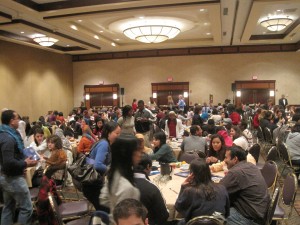 Meanwhile, the conference itself is very warm gathering of 409 Fulbrighters from 49 countries teaching hundreds of languages all over the country. I have met old friends who remember me, and those who don’t. I have also met new ones who had heard about me and those who hadn’t. There will be more conference sessions tomorrow, and more feeding sessions too, until Saturday when the conference officially ends. We have learnt about Social Networking for the Foreign Language Classroom, Writing for Publication in Foreign Language Journals, and Scenarios & Strageties: Addressing Individual Student Concerns. Tomorrow, there will be more… Before this conference ends, we will meet with some representatives from the State Department. No, I don’t think that there is a chance to see the Secretary of State, so that’s that, already crossed out.
 Anyway, when I broke open the two blasted cookies yesterday, I was too much in a hurry to consume them that I ignored the “fortune” paper in them until after the cookies, the food and the “soup” were well digested. And when I was ready, I took a look and here was what I found: >>>>>>>>>>>>>>>>>>>>>>>>>>>>>>>>>>>>>