“Hi, My Name is…

…and I’m an alcoholic!”

That was what the scene of the first class looked like. Sitting in a circle in a way to make visible any member of the class who might be inspired to go to sleep without permission, the students all introduced themselves and what their motivations are. “My name is… and I’ve always been interested in language. I’m interested in what the possibilities are for language teaching and learning and I look forward to being able to teach it somewhere around the world in the nearest future.” Of course that’s convenient. A second way to answer the question could have been “My name is… and I’m bored with staring at the cielings in my house, and traveling, that I decided to come back to school and make something with my grey matter.”

That would at least have been honest, if hilarious, but this student wasn’t thinking that mischievously at the time as he sat quietly along with eleven other folks of different ages and convictions from different parts of the world… Taiwan, Mexico, America, China among others, and being introduced to the course that will make their lives miseerable for the next thirteen weeks. One of the other fun requirements of this course is finding someone learning English for the first time and tutoring him/her for at least once a week for three months of the course, and to describe and respond to their tutoring experiences in a weekly online journal posted on Blackboard. Isn’t that interesting? It’s about time to discover what thrill and frustrations there are in teaching, this time a new language, but one that is still new to the target student.

“Hi, my name is… and I’m looking forward to being able to go to St. Louis at least once a week to mentor one or even more refugee students and understand their attempt to learn English for the first time. Thanks for having me.”

Festivity & Fun Feedbacks

Chapter nine of Toyin Falola’s A Mouth Sweeter Than Salt was probably the most difficult for the students to handle. It started on a rather shocking note of the sex songs sung yearly at the Okebadan Celebration of his youth. The songs were supposed to induce fertility in nature, praying down the rain to come and fertilize the earth, yet their words were those of the human anatomy, and they were explicit. Very. And little children as well as adults sang along on the street as they go from house to house taunting each other in the most explicit way possible. According to Falola, the songs for which one would ordinarily be punished had they being sung on an ordinary day would be sung loudly in public throughout the celebration and everyone would be joyous.

I have just finished reading my student’s report on the chapter and many of their observations left me in stitches of laughter. Many claimed to have been confused. Some were shocked, and a few said they found it interesting. Those who were shocked claimed not to have been exposed to any occasion in America where sex is discussed in such an open manner. I’m guessing that they had never attended the Mardi Gras. 🙂 In all, I have always had a good time reading their feedback on the text portrayed by Falola. Interestingly I myself have never witnessed the Okebadan festival, but beyond the words of the songs by the little children singing them, I don’t believe that it ever got any “raunchier” – to use the word – than the Mardi Gras, which I still think is a wonderful celebration of life as well.

This was – verbatim – one of the reports from a student:

The most interesting part of the ninth chapter for me by far was the beginning. The groups of people were running around the city and going to different houses singing all kinds of crazy sexual songs. It was not just the fact that the songs were somewhat explicit that made them interesting. The logic of the songs was rather interesting as well. One song stated that “Penis times vagina equals penis. Vagina times penis equals vagina.” I am not sure about this. Still, I found the songs very comical. After all, I am not a mathematics major.

Reading it here in my room, especially the last sentence, I couldn’t stop laughing at his sense of humour. And somewhere in my mind, I believe that Toyin Falola must have taken great efforts to make this chapter controversial with a subtle confrontation of African sexuality and spirituality with accepted Western standards of morality and propriety, since it looks like the book was written with foreign audiences in mind. Or why else would he devote so many pages at the beginning of that chapter to the matter of sex and the Okebadan festival? I’m glad at least for the discussion it generates. How for instance there is so much sex portrayed in the American media, and how different and conservative the real life society seems when observed at a close range. It’s all an interesting paradox.

PS: Photo taken at the 2010 Mardi Gras in St. Louis of two guys simulating homosexuality with rubber penises.

The Magun Report

Picture this hypothetical scenario:

A woman, suspected by her husband to have been cheating on him, is infected with a hate charm meant to kill the first man who sleeps with her within a period of nine weeks (including her husband if he so becomes stupid as to make love to her within that period). But wait, that is not all. If within nine weeks no man does so, the woman dies too, so it ends up as a lose-lose situation for the woman in question, and a sadistic win for the man depending on what his motives are.

Now picture this further conflict in the story: the woman, by some unexplainable coincidences, discovers that she has this charm on her, and later that her husband was the one who had put it there, since – on being given the chance to help her get it off in the presence of spiritualists waiting to remedy the situation once and for all – he had run scared, couldn’t do it and then didn’t deny his heinous crime when eventually confronted. Time is running down and she has only seven days to live, what should the woman do? Divorce, it would seem, is already a granted option. Here were the others…

a. Sleep with a stranger, a charming medical doctor, who has volunteered himself as the guinea pig for two reasons: He doesn’t believe in the existence of such charm anyway, and he had an eye for the woman since a long time.

b. Wait it out, disbelieving in such crap as a hate charm, especially since she is not from that culture that believes in such a thing as magun as the charm is called. The risk is a 50-50 chance that she might die.
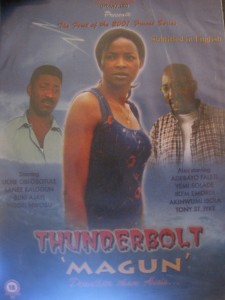
This is the subject of a class movie that we just saw to the end on Monday. The 2001 movie is titled THUNDERBOLT (Magun) and is an adaptation of a story by Yoruba writer Adebayo Faleti, and directed by multi award-winning director Tunde Kelani. Magun (literally meaning “don’t climb”) is an old and notorious myth in the Yoruba culture, and it has been credited for all the strange or spooky things that have happened to people engaged in illicit affairs. The scientific verification of the curse is impossible since no one has ever claimed responsibility for its activation, nor narrated experiences of its infection. The men concubines are supposed to die immediately afterwards, and the woman shamed. Thus so far, it exists purely at the level of myths, literature, movies and academic papers. The movie is instructive in the way it brings the western culture into a spectacular clash with the local traditional medicine, and superstition, and how the love triangle of death, intrigue and betrayal was resolved in the end.

We saw this movie last semester in class, and the students loved it. This semester, they did too, but there was at least one objection to the way adultery was portrayed as the solution to the death triangle. “I just don’t believe that it is right,” the student said, having walked out of the class at the last scene where a medical doctor who didn’t believe in “such crap” had volunteered himself as the guinea pig to test the veracity of the myth and thus get a chance to write an academic paper about its demystification. “It is a marriage for God’s sake,” she said, not really in these exact words “and marriage is a sacred institution. To allow such portrayal of adultery as a solution to something that is purely mythical is barbaric and ridiculous.” And for a moment, it seemed that the fiction on the screen had taken a life of its own out in the real world of the classroom. What she didn’t see in the last moments of the movie as she walked out in protest was how the guinea pig medical doctor who had put the myth to test had come face-to-face with immediate death thus adding veracity to the myth, at least for the benefit of the story. Much of the conflict in the movie however was about that clash of civilization and tradition, and the extent of human tolerance, love, respect and curiosity.

I had brought it along from Nigeria because it was one of the my favourite Nigerian Yoruba movies, because of its drama, and because of the way it explores a cultural myth and its interaction with a modernizing world. I recommend it for watching for everyone, and not just because one of my (now late) Professors was one of the main characters, but because it raises valid questions of what is to be done when one is suddenly confronted with the a life-threatening, time-bound discovery that the world is not all good and kind.

PS: Said student is the only married student in the class, which could make it easier – or not – to understand her objection. That said, I’m glad that the movie provoked such a discussion. Theatre/Fiction tends to do just that.

The Yoruba Talking Drum

I made this video during the cultural awareness week on the campus of the University of Ibadan in May 2009. The talking drum is a uniquely Yoruba percussion instrument that is peculiar because of its ability to mimic tonal patterns of actual human speech. In this video, I tried to engage the drummer in a little competition of abilities; he on the skill of drumming, and I on the skill of discerning. Enjoy.

I showed it to students in class today, along with some music videos of Lagbaja, once again to illustrate the blend of tradition and modernity in Nigerian contemporary music. I had a reaction to his appearance almost in a similar form to the one I had the first time I showed him in class. My students are supposedly aware of the concept of the masquerade, but apparently, not in this particular shape and form. Let me get back to you after the Mardi Gras, and I’ll let you know what I learn about how American masquerades really look like. I’m guessing that they are not as elaborate, or as “scary”. We also learnt about the concept of Abiku, how different it is from the scientifically verifiable child mortality, and how many children often used it as a weapon against abusive parents.

Short Observations from Class

  • Most students tended to make hasty generalizations from what they read. The book A Mouth Sweeter Than Salt had very many interesting stories from the perspective of the then young and uneducated Toyin Falola and his upbringing, but most who read it tended to think that his story was true for everyone else, e.g. people not remembering their date of birth. This happened last semester as well. Maybe we should bring Chimamanda back.
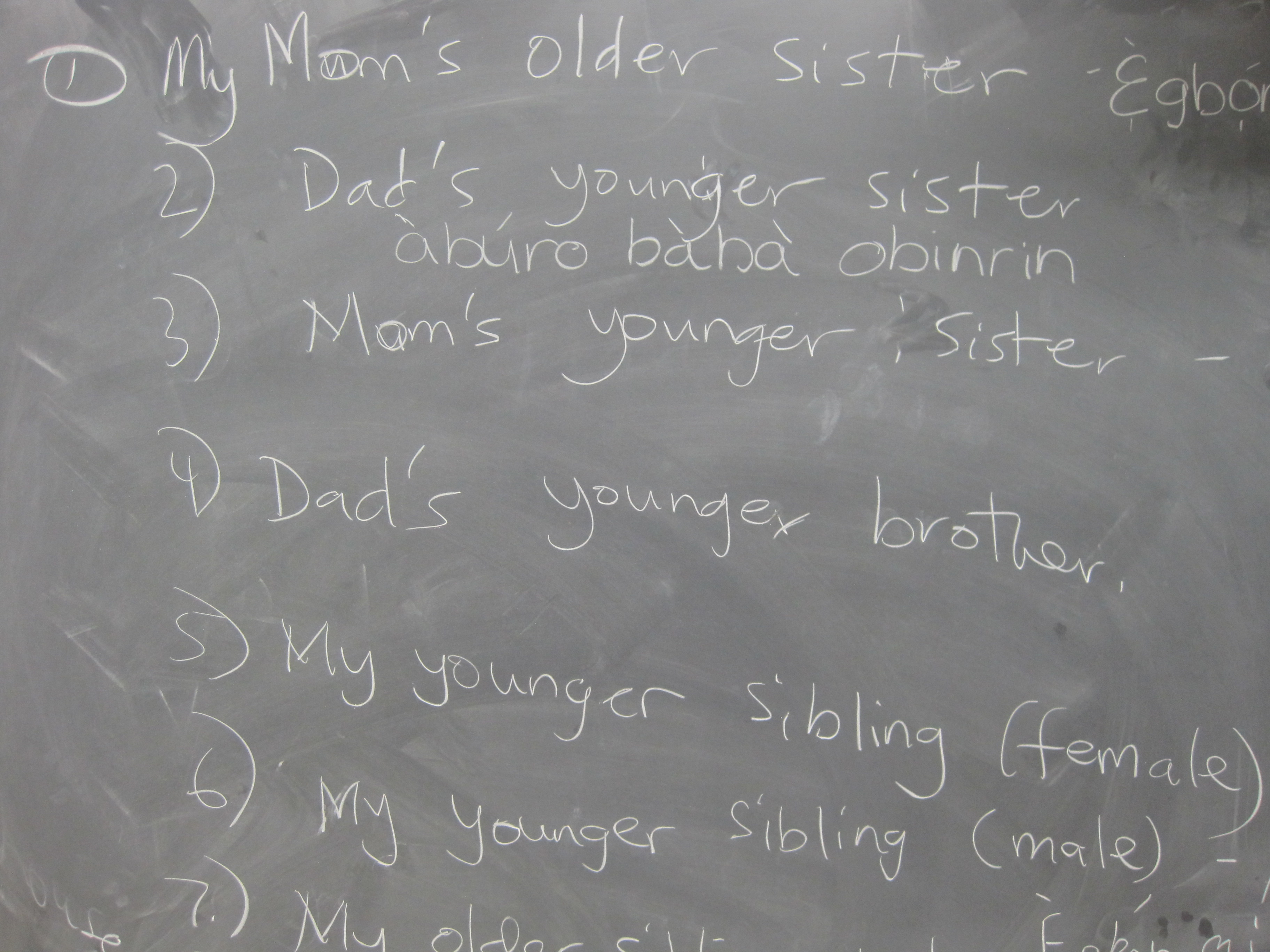
  • Americans wrote the shortened form of the English word for mother as “Mom” instead of “Mum” as I have been used to. I didn’t know this before. I’ve always written it as Mum, until someone from class gently corrected me after I wrote it on the blackboard. Then I gently corrected her too, and voiced my reluctance to ever adapt to American English. They found it amusing.
  • One of my students said on Monday after submitting an assignment to write a summary of the life of Wole Soyinka that his mother had met the Nigerian Nobel Laureatte once before, and found him to be brilliant. “Cool,” I said.
  • Many students used Yoruban whenever they used Yoruba as an adjective in an English sentence, rather than the usual Yoruba, e.g Yoruban boy, Yoruban culture, instead of Yoruba culture. Yoruba boy etc. I noticed this in the scripts of my Fall semester students last year as well. Do British English people make this generalization as well?