What Else Is New?

Q: How do I prepare for teaching class, usually?

A: I don’t.
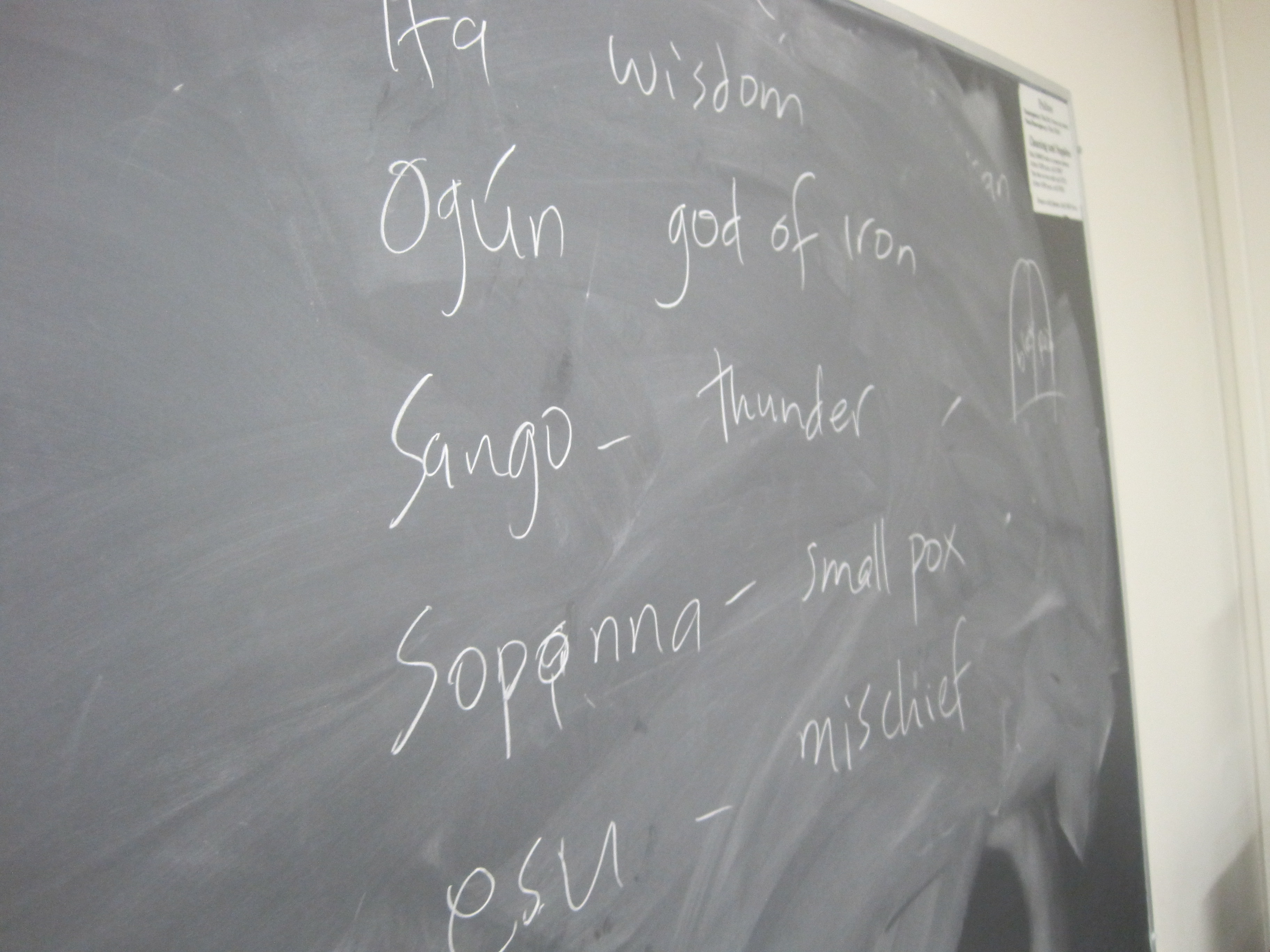
Well, that’s not true, technically. It’s just a short response. I spend all waking hours, especially at weekends usually mentally mapping the format of the next class that by the time it’s Saturday evening, I’m in an almost panic mode, worrying whether I’ve done enough even though I’ve been noting things down and recalling examples that could help pass the messages across better. But I don’t study much just for the class. I follow relevant links that I find online or offline, and I follow up on new and old leads. Yesterday I looked through the first chapters of Je Ká Ka Yoruba, the text for the language teaching again, and tried to see if there was something there that I hadn’t seen before or taught before. I needed to cover much of the weekly syllabus because of the Martin Luther King holiday that fell on Monday, effectively reducing my week by half.

Before I went to bed at 3am on Sunday night, I managed to read the first chapter of A Mouth Sweeter Than Salt for the very first time in one sitting. Last semester, I had only just glanced through that chapter because I had too much to read then. I got much of the ideas of it from the students’ summaries and what we discussed in class. Lazy, I know. But after reading it yesterday, I understood why anyone could be forgiven for trying to avoid reading it. For an avid reader, each sentence is a treasure of lore. It tells of some thing or the other that the author has either not talked about before earlier, or that he wants to say again in another way. I agree, the chapter could have been a little shorter, but you should read it. You should read it. It brings memories of things parents talk about. Reading it, I felt like I was listening to a seasoned elder speak of his childhood in a closely knit extended Yoruba family. If I could meet the writer, I would ask him too many questions. Or I would just sit at his feet, just listening to him talk. He is a good writer. He’s a good story teller too. Why is this book not read in Nigerian schools? Oh, I forgot, Wole Soyinka’s Ake has already taken control of that spot in autobiographical narratives in colonial and pre-colonial Nigeria. Their experiences are not the same, but they are similar, as I pointed out in class, lest they get the idea that everyone of us in Nigeria – just like this writer – do not know our exact date of birth. Alright, go and get the book, and read.

There is nothing new I want to tell you about today’s class. It stated on time and it ended on time. No other student has dropped off beside Gretchen who had dropped out after a first class. She left us for a class in Finance, so we’re nineteen now. Still, the textbooks are not sufficient. Many will have to share. We can’t complain. Now we can greet, introduce ourselves, respond in Yoruba and ask few introductory questions in Yoruba as well. It’s a start. These students are more agile, a little faster to learn than the last ones. I think. I could be wrong. They got the “kp” and “gb” far easily, for sure. Maybe it is because of the size of the class that gives this positive feeling and active participation. It is turning out to be a blessing after all. We may not be able to joke around as much as we did last semester, but we will try. I may find it harder to learn everyone’s names on time as I want to. It will take a while, but I’ll get there. Today we met esu, ifa, Obatala, and Sango. Next week, we’re meeting Wole Soyinka, and maybe later Suzanne Wenger. Maybe it’s not a bad idea to have such a large class. It feels warm enough. I love it.

I think that the most memorable thing I have found as a pattern is that I usually wake up early whenever I have to teach a class, notwithstanding when I go to bed. It’s a good thing. Maybe that’s why I’m tired on Thursdays…
Random Confessions

The successful outing of my My [State/Country] posts on this blog (after Texas and Saudi Arabia) is giving me many more great ideas. How many states will I be able to “visit” virtually and publicly thank before my time here is over? Who wants me in their area? I definitely would like to show here to you my readers all the  relevant ktravula hot spots all around the world, just in case it ever occurs to anyone someday to organize a get-together/reunion party of all my blog readers, fans and commenters. 🙂 But I can’t. Or so I think. Physically, I’ve now been to Providence RI, Washington DC, Boston MA, St. Louis MI, Edwardsville IL, Cahokia IL, Principia IL, Chicago IL and Olney MD, among a few other small places. But virtually, I’ve been in many more places I probably would never see. Here’s the plan, as time permits, I will go around the world from here. The traveller is coming to a location near you. 😀

School resumes on Monday. I have not yet confirmed whether classes resume too. If so, then I will use this weekend to plan my class schedule for the year. It’s the hardest (I think) part of the work. When the plans are set, it not so hard to follow through in class, even though there usually occurs along the way some things never before planned, like public holidays, snow storms, and other engagements. But I like to have a plan. It helps to keep me focused. The last time I checked, I will now have sixteen students. That’s a higher number than the last nine who, like they told me on the last day of class, must have told their friends to sign up for that foreign language class where you could get an A (if you work really hard for it) and have fun all at the same time. Talking about As, all my last students but one got As. The person that didn’t get an A got a B, deservedly. She wasn’t as punctual as she should have been. And she did really poorly in the mid-term test. As for my own Linguistics class, I have not yet seen my results. Next week, maybe.

How did I spend my Christmas? I went to the house of my Professor A., originally from Nigeria, who was spending Christmas in town for the last time. He had resigned from this university and was moving into government work in the capital (Springfield). The most memorable part of the very beautiful evening was the “lucky dip” where everyone was asked to pick choice presents from a whole lot gathered in the living room. I got a wall clock. Now I can see what time it is while sitting on my bed without first having to pick up my phone or computer. However, there was not much Nigerian food at the table, surprisingly. There was mostly American foods, which I enjoyed. And there was moi-moi. It was a very memorable and enjoyable evening in company of people of different nationalities, behaviour and beliefs. I met his young children and their friends. One of his children’s young cousins in attendance had attended St. Patrick’s school, Bashorun Ibadan before relocating to the States. Our discussions brought back memories of truancy in secondary school days when we snuck out of our school premises to attend Christmas parades in the compound of the Broadcasting House just across the road…

New year’s eve. This one was a story with a k-leg, because Chris from class who had checked with me many times about our earlier plan to spend the eve together at his house partying, playing, reminiscing and flirting around with American girls suddenly had a work schedule! Oopsie. (Sorry Chris. I know you might not believe it, but not all of us from that side of the world play around with firecrackers around festive periods. 😉 ) In any case, I believe(d) him and stayed indoors since Ben also had suddenly disappeared earlier in the day to go to his folks at St. Louis. I fell asleep at nine, and woke up barely at a quarter to twelve, so I slept again, hoping my some miracle to wake up before twelve. The next time I opened those eyes, it was 1pm and I had two messages on my cell phone, from Nigeria. Happy New Year, they said. There were no fireworks like it would have been at New York’s Times Square, or back home in Nigeria (yes, we use fireworks too. Note to Chris: They are festive fireworks, not explosive firecrackers). I went back to sleep a few hours later, consoling myself that in some other parts of the world – in California, for example – they were still in 2009 by a few minutes.

I broke my first and major new year resolution on the third day of the year. I ordered a $24 pizza from Papa John’s! And as guilty as I felt after placing the order, I enjoyed it. It was coming after a few gruesome days of needed abstinence. Thankfully I didn’t have to eat it alone. But on the (not altogether so) bright side of this matter, a freak error/mixup of communication between me and woman at the housing office on Monday when I went to make payments for my housing rent has cleared my bank account/card of ALL available funds. The situation, as she apologetically promised afterwards, is now being rectified. Five days later, it has not, and I’m mad! One week, and perhaps more, is a very long time to wait. This means of course that there would be no more Papa Johns, even if I crave it. And as soon as my supplies of food run out, which they will, very soon, I will be very screwed :D, not literally. So, sigh, wish me luck people, or send relief, or remember me in your prayers. But whatever you decide to do, when you eat your nice meal of turkey, moi-moi, amala, potato salad, stuffing, egusi, pounded yam, broccoli, jollof/fried rice, ogufe, or whatever else you have on your plate on your side of the world tonight, please remember this American child that is now surviving on less than a dollar a day. Don’t look for any paradoxical punch-lines to this. There are none! 🙂 😀 🙁

On the Mid-Term Test

IMG_0571The test of students’ progress is not always as tricky if one is lucky to have listened to the students beforehand and to have understood what they are used to and what they are not. In most cases, as long as the teacher knows that his purpose in the test is not just to surprise and attack but to monitor his own progress, there would be less tears and heartbreaks when the day is over.
A few days before our mid-term test, I had given the students a list of areas to focus on, as well as how exactly to answer specific type of questions. There should be no one-word answers to questions requiring full sentence responses. There would be extra credit points for those who put the correct tone marks where necessary. There would be questions on personal introduction, identifying objects, numbers and greetings. And lastly, they should go over virtually everything we had learnt in class. After all, it was supposed to be a test of ability as well as hard work.

Beside the thirty questions that covered all we had learnt in class, there were also five extra-credit questions meant to help whomever needed it to get their grades up, and the questions there included “Kíni orúkọ olùkọ rẹ?”, “What is your adopted Yoruba name, and its meaning”, “Who is the author of the class novel ‘A Mouth Sweeter Than Salt’”, “Where was Suzanne Wenger originally from?” and “What’s the word for ‘zero’ in Yoruba?.

I have now finished marking  (or scoring/grading in American English) the tests, and beside an overwhelming joy at how good they performed, I have made a few prominent observations:

  • That none of them remembered my surname. It must have either been too long to remember.
  • That many of them spelt “Good Afternoon” as “kassan” instead of “kaasan”. I’ve now told them that Yoruba does not have consonant clusters. That’s why when the word “brother” enters the language, it is pronounced as bùrọdá.
  • That only a few of them knew the name of the author of the class novel. A few more remembered only the first name and not the surname, while a few knew the surname but couldn’t spell it.
  • That everyone remembered the Yoruba word for “zero”.IMG_0573
  • That some of the students studied beyond what they were taught in class. A case in point: even though I didn’t ask for plurals, a student responded to a question on identifying pens as “èyí ni awọn gègé.” (trans: here are some pens). I found that very impressive, and she was rewarded extra for it.
  • That almost a quarter of the class didn’t remember their adopted Yoruba names, and half of those who did had forgotten the meaning. It was sure that they were not expecting to be asked about this in the exam.
  • That some students would just NOT read the instructions on the exam question paper no matter how many times they’re told to do so, and notwithstanding the same instruction having been previously stressed again in the exam review materials.
  • That there is always one student in class who would not perform well no matter how much help the teacher gives. S/he is either just lazy, or dull. The problem is, they are the ones who do not speak up when they don’t understand, for fear of being too prominent, when they should ordinarily be the most vocal.

I have my work cut out for me for the next half of the term.

Class Sessions 6

It was fun to be in class again on Wednesday, and revise the many words, phrases and expressions that we had learnt since the class began five weeks ago. Somehow, we all seemed to have grown on the Yoruba expressions and they don’t sound any strange as they probably did to the ears of the new students when I first walked into the class on that first day.

220920091368Yesterday, we had class practices of oral conversations. The students were paired with each other and they took turns to display their knowledge of conversation techniques by dramatizing the scenario of a chance meeting by two previously unfamiliar strangers meeting on the streets of Osogbo or any other Yoruba town.

Speaker A: Káàro o.

Speaker B: Káàro. Sé àláfíà ni?

Speaker A: Dáadáa ni/Adúpé/Àlàáfíà ni o. Ìwó nko?

Speaker B: A dúpé. Kíni orúko re?

Speaker A: Orúko mi ni Títilayò. Kíni orúko tìre?

Speaker B: Orúko mi ni Babafemi. Níbo lo n gbé?

Speaker A: Mo n gbé ní Collinsville. Kíni orúko àbúrò re?

Speaker B: Orúko àbúrò mi ni _______/Mi ò ní àbúrò. Ìwo nko?

Speaker A: Orúko rè ni _________. Ègbón mélòó lo ní?

Speaker B: Mo ní ègbon méjì. Ó dàbò.

Speaker A: Ó dàárò. Inú mi dùn láti mo é.

…and other short phrases improvised for conversation.

As far as elementary knowledge of the language is concerned, we have not done badly so far. Our areas of improvement include pronunciation. Many students still found the word “GBÉ” hard to pronounce, even though they could pronounce the English word “RUGBY” quite effortlessly. Can someone tell me why? In the next class, we will be in the computer lab to do get these expressions on tape, voiced by the students themselves. It is going to be a fun experience.

PS: According to the result of the web poll on the right side of this blog, I need to spend more time talking about my class sessions more than I talk about myself. I will keep that in mind as I go on, but I will occasionally have to share my personal experiences as they relate to my appreciation of the programme as a whole. Thank you for voting. I will appreciate as many more votes as possible. This is a chance for me to know what thrills you and what doesn’t. If you haven’t voted, you can still do so. The poll is on the right side of the blog homepage.

The Fifth Class

My fifth class was short, but only because it never took place. I’m blogging about it only because it has taught me another important lesson in my American experience: be punctual. But first, I should tell you why my sleeping pattern has become so irregular. Two words: time zones.

By the time it’s midnight in Illinois and I’m ready to sleep, a chat box beeps open on my laptop and someone in faraway Nigeria has woken up and wants to talk to me. It is six am their time. A little “hi” gradually turns into long phrases and sentences, and by the time my eyelids start closing by themselves, they somehow get the idea, and we part ways. It is not their fault but mine, for staying up beyond eleven pm when I should just shut down the blooming laptop and close my eyes.

"Good day class!"In today’s case however, it was none of the above reason. I was working on a translation task that took much of my time. I slept at twelve, woke up at two and slept again at five thirty. By the next time I woke up, I was thirty minutes late for my teaching class. I have never rode by bike as fast as I did today, and I got to campus panting like a deer. And silly me, I was still expecting to find the students waiting for me in class. I met only one of them the lobby, and I hurried up into the class to find an empty set of seats. Perfect. Back to the lobby, there was Bre reading, and waiting for her next class.

“Hey, where’s everyone?” I asked.

“We left.” She replied. “You weren’t there, and so we left.”

It was as simple as that.

It was another sharp reminder for me to wrap myself around the fact I’m no longer in Nigeria where students have to wait until the end of the hour for the teacher to show up in class.