Bassey’s Literature as Truth; Truth as Literature

I read an advanced copy of Bassey Ikpi’s new memoir a couple of weeks ago, and I haven’t stopped thinking about how important it is that the work exists in the world. I wrote an earlier review much of which I’ve now discarded for focusing less on the unique nature of Ikpi’s intervention in the space of writings about mental illness than about its similarities — or otherwise — of other books of its nature.
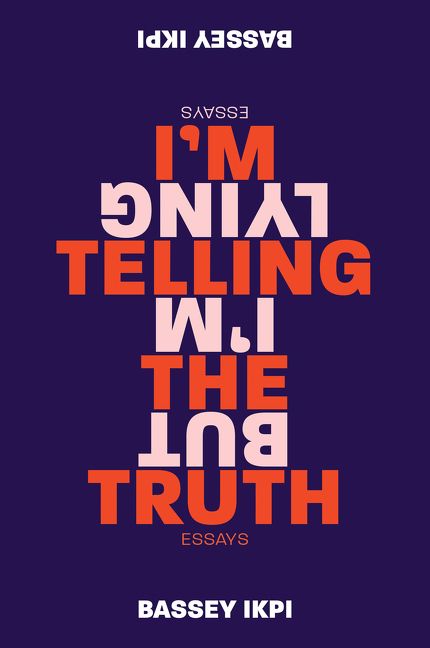
Bassey’s book of essays, titled I’m Telling the Truth but I’m Lying focuses on the writer’s life and upbringing, first as an immigrant child in an America she didn’t immediately adjust to, then as a young adult unable to name the mental issues that afflicted her, and into an adult that had to fight and struggle through the most destructive phases of a bipolar disorder. This summary, however, does no justice to the beautiful piece of literature that is Ikpi’s book. It is a memoir (don’t let the “essays” tag fool you), written mostly in first person, except when — in a style deliberately designed, perhaps, to help the reader simulate the rollercoaster nature of the writer’s journey through the ailment — parts were written in the second person, allowing the reader to pretend, for a second, to be a participant in the ordeal.

The book is honest, though the writer warns us in the title and in many other parts of the book, not to take her too seriously as a reliable narrator. It is raw and unflinching. It peels back an often opaque veil to show the extent to which people suffering ailments of this nature can go in order to feel “normal”, and extent to which mental disorders contribute in the blurring of lines between self-destruction and self-awareness.

“All my life, I feared being “bad.” I already felt broken, already felt like there was something irreparably wrong with me, the least I could do was coat myself in the “goodness”: this idea that who we are is based on how we are seen I already feel broken; I followed the rules but now I wanted to feel something different– to feel better, to feel unbroken–more than I wanted anything else. I wanted something other than this Novocain and numbness. Its very name revealed its power: I wanted ecstasy.”

Page 93.

But more than a confessional — it skips mention of a number of specific personal details on the writer’s professional life, so those looking to learn about the writer’s illustrious career as a travelling artist on the Spoken Word circuit through America will have to wait for another book — Ikpi’s book is a kind of map for those interested in learning about how mental illness affects people. “If I were a nurse or a teacher,” she tells me in a private conversation “It would have shown up the same way.”

And yet, it is not a grim book, because we know that the writer survived to tell the story. It is not a morality tale either. Let me quote Erin Wicks, an editor at Harper Collins here: “What you will find within these pages is something far riskier and far braver: a human breaking down her external wall to show us the structures beneath, and then examining them before our very eyes with great honesty, and love, and brutality, and rawness, and vitality, and mourning.”

I have interviewed Bassey Ikpi in the past, when she lived, briefly, in Nigeria in 2014. She continues to be an advocate for openness in speaking about mental illness. To a layman, especially in Nigeria, all mental illnesses are the same. In most African cultures, there is just one word for them: an equivalent of “mad”. In literature, and in reality, there are many dynamics and diagnoses, one not looking the same as the other. Dysthymia is not bipolar disorder, which is not dissociative identity disorder, which is not schizophrenia, which is not chronic depression. So, through the experiences of others, written — in this case with Bassey’s book — with prose that is as honest as enchanting, one hopes that the reader can build both a bank of knowledge and a muscle for empathy.

It is to our benefit that works like Ikpi’s exist and continue to put the conversation right before our eyes. While the illnesses may never quite cure, the result of the human will to thrive in spite of it, as evident in this beautiful book, is a spectacular reward of its own.

I’m Telling the Truth But I’m Lying will be out on August 20, 2019
NEWS: New Book-ish

I am currently rounding off work on a new book. It’s a collection of essays exploring my thoughts on language.

Those who have read this blog from the start may already be familiar with the direction of my thoughts on a number of linguistic and language issues. In actual fact, many of the thoughts in the book first debuted on this blog in form of small blog-sized arguments and opinions. Many more were written but never published, and a few were published as guest-posts on websites focusing on language survival, language endangerment, or mother tongue use.

This, along with a full-time job as a teacher of English language in Lagos, Nigeria, and a father of a young son under two, has kept me busier than I thought I’d be. It has also kept me quite engaged, and quite surprised at the number of things I’d said about language over the last five years. My current word-count is 50,000 words. I think I should stop now, before it becomes an epistle.

I hope to be in the United States again, for the first time in three years, this July, just for one month. One of the things I hope to do while I’m there (besides travel, spending time with family and friends) is to find a publisher – perhaps a university press – to publish the book. What I’ve heard from friends and other authors doesn’t give me much to be encouraged by, but when is that ever enough? There’s usually some good news out there. If you, my dear blog reader, have any tips that can be of help, please drop me a hint.

It’s been a while. I hope you’re all doing well in your chosen endeavours.

On the “Giants of History” – Book Review

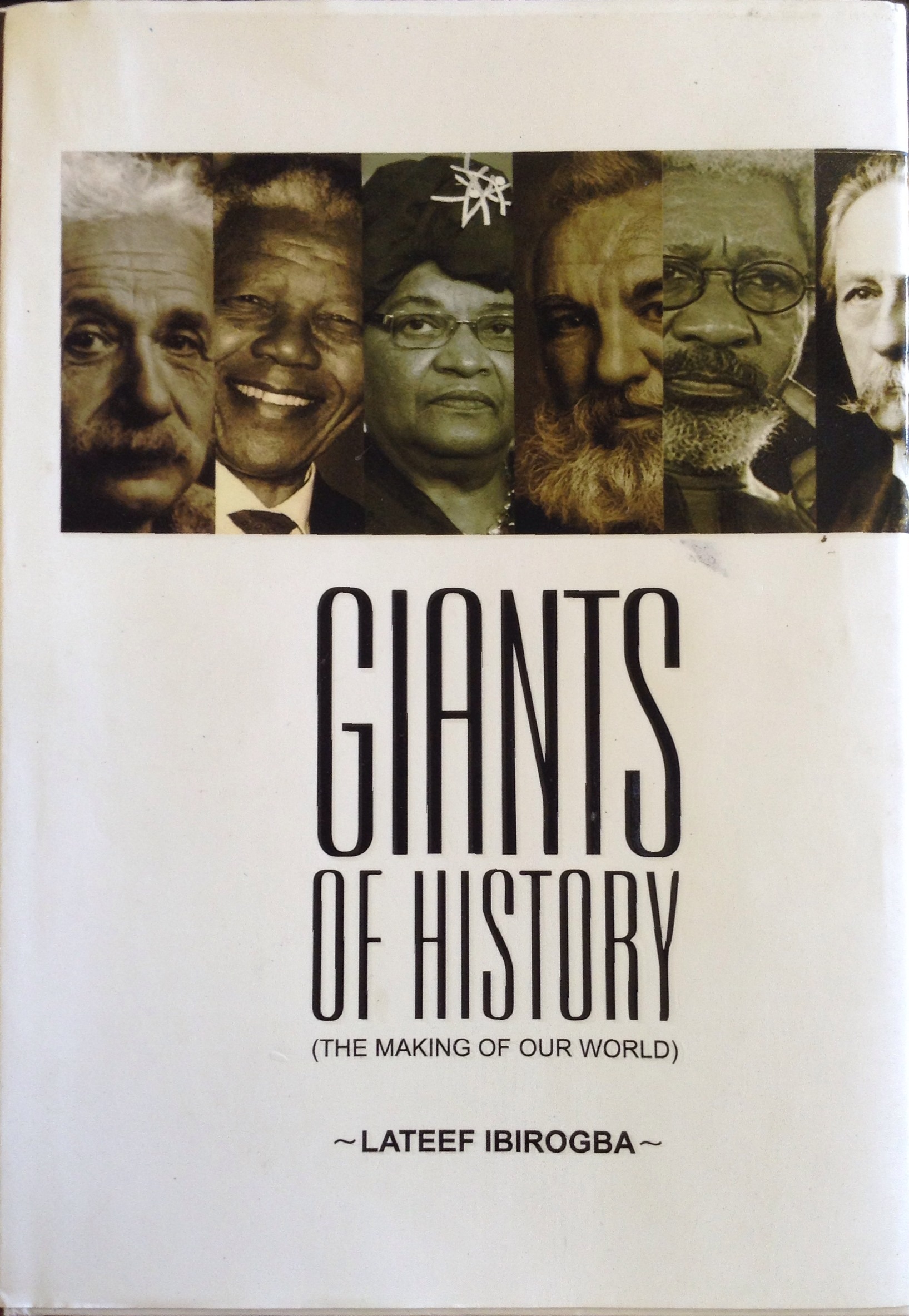
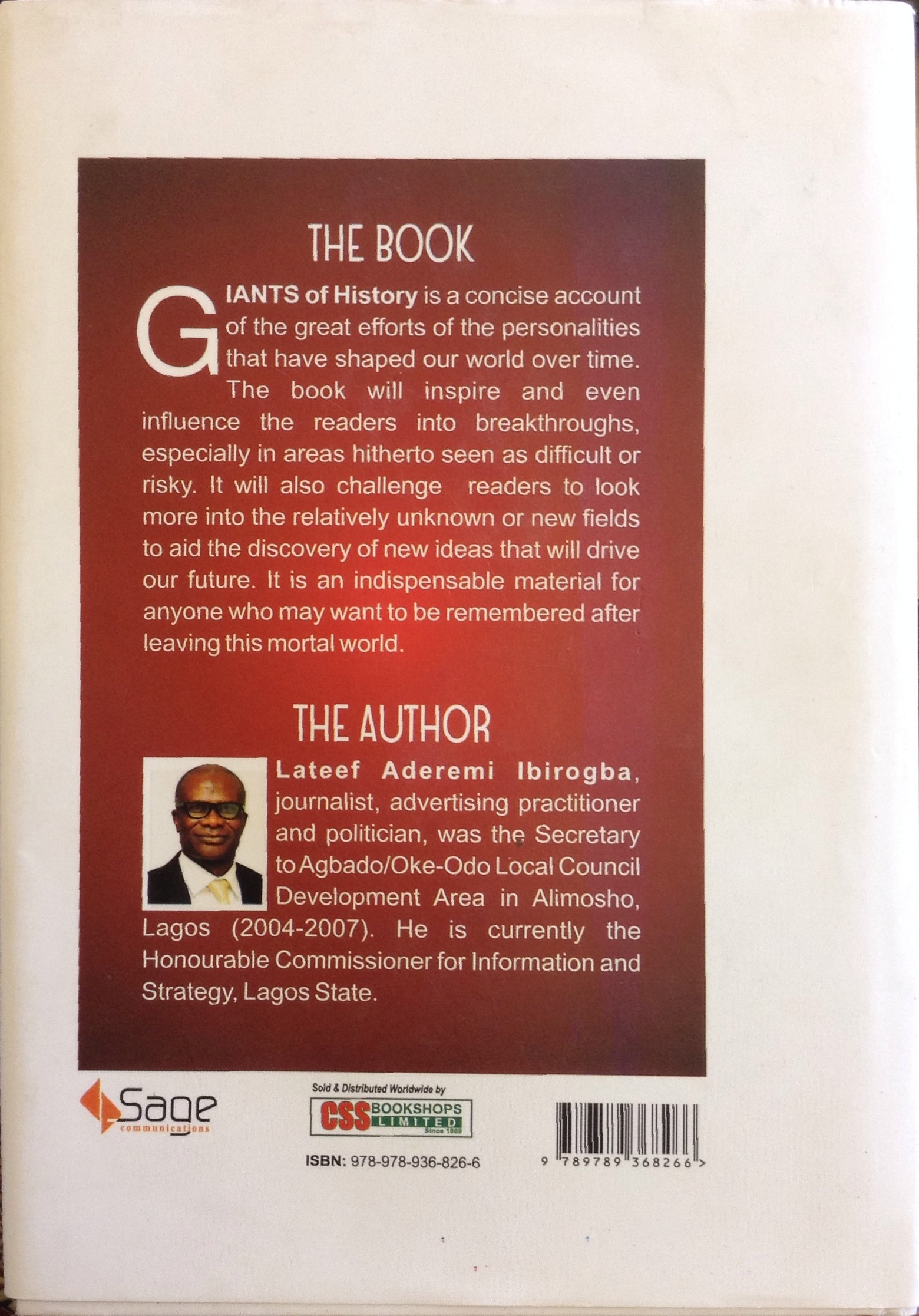
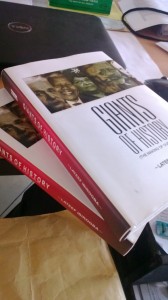
One of the projects I worked on from the middle of last year (in many capacities, most notably as an editor and all-round busybody) is a book of profiles and biographies titled Giants of History. (322 pages. Sage Publishers. Lagos)

WP_20140220_001 (1)

Written by journalist, and politician, Lateef Ibirogba (Currently the commissioner for Information in Lagos State), it is a look at 150 selected great men and women in history whose lives were exemplars of tenacity, dedication, leadership, and hard work – most of them. Readers who pick up the book will see why these descriptors don’t apply to all of the “giants” selected. The only thing that ties them together as deserving of being in the book is the extraordinarily notable lives they lived, the number of lives they touched, the power of their example, and their tremendous influence on the generations that followed them.

I was drawn to the book because of a number of reasons. When I was young, one of the most notable books I read that opened my mind to the idea of doing great things, and living a life worthy of being written about, was a book by Sanya Onabamiro titled Philosophical Essays (1980), and another by Tam David West, also with a similar title: Philosophical Essays: Reflections on the Good Life (1980). What both of them did – and I can’t tell one apart from the other anymore now – was lay down arguments supporting or opposing particular events in history, while highlighting why they had to happen and who was responsible. I will get those books again if I can ever find them, but one of the most important things they did for me was to open my mind, and challenge me to dream. They also informed me about a number of relevant historical events and their effect on the world. When I was invited to work on Giants of History, I had flashbacks to my delight with these great books. The format that Lateef Ibirogba chose to use in presenting this book in was just as important, and the role of his book serves just about the same purpose as highlighting history for those interested in it, and giving credit where due to the important human precursors to today’s important inventions and achievements.

frontThe book has now been published, to be launched in Lagos on April 22nd. I will be there at the launch, which should feature a number of heavy names in politics, publishing, and writing in Nigeria. The book reviewer, Tade Ipadeola – a lawyer and creative writer – was the winner of the 2013 Nigerian Prize for Literature (the highest literary prize on the continent, which carries a prize money of $100,000). I expect that the governor of the state will be there as well, along with a number of other still-living Nigerians whose names also made it into the book. It is important to mention that one of the impressive nature of a work of this kind is its good sense to include in the work not just historical figures from older civilizations around the world, like Plato, Aristotle, Isaac Newton, Mahatma Gandhi, Abraham Lincoln, but also notable historical figures from our own national environment, like Obafemi Awolowo, Nnamdi Azikiwe, Mary Slessor, Funmilayo Ransome-Kuti, Madam Tinubu, Fela Kuti, Chinua Achebe, among many others.

backI invite you to look out for the book, and to buy not just for yourself, but for your relatives, especially the young ones not yet sure of where life would take them, or what the point of everything is. If I could still remember the influence of a book on me as a thirteen-year old reader, then precocious thirteen year-olds around you will definitely appreciate you giving them a gift of such work.

A contrarian case might be made as to why publish a book of biographies when there is Wikipedia and the world-wide web to inform us – in multimedia richness – of the lives of living and dead heroes. The answer would be that the book is not dead. It is movable and presentable, and it is still the closest way to reach a reader, not hindered by access to electricity or the internet. It can be read in the village as in the city, and thus its relevance.

The book is available for purchase for now at www.digitalbooks.com.ng.

Launching Festschrift Honoring Rudolph G. Wilson

Dear Friends, Colleagues and Acquaintances of Rudy Wilson (Papa Rudy):

Kindly consider this note your official invitation to the launching of a book in Honor of Rudy Wilson on Tuesday, November 16, 2010 at 12 Noon at Southern Illinois University Edwardsville (SIUE).

Since his retirement from SIUE as Assistant Provost for Cultural and Social Diversity and a professor in School of Education, a group comprising of friends and mentees of Rudy Wilson has put together a short festschrift titled, Multiculturalism in the Age of the Mosaic: Essays in Honor of Rudolph G. Wilson. The book, edited by Dr. Michael O. Afolayan, Assistant Director for Academic Affairs, Illinois Board of Higher Education, with a foreword by Dr. Venessa Brown, Assistant Provost for Institutional Diversity and Inclusion and Professor of Social Work at SIUE, came out in September.

This important one-hour event will take place at the Morris University Center (Hickory/Hackberry Room). There will be short readings from the chapter on “Reflections” written by friends and colleagues of Rudy, brief statements from invited guests, and a response from Rudy Wilson.

Please mark your calendar, and be there to honor this “Man of the People!”

Another Monday

There’s a law that I can’t yet name, but it says that if you had all the time in the world, you most likely won’t do as much as you would if you were very busy and occupied all through the day. For now, let’s call it the KTravulaw of Time Management. It is the truth in that law that has prevented me from blogging as much as I should this month, and it’s just as well. Studies are kicking into full gear. If symptoms persist, I will blog less and less until I would be able to write only one post in a month. And maybe that will be Nirvana.

Before then, I will be busy finishing the autobiography of William Shatner titled Up Till Now. As expected, it has a lot of funny stories of the man’s life, from the time a female gorilla held his balls and wanted to sleep with him to his very many risks taken in life and in his career. And then I can get over my obsession with Fela! the Musical, and the life of those who populate the story, e.g Sandra Iszadore who was the only woman ever to sing lead on a Fela track. Who was she? How did they meet? What was her relationship with Fela like? Was the relationship consummated? And if so, why/how did they separate?

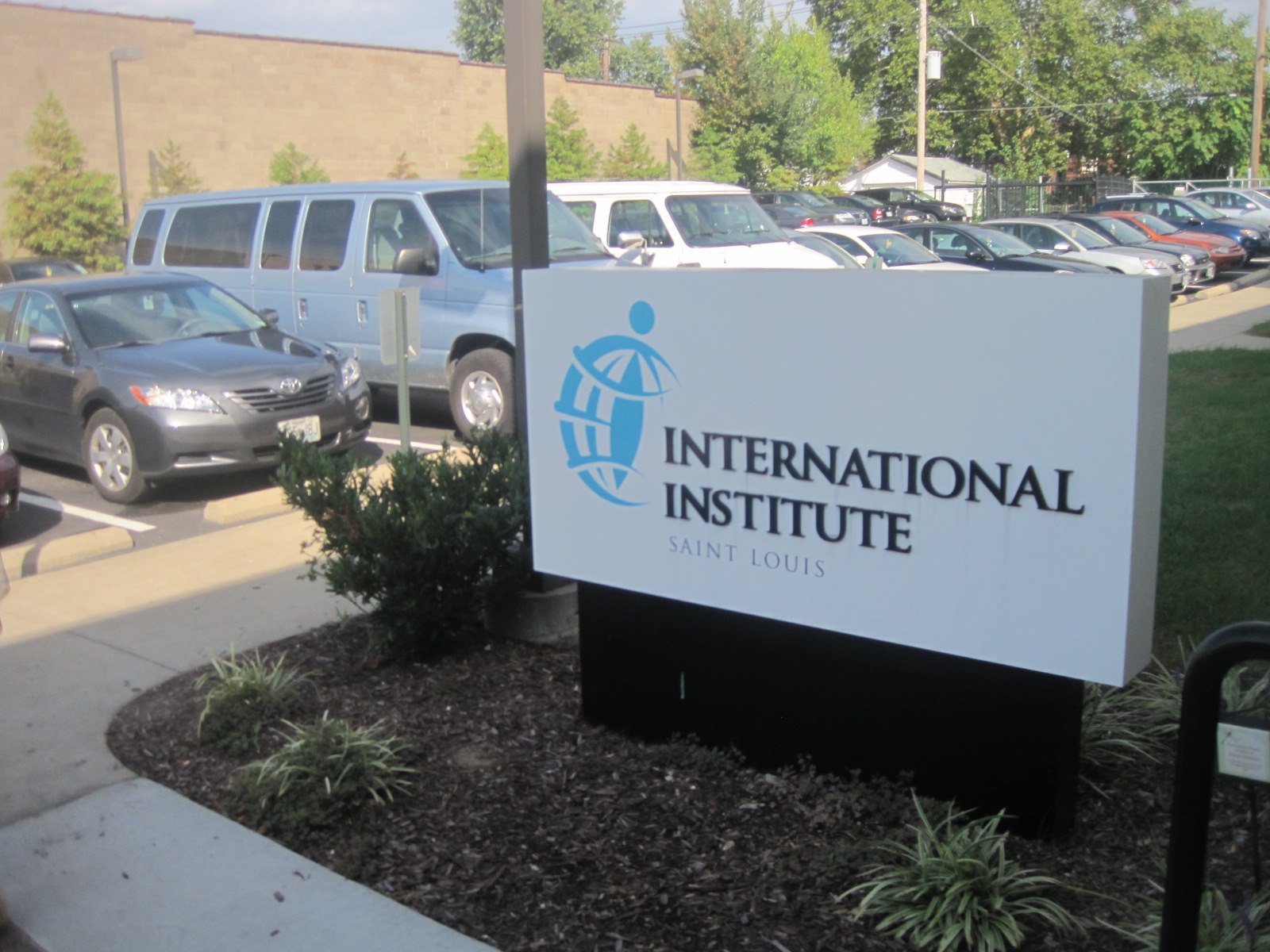
And then I will try to go to St. Louis all by myself for the first time tomorrow with or without a GPS. Thinking about it now, it sounds like an impossible task. But I have signed up as a volunteer at the International Institute where they teach and resettle immigrants and refugees from parts of the world. I would be teaching (very basic and elementary) English, and I look forward to the experience. More than just a chance to see how volunteering works, or how second language speaking adults learn English for the first time, I also need the experience for my pedagogy class. I was at the Institute for the first time last week with a classmate and I was impressed by what they do with little funding from the Government, but now I will have to go there all by myself. If I get lost, I know whom to call. That is if the road police don’t get me first for being confused on the very confusing interstate highways.

Many more things have happened to me since a while, but I can’t tell you right now. I should either be sleeping or reading for the week’s classes. The weekend went by too fast. Have a nice week.