To @MrBankole, who asked:
I’d like a brief comment, if you don’t mind… (on) your thoughts about the future of (Yoruba’s?) cultural legacies and how they interact with evolving mediums of expression. Do you think they’ll erode…or will they be preserved? Living, breathing, or digital fossils.
I’ve heard many versions of this question before, but this one is about whether the new means of communication (with their inherent tendency for language imperialism) will (or not) send Yoruba, or perhaps any other language with such limited use off the map completely.
I believe, of course, that they will survive. The question however (always) is “in which form?”
 The Yoruba language lives today in Candomblé, a religion in Brazil, and in Cuba as Santería. Some of the cultures of the old Gold Coast have remained in Jamaica and some other parts of the Caribbean in sometimes recognizable bits, or sometimes in totally evolved forms. This is the inevitable fall-out of language and cultural transposition. As dead as Latin is, it still lives on in science and in the Catholic Church. The point is that even in the worst case scenario, there will still be a recognizable part of the language left.
So, if in a couple of hundred years, Yoruba survives only in this (electronic) medium through the use by those who remember particular registers from their own childhood and nothing more, we may be left only with that: a Yoruba customized for a medium and a particular kind of audience. An e-diolect, if you will. Over time, as it happened in Brazil and Cuba, the chasm will increase and the distance between the original Yoruba from root and the e-volved Yoruba that lives on in the medium will increase to perhaps an unbridgeable length, with few exceptions.
Or not. (We never really know. Language is dynamic and their survival/destruction is often subject to other issues than just mere technological advancements. Maybe a war will take place and destroy all Yorubas in Nigeria, and the only surviving bits of the language will be those spliced with English and all the other acquired languages we’ve imbibed.) But these are hypotheticals.
I don’t believe that the original Yoruba from the motherland/hinterlands will ever completely disappear from the earth (just like English never will as well). But I believe that all things being equal, they will evolve, differently in speed – of course, depending on their medium of transmission (and the types/number of people that use one kind over the other).
Thank you for the interaction, Lord Banks.
PS: The Speak Yoruba Day on Twitter is still March 1, 2013. It is a chance to showcase the facility of the mother tongue and its relevance to the 21st century.
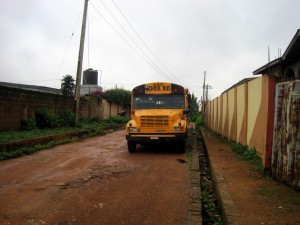 A pretty moderate traffic situation on the city’s many roads. Today, there are more roads (due to increase in population) but the traffic situation on major roads have got far worse. I went back to Akobo a few months ago, and I was shocked at how many people now live there. The distance from IDC to Anifalaje used to disappear in minutes under the small steps of my rubber sandals. Now it looks farther than I remember, and the last time I walked it (just a few months ago), I returned home panting for air. And yet, I may have got a better deal than the people who remained on the road, in their cars – to slightly exaggerate the congestion that the place now faces because of traffic.
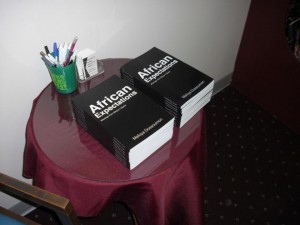 I find English a much simpler language for writing. French can become quite convoluted. My goal with African Expectations was not to write beautiful or intricate language but to convey ideas in the most direct and forceful manner as possible. I found the English language most suited to this requirement. Overall it was fairly easy to render the book purely in English but certain passages in the book, I have had to translate in my head from French to English. At this point, I mostly think and dream in English but sometimes I am unable to convey certain subtleties of thought directly in English. In those instances, I have had to think in French and translate to English. The translation part of the process has been a challenge because I have had to do research to make sure that what I wrote in English actually had the same meaning as the original thought.
 Scattered guests, wayfarers from everywhere, travelers,