The Emptying Vessels of Lagos

On my way to work the other day, at the Oando Roundabout, one of the many along the Lekki-Epe expressway, I overheard a couple of traffic cops complaining about the drivers on the road. They spoke loud enough for drivers in each of the cars nearest to them on the road to hear, if they paid attention, as I did. They gesticulated as they spoke, complementing each other’s point within the same discussion. By the time I got close enough to them within the creeping traffic, all I could hear was “See them, all these cars, there is just one person in each of them!” I recognised it immediately as the same sentiment I’d harboured for a while, about the typical unwillingness of Lagosians to carpool. I also noticed that, like many of the drivers on the road that morning, I was also alone in my vehicle.

The Lekki-Epe expressway is a tar stretch of 49.5 kilometres starting somewhere around old Maroko (now called Sandfill) and ending, across the Lagos Lagoon at Epe. The road was constructed in the 80s during the last civilian administration before the military took over in 1983, but expanded recently when civilian rule returned to Nigeria in 1999 during the tenure of Bola Ahmed Tinubu. The expansion turned what was, at the time, a narrower town road into a wider stretch able to accommodate more vehicles commuting everyday to work at the Victoria Island end from deep into the Lekki peninsula. Lekki itself, like Manhattan in the United States is as much a peninsula as it is a mix-bag community of mostly middle and upperclass people (but with a considerable mix of lower class, indigenous people, itinerant service workers from out of state, and other ethnic Lagosians).

IMG_3368_1

The House on the Rock Church, Lekki (pictured left, by the flag) was constructed with millions of dollars, and caters to the creme of Lekki middle and upper class Christians.

To claim to “live in Lekki” for most Lagosians and Nigerians is to claim a status that marks one as different from the masses. The image conjured is usually one of affluence: two to three cars for one family, a big house fully owned or at least rented at a high cost, a job in a prestigious bank or financial institution at the Marina or Victoria Island end of the Lagos island, and children who live either abroad, or who attend some of Nigeria’s most expensive schools. The perception is however unwarranted, of course, as many who live in Lekki (and yet work in low paying jobs, live in streets that get flooded whenever it rains, and typically take public transportation everyday to get to work) will attest. There are many “Lekkis”, from Lekki Phase 1, where the rich supposedly stay, and where rent for a three bedroom apartment start from two and a half million naira ($12,500) per year, to Jakande, halfway on the expressway, where rent is a little more affordable, but still higher for many average Nigerians (800,000/$3500) to Sangotedo, and beyond where many who can’t afford more than 400,000 naira per year ($2000), and lower, take residence. Like Manhattan, living on the Upper West Side is not the same as living in Harlem. Same borough. Different experience. (Certainly, different expenses).

WP_20141116_004

On a typical evening, as in the morning for the other side of the road, hundreds of cars stretch as far as the eyes can see. (Photo taken at Jakande area)

What is true and indisputable about the peninsula today however was what was confirmed to me on that morning ride: there are too many cars on the road. In a recent news report, the number of private cars on Lagos roads was put at 600,000, with another 120,000 accounting for motorcycles. This is for a state of a population of about 9.013 million people. I don’t have a figure for the number of public transportation we have on the road, and we don’t know just how many of these vehicles ply the Lekki-Epe expressway, but what we see every day on the way to work, where a trip that should otherwise last for six minutes (Igbo Efon to Ikate, to use the example of my route) on a Sunday usually takes fifty minutes on a Monday morning, and the number of people we still see at bus stops every morning looking for rides to work way past the 8am opening hours, tell us that there is not an efficient ratio between the number of cars available and the people who need or use them. The is so much wealth, but little value.
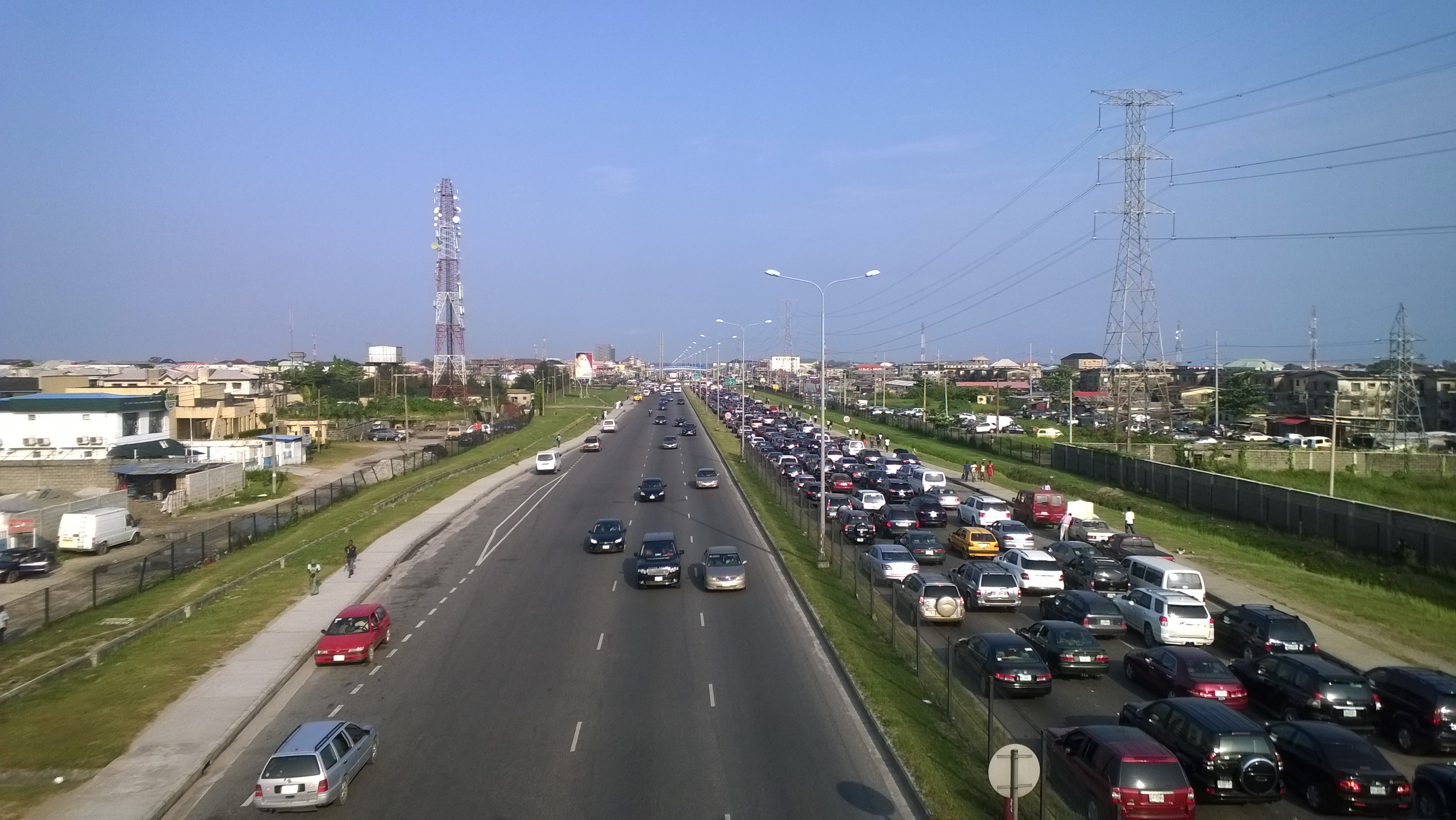
WP_20141116_006

Another view of the road at around 4pm in the afternoon. Motorists, most of them private cars, carrying less than two people in many cases, file behind each other for stretches of kilometres.

The Ibeju-Lekki local government that covers most of the area accessible to this expressway has a population of 117,481, out of which one can guess that more than a quarter of the adult residents have private means of transportation sometimes for themselves and for their spouses (and in some cases another one to pick up and drop off their children in school). This, ordinarily, shouldn’t be a problem in a free market, capitalist, democracy. The problem comes from what this has meant for city planning, the climate, sustainable development, ease of access for commuters, the road itself, and wellbeing in general.

Living in big cities has likely always had its drawbacks much of which relate to the level of noise and environmental pollution. In the case of Lagos however, much of it seem preventable and at the same time sadly inevitable. By having too many cars on the road most of which have the passenger seats empty, traffic jams increase, preventing most people from getting to work on time (except they have to wake up as early as 3.30am, like many of my colleagues do, thus reducing their quality of life, and costing companies millions of naira every year in wasted work hours otherwise spent in traffic, morning or evening), we pay a price in more ways than one. The traffic jams affect everyone including those in private transportation. A road that can currently take four to five cars at its widest, wear and tear increases as well as other maintenance expenses accruing to the state due to use, and may even break down into disrepair. More than that, more cars equal more carbon emission, damaging the atmosphere and endangering inhabitants, many of whom are already unhealthy from a sedentary lifestyle encouraged by private cars. 

There are many solutions to the problem, but the state government will need to step up. For one, the Lekki-Epe Expressway, by now, should have ceased being the only access road across the Lekki peninsula. A beach-side road from Victoria Island, said to have been under construction for a number of years, needs to be completed as soon as possible. So are the number of inside connections that can take a commuter from Lekki Phase 1 to Ajah without having to get on the expressway. These routes haven’t been developed because the government hasn’t invested enough in making the constructions needed to connect these barely motorable inside roads. And, away from cars, where are the safe bicycle routes that commuters can use, satisfying one’s exercise and transportation needs at the same time? New York has more people, and more cars, yet there are spaces for cyclists to ride. Where are the large commercial ferries subsidised, perhaps, by the government, to move large quantities of people from Epe to Victoria Island without fuss? Where are the trams and in-city trains? Also, what about policies that encourage carpooling where, for instance, cars with at least three people inside it will get a free or reduced pass through the toll gate, or at worst expedited passage?

From my experience as a commuter without a private means of transportation, I can attest to the goodness of a number of Lagos residents many of who will stop to give strangers a free (or even reduced cost) ride towards their destination early in the morning or in the evening. I have given many such free rides myself, particularly when it rains. However, this is not, and should not be enough. There have been other solutions, including the new ride-share services like JeKaLo and GoMyWay which are both Nigerian solutions to allow the private owner to carpool with vetted strangers for a small fee. I haven’t used either of them so I can’t speak to their safety or otherwise, but their continuing success through use points to the fact that they are meeting a need and solving some of the problem. Services like Uber, Lyft, etc are also playing a part in reducing the number of private cars on the road by allowing their owners use them for public transportation during their free hours.

We need many more ways of solving a problem that seems – with the number of newly imported cars entering the city every month – to be on the way to only get worse. As for me, I’d keep taking occasional opportunities to trek and explore the outdoors, saving car fuel in the process and stretching my legs. I’d say let’s look away from cars totally, but this is Lagos, the city of statuses and egos. That would take a very long time.

_________

All photos courtesy of the blogger
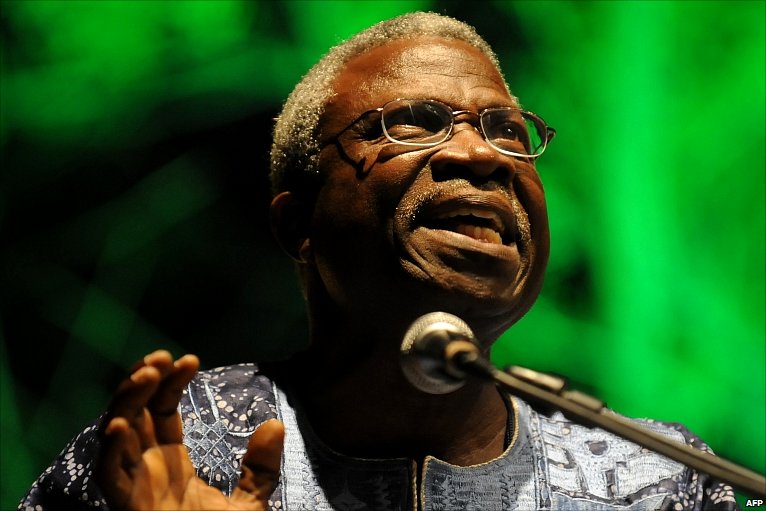
“Ours is Not Yet a Humane Society” | Conversation with Niyi Osundare

Professor Níyì sundáre is Professor of English at University of New Orleans, USA, and one of the best-known poets from Africa. His works of published poetry include Songs of the Marketplace (1983), Village Voices (1984), A Nib in the Pond(1986), The Eye of the Earth (1986), which won both the Association of Nigerian Authors Poetry Prize and The Commonwealth Poetry Prize in its year of publication. He was also a recipient of the prestigious Folon/Nichols Award for ‘excellence in literary creativity combined with significant contributions to Human Rights in Africa’. Other published volumes of poetry include Songs of the Season (1987), Moonsongs (1988), Waiting Laughters (1990), Selected Poems (1992), Midlife (1993), The Word is an Egg (2000) and Tender Moments(2006). Niyi Osundare has also published four plays and essays on literature, politics and culture. Orality and performance are important features of his works, which have been translated into the Italian, French, Dutch, Czech, Slovenian, and Korean languages.

________

Thank you for talking to me. And congrats on your 2014 National Merit Award.

I should be the one thanking you for providing the forum, for making it possible for this exchange to take place.

Let’s start with your poetry for which you’ve been widely acclaimed. The last recorded work from you was in 2006, titled “Tender Moments”. Is there a reason you haven’t released another published collection since then, almost a decade ago?

Tender Moments is, actually, not my last publication. The book has got two aburos: City Without People: the Katrina Poems, published here in the US, and Random Blues, the first volume of the collection of my weekly poetry column in the Sunday Tribune. Both were published in 2011. And right now, the publisher is looking at a new book of poems, some kind of travelogue-in-verse, which I completed last year after many years of preparation. I’m also working on a sequel to The Eye of the Earth, a 1986 book whose resonance and thrust I consider so achingly relevant in this age of the deniers of the scourge of climate change and global warming, even when the effects are so palpably, so tragically evident. Many of the poems from this manuscript have featured in three influential international journals on either side of the Atlantic:  Interdisciplinary Studies in Literature and the Environment (ISLE), University of Oklahoma’s  World Literature Today,  and Moving Worlds of the University of Leeds, UK . Mine were invited contributions, and I am both glad and inspired by these journals’ single-minded concern with some of the burning issues (all pun intended) of our time: nature, climate change, wild winds and tsunamis, etc.  So, you can see I’ve not been sleeping on duty!

I first met you on the campus of the University of Ibadan where you taught in the department of English, and then left for New Orleans. What was your most significant memory of teaching in Nigeria compared to teaching in the United States?

Now, you’re asking me to cast in the past tense  a narrative that is  still very much in the present tense. My pedagogical and academic relationship with the University of Ibadan (and other Nigerian universities) continues, though at a less formal, less regimented level than before.  You will remember that I said in my 2004 valedictory lecture that my relationship with the University of Ibadan is a laelae  (lifelong, everlasting ) affair. This is why I do not come on the summer vacation without having one kind of interactive session or another  with students in the Department of English – a mutually beneficial activity which I thank the present Head of Department for facilitating. I also actively participate in academic events in other departments. But I do know that both the tenure and the tenor of my service have changed, and things are not exactly where they were when I left in 1997.

Now, teaching at Ibadan versus teaching at the University of New Orleans. Many similarities and a few differences. To begin with, in both institutions, I have to deal with students, the centre of my professional concern. I have discovered that students are virtually the same everywhere: young, vulnerable, unsure, even fearful, but inquisitive, ambitious, demanding, generally idealistic. And on both sides students who are sharp as razor, engaging, and quick on the uptake, and those who are a little slow and need some gentle prodding. But what makes the real difference is the environment. It is common knowledge that the Nigerian student as well as her/his teacher are still engaged in a life-or-death struggle for the provision of amenities which their American counterparts have come to take for granted: steady power supply, potable water, relative freedom from hunger and suchlike harassment by social needs, a predictable academic programming and scheduling,  and above all, a relatively stable political system. A book comes out on Monday; by Thursday it is already within your grasp; access to internet facilities that are fast and inexpensive. These are facilities still far from the grasp of the Nigerian student.  But in a way there is some ‘sweet uses’ to the Nigerian’s student’s ‘adversity’ – to echo Shakespeare. Driven by need and necessity, the Nigerian student tends to be more aggressive, less complacent, and less dependent (Who are you going to depend on: parents who are barely striving to survive, or a government that has no interest in your welfare?). I have observed that drop-out rate is much, much lower among Nigerian undergraduates; for to drop out is to drop under and, in many cases, to drop dead; for the kind of socio-economic safety nets available to American students are nowhere there for their Nigerian counterparts.


At the faculty level, surely, the American academic has much more to work with: the laboratories are well equipped and functional, research funds are made available (depending on the buoyancy of the university’s budget; for, yes, even in America, colleges and universities do go broke!). As a result of a situation of general relative contentment, labour union activity is almost non-existent in American Academe. Many times I miss the rousing militancy of ASUU!

You were notably affected by Hurricane Katrina in New Orleans in 2005, and you’ve given a number of interviews about that sad event. Do you hope to write a memoir about it at some point? Many of us would like to read what it was like to get through those harrowing times.


Thank you for your concern.  The book mentioned earlier on in this interview, City Without People: The Katrina Poems, has tried to explore and articulate some of the harrowing experiences. The poems themselves are sandwiched between two prose pieces: a prose preface and an interview both of which put the Katrina narrative in proper perspective. But there was a prose parallel I was writing while composing the poems. Somehow, I managed to complete the book of poems, but the prose narrative stopped a few pages after 40. The memory of our losses weighed me down. The prose narrative literally collapsed under the debris. Why and how I found poetry a readier bearer of the tragic experiences, I still do not know. I think this would be an interesting study for psychanalysts.  Even the poems, I couldn’t complete until six years after the hurricane… I may go back to that prose narrative someday – maybe when I’ve retired from this penny-a-day teaching job and I have more free time to myself. And when the trauma engendered by memory of the event would have thinned out sufficiently to allow for relatively painless recollection. But then, who knows: some memories never let go of our faculty of remembrance.

Being influenced by your Yorùbá background, you must have strong opinions about poetry as performance (spoken-word) as opposed to poetry as text. How best do you think poetry should be enjoyed or employed?

Both ways, both modes. And more. In the house of poetry and its practice, there are many rooms. Some poems are written for the eye, some for the ear, and others for both. I see my Yorùbá background as abundant blessing to my poetry. I have always wondered what kind of poet I would have been without this fabulously rich culture and its language. Or, indeed, whether I would have been a poet at all. Come to look at it: everything in Yorùbá is poetry-in-motion, poetry-in-action. Yoruba language is music: from its intricate tone-system to its inimitable ideophones. Sounding is meaning, and meaning is sounding. A language whose syllables sound like drumbeats. A generously metaphoric language which can render the most abstract concept in the most arrestingly imagistic way. Compare ‘I am hungry’ with ‘Ebi npa mi’ (Hunger is beating/killing me); ‘I am shy’ with ‘Oju nti mi’ (Eye is pushing me) . This phonological and imagistic paradigms are central to my poetics. For me, the line is not complete until I make it sing and make it sing meaningfully.  My Muse is never far from her/his music. Those who cavil at the abundance of repetition in my poetry need to know the music behind my Muse. Fortunately, this is not an exclusively Yoruba attribute. The music of Welsh language drives the prosody of Gerard Manley Hopkins and, to a lesser extent, Dylan Thomas; Irish inflections in the drama of John Millington Synge. How can one come to a full experience of Igbo masquerade chants in the poetry of Obiora Udechukwu and Ezenwa Ohaeto; of udje songs in Tanure Ojaide,  without remembering the haunting  musicality of Soyinka’s Death and the King’s Horseman and Osofisan’s The Chatterinng and the Song, the threnodic minstrelsy of JP Clark in Casualties and Song of a Goat? It is this blend of sounding and meaning, music and movement that lies at the heart of the performative strategies and enactive potentialities of the poetry of Akeem Lasisi and Segun Akinlolu (Beautiful Nubia)… At the personal level, I hear my words before I set them down on paper. I allow them to indulge me in the sheer musicality of their essence, their dramatic possibilities. Most times, I see with my ears.  For every word I care about, all the world’s a stage.

It’s been said that your decision to resettle in the United States was based on the educational opportunities afforded your daughter who is hearing-impaired. What has been your experience from the time of your resettlement about what’s lacking in Nigeria and what can be done about it?

Thank you for not forgetting this personal dimension. Yes, indeed, my family and I left Nigeria hurriedly in 1997, (leaving behind  our son who was then an undergraduate at the University of Ibadan).  My wife had to leave her job while I took an unexpected leave of absence from mine. The English Department of the University of New Orleans facilitated our relocation by providing me a job. Upon our arrival in the US our daughter was enrolled in the Louisiana School for the Deaf in Baton Rouge, about one- hour drive from New Orleans where we live. That school provided the necessary educational needs and a conducive environment, and our daughter took full advantage of these and began to thrive. Her talent in Fine Arts was spotted straightaway and fully encouraged. Two years later she was recommended for admission to Gallaudet University, America’s famous university for the deaf, in Washington, DC. where she graduated with a degree in Fine Arts. She is out of school now, still figuring out what to do to earn a living. It’s been a challenging period for all the family, but we are happy this girl has not ended as a roadside beggar in Nigeria. Our experience has shown us all the more how little Nigeria is doing for her citizens, especially those impaired and those with special needs. Ours is not yet a humane society. There is plenty of work to do to get us to achieve that ideal. But we must not relent. Every child deserves the best.

What role do you think that poetry should play in the political and cultural environment in Nigeria and around the continent?

Seven cheers to you for asking this question which many would have considered  intolerably old-school,  even passé, in our triumphally ‘post-colonial’,  post-functionalist, post-humanist condition… Poetry is the soul of a people, their heartbeat, the rhythm of/in their movement, the rhyme in their reason. It is that magic which distills cosmos out of their chaos, the song which salves their sorrow and exults their gladness. It is that oríkì which causes the head to swell; that èébú which makes the victim feel like jumping into a bottomless river. Poetry has never been far from politics, for the real poet is one who holds up the mirror to  the naked emperor; one who calls evil by its original name;  one who perceives hope where others only see despair. Have I idealized the poet and the role of poetry? Yes, and deliberately so. The poet is no insulated saint nor is s/he an angel. I am inclined to judging life by its possibilities, not its failures; to accept life’s cup as half-full while I join others in finding a way to fill the remaining half.. It is legendary now, the staunch, life-affirming role that poetry has played in African politics, from the anti-colonial, pro-Independence versifying of the Osadebays to the towncrier griotism of the post-Independence era, and the ‘decentred’, ‘indeterminate’ collage of the ‘post-colonial’ present.  Has poetry ever caused the toppling of bad governments in Africa? I wouldn’t know for sure; but I do know that excoriative words and guillotine verses have chipped away at the ramparts of despots, military or civilian, opening up fissures and cracks for the entry of revolutionary barbs. As for culture, African poetry keeps reminding the African tree of the neglected importance of its roots, the African society of the pollution of its values.

Literary output in the local languages of Nigeria has been abysmal in the last couple of decades. Why is this so? What can be done to revitalise the industry? Is it even worth it?

Our indigenous languages are in that state because they have been neglected by our government and ignored by our school system – just like other aspects of our culture.   The enthusiasm brought to bear on their cultivation and promotion in the  1970’s and 1980’s has fizzled out just as aggressive, and philistine foreign religions have desecrated and taken over the temples and shrines of indigenous deities. Ọmọlará Wood put the matter so succinctly well in her book chat at the  First (2013) Ake Book and Arts Festival when she said ‘I think a lot of our ways are demonized, especially in the Nigeria of today where it is perceived to be uncouth to speak your language’. She then sums it all up in this painfully crisp, undeniable statement:  ‘Others rubbish our culture because we don’t value it’ (Both quotes from Sunday Tribune, January 13, 2014).  We Africans are a people in danger of a looming culturecide. In the southwest, people like Adébáyọ̀ Fálétí and Akínwùmí Iṣọ̀lá have built on the solid foundation of the likes of Fágúnwà and Ọdúnjọ, and produced literary works that are deep and enduring. I shudder to think of what will become of creative writing in Yorùbá when these intrepid cultural and linguistic nationalists are gone. Well, maybe it will be Nollywood to the rescue, though the kind of trivialization and literalization the indigenous languages are going through in the video world are a cause for worry. Needed urgently an educational policy that will make the teaching and study of Nigerian languages compulsory in all Nigerian schools, and a mindset that does not privilege the foreign over the indigenous. Without an iota of doubt, we can only get to that juncture when/if we get our politics right.

How do you see the future of literature in Nigeria? What gives you hope? What gives you despair?

On the positive side: Thronged.  Complex.  Diverse.  Largely relevant

On the not-so-positive, my concern about the increasing diasporization of Nigerian/African literature in conjunction with the phoney globalization which deceives  people into the acceptance of  a world  on whose map their own home is missing. Consider this:  Our ‘best sellers’ are determined abroad, in places where the values which propel our imagination are either unknown or disdainfully discounted. Virtually every young Nigerian now dreams of getting published abroad (read USA and Europe). The cultural, socio-economic, and aesthetic repercussions of this exogeneist mentality are grave and far-reaching. Our writers’ charity no longer begins at home. This is culturally and psychologically suicidal.  But who can blame these young folks, considering Nigeria’s illiterate, philistine political leadership, our inefficient and dishonest publishing culture and abysmal reading habit, and the consequent slump in the sale of books. We must create an enabling environment that does not alienate Nigerian writers and their vast and diverse talents.  For this to happen, again, I say: we need to get our politics right.

____

This interview first appeared in Aké Review 2015

Blogging in Klieg Lights

A while ago, while pondering the changing landscapes of contemporary media, I suggested that many things have irrevocably changed enough to warrant a different attitude, especially by prize-giving bodies, towards alternative media and publishing outlets. I must have said it in many other different ways afterwards. It was true then as it is now, that the democratisation of the media which has given rise to many new voices and expressions that would otherwise remain silent has not received much of its due respect from the traditional gatekeepers.

A number of times on this blog and elsewhere, I’ve made a case for blogging as “the future, or at least the way to it.” I believe this to be true, although the Booker, The Nobel, among other literary prizes have however not yet taken any relevant cues from this reality enough to change the traditional nature of their annual winner selection. Rational people expect the changes to be slow. However, great, brilliant and beautiful work is still being done everyday on web platforms by writers who either can’t find publishers, or don’t think that the traditional route of print publishing is effective in reaching their audiences. The earlier we begin to recognise them in spite of their refusal or inability to comply with traditional methods, the better. The world is now a different place.

cnn_aja_logo_2015_rgbI want to say though – some of you probably know where I’m going with this – that I’ve received recently some encouraging validation for that aspiration. This blog has been nominated for the CNN/Multichoice African Journalist of the Year 2015 for a travel report I did for this blog a while ago.  (I’ll tell you which one it is, shortly). And for that, I’ve been invited for an all-expense paid to Nairobi, Kenya – this October – to writing workshops, networking, and the gala night to hear the name of the winners. (I also found it incredibly gratifying to be returning to Kenya exactly ten years since my first visit in March 2005. Yay for travel, nyama choma, and meeting old friends. Habari yenu, Kenya!).

More enchanting for me, however, is a possibility for the future. We’ve seen it with Uber successfully subverting the idea of organised traditional taxi service, and of AirB&B helping people turn their home and apartments into “hotels” without having to get a licence or own properties like the Hilton or Trump. It has happened with radio vs podcasts, and with music companies vs Pandora, Spotify, etc, and with e-Books helping writers reach their audiences faster and more affordably. Everywhere we turn, new ways are challenging the old and forcing us to negotiate the world in a lot of different, less cumbersome ways. I see blogging in the same way: a platform that is accessible to all, can be set up at no cost, and yet can be incredibly powerful in transmitting and interpreting the human experience across boundaries like never before. This has certainly been my experience here and it’s hard not to be excited for the attention of traditional media giants, CNN and Multichoice, to this new reality.

As for you, dear readers, whose constant presence in my analytics make sure that I keep coming back here, it’s all your fault! So, thank you! Now, let’s go have some East African fun.

_____

References

Blog, Writing, and Real Life (October, 2009)

A Case for Blogging (June, 2010)

Book, Blook, Bloog, Blog… (October, 2011)

A Little More than Fun (December 2012)

Blogging and Other Botherations In Saraba Issue 7b. Page 10 (December, 2012)

An e-Book is a Book (September 2013)

Interview with Eghosa Imasuen

PUBLISHING IS PERILOUS, BUT ALSO SOMETIMES REWARDING. SINCE MOVING FROM FULL-TIME WRITING TO FULL-TIME PUBLISHING, WHAT HAS BEEN YOUR EXPERIENCE, POSITIVE AND NEGATIVE?

eghosaYes. It is perilous. I only had a view of this, barely, because I was a backseat driver, one of those authors who always chided the publisher for not enough publicity, do more, do more. But now that I have taken the wheel, at the firm that published my first two novels, no less, I see things a bit more clearly. It is a difficult business. Both for the pocket and soul. The pirates dictate how you price your books. You are in competition with yourself. Cost of finance in high in Nigeria. There are issues with power and noisy generators that affect productivity in the editorial department. Then there is what reading reams and reams of bad submissions does to someone. It is killing; bad writing kills me.

– Read the rest of the interview on Brittle Paper

On His First (Bilingual) Words

One advantage of having a young child to raise, as a linguist, is the chance to use them as human study materials for language acquisition. It’s so cool I don’t know why I never thought of it before.

IMG_9437In any case, already a little sensitive to the intrusion of English into that early education space that I (and a majority of researchers) believe should be meant for the mother tongue, I’m pleasantly surprised that all of my son’s first words are – so far – in Yorùbá. At eighteen months and a few weeks, we’re now able to recognise “gbà” (take), and “bàbá” (father) out of hundreds of other yet incomprehensible syllables. He, of course, also says “bye-bye”, an English expression, with his wrist flailing up and down in a goodbye wave. The linguistic explanation for his easy acquisition of bilabial plosives first isn’t far-fetched.

However, from the time he was able to listen to instructions, I’d made a habit of regularly prodding him to pronounce those common Yorùbá words. Bàbá (father), Màmá (mother), “gbà (here, have), “wá” (come here), wo (look!), maabọ̀, etc. So far, he hasn’t mastered them all, but he knows what they mean and how they are used. And now, he can already pronounce a few of them. He can also understand equally accessible English words like “no” and “come” and “mummy”, which is helpful, since his mother speaks predominantly in English.

What I’ve come to discover in the end is that this bilingual upbringing will likely follow a similar path as monolingual one as far as the acquisition of complex terms are concerned. No matter what language the child learns first, won’t he still learn the easy, monosyllables first, and then others? And if that’s the case, why not just open him up to as many languages are possible? In any case, pure monolingualism is, these days, likely an impossible eventuality. Not in Nigeria anyway.

Maybe I have a theory here somewhere. In any case, there is hope.

_____

PS: I’m currently editing Ake Review 2015  the literary publication of the Ake Festival 2015. If I’m not on this blog as regularly as I’ve always been, this is why. If you are in this area, you should come to Abeokuta in November for a gathering of writers from across the world.

I’m also working on my TED talk meant for delivery at TEDxIfe event in November. It’s a talk I’m tailoring towards this issue of bilingualism, particularly the destructive nature of our current educational policies. I’m currently in-between getting together a sunny speech to convey what is actually the gloom I feel. Not an easy balance.

Also, school has resumed, so plenty busy days lie ahead.