
No, not okay.
Grumbles!
Okay, it’s not as if Maya Angelou needs any more publicity. At eighty-one, she probably has achieved what many in her generation only dreamt about. Therefore, this will be last post I will make about the writer, until I finally meet her on Sunday. As I tap this out here, I do not yet know what I want to tell her if the chance ever comes. She’s old, I’m young. She’s American, I’m African. She’s a writer, I’m not, and it is most likely that my best of charms will fail if our promised meeting fails to occur in a place devoid of the tension of a gathered University crowd all beaming to see and have a piece of their icon. I can only imagine Wole Soyinka at a Nigerian campus and a Ghanaian scholar trying to get access to him. Well, maybe that’s not a most appropriate analogy, but it is somewhat similar, and in the two cases, it might equally be a difficult task to achieve.
Now here’s something else I found strange: the last time I checked on the website of the campus magazine for the news about Maya’s coming to campus, I was surprised at how much venom some students spewed as comments on Maya’s personality, talent and politics, and some expressed the wish that she should be stopped from coming to campus because of what they called her racism, anti-Semitism, and a few other isms. This was definitely strange to my ears as I have never read traces of any such opinions in any of her works that I’ve read. Her autobiographies are mostly stories of triumph over personal difficulties of race and gender. But what do I know? Here are students venting their rage and sometimes ignorance in response to a news story. Today, when I checked the news story, I found that comments have been disabled, I guess so as to prevent a bigger rancour that was surely becoming a sort of distraction to the news of the visiting novelist.
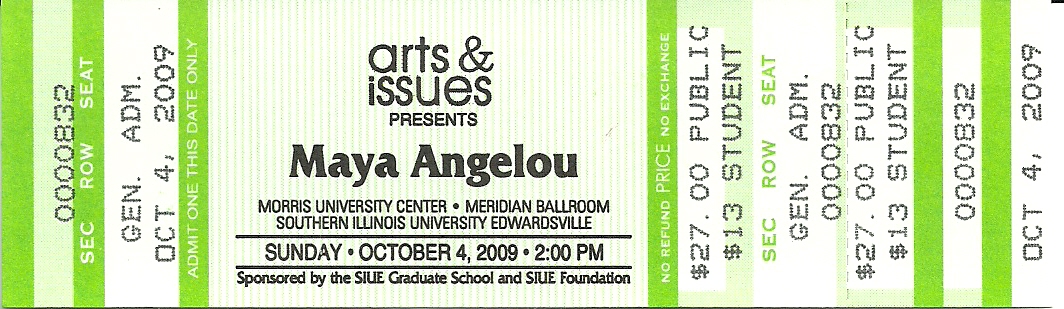 I have now returned from Dunham Hall, where I had gone to obtain my tickets to the programme, and where I discovered to my amazement that all the tickets have sold out. Completely. The organisers have just made arrangements for a hundred more seats, and I was lucky to get two of those. My hosts at the Office of International Programmes who had promised to get me tickets into the show are now nowhere to be found. If they ever come forward with any more tickets, then maybe I can afford to take someone else along to the show. But a most unfavourable part of this visit of the American Poet Laureate is the news that she might not be staying long after her talk to sign books or take pictures after all. Now this, if true, is just horrible, but I understand. She’s probably too old for all that stress of sitting though signings and photographs. But being young and tenacious, I’m probably too heady as well to let her go without a fight. Come, come Sunday!
 ALONE
ALONE
Nobody, but nobody
Can make it out here alone.
There are some millionaires
With money they can’t use
Their wives run round like banshees
Their children sing the blues
They’ve got expensive doctors
To cure their hearts of stone.
But nobody
No, nobody
Can make it out here alone.
Alone, all alone
Nobody, but nobody
Can make it out here alone.
Now if you listen closely
I’ll tell you what I know
Storm clouds are gathering
The wind is gonna blow
The race of man is suffering
And I can hear the moan,
‘Cause nobody,
But nobody
Can make it out here alone.
Alone, all alone
Nobody, but nobody
Can make it out here alone.
Maya Angelou
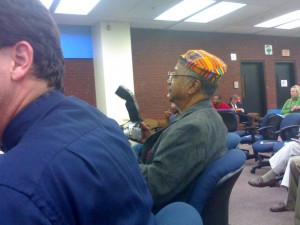 I stumbled onto a photo exhibition on campus on Wednesday, after a very stressful day of two classes. If not for a chance meeting with retired Professor Eugene B. Redmond as I headed home from Pizza hut, I definitely would have missed out. I had first met EBR last in Ibadan in 2003 or so when he visited the University campus there on an exchange programme, and to present new editions of DrumVoices Revue – a quarterly publication of poems from all over the world. I was with him and another professor from Ibadan when he visited the palace of the Ooni in Ife – which was the first time for me at the time. I have not been successful in getting him to grant me access to my digital copies of those photographs. Maybe they will end up in an exhibition someday. It will definitely be a pleasure to see them for the first time in over five years.
Eugene Redmond’s reputation doesn’t always reflect on his regularly meek appearance, but he has travelled far, met notable people, and contributed so much to the development of the arts and the African-American culture. On Wednesday, he was in a kente jacket and a matching cap, covered with an dark coat. He is most likely to be seen with at least two cameras on him at all times. Till date, he is reputed to have taken at least 150,000 photographs of people from all over the world. He was named the Poet Laureate of East St. Louis in 1976, and he boasts of a long time of frienship with very many leaders of the Black Movement, past and present, in literature, music and the arts, from Henry Dumas to Toni Morrison, Wole Soyinka, Katherine Dunham, Oprah Winfrey, Amiri Baraka and Maya Angelou, all of whom he has captured with his camera lens at one time or the other.
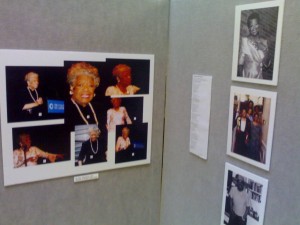 The exhibition was titled “Eighty Moods of Maya”, and it features eighty of the pictures taken of the poet and novelist Maya Angelou over several decades, and in many moods, some serious, some trivial, some private and relaxed, and some public and tense. Eugene Redmond has worked as a poet, journalist and photographer as well as a critic, academic and publisher. He first attended SIUE as a student. He was a student journalist with a camera at the 1963 March on Washington as an editor of The Alestle, a student publication here on campus. He has also taught many times at SIUE before he retired a few years ago. On retirement, he donated a collection of his photographs to the SIUE Library, and thus became a patron of the institution.
The exhibition which took place in the library also featured little speeches, food, and conversations among all present. We all knew we were waiting for Maya Angelou who is coming to campus later this week. The exhibition was just a teaser. There will be a long crowd on campus on October 4th to listen to the 81 year old poet and novelist who made history when she read “On The Pulse of A Morning” during President Bill Clinton’s Inauguration in 1993. In my case, I look forward to presenting to her something (I won’t tell you what) that I brought from Nigeria, getting a book signed, and getting a nice picture in my camera. Wish me luck.
On Wednesday, we spent much of the hour discussing the third chapter of a book of fiction titled “A Mouth Sweeter Than Salt” by 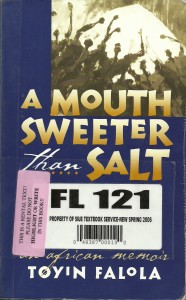 Toyin Falola which is our second class text. In many ways, the book is much like Wole Soyinka’s “Ake”, in style, content, and value, especially in the clever turns of phrase, eloquence, and reference to recognizable landmarks in the history of South-Western Nigeria before independence. The chapter is set when the author was nine years old, and the whole work is written in a way that makes it seem that we are listening to a child talk, even though we know that it is an adult relaying his many interesting experiences from childhood.
The third chapter dealt with the author’s first train trip in the 1950s from Ibadan to Ilorin, and his adventures on the streets as a beggar’s boy. He had started school, yet he could not resist a chance to ride on a train which was then a novelty in town. In the end, even though he didn’t have the train fare, he found himself in the belly of the electric “snake”, as he called it, delighting at the wonder of the European invention. As soon as he was discovered to have been riding without a ticket, he was dropped off somewhere along the way, and he found that he was in Ilorin, all the way from Ibadan, and he was loving it. Soon he became a “beggar’s stick boy”, holding the stick for one of the many fake blind men on the streets of the town who begged for alms in lieu of decent work. That job, which provided him with stipends on which to survive, and plenty adventures on the street, ended on the day he mistakenly spoke in English to a postman, wondering if he could send a letter home. Even though he was dirty and looked totally ragged, his grasp of the language shocked both his fake “blind” boss who immediately dropped his end of the stick, and fled as far as he could so as not to be arrested, and the postman who immediately grabbed the boy, and promptly drove him back home to Ibadan to the arms of his bewildered parents and neighbours. It surely reminds of some parts of Soyinka’s “Ake.”
I am convinced that the reason why this book is a recommended text is because of its many descriptions of Nigerian, nay Yoruba cultural life, especially before and during colonial times. The author was born in the 50s, and he grew up in a less educated environment than, say, Wole Soyinka(who was born in the 30s, yet had a whole library of books to read before he even went into school for the first time.) But in the end, there were so many questions raised than could be answered in that one class even though we tried very hard: Why did the boy find the train strange? Why did the postman take him home instead of to the police? Why was a boy not immediately embraced when he got home, instead of being suspiciously viewed by family and neighbours as some form of emere who was born only to torment his folks? Did children beg for alms a lot on the streets of Nigeria? How much of human sacrifice did the Yoruba believe in? Do they still sacrifice people to make money? What is the punishment for such a crime? What is the Justice system like? Do they hang condemned criminals in public or not? Do children have toys to play with? Do you have Amusement Parks in Nigeria? Do you have Six Flags in Nigeria? How come some people do not know/remember their dates of birth? Do you know yours, Traveller? etc.
Every day, I discover new reasons for the perceptions and misconceptions (many of which are justified) about Africa and it cultural practices. Every day, I learn new things about the influence of literature, and the power of words. And every day, I find new reasons why this programme is one of the best, and most useful projects of the American government, in helping us to understand better the world in which we live.