Peter Akinlabi was the winner of the Sentinel Literary Quarterly Poetry Competition in October 2009 with his poem, Moving. He holds a B.A degree in English from University of Ibadan and an M.A in Literary Studies from University of Ilorin. Peter currently lives and works in Ilorin. I had this conversation with him via email.
________
Tell me about your involvement with poetry. How long have you been writing and how did it all start?
I record no precocity here, as it were. My involvement in poetry began as a love for creative use of language. I started writing after high school, however. The space of time in-between high school and higher education, when you generally cast about for something to do while waiting for WAEC and JAMB results. I read a lot of stuffs then, Fagunwa mostly, books in Heinemann African Writer Series. Obi Egbuna’s The Rape of Lysistrata was a long-lasting influence in this phase- have you ever heard of the author or the book? So was my threadbare copy of K.E Senanu and Theo Vincent. Ulli Beier’s edited collection of African poetry was like an appendage to my body.
I wrote short love poems for a girlfriend, lifting words and expressions from impossible sources as diverse as Helen Ovbiaghena, Shakespeare, Kwesi Brew, Lenrie Peters, Dennis Brutus and other poets in recommended high school anthologies. Later I encountered Alagba Opadotun’s Arofo, Soyinka’s Idanre and Okigbo’s Labyrinths. Things changed from there. I started thinking of poetry beyond juvenile, amorous verse. Then I went to study Literature in English in the university.
Have you always had a preference for poetry or that just happened to be your first love?
Poetry is my first love. I love fiction. But I knew if I decided to do fiction I probably would write only one novel in my lifetime. This is because I would love to write the kind of stories I like to read – stories that can elevate consciousness, that can torpedo the base of creative expectation; stories that can eternalize reality. I love profundity in fiction… Fiction that blurs boundaries of consciousness. I would write the first draft at say 25 and would perfect it for another 30 years. But I could write a poem in 5 minutes and perfect for a month, a year, but I surely would have written more poems in between. I wonder how long it took Yvone Adhiambo Owuor to complete ‘The Weight of Whisper’.
How much did Yoruba language influence your writing?
A great deal. Thing is I started speaking English when I was about fifteen years old and in third year of secondary school- you know how township public school could be like. But by then I had read through all Odunjo’s Alawiye texts, Oju Osupa series and all Fagunwa’s novels.
Then I grew up in a context of Yoruba artistic practices. I grew up amidst daily rehearsals of Ijala Poetry by my uncle Ogundare Foyanmu and his group. The way they bantered words gamely in their discourse of abuse was especially a delight. Then the annual Egungun festivals and the attendant cultural spectacle- especially the Iwi. I picked a formidable bit of Ifa poetry from another uncle who was a diviner chieftain. I was also introduced to the beautiful poetry of Lanrewaju Adepoju, Odolaye Aremu and Olatubosun Oladapo at this time.
Yet what Yoruba language gave me, and still gives me, is a gift of imaginativeness, of transgressive conception of worldview through language. The material of my poetry is not essentially Yoruba, but the ontology is.
Who are your Literary Influences and just how much have you taken from them?
Early influences in poetry are Soyinka and Okigbo and they still remain constant creative founts for me – I mean how can you possibly get over Idanre or ‘Distances’? But I would soon discover a dizzying poetic experience in the university: Russian poetry- especially Mayakovsky; American- Walt Waltman, Brodsky, Allen Ginsberg; English- ah, Auden, Plath; Irish-Yeats, Seamus; African American- Sonia Sanchez, Langston Hughes Caribbean- Walcott, Braitwaite and the spaniard Garcia Lorca. Then a very important poetic influence is this book of creative non fiction by Harbison called The Eccentric Spaces.- that book makes you see the godhead in a most prosaic object. Then time froze, when I discovered Jay Wright- I unearthed a poetic joy on the strength of only one collection- Boleros- a book of exceptional beauty and elegance. Recently, I go back often to Mani Rao, the Hong Kong poet of Indian descent, I call her poetry deep and rumbling stillness of waters. Niran Okewole and Benson Eluma rupture the box; I read them as some read the stars – to see.
How many poems have you written so far, and where have they been published or pending publication?
I am lazy. I am slow. I am careful. I only push a poem out when I have convinced myself and some of my friends that it is fit for the public. I once wrote a ‘yab’ poem titled ‘To a Poet Manqué’, you see, deriding some poetaster who thought he was Okigbo of some sort. I have poems scattered in all sorts of places. But I am slow and careful in working my poetry, my process is kind of sculptural. And I believe some of my poems will appear in major literary e-zines in coming months.
What influenced your Sentinel Poetry winning poem ‘Moving’?
That poem mediates the experience of loss, memory and creative replication of place that attend all migration, especially when relocation is threatening and sudden as the expulsion of Nigerians from Ghana in the late 60s was. My family was a victim of such forcible uprooting, though they called no where else home but Kumasi, Ghana, since 1940s. There is a bit of fetish pain in trying to reconstruct places only others remember. ‘Moving’ reconstructs the Kumasi experience.
How did you feel when you found out you won the competition?
No grandiose feeling, really. That was not my first literary prize. There was the Okigbo Poetry Prize of the University of Ibadan, a later edition of which I believe you too won. It was initiatory, you know, you felt confirmed. But then Sentinel comes with a cash prize- that delighted. The elation really was later when I found out I was the first Nigeria to win it. The absolute pleasure is the opportunity to step on such large stage as the Sentinel team provides. We thank them.
Describe the nurturing of your creative development at the University of Ibadan. What stood out in your memory?
The library. The books. That was the first time I was seeing so many books and I must have thought some fire could consume the library if I didn’t finish reading the book early enough. The library offered me the first, initiatory companionship on encountering UI. I, however, was jolted out of the ritual when I almost got expelled for dismembering a book. Then, the faculty. There were some of the academic staff whose sheer presence can revolutionize creative or artistic genes in you. But what actually blessed my days were contacts with some colleagues, fellow students, whose creativity and conviction, in different ways, gave me a sense of direction and commitment.
How would you rate the quality of literary offering in Nigeria today and the climate of literary production?
Terrific. Absolutely.
What brings you inspiration?
Every thing that lifts reality out of the mundane. To misquote Tom Robbins, Everything that amplifies the whisper of the infinite until it’s audible.
What is the state of the literary scene in Ilorin where you now reside?
Non-existent. I live in Ibadan as far as literary creation goes. And Ibadan is really a mouse click away, you know.
Do you see any hope for the renaissance of literary development in Ilorin anytime soon?
Well, Ilorin has never been known as a literary city. There are three important literary figures I know of in Ilorin currently, however- Olu Obafemi, the playwright, Charles Bodunde the poet and Abdurasheed Na’allah. Incidentally all of them are also very busy academics. I am not aware of younger or aspiring writers in the town who can push the word rolling. And I have not heard of any writerly group either.
What are your creative writing plans for the future?
I hope to publish a collection of poems as soon as I could arrange my time and pen for the purpose. While I work on that, I surely would continue to engage the various literary avenues the internet can offer creatively.
Thank you for taking time to talk to me.
Thank you for the opportunity.
 But it was while returning, alone, at night that I had another one of my travula moments. I got to a traffic light that showed red, and I brought out my camera to immediately capture the contrast of the colours against the darkness of the night, only to hear some voices from inside a car on the road, also waiting for the lights to change, screaming in my direction.









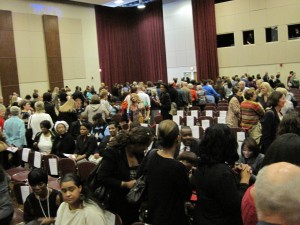
 There was a fore-warning that there would be no question and answer segment, but listening. Only listening and laughing, for the poet is one who commands her audience in charm, and holds them spellbound as soon as she steps onto the stage like an acrobatic masquerade. She was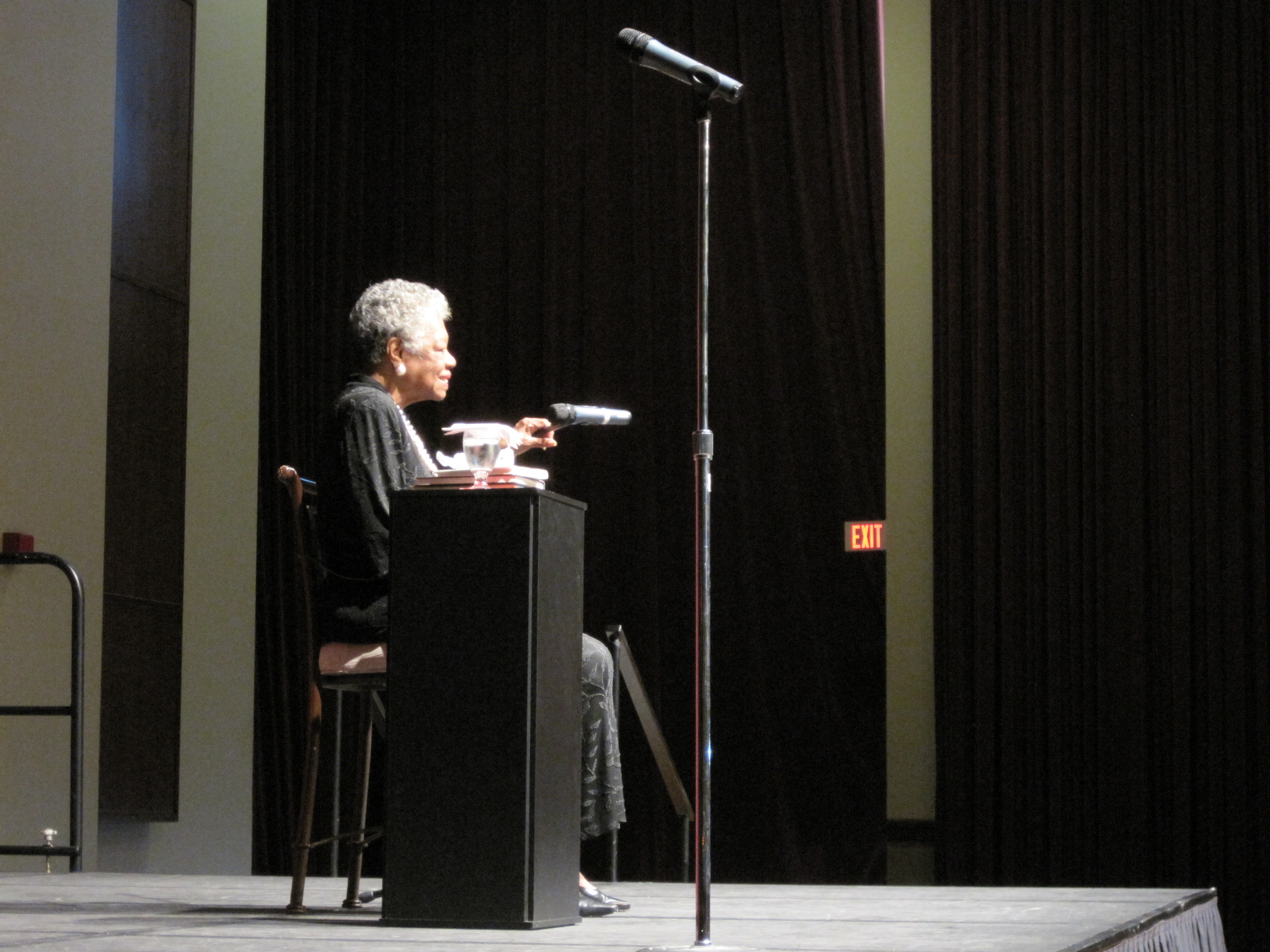
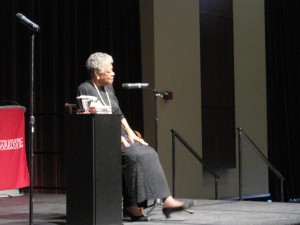
 And then she told stories from her past, in a husky voice that bellowed around the room. She told of discrimination, and hope, and joy, and rebellion, and progress, and love. “We are all rainbows,” the author said, “placed in the clouds to make some other person happy. And we’ve all been paid for,” she continued, “with either blood and human excrement from the slave ships from Africa, or the blood and brine of fleeing Jews from the camps of Eastern Europe, or the sweat from the brows of the Asians who came to this country in the 1800s to lay the railroad tracks, and buy properties so that their descendants can lay claim to the new nation.” Each one of us has an ancestry of brave people who have suffered so that we may enjoy. And so when we go out in the morning, just a little word of hope, of compliment, can always, always make a difference in some other person’s life.
 And then she sang, beautifully. Pleasantly. At her age, one would expect brokenness. But no, she definitely didn’t sound coarse or broken, but rather mellifluous. She let it be known that she had written a couple of songs for some of Roberta Flack’s albums, and she sang one of them today as well, to rounds of laughter and applause.
 In the begining, there was just me, going to a University in Ibadan, Nigeria. I had gone through all my primary and secondary education in this same city, so it was just as well that I never knew – nor would have given any thought to – the reality, fact or fiction of the phenomenon of “six degrees of separation.” There was no way in the world that a little boy from that ancient town could relate to the likes of Martin Luther King Jnr, Roberta Flack, Bill Clinton, Oprah Winfrey, Coretta Scott King or Toni Morrison, even if by chance I knew a few of their names back then. The first American I could say I warmed up to was James Hardley Chase, and I didn’t know if we’d have gone along well if the chance ever presented itself for us to meet. Then there was Denise Robbins, whose many novels I read before I completed secondary school. The likes of Mark Twain, and Alex Haley came much much later, as did Toni Morrison, Eugene Redmond and Maya Angelou. I remember seeing Maya the first time while browsing through the now rested Microsoft Encarta Africana CD of 2002, and watching her read her poem, “Still I rise.” I was enchanted immediately, and while reading more about her, I realized that it was impossible not to be, considering how much of stories her life embodies. She was born in St. Louis, grew up in Southern California and Arkansas, then moved over to Ghana with her African Revolutionary husband whom she had met in the United States during the anti-colonial movement of the fifties. She returned to the States after her first son to the African, became a dancer, writer, teacher, public speaker, novelist, poet, film director and movie producer and later Inaugural Poet, the first African-American so honoured to recite for the in-coming president. She read her poem
 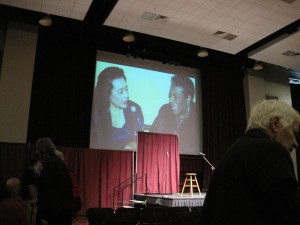 Now here I am in Illinois, less than ten years after that memorable introduction, now meeting the icon face to face in a campus auditorium. Looking at a slide show of pictures taken from the Eugene Redmond collection of photos of Maya Angelou on the big screen, I see a shot of her once with Coretta Scott King, the widow of the slain Civil Rights Activist, then another with Toni Morrison, then Oprah Winfrey, Eugene Redmond, Amiri Baraka and very many other famous names in African-American culture, and I remembered the rule of separation. If only because of this enchanting day, this time and this moment of fate, I can say that I may have finally connected my last branch of life’s six degrees, joining imaginary hands with all of the rest of the world, with everyone just six persons – or less – distant from me, no matter where they are. Oh how I like the sound of that!