Befriending Lagos: A Benin Story

By Stephanie Ohumu

It is October, in the year of Donald Trump, 2016. I have recently moved to Lagos.  On the first day of work, I start to live. I walk in, breasts uncased and participate in surprising normalcy. Wild and free breasts do not bother the people here.  This is how I know that I will be fine in this Lagos. Just fine.

img_20161026_162122My name is Stephanie and I am 20. Inside of my heart is mourning for Benin, where I have lived all my life. This isn’t a story you have not read before. If you can believe census figures,  Lagos is home to 18 million. Many of whom were  not born here.

Everybody comes to Lagos with stifled love for their birthplace and hungry yearning for the city that will make them. Yawn. This is about, well, fuck if I know.

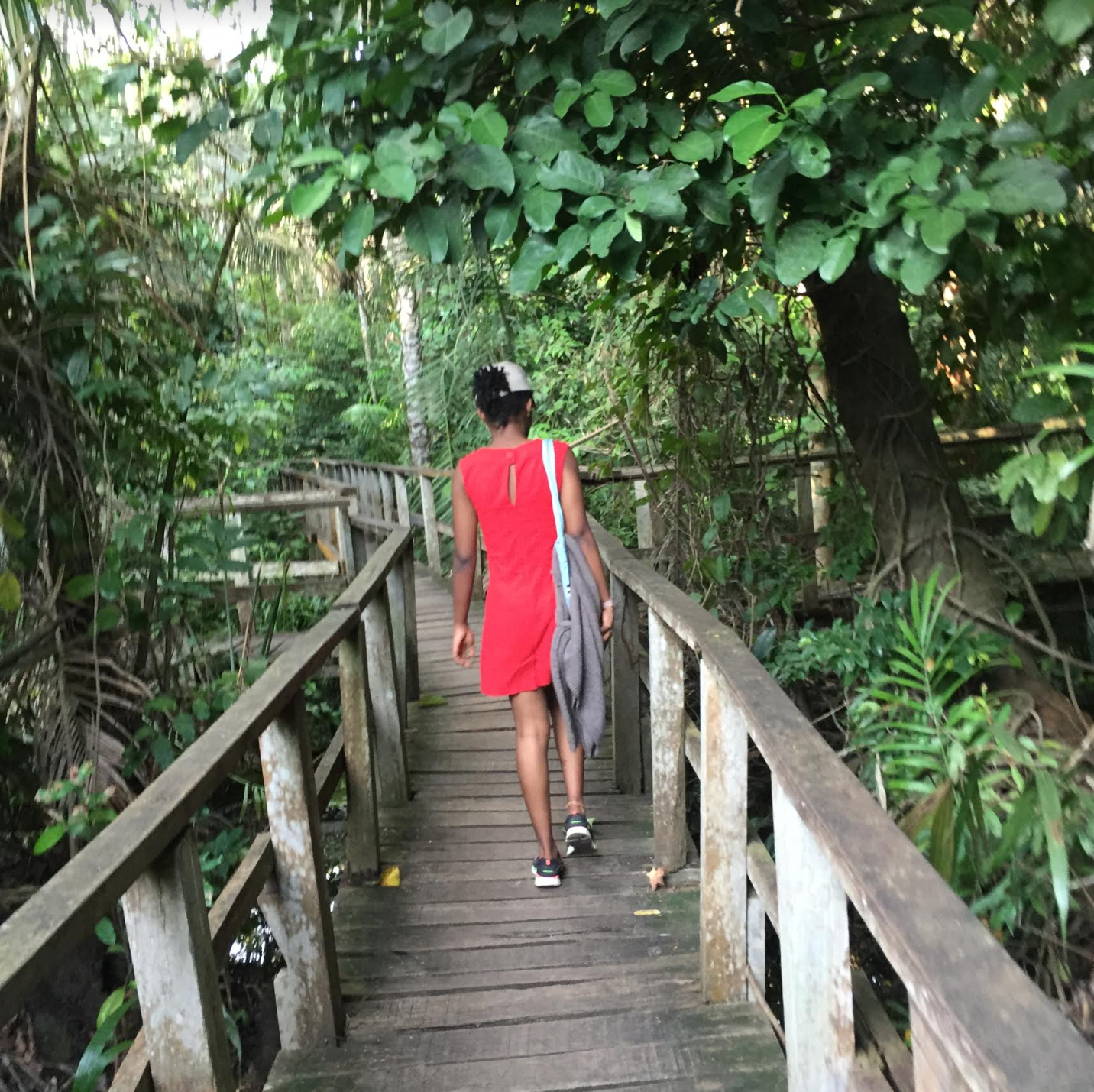
I am living in Yaba. Alágoméjì, if you’re big on details. In a serviced apartment with flatmates on the same evolutionary level as me. There are no fights. Every day, I walk to work. It is just by the corner on Herbert Macaulay. At night, I walk back home. And sleep. This is my routine until, one morning inside of Slack, I sort of cease to be employed.

img_20161002_214230Now I have to move out of the apartment where the generator comes on at 9 and dies at 6. I move to Kétu. In truth, this is when I truly move to Lagos. To the yellow of marwas, renaming of bole (appaz it is called bọ̀lì here) and boarding calls to Ọbáléndé, repeated until you are certain that that Tekno song you can’t get out of your head was low key produced by a conductor at Toll Gate.

So far,  this is what Lagos means to me:

Proof.
That if you are mentally ill, the people in your head will relocate with you to new cities. Go to the doctor and start your treatment. Migration is not a treatment plan for bipolar.

An uncurled palm.
This is a space to trace lines of uninhibited passage. If you can walk it, walk it. Be, but only if you dare. Proclaim your batch number and run with it. Stop. Change your style. Be like that until the next stop.

Evidence of life.
screenshot-205In the very many heads of tired bodies awaiting the arrival of BRT buses. In the secondary school student occupying a world in Yorùbá to which my illiteracy bars me entry. The same one I will teach to check her Gmail as an assignment in a dingy café. Life is happening in this city of multiples, in multiples, daily.

And I am here. Existing in the pace of this place. One hurried foot and then the next. Power walking to catch a bus that will be replaced by another in a moment not because haste is required but because it is expected. I have just moved to Lagos and life is happening. So this is me, atop the uncurled palm, paying tribute to the city by living alongside it.

One month in mind.

On the anniversary of your migration, we remember the Benin girl you once were.

Signed,
Phoenix, for the Tenants in Her Head.

____________

Stephanie Ohumu is a writer who doesn’t understand why bios have to be written in third person. She currently lives on Twitter: @SI_Ohumu.

Top African Destinations for the Romantic in You

Top African Destinations for the Romantic in You


Africa has it all: epic landscapes, iconic wildlife, natural wonders and an incredible variety of cultures. This beautifully diverse continent also has a romantic side and offers a host of destinations where hopeless romantics can celebrate their love in the lap of luxury.

Tanzania

Zanzibar, the white sand archipelago located off the coast of Tanzania, is the jewel of the African coastline. The soft sand beaches, deep blue waters, mouthwatering cuisine and quaint little streets make you feel like this island was built on romance. Take a stroll through historic Stone Town, a UNESCO World Heritage Site and one of East Africa’s last ancient cities. Zanzibar is home to a number of hotels and resorts. Most interestingly it home to a number of private islands perfect for couples to get away from it all and relax on sun kissed beaches. Try Mnemba Island Lodge, which is a private getaway located on Mnemba Island. This private beach getaway accommodates only 20 guests and is the pinnacle in barefoot relaxation and luxury. Mnemba offers a range of activities for the more adventurous couples such as snorkeling, scuba diving or kayaking trips. If you just want to spend some quiet time with your partner then you can head to your own little private beach, which is yours for the duration of your stay.

Madagascar

The island paradise of Madagascar is surrounding by crystal clear waters and offers an alternative experience for those of you looking for a less popular island destination. It is home to some weird and wonderful creatures and perfect for those of you looking to mix a little more adventure with your romance. Mythological creatures, endangered lemurs, unspoilt beaches and rainforests ensures that Madagascar has a little something to bring out the adventurer in you. Belo Sur Mer is the perfect romantic introduction to the island. This tiny fishing village offers peace and tranquility. It serves as a beautiful home base as you take day trips to the numerous national parks and attractions around the area. If you’d like to take experience the color drenched Baobabs at sunset or the thriving wildlife then stay at Mandrare River Camp. Alternatively you could explore forest-lined coves and secluded beaches at Manafiafy Beach and Rainforest Lodge.

South Africa

South Africa is filled with a wealth of opportunities for the romantic at heart. Blessed with beautiful beaches, picturesque mountain ranges, endless vineyards and sprawling semi-desert regions makes South Africa a one-stop destination for honeymooners and romantics alike. Start your trip in Cape Town. Experience the glorious Cape Town sunsets from the shores of one of its idyllic beaches or from the top of the legendary Table Mountain. The Twelve Apostles Hotel, situated along one of the most beautiful shorelines in the world is the ideal spot to cater to all your romantic needs. Those of you looking for something a little different can head inland to the world famous Kruger National Park. This is the true jewel in the South African crown. Home to a multitude of plants and animals, the main attraction is undoubtedly the Big Five. Local Safari Game Lodges offer you unrivaled luxury and a unique safari experiences. It is here that there are so many fantastic places for you and your partner to experience the lives of its many wonderful creatures.


About the Author

Mark Norman grew up on a farm in South Africa and continues to find joy in immersing himself in the great outdoors. Passionate about animals and conservation, Mark is a capable outdoorsman and works at Pondoro Game Lodges where is able to make a living doing the things he loves most. 


Across the West African Coast: Gambia

by Yẹmí Adésànyà


Gambia started on quite a happy note: a small serene country with clean beaches and monkeyed trees. I went to bed to the sloshing sound of the moiling Atlantic Ocean, drowning the indistinct chatter from drinkers at the outdoor pool-side bar. I loved Gambia at first sight.

gambia2

Work too started on a good note, and I quickly made my way to Timbooktoo Bookshop, aiming only to deliver a few copies of Musings of a Tangled Tongue as pre-arranged, but leaving the store with ten new books for my bibliophilic babies.

The despair that found me comfortably ensconced in Brufut was not brewed in Banjul. A part of me perished in Gambia; a part I had hitherto taken for granted, but nevertheless nurtured and savoured, since a time I have no surviving memory of.

My younger sister was due to have a surgery in Lagos, and my last communication with her the day before my trip was hope-laden: I would come see her and her new baby as soon as I returned. It was not to be. I returned to Lagos to the new baby only. My sister had died during the elective cesarean section. Nigeria had taken a huge chuck of my heart, and I was in Gambia suffocating. My howls were drowned by the obstreperous sea outside my window, with every wave of the tide washing away my dream of enjoying the city’s understated beauty. The waves, only the night before reminiscent of an alluring melody, had turned irreversibly to an immutable threnody. Olaitan’s death is a loss that cannot be licked by the lapse of time.

I was only counting down to departure after I was notified of this tragedy, life would never be the same.

gambia1Time went by quickly in Banjul, work took the day, while evenings sought comfort curled up in bed, taking depressing walks by the beach and eating only fresh mangoes; the surrounding beauty recessed to the background of a solemn promise that I would be back.gambia5gambia4

I ate the Gambian equivalent of Jollof rice too, on my first day at work; a disappointing presentation, and befitting mediocre taste. But I’m glad I got that out of the way, and quickly filed that experience away beside its Accra compadre.
When it dawned on me by Friday afternoon that my time was up in the city, I inquired of my colleagues about Gambia and if there was anywhere one could see in town. I was not in a good frame of mind, and needed a distraction, something else to remember the peaceful country by other than my muffled yowls.

gambia11

The Kachikally Crocodile Pool was the place everyone suggested, it wasn’t too far from the office and the incredible tales sounded exhilarating: harmless crocodiles living peacefully with locals! Some of them were said to have filed out of the pool once to pay homage to the deceased founder. And visitors could touch the harmless reptiles. This sounded insuperably menacing to me, but tickled my bereavement-sedated sense of adventure.

The crocodile pool was only about five minutes’ drive from the office; in the heart of Bakau village, an otherwise unremarkable residential settlement next to Banjul–Gambia’s capital city. The pool is owned by the Bojangs, a friendly family representative on sight to welcome us. Everyone in sight looked unperturbed, including the sun-bathing crocodiles. The pool is encircled with wire mesh; this was to keep humans out of the pool really, as there was sufficient allowance for the crocs to come outside unto the open dry land. Park attendants too were on hand, encouraging us not to run or panic.

gambia10True to the legend, the crocodiles appeared harmless, as least they were not hunting us; I touched one of them, eventually, after I was able to overcome my morbid fear of being eaten alive.

How To Look Crazy in Kigali

by Laila Le Guen

There’s nothing wrong with looking a little crazy on a trip. In fact, it can be a fun way to make friends. I know, I know, crazy is probably not what you’re going for. You’ve researched the weather and fashion trends, packed adequately and learnt three words of Kinyarwanda. You’ll totally blend in. Except…

Take it from me, looking crazy doesn’t happen on purpose and preparedness has little to do with it. There’s just a sort of disinhibition that happens when you smell the air of a new place that makes you giddy and you may sometimes act in ways locals consider eccentric, whether they let it on or not.

There’s plenty of places online where you can find tips on where to stay, what to do, what to eat in Kigali. This is a different – though equally thorough –  type of guide on quirky things to do and say in Kigali.

<center>Photographer: Gwendolyn Stansbury/ IFPRI</center>

Photographer: Gwendolyn Stansbury/ IFPRI

Enquire about safety

It only takes a year or two of living in Nairobi (or Lagos, I’m sure) for safety concerns to become second nature. I’ve learnt to never ride in a car without first checking if the doors are locked and I would not dream of walking around by myself after nightfall in an unknown neighbourhood, nor would I board a random taxi if I could help it. These habits die hard, even when you know that Kigali is generally very safe.

So here I am, on a weekday night at Sundowner in Kimihurura, enjoying a lasagna dish and pretending to read while in fact I’m distracted by the lights, the music and the hum of conversations coming from every corner of the pub. I had strolled to Sundowner before nightfall and found myself in a bind: should I walk back in the dark or take a cab to cover just 500m?

After requesting the bill, I debated whether to ask the waiter. I didn’t want to cede to fear but I also wasn’t going to take unnecessary risks in a city where I knew nobody. I figured there was no harm in asking, only the threat of awkwardness.

Awkwardness did occur when the waiter gently laughed at my incongruous question and assured me it was safe. So I walked back feeling tense the whole way, even though the most threatening presence was a bunch of barking dogs behind a closed gate.

When in Kigali, you can afford to chill. And that’s great, if you actually manage to put aside old habits and actually chill. I’m not saying muggings don’t happen, but your guard doesn’t need to be up all the time. Feel free to take a holiday from your high alert default mode, was the message Kigali residents kept reiterating.

Get on the bus

2-kigali-moto-dylanwaltersThanks to consistent signage and well-organised bus terminals, public transport routes are really easy to navigate in Kigali and I tried to use them as much as possible. I find the slow rhythm of the ride an occasion to breathe, to wander, to observe the movement of the city.

A visitor to Kigali, much like Kampala, won’t really need to use buses, as motorcycle taxis (moto) are inexpensive and so numerous that you’ll never wait long before catching one. So when I asked for information about bus routes to strangers at the bus stop and to my host, they inevitably looked bewildered. Why would I choose to take the bus and “waste” half an hour, when I could just hail a moto and have virtually no chance of getting lost?

I could see how it sounded weird and irrational. For me, the joy of riding the bus is in the figuring out of the paths through the city, in the conversations you strike up with strangers, in the languages you overhear. And how else would I have experienced the prepaid “Tap&Go” card system used on many routes in the Rwandan capital?

Pavement passion

For three days, I explored parts of the hilly capital on foot and I did so with my eyes to my feet. Not to avoid potholes or puddles but because I couldn’t stop staring at the beautiful Kigali pavements. Just the fact of their existence in every part of the city filled me with joy.

I might have raved about them to every person who would humour me…

Pedestrians in Nairobi get the short end of the stick since pavements – where they even exist – are seen as a space open for dumping stones and rubble when they are not used as a parking lot extension. Most of the time, you’re walking on the roadside.

Kigali residents, I’ll say it again: your pavements are wonderful.

How much hadi la gare?

3-kigali-tapngo-laila-cc0-licenseSince I could never guess which language someone would prefer speaking and Kinyarwanda was not an option for me, I tried English, Kiswahili and French successively (not necessarily in this order). While this linguistic trio makes for strange multilingual introductions, it proved to be a winning strategy in everyday communication.

For moto rides, knowing basic round numbers in French is very helpful (you’ll be counting in hundreds, potentially up to a thousand). Even when we initially spoke English, the driver would often quote a price in French.

Kiswahili is also a good language to have in your toolkit. Many Kigali residents speak it and you’re likely to come across swahiliphone Congolese people as well, so do try it: reactions were always very warm and I found it quite easy to engage with strangers in Kiswahili.

Most of the time, the situation called for a mix of English, French and Swahili because things like ‘sauce provençale’ don’t really translate. Not to worry though: even if your only available option in this context is English, you’ll still be able to get by just fine.

Roju…what?

It took me all of two days to be able to pronounce the name of the nearest landmark to my guesthouse.

I had one of those retrospectively hilarious moments where it’s late at night and you’re trying to explain to the moto driver where you stay but, this time of all times, you have no language in common and the words that come out of your mouth don’t seem to find any resonance.

I kept repeating different versions of the name ‘Rojugire’ but the look of recognition never came. On top of that, we were both getting soaked under the pouring rain!

I ended up walking back with a kind stranger from the pub who happened to know the neighbourhood like the back of his hand because he had grown up there. While we huddled under his umbrella, he told me about the time he got mugged in Nairobi. It sounded like a variation on the universal East African travel story: I went to Nairobi and I got my phone stolen. We made nervous jokes about how unwise it would be to have a stranger walk you home at 11pm in Nairobi.

This trip was about contrast and wonder. Three days in Kigali is enough time to be charmed by perfect pavements and enjoy views over hill after hill, but not enough to to start noticing the flaws that would likely drive one mad after a year.

Do you feel like unleashing your own brand of crazy on Kigali yet? I sure hope so.

__________

Laila Le Guen is a 2016 aKoma Amplify fellow based in Nairobi. Growing up in France, her dreams of getting to know the world outside her small town were nourished by books from the public library. Her work has appeared or is forthcoming in Brainstorm, Aerodrome, Afrolivresque and Saraba.

Nigeria’s New Feminism – Say-You-Are-One-Of-Us-Or-Else

by Yẹ́misí Aríbisálà

___

yemisi2My name is Yẹ́misí Aríbisálà. Because of context I must state that I am not a feminist nor will I ever be one. As made clear from the paragraphs below, the “or else” will come to my door and meet it open.

Over the last few months and especially after an interview in recent days, Chimamanda Ngozi Adichie has become the woman that we all love to hate. What irony. I only have one indictment for her regarding the attacks on social media for words spoken to the press in that interview: It is that she wittingly contributed to the creation of the “We”, the same mob that turned against her. It is what happens when people are not allowed to go away and really think and decide what they believe as individuals, and they are coaxed and persuaded and ushered into making decisions in groups. What happens when we all become a “body of feminists” without a a coalition of working, dissenting brains is that we are and become a mob.

The most recent social media uproar against Adichie is over her differentiation between feminisms – hers and Beyoncé Knowles-Carter’s. It is allegedly also about Adichie’s arrogance and the way she expresses herself that seems to condescend to the person being addressed. It is about causing a rift between feminists and seeming thereby to designate some as intellectuals and others as liberal and possibly nonintellectual. That feminists should not be distinguished thusly is the crux of the protest. Lastly it is about a supposed change of position indicated by Adichie’s permission to Beyoncé three years ago to use her words in the song Flawless suddenly retrospectively retracted in the interview. Or if not retracted, sidestepped in a clarification that said that giving permission for the use of her words in no way indicated that she and Beyoncé’s feminisms were moving along the same track.

So people are angered by the backtracking and the condescension and the lack of acknowledgement by Adichie that she got plenty of mileage in allowing Beyonce to insert her words in her song. But really the whole thing is about being fed up with Adichie’s condescension.

Here are my thoughts:

Adichie’s responsibility to her audience is completely different from Beyoncé Knowles-Carter.  Both may be in the public eye but Adichie is an intellectual and a woman of words. Someone whose philosophy cannot and should not be ignored. It is not a philosophy of entertainment that belongs to Beyoncé.  The philosophy of entertainment allows all kinds of things that real life will not accommodate. For example, a woman in entertaining people may take her clothes off and bend over to show her crotch in front of a room full of people and they will clap and encore her. In real life, she cannot do this, she may be dragged off to an asylum.

If certain people do not like the fact that the artist has exposed herself, they don’t have to go to her show the next time, and if she really offends, she can pass it off as intrinsic in the licence of artistic expression. Not so Adichie. Even though she doesn’t have a very effective PR body advising her on how to manage the balance between the transience of celebrity and the more crucial creation of art and a strong body of ideas that will surely outlive her, she is still operating in real time, in real life where people do not react liberally or placidly to the showing of crotches and cleavages and erotic dancing. Even when people try to pretend that they have blurred the differences between entertainment and reality, we should not believe them. They are being false. Real life is real life and entertainment is entertainment. And we all understand that no matter what happens in the rooms of Big Brother Africa, the contestants have to go home.

chimamanda

Chimamanda Adichie. Photo source: MyCelebrityAndI

I do not like Beyoncé’s art nor her expression of it, but that is irrelevant because I don’t have to go and watch her or buy her records.  More importantly, because she is an entertainer even if one who likes to include political material in her art, I don’t have to take anything she says to the bank. I don’t have to accept her philosophy of life and relationships. I don’t have to ascribe to my daughter sitting in a car and performing oral sex on a man and agree that this is liberal and open-minded. I don’t have to take her seriously at all. I don’t have to take a bat to a car. The agreement is that she is an entertainer and even if I am carried away by her beauty and power, and feel all hot and wonderful after her show, I don’t have to believe any of it. This is the contract of entertainment that exists but which people are attempting to falsely blur. Beyonce’s art is often about channelling pain and joys of relationships with men with very questionable language. The nudity, sexual language, and violence are in my opinion not powerful at all – not in any way about real power – and should be considered with great caution even in the realms of entertainment. But I am unwilling to tell people what to consider as entertainment. I love Billie Holiday’s music but on no account can I consider her doormat hood to husbands and lovers as expressed in her art as a sensible philosophy to life.

The contrast is that we cannot ignore Adichie. Not only because she carries enormous intellectual potential whether we like her or not, and possesses a great influence over generations of Nigerian women, but also because her views are daily being written down and concretised. She is a philosopher of real life in real time. More importantly, Adichie belongs to Nigeria and she is a beacon of that which is possible for the Nigerian woman. We cannot underestimate her worth nor her work. The attempts to disregard her are also a falsehood. Having said that, I must add that I dislike Adichie’s Americanah’s treatment of relationships between men and women. Her portrayals of traditional, non-“liberated” women in that work are uncharitable and tapered. Without a good balance of her art, her work, and her personal brand, she willingly inserts a fragility in her writing. Again I cannot take liberties in telling people how to live their lives. She can do what she wants. Adichie in the end is a powerful Nigerian intellectual with serious responsibilities.

In my opinion if Adichie informally retracted the permission she gave to Beyoncé to use her words in her song Flawless, then it was the right thing to do. Retrospectively, it is the right thing to do. If she never really gave it, then even better for Adichie’s ideas are in fact too good for Beyoncé’s entertainment. Too bad if Adichie did not know that, or if she saw it as an opportunity three years ago to get her words attention. If a person makes a decision one year then three years later changes that decision. That is what is called growth. And rather the person should be commended for growing and for changing their minds than castigated for speaking.

I will never pretend that I don’t change my mind.

The Yorùbá hold as sacred the head. That head has a mouth in it and each person has a head and a mouth. We can take this as a pointer towards individual thought and speech. We all have our irritating quirks, our mannerisms that rub people the wrong way, our crazy headless ideologies. We are all work in progress.

I am appalled that I can count on the fingers of one hand the people who stood up for Chimamanda Ngozi Adichie in a week of strong personal attacks against her from women like her, from women to feminists on social media. Not surprising, as a few weeks before that on Ikhide Ikheloa’s facebook page it was the annihilation of another woman, Abiodun Kuforiji Nkwocha, using language that made one’s mouth fall open in shock and disgust.

Chimamanda Ngozi Adichie is not a friend, a relative, nor even an acquaintance that I bump into once a year. I did sit next to her for two weeks in 2012 during the Farafina’s Writers Workshop. I disagree with many of her ideas, as I am sure that she disagrees with mine. Yet I have a responsibility to look at her and say – this is a woman like myself, with her own traumas and challenges and insecurities. More flesh and blood than a feminist philosophy or tract. More present than BBOG or some vague profile of a woman who is a victim of domestic violence, or some powerless hungry hawker of a girl. She is a woman, a mother and a wife. One day her daughter might google in her name and find the hate and vitriol and ugliness spouted against her. It is self-preservation on my part. I don’t want my daughter to be the google-r and see that I am a grasshopper in a swarm of locust attacking one person by consensus – telling her she cannot speak her mind. My role as a woman is not to gag other women and take away their voice – whatever it sounds like. Debate(s) should, happen but not on vicious personal terms.

yemisi3Why be the fighter for the rights of some faceless woman who I don’t know when I am going to be part of a mob rolling out the old tires and lighting a fire for burning another woman That I Do Know. If you do not like the woman, nor agree with her, is it possible to agree to disagree with decorum then let her be? I can determine that I find her tone arrogant but I don’t have to retaliate arrogance with arrogance. I can stay out of her way completely if it helps. I don’t even have to accept her philosophy for real life either. I don’t. Whatever my decision, it must be clear that like all tides things have a way of turning around.

I hope that if a mob does stand opposite me one day, someone will say “I know her, that lady that cooks moin moin on the internet. Let her be.”

____________

Yẹ́misí Aríbisálà is the author of a new memoir titled Longthroat Memoirs: Soups,  Sex and Nigerian tastebuds. (Cassava Republic, 2016)