Browsing the archives for the Uncategorized category.

The Train to Busan

Apparently, there is a horror movie of the zombie kind, made in Korea, with the above-named title.

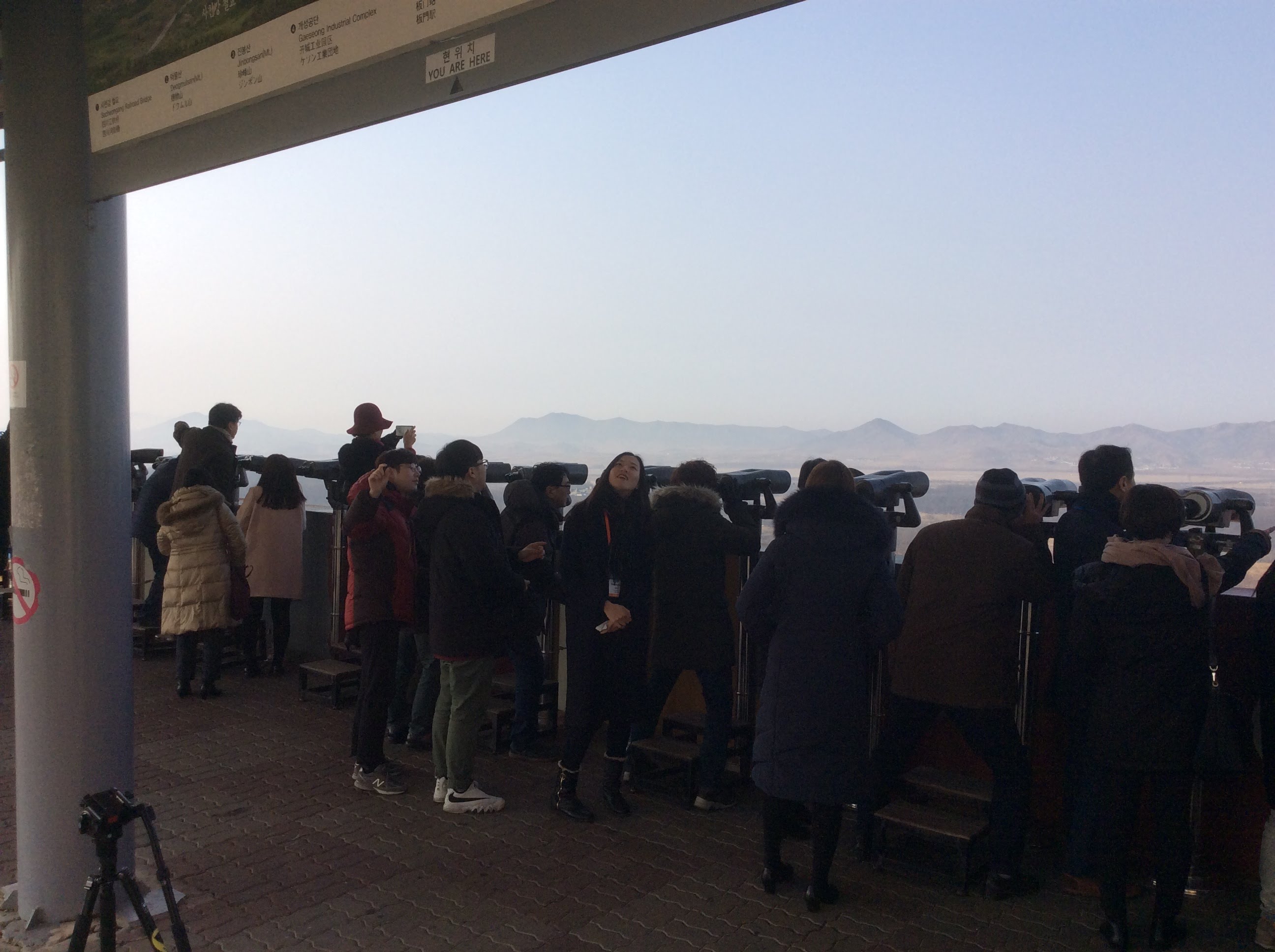
I discovered this by chance, through Sarge Lacuesta, a Philipino writer with whom I’d attended the Pyeongchang Humanities Forum in Seoul and Pyeongchang in late January. We had been informed a few minutes earlier as we sat in the Orchid Room at the Westin Chosun Hotel that a planned trip to Busan later in the week would take us through a newly commissioned bullet train ride from Seoul.

Train to Busan, the movie, Lacuesta said rather enthusiastically, exhibited some of the best of Korean cinema which, according to him, had come into its own over the last couple of years, with compelling visuals showcasing the brilliance of Korean storytelling. It would be my first time of hearing of Korean cinema and I expressed same to him. When we were young, in Nigeria, we saw lots of Asian movies, but it was hard for us as kids to tell which was Japanese or which was Chinese. When we grew up a bit, we could recognize Jackie Chan and knew that he came from China. For the other films we watched, it was enough to enjoy the synchronized violence of the entertaining martial arts the movies were known for. As an adult, of course, I’ve since figured out that some of the biggest brand names in electronics came out of Korea, from Samsung to Kia to HiSense to Daewoo to Hyundai.

I’ve also come to learn more about the really impressive story of the Korean entertainment industry, from Psy of the Gangnam Style fame (we did visit Gangnam too) to G-Dragon, Taeyang, and the many other popular K-Pop stars the country has blessed the world with. The Busan Film Festival, as well, has come to represent one of the most impressive annual gatherings of artists and moviemakers from all around Asia, making great and beautiful movies for a global market. These are things I knew little about until I visited Korea for the first time.

I never did see the movie Train to Busan though I intend to in the coming weeks. Neither did we encounter any zombies on the really comfortable train ride from Seoul to Busan and back (how often do you get to use fast internet on a moving bullet train without paying extra for it?). But a few weeks after I returned home, I was able to travel back to Busan a, nd to the Korean film universe through the current blockbuster Marvel movie Black Panther. Those who have seen it will remember some of the most action-packed scenes took place in Busan and featured phrases of Korean and fine pictures of Hangeul calligraphy.

The event I’d gone to attend in Busan was called New World Literature Beyond Eurocentricism, and it featured conversations with some of the city’s finest artists, writers, scholars, on the direction of the arts and literature in languages and schemas other than the ones dictated by English and other European thoughts. I enjoyed it. My recent knowledge of the successful and dynamic movie and literary culture from Korea – I realize now – is a fitting coda for that fascinating trip.

____

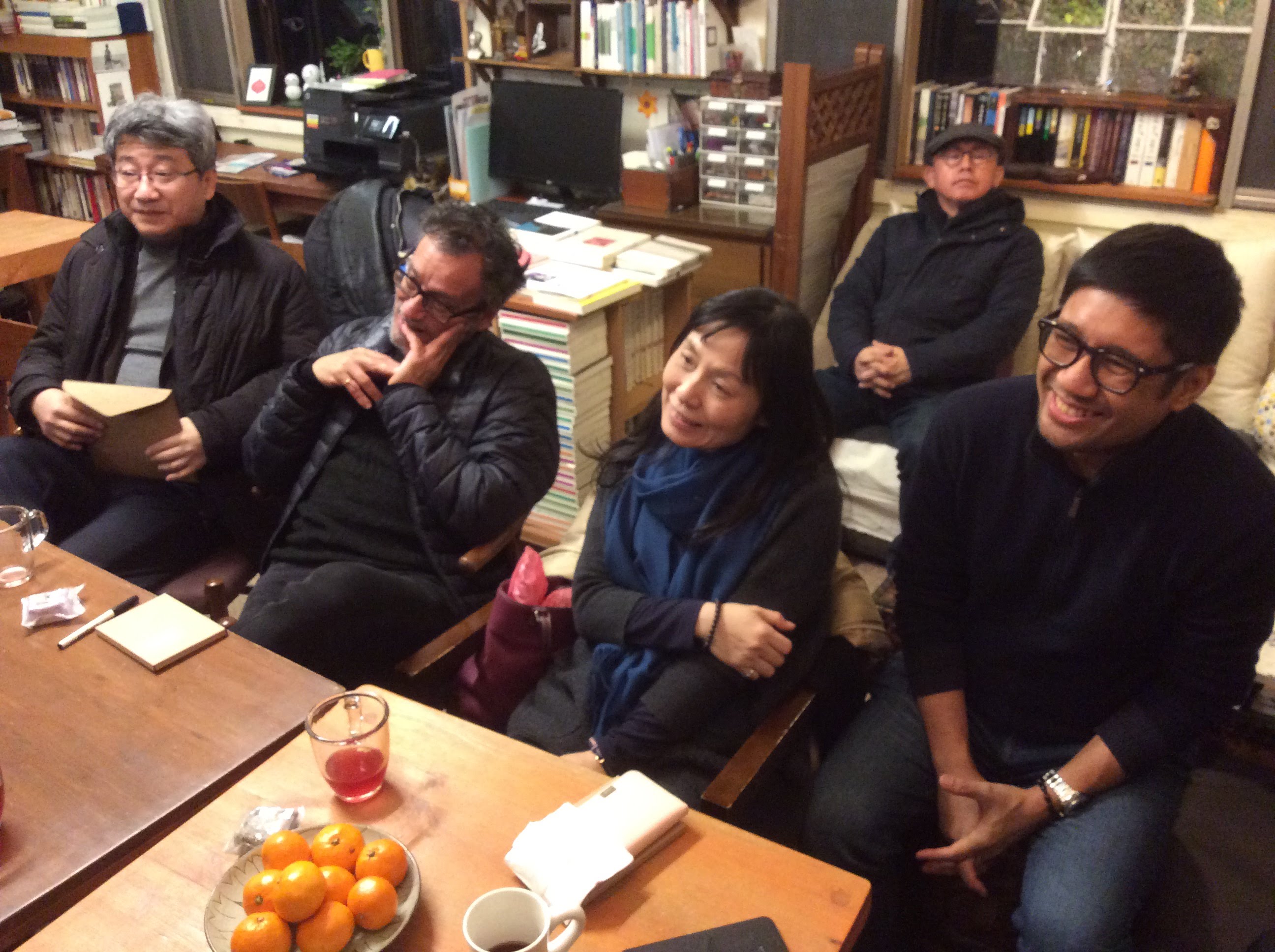
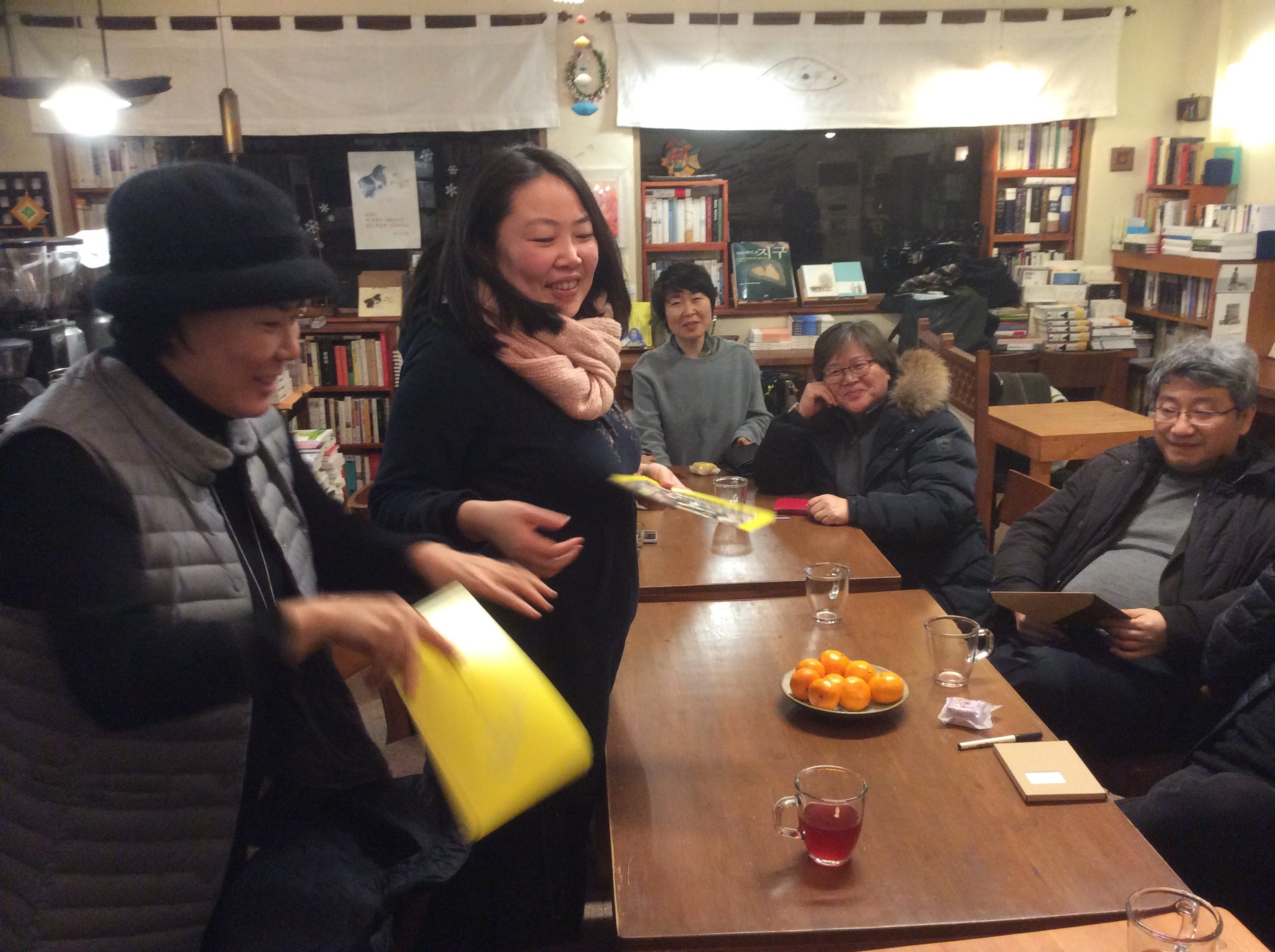
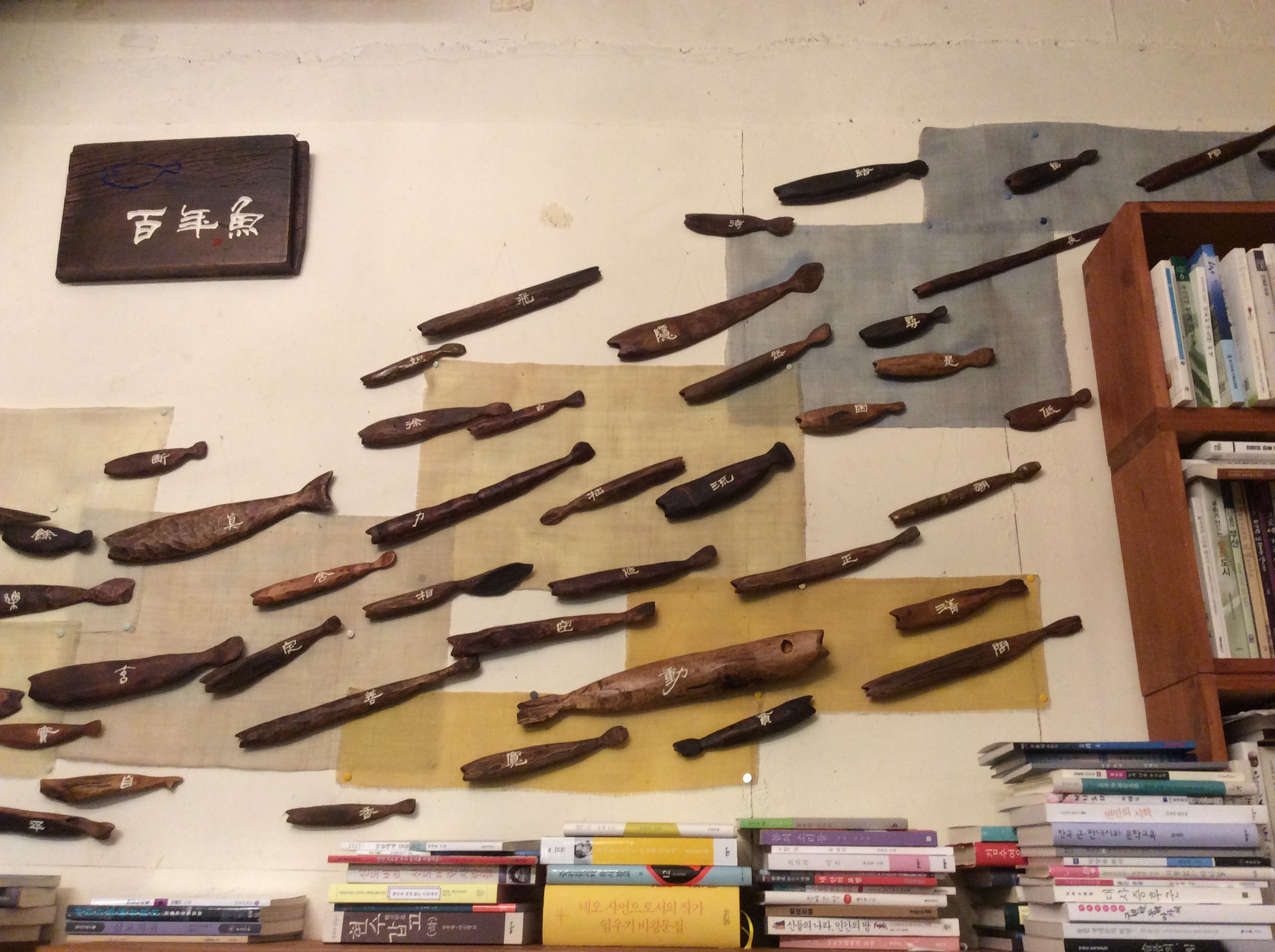
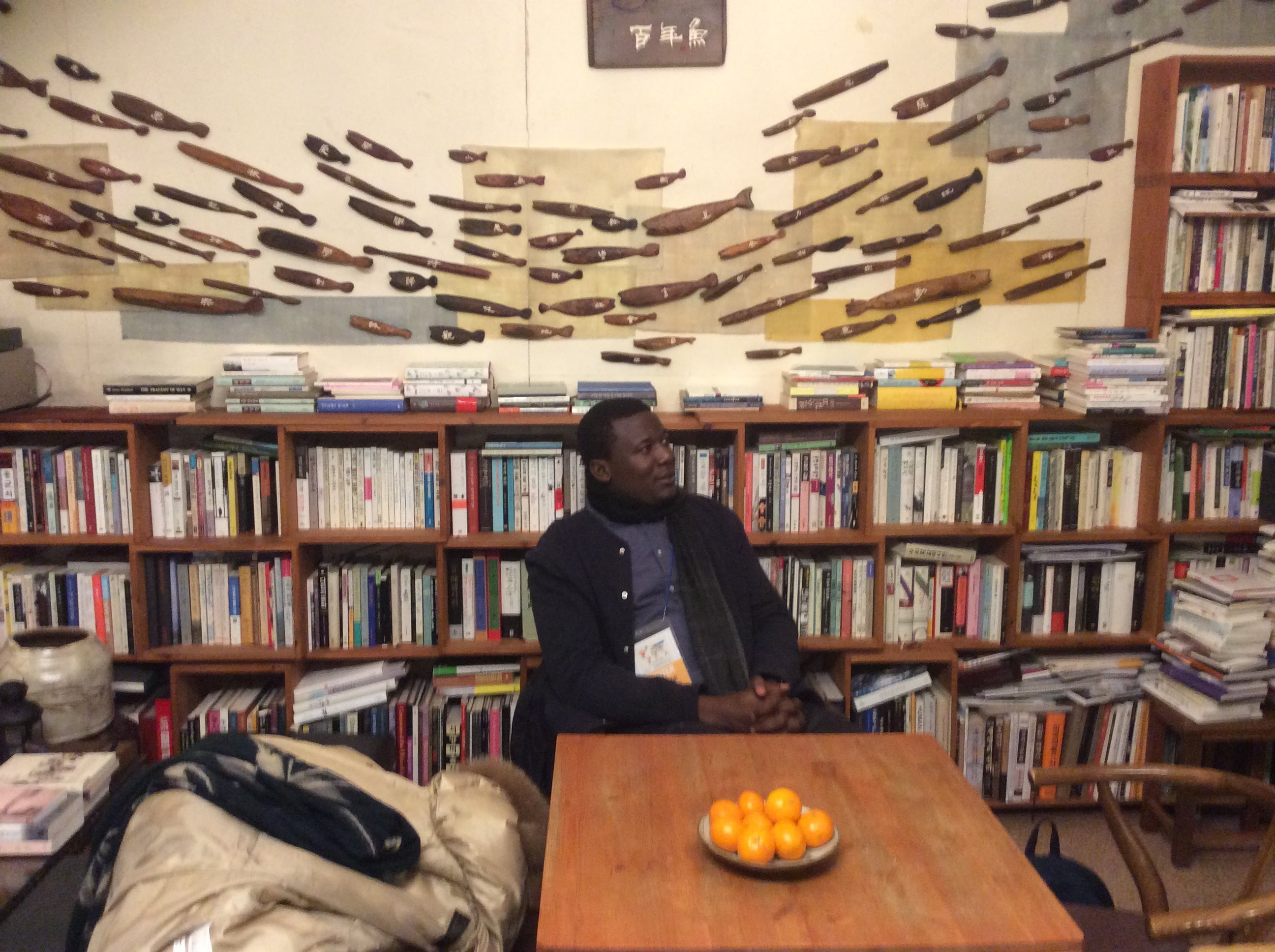
All photos taken at a Book Café run by Kim Soo Woo, Korean travel writer and translator, one of our hosts in Busan.

On “The Heresiad” by Ikeogu Oke

The Heresiad (KraftGriots, 2017) by Ikeogu Oke is, in my opinion, the most ambitious of the books on the prize shortlist this year. It is a book of what the author called “operatic poetry” (another way to put this would be “poetry in drama and song”) featuring one poem extended over a hundred pages. Yes, one poem. It is epic in its scale, ambition, and character (and even in the words of one of the blurbs. See it:

“It is powerful, and brilliantly composed – a true epic!” – Lyn Innes (Professor Emerita, School of English. University of Kent, Canterbury))
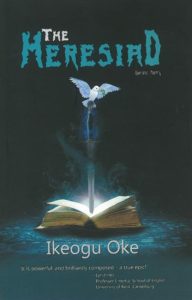
But seriously, the work packs within it a lot of history, philosophy, narrative, culture, allegory, politics, and tradition, rather unapologetically. Without the author’s name, one might confuse it for a work by Shakespeare of any of the writers of the old traditions defined by form, rhyme, and musicality. Only slightly, of course. References intrude from Nigerian (and African) socio-political issues enough to define the work as one addressed to a specific, even if global, audience. And to that idea of musicality, the author graciously provided musical notes with which the poem can be sung.

The name Heresiad, is derived from “heresy” just as the Iliad was derived from “Ilium” or Aeneid from “Aeneas”, as the author explains in the preface. But what needed defending, even more, was the style, operatic poetry, which Oke described as being deliberately crafted as “an art form that transcends verse and goes on to embrace song, music, and drama.” Previous works of this nature which have misled readers into expecting musicality through the use of “Songs of–” in their titles were singled out, from Turold’s The Song of Roland to Vyasa’s The Lord Song to Okot p’Bitek’s Song of Lawino. (He couldn’t have called out Tanure Ojaide’s Songs of Myself, the other book on the shortlist, because this serendipity of both their presence on the shortlist couldn’t have been predicted. But the juxtaposition of this factor in defining Heresiad as unique and better realized as practical literature does appear significant). By discounting the need for a titular nod to musicality and instead embracing it in true form, Oke admits to pursuing a grander ambition: to make written words sing, a homage to Ngugi wa Thiong’o, whose words to that effect was quoted as an epigraph.

Of the thematic preoccupation of the book, Oke says it is written “to make a case for unhindered intellectual and creative freedom… and for mutual respect and harmony between faith and thought, otherwise religion and intellectualism.” In my interview with him, he admitted that the idea of the book, and the first verses in the book, came in 1989 when “a famous writer” was condemned to death for the crime of heresy. He didn’t need to – nor wanted to – mention Salman Rushdie by name, but that connection became immediately apparent. In this book, the condemned author and narrator is Zumba, who was so censured for having writing a “bad” book. To enforce this sentence, and to save him from it, a few other characters, in the person of Reason, Doom, Anger, Sword, Machete, Axe, Stone, Panther, Care, Bluff, Smithy, etc, were introduced with fully-realized characters, compelling presence, and voice. In their thought processes and the unfurling of the curious plot, the poem realizes itself in full glory.

One of the limitations of traditional poetry, which can also become its most enchanting feature, is rhyming. It is a feature that I happen to love. But it is a feature fraught with a lot of risks one of which is the occasional trading of meaning for the benefit of a properly rhyming word, or the use of the immediately available rhyme instead of striving to find the perfect one. In Heresiad, some of these limitations show up, like when “bypass” is made rhyme with “pass”, “reproof” with “proof”, or “unwise” with “wise” (and in one unintentionally hilarious instance, when the native language interference pushes “blade” to rhyme with “head” (page 57). For a book of this type of ambition, it might be that those kinds of lapses are to be expected and tolerated. But for an unlucky book, they can become the flaws by which they are defined.

But when it works, though, it works quite beautifully.

I’m part of this misnomer, I confess,

And so are all you Faithfuls, nonetheless.

Or who among us Faithfuls can have read

The book for which we seek the author’s head?

Rhyming might seem like a trivial issue on which to spend critical time until one realizes that each couplet throughout the work sticks to this rhyming pattern on top of what Oke describes as “lyrical pentameter” (adaptability to lyrical utility). The realization that the author had spent countless man hours crossing all his Ts to achieve this kind of ambitious and thoroughly satisfying theatrical result is most impressive of all.

Now, the author’s plea had reached his ears,

A plea that dripped with anguish and with tears;

And Reason, yes, had pondered through a plan

To take help to the joy-forsaken man.

(page 36)

Equally as impressive is the realization that the book took twenty-seven years to write, over different iterations.

Now lift your voice; lift your voice and say;

Your voice, not mine, must rise and lead the way:

What now transpired among the rising five

Who wished our author more dead than alive?

What – the thought – that, of its own accord,

Changed their common tilt towards discord?

A love as yet profound inspires my choice

To be the human echo of your voice.

(page 52)

Speaking of theatre, when was the last time you read a book of poetry with accompanying musical notations? I certainly haven’t seen any. But here, on page 106-112, the author, with the help of Adéogun Adébọ̀wálé, helpfully guides the future theatre and/or musical director on what is the appropriate way to translate the texts into music.
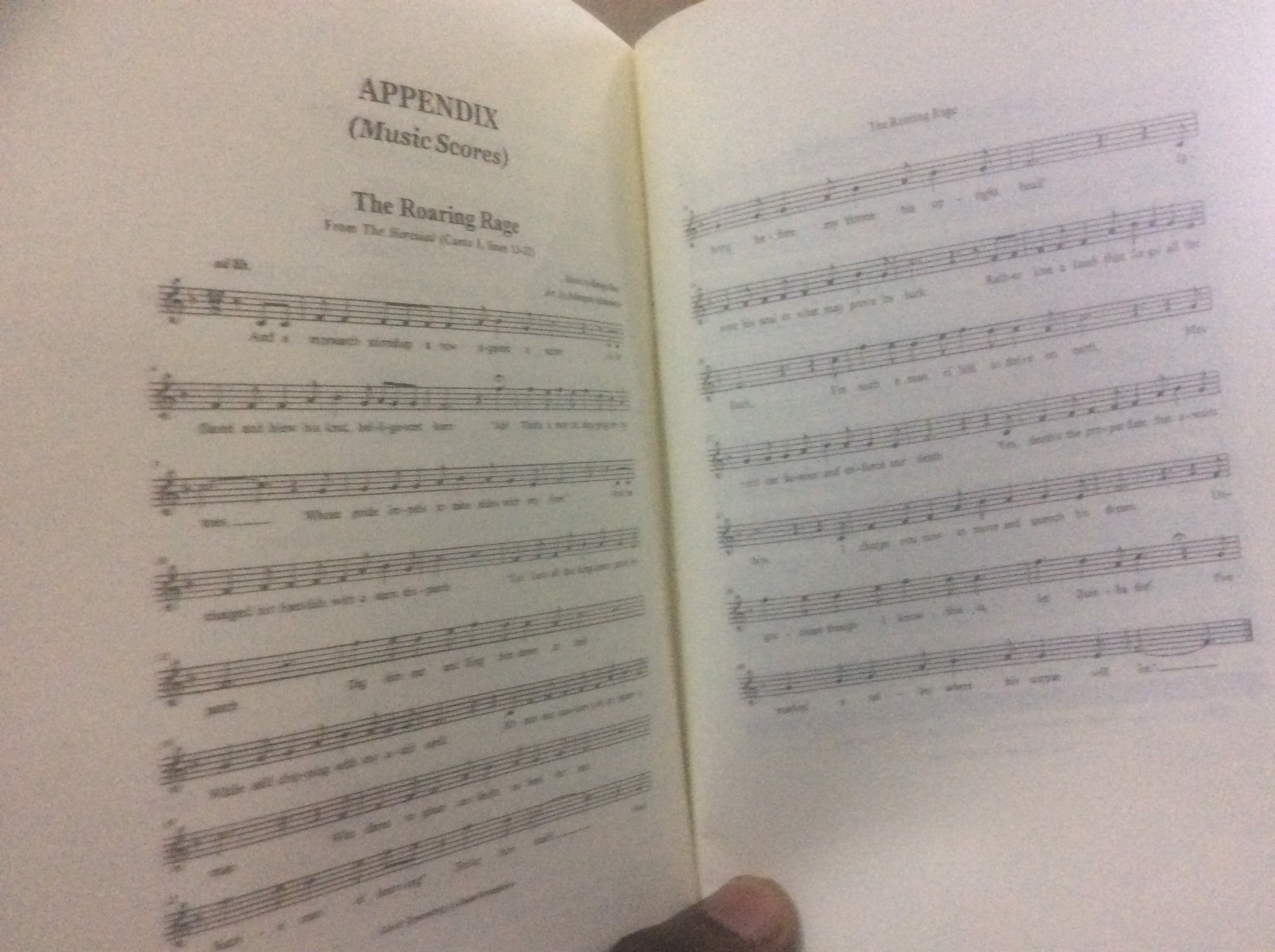
During my interview with him, I asked whether he would be willing to sing some of the lines to me, and he graciously obliged. It was not as impressive as I’d expected it, but who expects an author of a work to always be its most competent performer? Not me. It is ironic, of course, that this musical characteristic of the work once became a point of risibility when a restless Facebook critic dismissed it as a gimmicky invention to win the $100,000 prize money. On the contrary, I think it is one of the book’s distinctive features, showing it as different as possible from the others on the shortlist in terms of ambition, inventiveness, interdisciplinary scope, and resolve. Now, to see it on the stage!

The author’s habit of including footnotes and references at the bottom of relevant pages irked me at first. They had appeared as an unnecessary usurpation of the critic’s role. But this wasn’t the case. They add a lot of value to the work in illustrating, where necessary, the writer’s influence, allusion, or research. Not one was superfluous.

From what I have observed of the pattern of choice by the NLNG judges, who have typically favoured works of formal and traditional forms in style and ambition (See: The Sahara Testament), I will predict that The Heresiad might take home this year’s prize. There is something about the work that speaks to an intense commitment to innovation, tenacity, joyful experimentation and social commentary in a way that provokes delight and engagement. It is doubly worthy, of course, for its successful bridging of the genres of poetry, drama, and music, while making a strong point, through allegory and an enchanting imagination, about the role of free speech and the responsibility of the writer in a modern society.

I’ll be surprised if the judges disagree, but such surprises are welcome when it’s not one’s work on the shortlist.

______

Find a link to the previous reviews here.

______

Update: October 9, 2017: Ikeogu Oke’s The Heresiad is the 2017 Nigeria Prize for Literature winner. Watch my interview with him here. Congrats to him.
In Defense of Engagement: KABAFEST, Literary Festivals, and Bad Faith Protest

Op-ed first published on Olisa.TV in July of 2017.

___

By Kọ́lá Túbọ̀ṣún

Earlier this year, when Hassan Minhaj was invited to perform at the White House Correspondents’ Dinner, an annual event in which the sitting president was always a notable feature, there was some suggestion that he boycott it. After all, as a Muslim comedian, this was a president who had shown nothing but contempt for not just his religion and his race, but for the press itself. Why was the White House Correspondents Association inviting a bully and a racist president to grace an ostensibly ceremonial occasion set up for those entrusted with the responsibility of holding leaders’ feet to fire? Hassan’s response, which ultimately prevailed, was that there was no better chance of speaking truth (and satire) to power than a pulpit a few feet away from the most powerful man on earth, and at an event watched by millions of people worldwide.

In the end, it was the president who flinched, choosing instead to appear at a  public rally hastily organised in a different state but at the same time as the dinner that held so much embarrassing potential for his fragile ego. And in his absence, the comedian delivered as much of a fiery performance as was expected, not just of the absent president, but of the ideology that produced him and the media that failed to hold his feet to the fire.

I’m not Hassan Minhaj, a disclaimer that is quite useless at this point, but I’ve had course, over the last couple of days, to consider that event and its significance, in the face of a certain bad-faith response to the first edition of the Kaduna Book and Arts Festival, a privately organized* event. The argument, similar to that against the American comedian, was that the partial support of the Kaduna State Government for the literary festival taints it enough to result in writer boycotts. Mallam Nasir El-Rufai, the governor of the state, it is argued, is a problematic political figure who had looked the other way when innocent civilians were killed under his watch, among other inadequacies. Therefore, he is not worth associating with in any way by writers who care about justice and accountability.

On the surface, the argument is sensible. After all, who wants to sit and dine with a politician who seemed unfazed by the violence meted out to a religious minority group under his watch. 

Except that, first of all, the festival is not a “wine and dine”. 

It is a gathering of people with diverse thoughts and opinions sharing ideas and their love for reading against the background of books and other artistic productions. I have been invited to conduct a book chat with author Laila Aboulela who was the first winner of the Caine Prize. Her book, The Kindness of Enemies (2016) examined the emotional and human origins of modern extremism through the story of Imam Shamil, a warrior from Dagestan during the reign of Tsar Nicholas II in old Russian Empire. The writer, a muslim Sudanese writer, will also be organizing a two-day workshop for 22 women selected from over 40 applicants.

Those who have attended the annual Aké Festival will testify to its setup as one facilitating conversation as much as disagreement. At the 2015 event, I remember clearly the moment when President Olusegun Obasanjo’s demeanour changed from a feted guest to one of a cornered politician when a young girl took up the microphone and challenged him on the failure of his role so far in the Nigerian experiment. In a follow-up session later in the evening, Nobel Laureate Wole Soyinka piled on by describing the former president as an unrepentant liar. In 2016, during a book chat between Helon Habila and Teju Cole, moderated by journalist Kadaria Ahmed, most audience reports of the conversation focused on the way the anchor challenged the writers to justify the usefulness of their work on the Chibok Girls if it did nothing to better inform the reader or improve the situation on the ground. In short, like most book and art festivals, it ends up as a space for a cross-fertilization of ideas, in as many necessary directions as necessary.

I have been privileged to have attended these events yearly and I’ve been impressed by the renewed focus they have put on books and literature as important entry points into social and political discourse. But Aké Festival, especially, also does something more. By taking invited writers into town to interact with young school students, and endowing book grants and scholarship opportunities for students to attend, they sow a seed towards a more robust culture of reading. As a high school teacher from 2012 to 2015, I often travelled to Aké with dozens of my students, to listen, learn, and interact with writers many of whom they had only read about or seen on television. The power of that kind of on-the-ground interaction can not be overemphasized. From what I see on the KABAFEST website, I have no reason to doubt that this maiden edition, made even more special for holding in Northern Nigeria where the literacy rate leaves too much to desired, will have the same influence on students and writers privileged enough to attend, or to have writers visit their schools. 

But it is this dimension of engagement that seems most befuddling in what the critics suggest should be the response of writers in all cases to issues with which they disagree. Is it to be believed that packing up and leaving is the right way to address anything considered objectionable or staying and speaking? It can’t be that only one way is right. It would be in anyone’s right to choose either, as long as it is based on principle rather than force or in service of a political agenda of a different kind. But to say, as Ikhide Ikheloa did last week on twitter that those who choose to stay and speak “do not care” about political oppression is both a weak and sanctimonious intervention, not in the least helped by the fact that the writer himself had not been shy to take sides with more despicable political leaders when it fit within his ideological bent. To take it a step further by publicizing the headliner’s agent details on his facebook page in order to embarrass her from attending the festival is nothing short of despicable. What if someone did that about his own place of work?

And so, if the question is in whether or not by associating, even by the mere fact of attendance, with a festival in which a government has input, one is condoning everything that that government or its governor stands for, the answer is easy. Government funds do not belong to one man. It is possible that Mallam Nasir El-Rufai is a despicable human being, a weak leader, and one with animus against a group of people over whom he has power. If so, then what better way to let him know than to attend a festival in which one will get a chance to challenge him face to face. We are writers, conscience of society. Our role is to hold the feet of powerful people to the fire, many times to their face, and even at the risk of personal or professional loss. Many of the Northern-Nigeria-based writers that will attend this book fair have strong opinions about El-Rufai’s tenure as Kaduna State governor and will be expected to express it in as forceful a way as possible. I haven’t read enough about the man to have an opinion, but I intend to do so. But to insinuate that all attendees are “indifferent to oppression” is in a bad taste, and in bad faith.

Like the journalists, artists, and comedians who have attended the White House Correspondents Dinner to challenge the president of the United States to his face, the presence of writers in the presence of power is often actually the protest. It is the politicians who should be afraid.

——-

* I have since found out that the Festival is a Kaduna State Government-sponsored event, but all the points still stand.

Top African Destinations for the Romantic in You

Top African Destinations for the Romantic in You


Africa has it all: epic landscapes, iconic wildlife, natural wonders and an incredible variety of cultures. This beautifully diverse continent also has a romantic side and offers a host of destinations where hopeless romantics can celebrate their love in the lap of luxury.

Tanzania

Zanzibar, the white sand archipelago located off the coast of Tanzania, is the jewel of the African coastline. The soft sand beaches, deep blue waters, mouthwatering cuisine and quaint little streets make you feel like this island was built on romance. Take a stroll through historic Stone Town, a UNESCO World Heritage Site and one of East Africa’s last ancient cities. Zanzibar is home to a number of hotels and resorts. Most interestingly it home to a number of private islands perfect for couples to get away from it all and relax on sun kissed beaches. Try Mnemba Island Lodge, which is a private getaway located on Mnemba Island. This private beach getaway accommodates only 20 guests and is the pinnacle in barefoot relaxation and luxury. Mnemba offers a range of activities for the more adventurous couples such as snorkeling, scuba diving or kayaking trips. If you just want to spend some quiet time with your partner then you can head to your own little private beach, which is yours for the duration of your stay.

Madagascar

The island paradise of Madagascar is surrounding by crystal clear waters and offers an alternative experience for those of you looking for a less popular island destination. It is home to some weird and wonderful creatures and perfect for those of you looking to mix a little more adventure with your romance. Mythological creatures, endangered lemurs, unspoilt beaches and rainforests ensures that Madagascar has a little something to bring out the adventurer in you. Belo Sur Mer is the perfect romantic introduction to the island. This tiny fishing village offers peace and tranquility. It serves as a beautiful home base as you take day trips to the numerous national parks and attractions around the area. If you’d like to take experience the color drenched Baobabs at sunset or the thriving wildlife then stay at Mandrare River Camp. Alternatively you could explore forest-lined coves and secluded beaches at Manafiafy Beach and Rainforest Lodge.

South Africa

South Africa is filled with a wealth of opportunities for the romantic at heart. Blessed with beautiful beaches, picturesque mountain ranges, endless vineyards and sprawling semi-desert regions makes South Africa a one-stop destination for honeymooners and romantics alike. Start your trip in Cape Town. Experience the glorious Cape Town sunsets from the shores of one of its idyllic beaches or from the top of the legendary Table Mountain. The Twelve Apostles Hotel, situated along one of the most beautiful shorelines in the world is the ideal spot to cater to all your romantic needs. Those of you looking for something a little different can head inland to the world famous Kruger National Park. This is the true jewel in the South African crown. Home to a multitude of plants and animals, the main attraction is undoubtedly the Big Five. Local Safari Game Lodges offer you unrivaled luxury and a unique safari experiences. It is here that there are so many fantastic places for you and your partner to experience the lives of its many wonderful creatures.


About the Author

Mark Norman grew up on a farm in South Africa and continues to find joy in immersing himself in the great outdoors. Passionate about animals and conservation, Mark is a capable outdoorsman and works at Pondoro Game Lodges where is able to make a living doing the things he loves most. 


Interview with Yagazie Emezi

I caught up with Yagazie Emezi a while ago for a short conversation on her work and on the current Invisible Borders road trip. Here’s an excerpt:

You have spoken before about your interest in documenting physical scars on stranger’s bodies. What informs this interest? And what have you found?

For a while now, I have had a passion for body positivity and awareness, some of my videos address just that. Over the years, I have received numerous messages from people struggling to accept their bodies in various forms. I decided to embark on this project to find individuals who have come to terms with their bodies after going through extreme life changes and understanding their process so as to hopefully aid others still struggling to do so. I have found out so far, body acceptance is a continuous process. Just like we never stop learning in life, do we ever stop learning to accept ourselves through all our changes? Most of the people I have met yes, have accepted their bodies but it appears to be more of a resignation to their bodies.

Read the full interview on Brittle Paper.