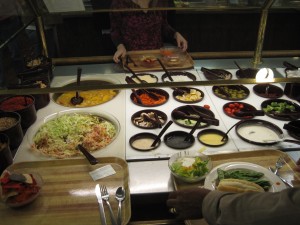
 When is a soup a soup and a yam a yam? My concept of these two food items has definitely undergone a radical change in the past three months since I’ve been here. Well now that I think about it, there has been some gradual change in my perception of them, but not in the way that the United Forests of America has shocked this Nigerian ghoul into a different realization.
In the beginning, soup was red, peppery and totally fluid, except for pieces of meat, fish, shrimp or other animal flesh. Of course, soup was also vegetable cooked with crayfish, onions, spices, oil and some other nice stuff. And then I travelled out of my comfort zone and came across a few women to whom what I called “soup” was just pepper stew. Yea, if you’re an Igbo Nigerian, you’re probably grinning by now in agreement. I discovered from those women from South Eastern and South Southern Nigeria, and from an Igbo roommate while in the University that what I called soup (by the first definition) was nothing but ofe n manu (stew filled with palm oil, or something like that). We had many bouts of argument about what made a “soup” different from a “stew”, and I never agreed with his insistence that soup must have more than just a flood of water, oil, pepper, fish and meat cooked in a certain fashion. In Yorubaland, that is a perfectly cooked pot of soup which was aided many times by ewedu, okra, or efo riro. In any case, my idea of “soup” had been well defined before I boarded that British Airways flight from Lagos.
Okay, you already know where I’m going with this… I ordered some food yesterday and one of the items on the ordered menu was a bowl of soup. When it arrived, it came in a large cup, was greyish white in colour, didn’t have oil in it and was sweet in a way that doesn’t meet and could not have met the “soup” definition criteria of either the Yoruba or the Igbo women in Nigeria that I know.
This is not my first encounter with American “soups”, but this is one of my first conscious consideration of the criteria we usually employ to define types of food. It is the same case with Yam. I did tell you that a few people here have ever heard of, or seen, what the yam looks like, right? I have since discovered that America indeed had “yams”, but they are not our African discorea species kind of yam, but Irish potato kinds, even though they’re not called Irish potatoes here, but “potatoes” simply, or “yams”. If you find yourself confused right now, I don’t blame you. Papa Rudy, my host family at Edwardsville once did try without luck to explain the differences to me between the red (supposedly sweet) potatoes and the “Irish” ones. “These red skinned ones,” he said “are ‘yams’, and these grey skinned ones are ‘potatoes'”. I nodded in agreement, and went back to playing solitaire on his computer in the living room.
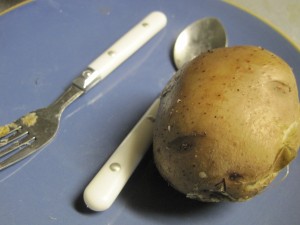 It was just as well, because almost three weeks ago when I went into Aldi’s to shop for groceries, I saw some of the red ones and felt suddenly giddy. I would be eating “sweet” potatoes for the very first time in a long while. What heaven! I bought sufficient, ignored the grey ones, and headed home probably dancing to the songs in my head. Alas, the horror of horrors awaited me when after about thirty minutes of cooking said “yams” or “sweet potatoes” on fire with little salt, I sat cross legged in front of the television and peeled them to eat. I couldn’t believe my tongue, and I had to taste them all one after the other to confirm what I was now discovering anew: this “yam” is actually a friggin’ yam, goddarnit! A yam, albeit of a small variety! In Yorubaland, we called this èsúrú! Aaaaaaaargh! I used to love èsúrú, but at that moment of sudden discovery of a kind of cheating from the culinary gods, I suddenly lost interest, and went back to doing other things.
The lesson for me there was not only to learn to keep my taste-bud enthusiasms in check until I’ve actually tasted the product of my cooking labour, but never ever to judge a food just by its name. Yes, I’m sure that real sweet potatoes exist in North America, and that I might find them someday if I ask around, but who’s gonna eat all these red-skinned impostor-yam èsúrús now? Surely, not me!
 10. People feel uncomfortable when you speak a “strange” language around them.
 One day very soon, I am convinced, I will write a post on this blog that might begin with words like “tttoooeddydyy isssss teiehehe ffirissttt ddyofff snoeoow”, which would only mean that I was cold, freezing and shivering enough not to be able to edit simple sentences. I am convinced that that day is very, very soon. In fact sooner than I expect. Yesterday was my coldest night ever in Edwardsville and it reached -3degrees by my blog temperature meter, and 30degrees Fahrenheit. Even my bed now is too cold for comfort. Very soon I won’t have to go out to feel cold, and I am not looking forward to that.
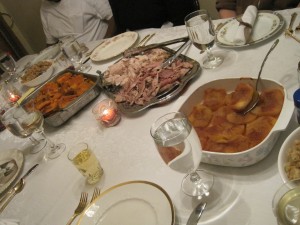 Meanwhile, I’ve just returned from another day of feasting – probably my last of the Turkey Genocide season. This time, to the house of my “official” host family: the Indian father and the American mother. The special attraction was another visiting family from Chicago, who were originally from Nigeria. It had a father, let’s call him Dr. O, his wife, and two kids who would not speak Yoruba to me however I tried to make them. They were born in Nigeria but have lived in the States for a long time that they have become Americanized in dressing, speech and conviction in a way that could have been bad if it had hampered their cultural awareness. Apparently it hadn’t, and although they would rather not communicate in the language, they had a kind of cultural awareness that could only have resulted from good upbringing and appropriate socialization. To them, I must however have been a special kind of attraction as someone sent specifically from the home country to teach Americans the language. But if that was the case, I didn’t notice it. It was mostly a gathering of laughter, wine, food, and practical jokes. The first born of the Dr. Os is married to a beautiful American girl who was also present, and who I am discovering to be a masters student of my University as well.
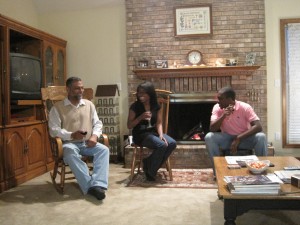 In gatherings like this, I am almost always bringing back the topic of language and awareness, and here’s how Dr. A, my Indian host rationalized it from his reading in German, Indian, Irish, French, and African migrations to the United States: First generation immigrants usually speak and understand the language, being a product of the two cultural experiences, and usually try to pass it along to their children. Their children – the second generation with little connection to the cultural experience of the homeland beyond their parents’ teaching usually become rebellious and toss out the language and cultural ideas of their immigrant parents while opting for the American way of life. It is the third generation however – without any link whatsoever to their original culture and language, according to him – who make the most effort to reconnect with their grandparents’ cultural base. This, obviously, is because they are usually the ones without an anchor. They most experience the feeling of homelessness and limbo, and usually find themselves going back in research to connect with what they feel most deprived of. According to this theory, it is only a most natural process when children of first generation immigrants try to become “Americanized”. And everything made sense to me.
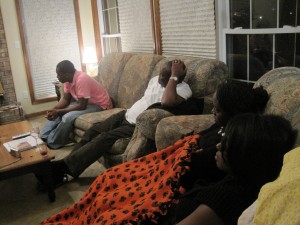 However, contrary to the seriousness of this last discussion which actually took place in the car drive back from his house, the atmosphere of the get-together was one more of conviviality, guitar playing, joking and generally fooling around. It was like one of those old times of my upbringing when I sat around my siblings on an idle night after a game of cards, just tossing around all the craziest ideas in the world, laughing, arguing and generally being silly. I bring it up here because now that I think about it, I suddenly miss those times when all that mattered was who had the silliest ideas, and we would stay up all night singing, scrawling on the wall, or decorating the house for Christmas with little coloured paper decorations cut out and sealed with pap syrup and stretched across the house ceiling sometimes with multicoloured Christmas lights. It is usually towards this time of the year as well when we begin to learn new Christmas songs or make a fool out of the old ones, all the time trying to be careful not to make too much noise that could get us the beating of our lives. Oh the times we had. Tonight, I’m convinced that we could never get back that memorable childhood in the same old form we enjoyed it, but I look forward to a grown-up future recreation of those experiences, this time along with nieces and nephews, and a bigger happier family. Some day soon folks…