 I realised, on my way back from the coronation of the Ọọ̀ni of Ifẹ, last Sunday, that I’ve never attended a properly-planned public event in this country as an adult. Be it a wedding, a naming, or an engagement ceremony, or even an official governmental or artistic event, the evidence from my trip down memory lane has left plenty to be desired, particularly as regards planning and implementation. True a few have come very close to proper organisation, but they have been too far in-between to be the norm. Either we Nigerians are terrible event planners in general or we are just terrible audiences of otherwise well-planned events, both leading to undesirable consequences.
First, the invitation card to the coronation of the spiritual head of the Yorùbá people had shamefully incorrect diacritics on the names of the new king – an unforgivable faux pas tolerable only because of our erstwhile collective tolerance of that kind of cultural laxity and mediocrity. Heck, we are numb already to books and newspapers printing Yorùbá (or Igbo) names without appropriate tone-marks, even when the editor of such publication claims to be an educated Nigerian individual. In an alternate universe, whoever was in charge of this royal invitation would be fired, pilloried, and barred from any future participation in any cultural events relating to the king. But our “educated” newspaper and book editors still collect salaries while putting their stamp of authority on the idea that this kind of (cultural and linguistic) certitude counts for nothing. Shame on us.

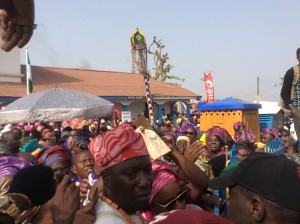 And secondly, an event slated to host royal dignitaries from around the world started almost as a free-for-all as royalty and “common” men jostled together in a crowd to make their way through a narrow gate into the hall. At one point, I spotted the king’s own father himself being pushed and shoved with the crowd, and having to prove himself to be who he is. It was the same situation for the mother of the princess and other numerous otherwise dignified guests who had to fight through what seemed like the eye of a needle, even while holding a VVIP invitation card. At one point in the crowd, one spots the staff of office of the Olúbàdàn of Ibàdàn – an otherwise important instrument of office that should pave way for its bearer without questions. For almost an hour, the staff and its carrier remained nestled within the throng (pictured).
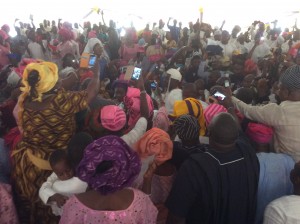


 By the time the Ọọ̀ni made his way into the hall, not only was his path blocked by indecorous photographers, well-wishers and other media practitioners wishing to take his photos, the whole hall seemed, at once, to have turned into a barbarous throng, with everyone standing on their seats with phones and devices at the ready to take photographs. Our modern interpretation of this phenomenon might excuse it as a sign of the king’s importance in our imagination, or our celebration of his ascendance -Fair point? – rather than a more unflattering suggestion: that it is a display of our lack of decorum at such events. One wrong footing and one of these amateur photographers would fall, deservedly, and land either on the king’s head or by his feet. And even without that, the walk from the entrance which should have taken less than a minute took over fifteen minutes: a newly crowned king pacing himself through an artificially-constructed hedge of human nuisance.
A while ago, on a flight back from the United States, I found myself in Paris, at the Charles De Gaulle airport, on the last leg of the trip. And for one moment, something that hadn’t occurred to me on any other part of the trip suddenly came to embarrassing prominence. The airline announcer had taken the microphone to announce that boarding would now commence to Lagos. But before the first few words had landed out of her mouth, a loud and cacophonous shuffle began, seemingly out of nowhere, involving only the Nigerians who a few seconds earlier were sitting quietly and minding their businesses. As if a shortage of airline seats had just been declared and an order placed that only the first at the gate would be flown to Lagos, my countrymen hustled and shoved themselves into what eventually became the queue. It has happened in other instances too, like two seconds after touching down, even before the seatbelt signs are turned off. My countrymen jump out of their seats and immediately proceed towards their luggage, as if they were going to disappear after just a few seconds of waiting.
Those who have cared about the matter have blamed much of this on our cultural conditioning. But I’ve been to Kenya and the situation is way different, from private comportment to general orderliness in public spaces, proving that it certainly isn’t an “African” conditioning. It’s a Nigerian issue, celebrated in other instances as our unbound boisterousness. In instances like this however, and in many others where acculturation should otherwise show itself as decorum, we have terribly failed, and we need to find our way back.
 One day very soon, I am convinced, I will write a post on this blog that might begin with words like “tttoooeddydyy isssss teiehehe ffirissttt ddyofff snoeoow”, which would only mean that I was cold, freezing and shivering enough not to be able to edit simple sentences. I am convinced that that day is very, very soon. In fact sooner than I expect. Yesterday was my coldest night ever in Edwardsville and it reached -3degrees by my blog temperature meter, and 30degrees Fahrenheit. Even my bed now is too cold for comfort. Very soon I won’t have to go out to feel cold, and I am not looking forward to that.
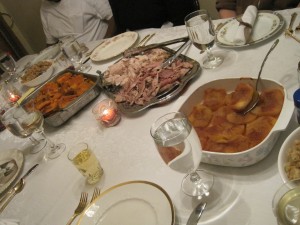 Meanwhile, I’ve just returned from another day of feasting – probably my last of the Turkey Genocide season. This time, to the house of my “official” host family: the Indian father and the American mother. The special attraction was another visiting family from Chicago, who were originally from Nigeria. It had a father, let’s call him Dr. O, his wife, and two kids who would not speak Yoruba to me however I tried to make them. They were born in Nigeria but have lived in the States for a long time that they have become Americanized in dressing, speech and conviction in a way that could have been bad if it had hampered their cultural awareness. Apparently it hadn’t, and although they would rather not communicate in the language, they had a kind of cultural awareness that could only have resulted from good upbringing and appropriate socialization. To them, I must however have been a special kind of attraction as someone sent specifically from the home country to teach Americans the language. But if that was the case, I didn’t notice it. It was mostly a gathering of laughter, wine, food, and practical jokes. The first born of the Dr. Os is married to a beautiful American girl who was also present, and who I am discovering to be a masters student of my University as well.
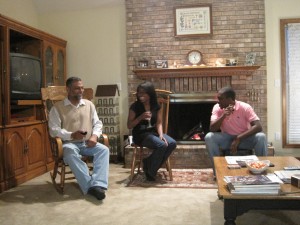 In gatherings like this, I am almost always bringing back the topic of language and awareness, and here’s how Dr. A, my Indian host rationalized it from his reading in German, Indian, Irish, French, and African migrations to the United States: First generation immigrants usually speak and understand the language, being a product of the two cultural experiences, and usually try to pass it along to their children. Their children – the second generation with little connection to the cultural experience of the homeland beyond their parents’ teaching usually become rebellious and toss out the language and cultural ideas of their immigrant parents while opting for the American way of life. It is the third generation however – without any link whatsoever to their original culture and language, according to him – who make the most effort to reconnect with their grandparents’ cultural base. This, obviously, is because they are usually the ones without an anchor. They most experience the feeling of homelessness and limbo, and usually find themselves going back in research to connect with what they feel most deprived of. According to this theory, it is only a most natural process when children of first generation immigrants try to become “Americanized”. And everything made sense to me.
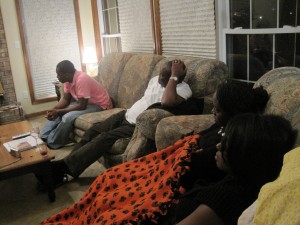 However, contrary to the seriousness of this last discussion which actually took place in the car drive back from his house, the atmosphere of the get-together was one more of conviviality, guitar playing, joking and generally fooling around. It was like one of those old times of my upbringing when I sat around my siblings on an idle night after a game of cards, just tossing around all the craziest ideas in the world, laughing, arguing and generally being silly. I bring it up here because now that I think about it, I suddenly miss those times when all that mattered was who had the silliest ideas, and we would stay up all night singing, scrawling on the wall, or decorating the house for Christmas with little coloured paper decorations cut out and sealed with pap syrup and stretched across the house ceiling sometimes with multicoloured Christmas lights. It is usually towards this time of the year as well when we begin to learn new Christmas songs or make a fool out of the old ones, all the time trying to be careful not to make too much noise that could get us the beating of our lives. Oh the times we had. Tonight, I’m convinced that we could never get back that memorable childhood in the same old form we enjoyed it, but I look forward to a grown-up future recreation of those experiences, this time along with nieces and nephews, and a bigger happier family. Some day soon folks…