Browsing the archives for the Soliloquy category.

Why Nwaubani Was Wrong

Many commentators have already responded fittingly to a recently published op-ed in the New York Times by Nigerian writer Adaobi Tricia Nwaubani. (One of them was Carmen McCain in this blogpost). In “The Laureate Cause” which you can read on NY Times or on 234NEXT, Ms. Nwaubani argues a faulty logic that implies that having new authors write in local languages is detrimental to national unity and cohesiveness and thus bad for literature. To momentarily ignore the fallacy in assuming that writers write so as to further nationalistic goals rather than to justify their creative potential by creating using whatever means they have, the argument she makes insults intelligence. Language diversity is one of literature’s best assets as well as one of its most assaulted elements. It doesn’t need anymore drawbacks.

With an array of opinions and ideologies as many as the tools of translation available to linguists, it is already difficult to prevent one work from misinterpretation. (Orwell’s Animal Farm was translated into two different ideological interpretations in East and West Germany respectively during the cold war.) However, the pleasure of being able to read works written in the native thought and tongue of the writer has aways been unquantifiable, as can be seen from the feting of writers like Gabriel Garcia Marquez, Naguib Mafouz, Gunter Grass, Mario Le Clezio and very many others including recent Mario Vargas Llosa who have all written in their local languages. If Ngugi Wa Thiong’o had won the Nobel this year, he would have been deserving of it, not just for the depth of his creativity, but for his contribution to the development of Gikuyu by choosing to write in it. We can only hope for more of those kind, and not less.

Many of the books I read as a child were in Yoruba and I can’t say it enough how much it helped my appreciation of English and all the other languages I have learnt to use. If tomorrow I choose to write in Yoruba – which I have certainly considered, I would represent an important a voice in literature as someone who decides to do it in Igbo or Swahili without care for English as an international language as long as I stay committed to the craft and say something new (or even something old, in a new voice and style) and say it well. We’ll have literary translators to do the rest. To make the case for English as the only medium of creative process is easily the biggest one of the many flaws of her essay, and a disingenuous take on the African literary present and future.

Cross posted at Nigerianstalk.org.


In Africa, the Laureate’s Curse

Daydreams and Questions

“What do you eat back home? No, what meals? What is the nutritious content? What utensils do you eat with? Do your children play with barbies, What is the rate of HIV/AIDS? Do you ride a car? Do you have cars? What kind? What of your roads? Of what kind are they? What’s your government like? You run a socialist government, right? No? But your medicare is government run, right? Not as efficient as we have here. You can go to the hospital and get treated without having insurance. Yes? No? Do you like Obama? How did you speak English? Just what is like in Africa where you’re from?”*

Beaten paths of childhood dreams and games on a once dusty road, I return to the noises of the street from where I come. It lay bare in the eye of the sun, with drumbeats of restless feet, and hope on thumping hearts. It seems distant, but also sometimes close by in the eyes of the little children I encounter within the walls of this new land: adventure, love, curiosity, precociousness, love, hate, impatience, impetuousness… Their parents dote on them with love and protection, as they should, in hopes of a more hopeful day ahead. It looks the same to me, I think, and smile back at the little shy girl on the lap of her father. She inherits a large world of new dreams and places to see, and taste.

Behind my childhood home, about half a mile towards the more silent parts of the neighbourhood is a railway line that divides the city into two. I’d stand by its side, looking towards each direction from where locomotive trains blare their horns early in the morning as they move coal and some other market goods around, and dream. The rail goes as far as eyes can see, into where else its makers destined it and on the regularity of black but shining tracks. It recedes beyond my reach all the time, and along with the dusty sweat on my brow carry with them a dream of a place far beyond the reach of limits. It is here. It is even farther beyond. Out through the window of the child’s eye, I see that dream of the past and the adventures of coming days.

Holidays and Readings

This period of the season just after final exams means only one thing: a long space of time left open to do anything under the sun – or on top of the snow, depending on what part of the world you occupy. Holiday means days without school, without classes or volunteer work at the Institute, without work at the Foreign Language Lab, without driving (much) and without Blackboard postings. I need that. I looked into my book drawer yesterday and found almost two dozen books I’d bought without reading more than a few pages.

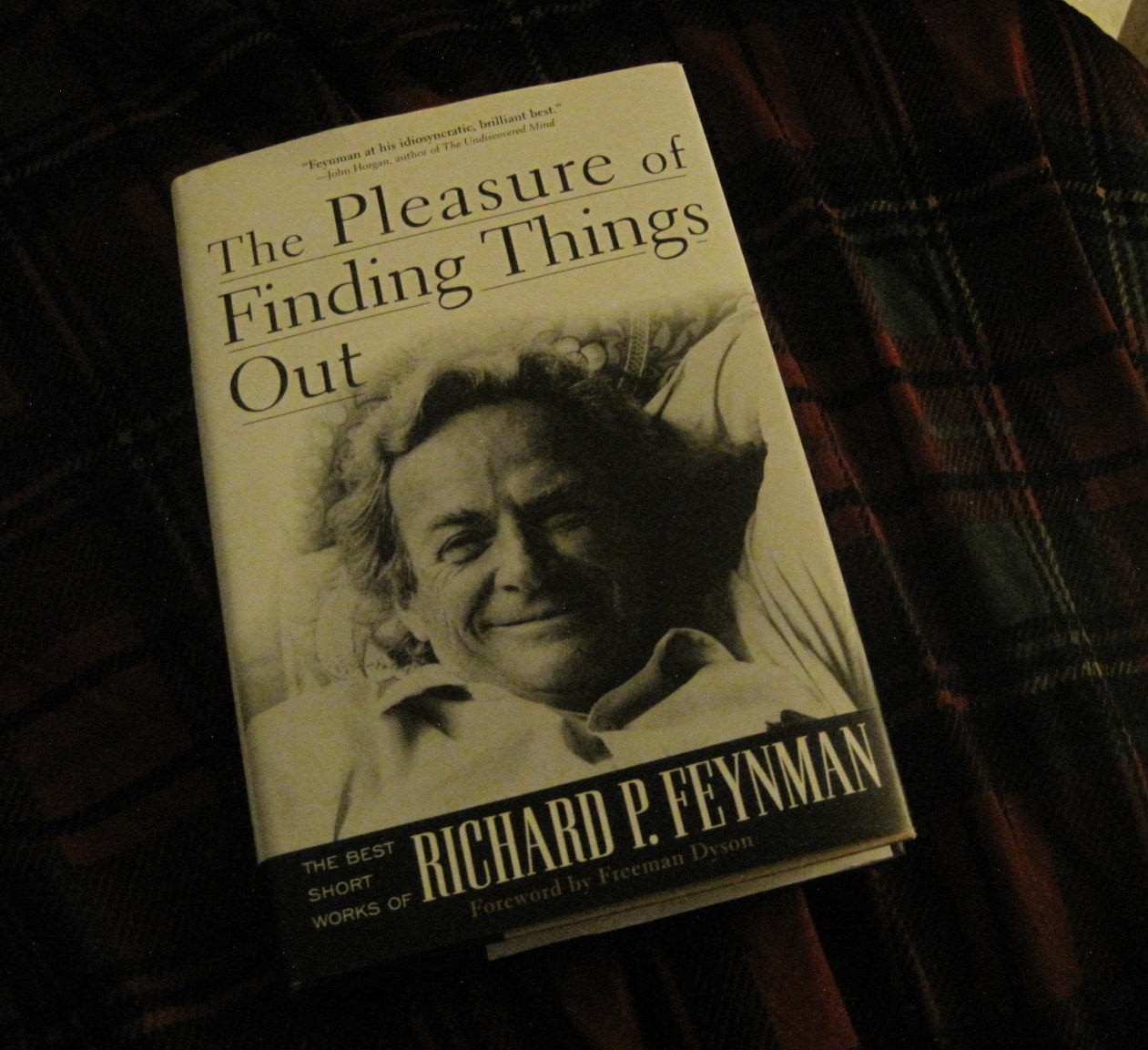
Just yesterday, two more arrived: Richard Feynman’s The Pleasure of Finding Things Out and Wole Soyinka’s Art, Dialogue and Outrage. The latter was a text that had dominated much of the many conversations and debates with mates and scholar as an undergraduate in Ibadan. Obviously important to understanding the thoughts of Africa’s first Nobel Laureate in Literature, the book has always been a reference point. Spending a few minutes on the preface has however convinced me that I should read it only when I’m well fed, and in a most patient mood for deliberately difficult writing. Feynman’s collection of essays is a delight, like many of his earlier publications. Much of the book are transcribed from his BBC interviews as well as from many of his published essays and speeches. Another one of his books What Do You Care What Other People Think now lay somewhere in my bag. I can’t wait to devour them.

The other crazy idea in my head, encouraged – no less – by Mohamed is that we get in the car and drive to California during the winter break. If I wasn’t considering it myself, I would have said that he had gone nuts. Now I’ve given my (almost) word and may have to do it after all. The only obstacle is a stretch of road 2000 miles long which may most likely include black ice and heaps of snow many miles long. What do you think? Is it worth it or would a good old flying do? Oh, there’s still the TSA scanners and grope-downs to worry about.

Interlude

There is no writer’s block, just laziness. Perhaps.

A few weeks ago, I wrote an article for an e-zine on the motivations for blogging, the challenges it provides, and the general pleasure of having things to write (now just “almost”) everyday of the week. Here’s my experience. I sit down facing a blank sheet of paper trying to write something serious or concrete either for a newspaper or for a class project/assignment, and I get stuck. Nothing comes. The part of my brain needed to get the work done just blatantly refuses to start up, and I remain in one spot for as long as possible, beating myself up and wondering why on earth it seemed so hard to do something as simple as writing, and why I’d been so hated to have been given the task that offered no exit, and no mercy. Nothing else to do, I would then go to my blog, open a blank page for new posts, and write something long and pretty – in less then fifteen minutes – in relative ease, loosening my “writerly” tongue and allowing the brain the luxury of admitting that writing could actually be pleasant. It is the same brain which a few minutes before had locked itself up like a clam. It is also the same typing fingers now addressing a different audience. And that has always defied all explanation. Is the conclusion to be drawn that of the fact that life should be smooth, easy, and playful, subject to our moods and whims? Or should it be regimented and organized, subject to the wishes of a remote instructor waiting to mark our work with inks of red? Or that whenever faced with the latter, a mood of the former should be immediately invoked in order to get through the mood?

Here I am, unable to find the first word with which to begin my final class project due next week, writing without stopping for air on a blog that would give me neither an “A” nor a tuition refund. FML(?) Back to work now.

Remembering Feynman

I strongly recommend Richard Feynman’s book Surely You Must Be Joking, Mr. Feynman! for anyone interested in the appreciation of the world and the little beautiful things in it. Not able to tell you why I’m thinking about him right now, I found his recollection of his childhood and professional life to be one of the most pleasurable one I’ve ever read. I can say for a fact that his was one of the best books I’ve ever read. And the last time I read this book was more than five years ago. He also wrote The Pleasure of Finding Things Out and What Do You Care What Other People Think.

Written from transcripts of interviews recorded over a long period of time, the man walks through the many curious instances of his precociousness, from learning the secret of mathematics to learning to pick locks and safes. At some point in the later parts of my teenage years, I almost learnt to pick locks too, picking after the physicist. I failed terribly. It was the early days of internet in Nigeria and I desperately craved its promised access to the information highway, and I would do almost anything to get usernames and passwords of uncles and friends without their permission. I failed at that too, eventually, and I remember the very many nairas, savings from my first real (also poorly-paying) job at a computer service centre, which I spent surfing the internet and learning new things along the way. Who knew that a day would come when everyone had internet on their computers for 24 hours every day. As far back in 1997 in Nigeria, that looked like a faraway fantasy of a future.

The book by Feynman also takes us back to the beginning of the research into developing the atomic bomb, and all the mischief he caused on site of the research facilities at Princeton, and as a professor at Carlton and MIT, picking locks and leaving clues for his scandalized superiors.  He claimed to be the only person to see the bomb tested with his own eyes through the UV shield of a car. All the other people wore glasses. (He also worked at Los Alamos at some point later). Beside the lucid and very absorbing prose and his story telling abilities, Feynman comes across as an eternally curious being not limited to his field (of Physics) or any field at all in his approach to understanding the world. After the crash of the space shuttle “The Challenger”, he broke down the hard details of a scientific error for the common man on TV at a public hearing, and cemented his reputation forever. Whenever I think about my outlook on the world, I think about how much of it I owe to the kinship with the spirit in Feynman’s book. I also immediately begin to look for the phone numbers of my friends who have always pawned my copy every time I buy a new one.

From the love of the science of language, to syntax, to computer programming (which I learnt at some point during the idle times after my secondary school), to learning to play musical instruments, sing, laugh, ride bicycles, almost crash my parents’ car, mess up my cousin’s hair at some point with the barber’s clipper as an experiment (and getting deservedly pummeled for it later on), and learning to draw, to paint, to write, to learn languages, and mostly to explore the many awesome areas of life as it tosses them my way, I have learn to live life to the full. We have less than 24 hours of it at our disposal every day, but it’s amazing just how much pleasure each discovery brings. If I ever become famous, I want to be like Richard Feynman, a wonderful down-to-earth physicist and a great teacher whose ideas changed the way we looked at the world, but who himself never stopped being just a man, with a regular (although many times very mischievous) taste and sensibilities.

Image from http://www.brew-wood.co.uk/physics/feynman.htm