Browsing the archives for the Soliloquy category.

Side Effects of Syntax

There is a long and heavy sigh that now usually accompanies the end of another painful attempt in class to win her heart. Every other fallout from that – including sleeplessness, irritability and crankiness, and an inability to update blog as necessary shall be called the sytax syndrome. Who would have thought that I would find a formidable opponent in her after more than seven years of a painless mutual separation. A mutant demon just slightly different from the X-bar and Transformational Generative Grammar models of that undergraduate life has now returned in my American class, and the result is not pretty. Add that to the annoying schedule of activities that lap up all the waking moments of my week, and you have a little glimpse into the direction of my life at the moment. Underneath all sentences and utterances of English (and every other language of the world, in fact) lies this very benign-looking but really mischievous virus. It looks like network of trees and sticks from a microorganism when looked at under a lens. Unfortunately, everything else in the appraisal and understanding of language derives from its bosom, and there is no escape.
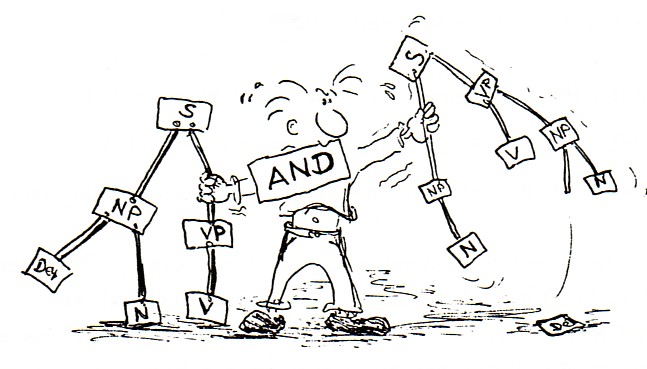
What I’ve been doing then in an attempt to strike back is a diligent and thorough approach to its challenge. It involves sleeplessness and excessive eating, denial, and plenty tree diagram exercises among others. It is not proving to be an easy one, especially because of the pressure from two other equally demanding classes on pedagogy and teaching assessment. Whoever said the life of a graduate student is easy hasn’t been studying linguistics. And whomever said there’s no “i” in team hasn’t been studying phonetics either. In this curious battle between the tormented mind of a young linguist and the gigantic demon that is syntax and its ramifications, the “i” in team, just like its phonetic equivalent, is a long and lonely one, sandwiched between two formidable consonants. Meanwhile, here is (more than) a week long break for eating, travelling, fun and merrying in my hands that is about to yet again be intruded upon by syntax and generative grammar. What to do? What to do? If I can just admit to myself that much of my present resentment comes from a reluctance to now engage this familiar adversary on its own terms, maybe I’d actually do better. Or maybe not.

At least if I lose my mind now, I’d know who is to blame. Right now, all I see are trees branching in different directions, upside down with thin black branches. Hello sytax. We meet again. How can we engage so that we part on good terms this time, and for good?

(Image from http://www.elloandfriends.uni-osnabrueck.de/wikis/1/show?n=syntax.syntax)

Protected: Saving the Words

This content is password-protected. To view it, please enter the password below.

Pondering Education

On returning from my weekly work in St. Louis, I’m pondering the importance of education and the state it is today worldwide (and especially in the US since I can only speak from the sneak peek perspectives that I have from being a teacher as well as a student at different times so far.) No doubt – as Clarissa comments in one of her recent posts – higher education in the US is (one of) the best in the world today. The reason why this is so is not just because of facilities, but because of some safeguards put in place to ensure independence of thought, and the freedom to pursue new challenges. It is terrifying to think of how easily it can collapse if allowed to become subject to the whims and prejudice of politics. Just last week, I followed the very many of people in the academics who had their hearts in their mouths while waiting for the result of the gubernatorial election because of the prospects of what would happen if a certain candidate wins. He had promised to cut funding to Universities in order to fulfil his party’s agitation for “small governments.”

The No Child Left Behind Act passed under the Bush administration is notorious today because of how it subjects the prospect of learning to a set of blanket rules that doesn’t take into consideration a lot of testing biases, and variations in language aptitude and proficiency in child learners. It also subjects funding of schools to fulfilling a set of rules arbitrarily set by Government without regard for procedures or tested and trusted research results on child education. I’ve been reading a lot about the act and its effect on early childhood and high school education in the US, and it brings tears to eyes to see that had the changes in the Senate had been as drastic as it had been in the House of Representatives last week, by now, we would have returned to the same old process of returning schools to that retrogressive path. For now, higher education has been (only largely) immune from the influence of federal politics, but for how long will that remain? Till the next election?

The US federal budget for defense is more than twice the total annual budget of some other countries in the world – and for good reason, some might say. It’s not my place to knock the country’s defense or military agenda. Yet, thinking about it, one wonders if it is not always infinitely better to educate the mind of citizens than spend an even larger cost putting them and the country in harm’s way sometimes for totally non-justifiable reasons. The program on NPR today on my way to St. Louis focuses on the increasing number of US soldiers that have committed suicide since the occupations in the Middle East began. The number increases everyday, and the country spends more and more seeking psychologists and psychiatrists to take care of the resulting effects of the combat fatigues that fuel those horrible, preventable deaths.

I do hope that education grows someday to become a bigger priority for government spending, but I won’t cross my fingers yet. I live in a country of sometimes contrasting values, possibilities and characteristics.

Religion, Campus, Trouble!

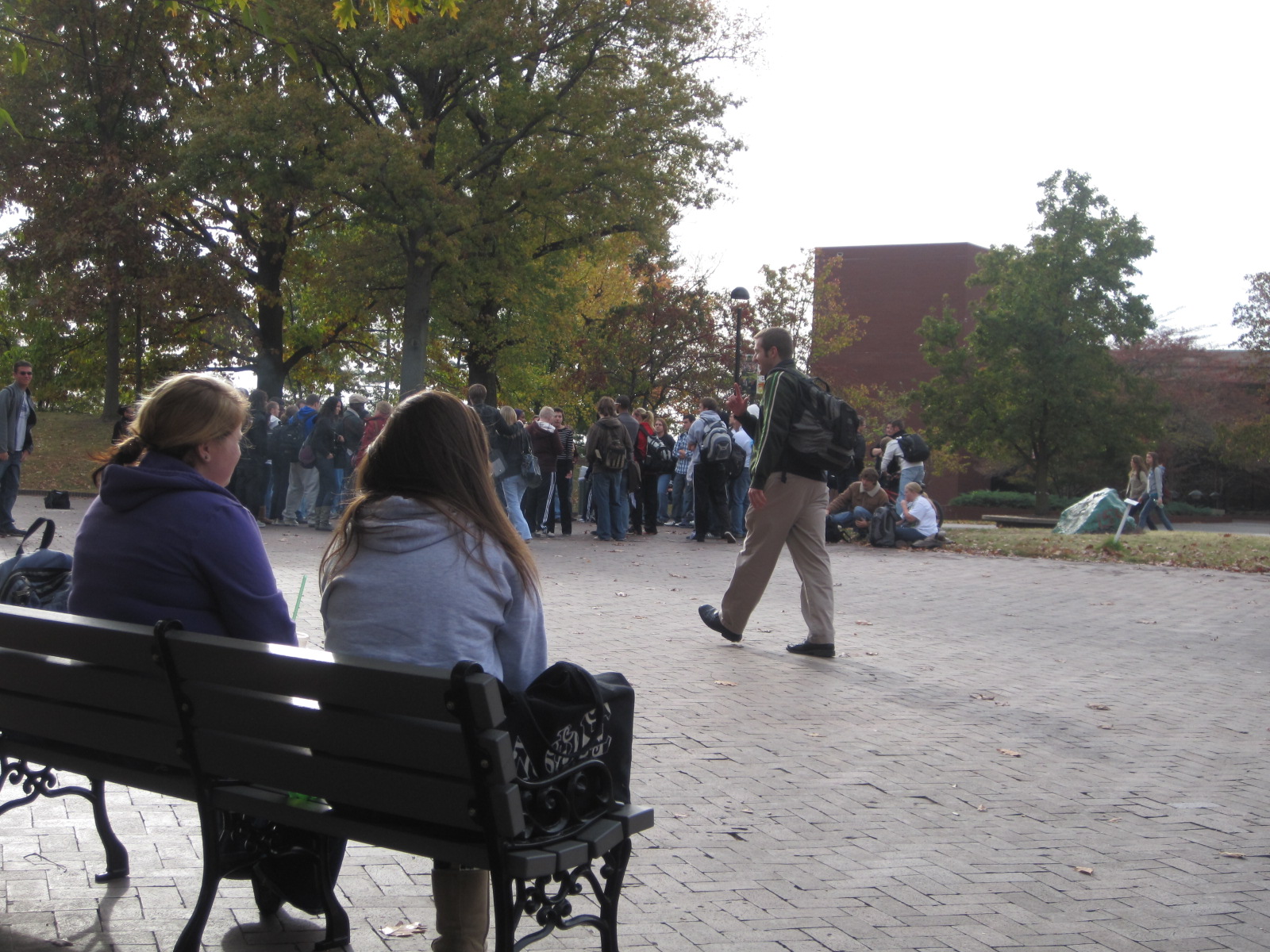
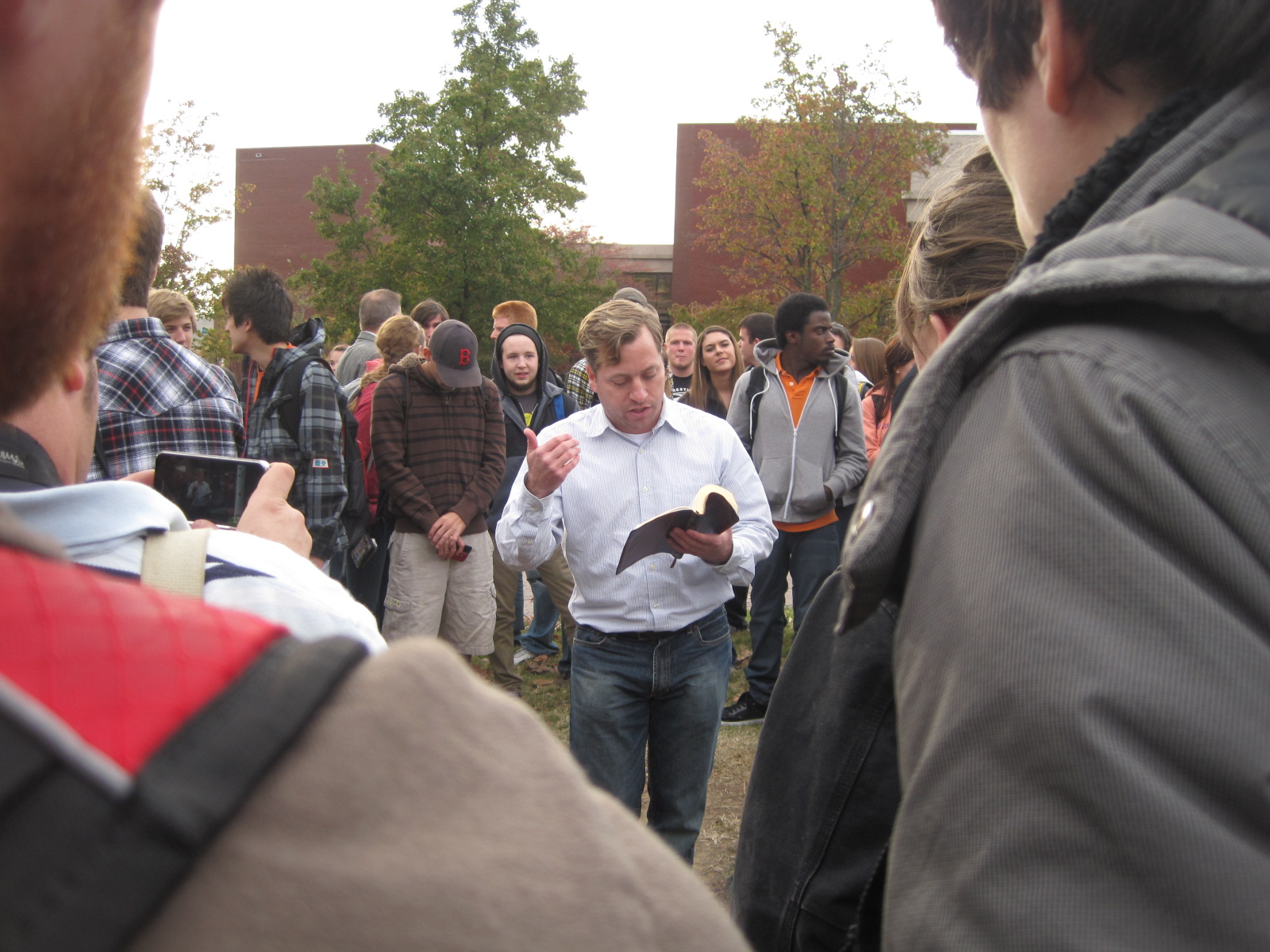
Really? Not really. But if you see someone in the middle of a university campus on a cold afternoon preaching with every zeal in his body, you’re bound to have a few eyebrows raised, especially if that University is in the America. Very soon, the crowd around the said preacher will get bigger and bigger, and its members would begin to engage him in a loud debate. Trust university students never to let an opportunity for an argument go to waste. And then, as a result of that public spectacle, more and more people would come to see what the whole thing is all about. They don’t see that often.

I’d been alerted by a phone call. “Oh Kola, come! A crazy man is preaching here.” But I knew that the man wasn’t a crazy man, by the hysteria in the voice of the caller. I’ve also seen many preachers in public places (Who from Nigeria hasn’t seen one of those anyway), and I knew it highly unlikely that a crazy man would be allowed to stand for long in the middle of campus in America. Maybe it was just a healthy argument of opinions, I thought. Getting there and seeing the young man within a circle confirmed my suspicion. He was only as crazy as his decision to come to a campus filled with young fun-loving students to preach the gospel of Christ. So we all stood there, and listened to him.

But he never really made any new points, perhaps because of the hecklers who didn’t give him the chance. What he did the most was rehashing an old conservative messages of Christianity that excludes recognition to gay people, Jehovah’s Witnesses, and the theory of evolution. And all I was thinking as we were joined by the many other people curious about the activity in the circle – and a few other angry hecklers that wished they had a chance to push him off – was “What what the young man was trying to prove?” “Is this the right place for this?” “Does he mind that people were there mostly for the heated debates?” If anything, does he realize how much of a lightening rod for criticism of all that is wrong with zealous proselytism as he stood there responding to every heckler in the crowd with an opinion? And then again, I wondered how possible it can be to make a case of God’s love for some special people alone over all others without sounding inappropriate.

The police eventually showed up but didn’t disperse us. They stood at a distance, watched, and later walked away, as eventually did I, wondering if there was any lesson to be learnt from the drama. It doesn’t happen often around here.

It is reported here and here in the campus newspaper.

My Dashiki Halloween

Last year Halloween, I missed my chance to dress up as a Pirate of the Caribbean. This year, to redeem myself, I came up with a variety of costume ideas. At first I thought that I could be Robert Mugabe, the Zimbabwean dictator. I gave that up when I realized that I’d need to wear a three piece suit to be close. Then I wanted to be the stupid Nigerian Underwear bomber from last year. To do that, I might need to wear a t-shirt (and maybe a fiery underwear) and look silly. No way. Then I thought I could be Kunta Kinte. Who cares, I thought. Halloween is such a day for the ridiculous anyway. However, Kunta was a short man, and I’d have to look and behave really angrily. I gave that up as well. Then I said I’d be Fela the musician. Then I realized that no one around here really knows who he was to be able to correctly identify me. Then I said maybe I should be Eddie Long. Oh no, I said again. I’m not that desperate to be ridiculous, so I jettisoned that too. I decided to go as myself, in a classy Yoruba dashiki vest.

Nothing more needs to be said except that it was thick enough to keep the cold out when I’m outside, and colourful enough to be a Halloween costume in America. When I was asked who I was supposed to be, I said I was an African president from the Congo – not minding that the clothing material is not even worn in the Congo. When I went to the parade at downtown Edwardsville yesterday, I wore it again, and I got a few interesting glances. It’s Halloween, geddit? Let’s see what happens when I wear it to the department sometime. A student from Ghana saw me and said it is called fugu in Ghana, and is worn mostly by the Hausas in the Northern part of the country. All I know is that Wole Soyinka wore it on top of an “English” dress to accept his Nobel Prize in 1986 in Stockholm. Now it all makes sense. The cold in that part of the world is beyond belief.

And so it ends, another season of fun and festivities.

______

Random: I think it’s unfair that most of America’s fun places are in Missouri rather than in Illinois. Sometimes last week, I went to Grant’s Farm – a spacious fenced plantation ground belonging to the former general and president Ulysses Grant, also in Missouri. The grounds of the farm – now populated with animals of different kinds – was where the president spent much of his time during the civil war and the Mexican war. The state has so much more than has been presently discovered, and I’d be glad to check out as many more as I can discover.