Browsing the archives for the Observations category.

So Where Are We From Then?

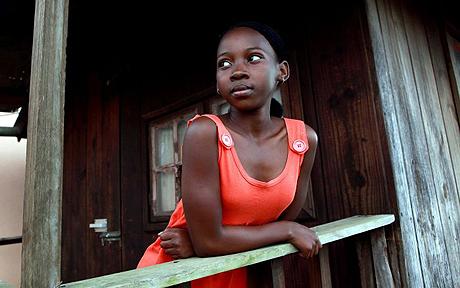
(Photo credit: RAJESH JANTILAL/AFP/Getty Images)The most famous story about the origin of the Yoruba people is that we all descended from one man called Oduduwa. It is also the most misleading of stories because the man called Oduduwa who was said to have come from a place called Mecca (or, as historians have agreed, somewhere in the Middle East) most possibly found some indigenous people already living in the area now called Yorubaland when he landed with his travelling party from Mecca, and could not have been the sole progenitor of the now over thirty million people. In any case, he was said to have had only one son, who later had seven. So, for all intent and purposes, it was a conquest, kind of like the Founding Fathers arriving on the American continent from Europe, or Christopher Columbus “discovering” America after a long ride on the ocean, or Mungo Park “discovering” the Niger river. If that is the case, then when as citizens we use the now famous self reference “Omo Oduduwa”  to refer to ourselves, we engage in a kind of deceit, or self-disservice, or at least a subservient acceptance of the prehistoric conquest. The verifiable children of the man Oduduwa were the original seven kings who descended from his son Okanbi, and their own living descendants who now occupy the kingship thrones in Oyo, Benin, Popo, Sabe, Ife and two other Yoruba towns. That said, we are all Yorubas, just like the occupants of Britain are now all Brits, not Normans, or Romans, or Celts just because they were once occupied by those forces.
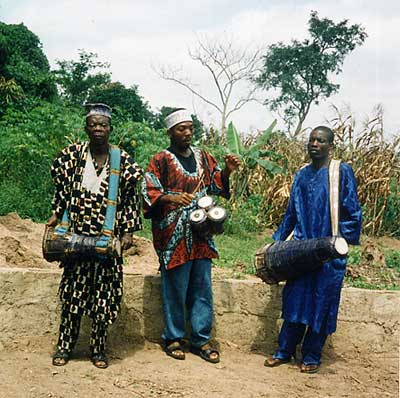
Image from http://www.agalu.com/biography.htmlBut where did we come from, the Yorubas? Going by the Oduduwa story, we (at least those Yoruba citizens that have “royal” blood) are all descendants of Oduduwa, who in turn is a descendant of Lamurudu.  Lamurudu interestingly is the Yoruba’s corruption of the name Nimrod from the bible, according to the Reverend Johnson in his book The History of the Yoruba. So there it is! We’re confirmed descendants of the Jews. Yet history does not rule out the possibility that Lamurudu/Nimrod was not even the immediate ancestor of the man Oduduwa, or that Oduduwa himself was not the immediate ancestor of Okanbi, so it is fair to take liberties with the fact. It is possible, almost certain by these accounts, that we were descendants of Nimrod the son of Cush, grandson of Ham, great-grandson of Noah. Now, even to me, that’s far removed. Why? Because Nimrod’s personality has never been fully established, and every once powerful civilization from Egypt to Greece to Jewish cultures have their own written perception of him that are not always complimentary.
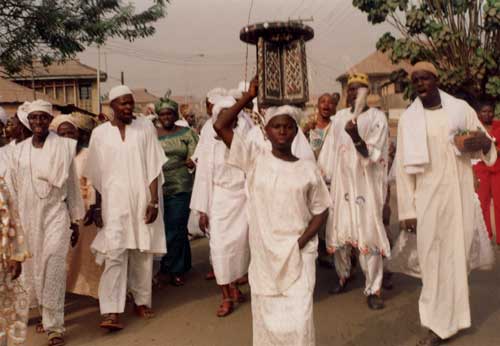
Image from http://obatalashrine.org/000004.phpSo where did we come from then? A literal mecca? Quite possibly. The islamic civilization has it recorded that many years before/after Mohammed the prophet, many so called idolators were expelled from the city into the world outside. The man Oduduwa and his entourage who later settled South West of the Niger river were believed to have arrived there not only with magic and graven images (which were markers of idolatory for which they were said to have been expelled from the religious middle eastern city in the first place), they also came with peculiar forms of dressing, communication and way of life that marks them as from that part of the world. They worshipped man-made gods, they made sacrifices to them through priests, they wore long robes, greeted each other in a particular way, and their women covered their heads as part of their cultural identity. The staff of Oranmiyan in Ile-Ife today still has the words “Oranmiyan” engraved on it in Jewish letters, and it was erected before the coming of the Europeans to that side of the world. Have you ever wondered why the Yorubas name their children on the eighth day of the birth of the child? I have. Could it be, as suggested to my surprise by an American student in my Yoruba class on Wednesday, that we are following the tradition of the old Hebrews who always circumcised their children on the eight day after birth, as ordained by their God? I don’t know, but I won’t bet against it. There is so much that I don’t know, that I wish I knew. There is so much more we need to know about ourselves.

The real wonder for me is where we are from, we Yorubas who are not descendants of kings or the patriarch Oduduwa. Any takers?

___________

Photo credits:

Word of Wisdom

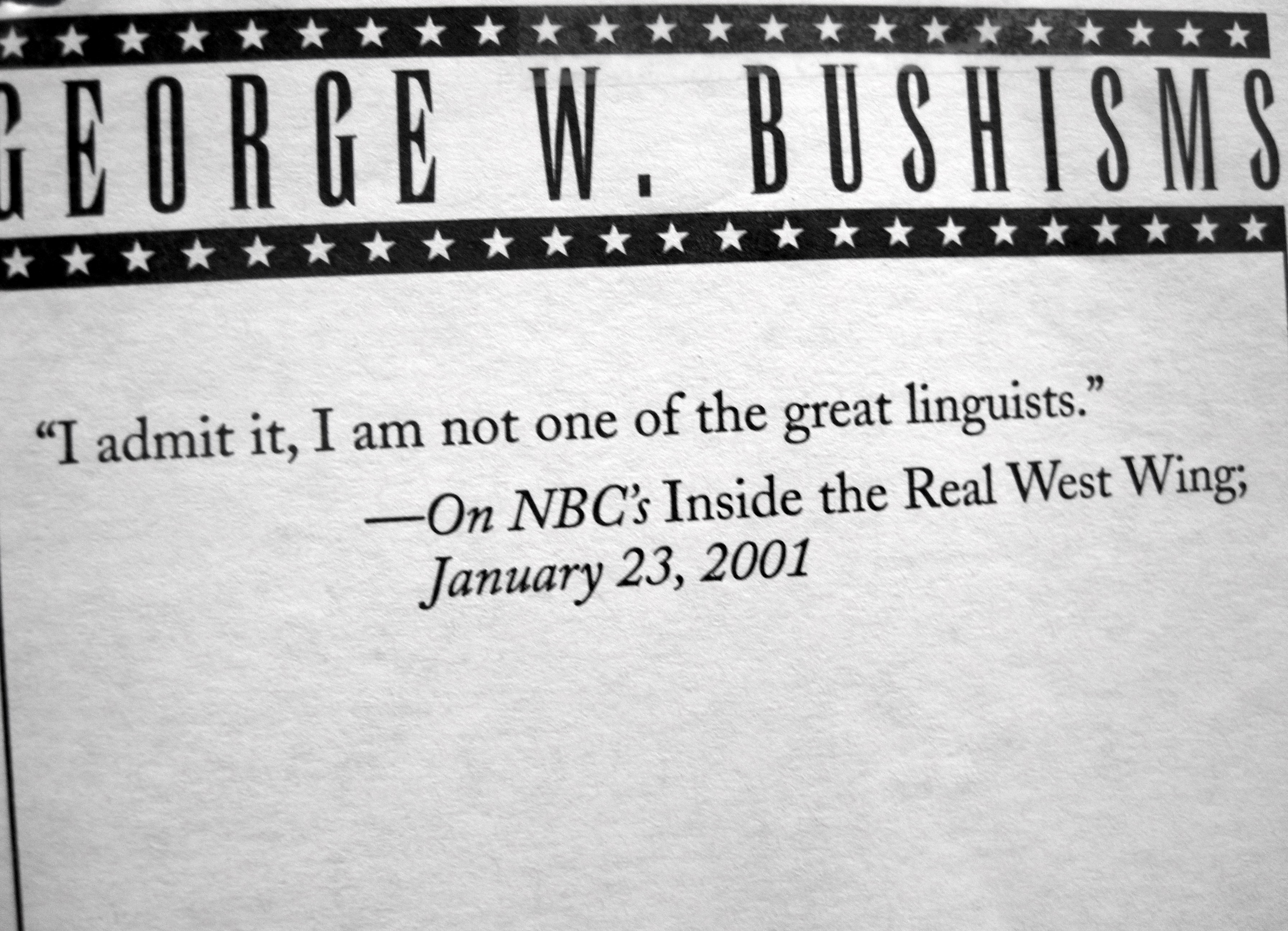
“I admit it, I’m not one of the great linguists,” he said.

Yea right?

I found this on the office door of my Linguistics professor.

Just Like Old Times

“There are three major reasons why I wear this cap wherever I go, around the University, and when I come to class as I will from now on. I’m about to tell you.”

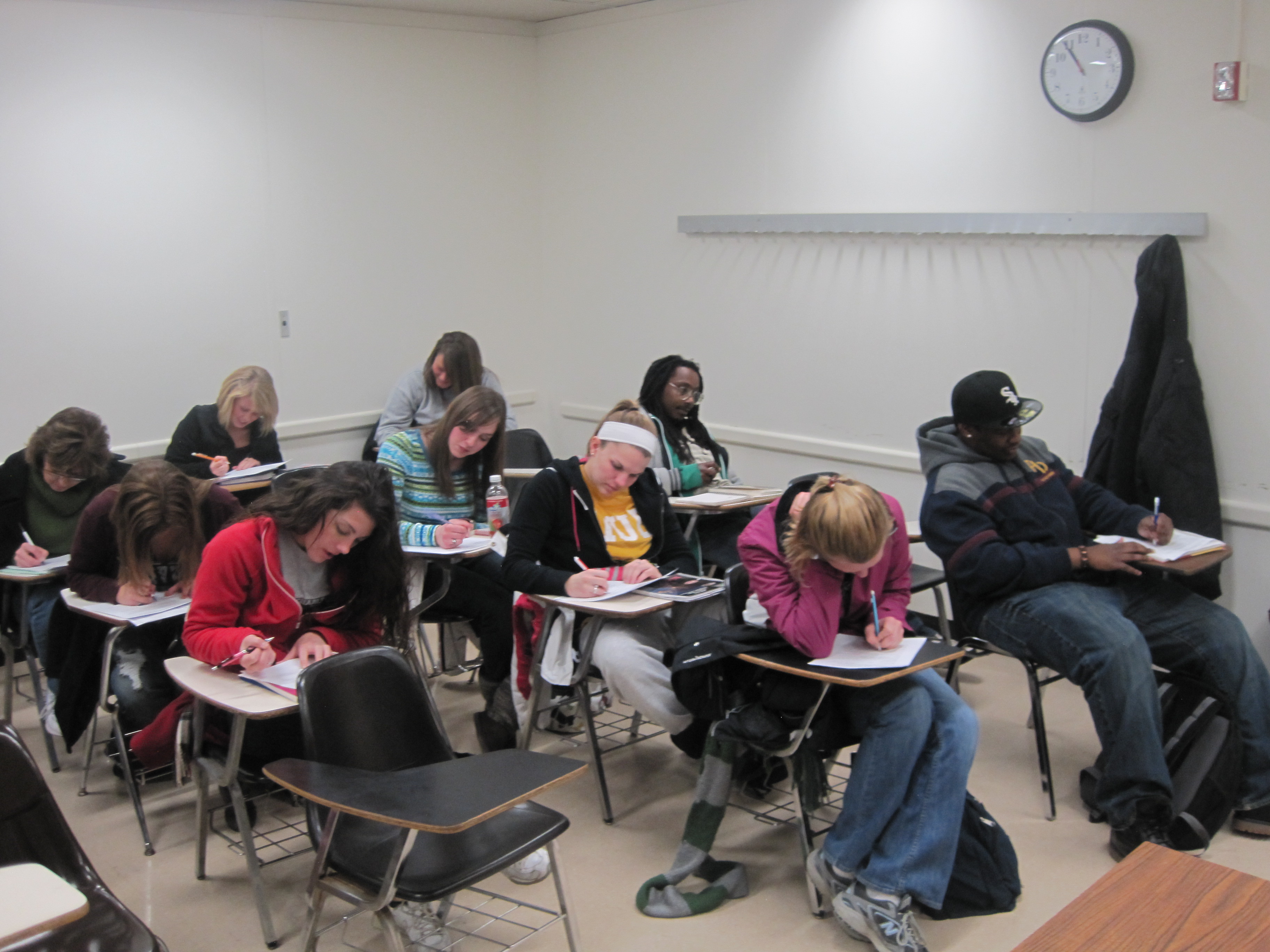
That was one of the first things I said to them them, a few seconds after I walked in to the full class where a horde of quiet, curious looking faces of attentive students stared back at me, none of who knew what exactly the class was going to be like. It was just like old times. They gave me rapt attention, they smiled when they had to, they had random looks of wonder and intrigue. But they probably had never seen anyone wearing this kind of cap before. It’s African, made of the finest aso oke, from Nigeria, West Africa. The class was full. I had prepared only seventeen copies of the syllabus, hoping that there would be at least fifteen students in class, and I’d have a few to spare. There were nineteen of them. No kidding! The twentieth student signed up a few hours later. This is a long shot from my previous nine students of the Fall semester! I took in the sight of them, fidgeted for a few seconds, and found a way into an introductory talk that was meant to put them at ease while providing an insight in the content of the course, and what it would take to pass, and to enjoy.

“The first reason why I wear this cap is that it is cultural. Yoruba people like to complement their dressing with a matching cap.”

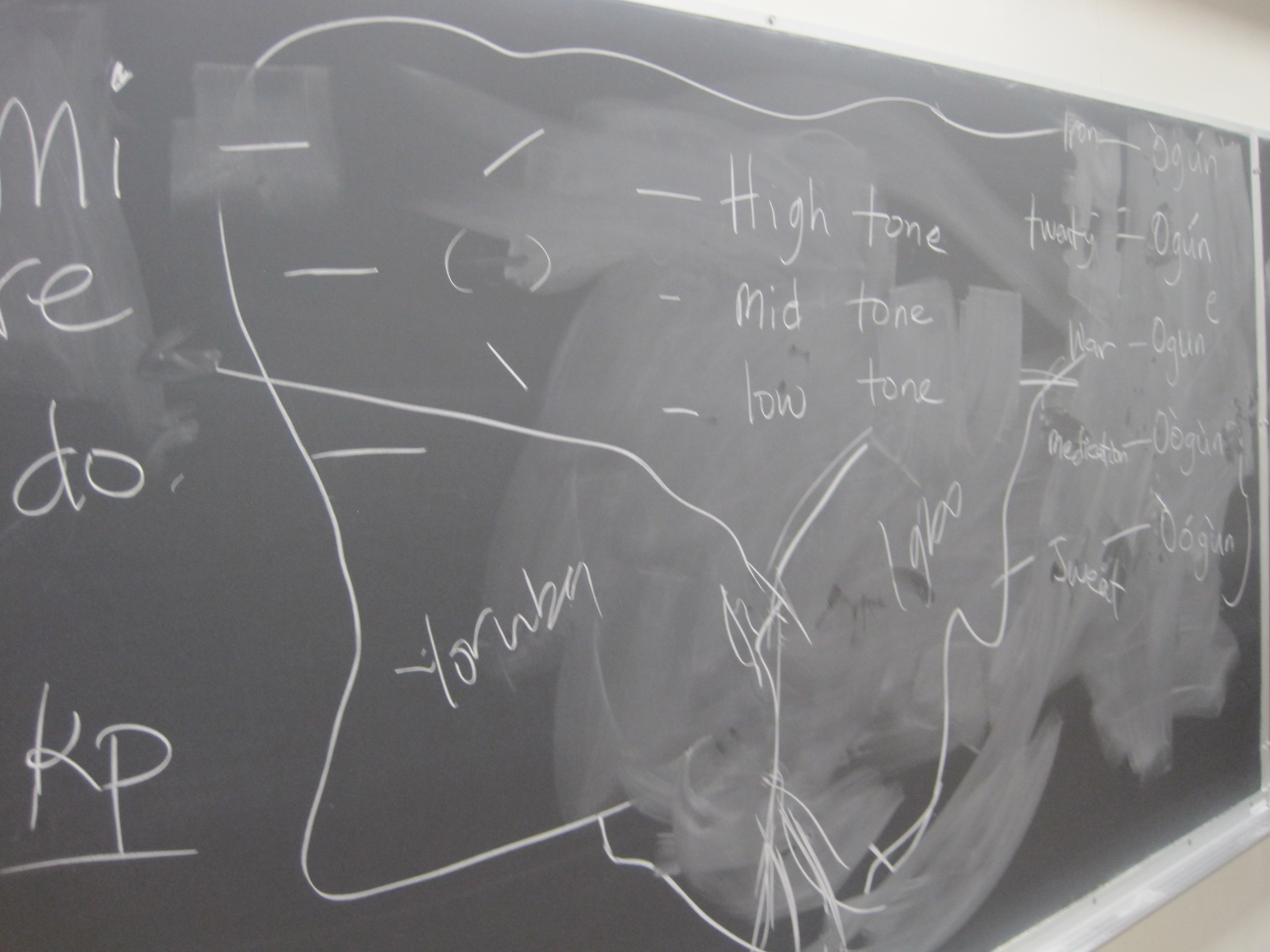
Before I told them where I’m from, I first asked them to take a guess, and none got it right. So, I wrote it out on the board, and I heard a gasp, and random giggles. “Yes,” I said, “By now, all of you are familiar with the name of this country since Christmas day, right?” They all agreed. “Well, what you probably didn’t know,” I continued, “Is that we have over 250 ethnic groups, and over 500 languages. You also didn’t know, perhaps, that Yoruba – the language you would be learning for the rest of this semester – is spoken by over/about thirty million people both in Africa and all around the world. We have also produced a Nobel laureate in literature.”

“The second reason – as you can guess – is that it’s winter, and I don’t want to kill myself by exposing my head to the harsh cold weather”

They laughed at this one. It was the first victory. “It’s true,” I continued, “I’ve never lived in any place colder than 20 degrees Celcius before. It’s a wonder that I’m still alive now in a temperature of sometimes minus twenty.” That seemed to shock and surprise a few of them, and I continued. “Has anyone of you heard of a singer called Sade Adu? What about the musician called Seal? Oh, you have? Good. Does anyone know who Hakeem Olajuwon is? He played for the Chicago Bulls, I think. Oh yea, many of you do? Nice. What about Adewale Akinnuoye-Agbaje, that very dark-skinned man that played an Egyptian mercenary in The Mummy Returns and a French Legionnaire in the movie Legionnaire? He was also in the first seasons of Lost, I think.” I counted them and smiled. “Well, great,” I said “one thing they all have in common is that they are Yoruba, originally from Nigeria. Are you excited already? In this class, we shall learn everything we can about the Yoruba people, their culture, way of life, and language. And the first step in that knowledge is that we all must have Yoruba names. Yes, indeed. I’ve told you mine, and you’ve told me your American names. Now, you have to go and look for Yoruba names, their meanings, and why you want to bear them. Go online, ask friends, read books, but by Wednesday, we will all begin the necessary steps to become Yoruba citizens. Who’s excited already? Great!”

“Well, the third reason is that I sometimes forget where I left my comb in the room when I wake up in the morning…”

And so it begins, just like old times!

Schools Kill Creativity

I came across this video through a friend a few days ago, and I am convinced that this is was very apt now that school resumes today. Most apt. Well, enjoy the speech by Sir Ken Robinson. He makes a whole lot of sense.

PS. There is the option of subtitles for the video, for those who don’t do well with spoken British English.

Courtesy Ted.com

Do You Speak English?

If I were to rank all the awkward questions that I’ve been asked since I came here, I’d rate this one the highest: “Do you speak English in Nigeria?”, along with its many variants of “How do you learn to speak this well/this fluently?” and “I like your accent.” I have got inured to its silliness over time, and learnt to enjoy it as a compliment whenever I hear it. So I respond instead with “Oh, thank you.” Sometimes for effect, I also add “Oh, I like your accent too” just to relish the priceless expression of shock or incredulity that immediately shows on the face of the person to which it’s directed. “Who? Me? What do you mean that I have an accent? I’m American…” as if accents were either a disease, or only one person’s idiosyncrasy. I have realized that many people, even in the university (well, not students of language), do not know that there are many accents of American English, depending on where one resides. St. Louis English accent is definitely different sounding from Boston accent, Chicago accent or Mississippi accent that all have their own peculiarities of more than just pronunciation but also grammar. In any case, whenever I’m bored, I occasionally like to relish the pleasure of trying to distinguish accents and speech peculiarities. It’s not easy for me, needless to say, since I’ve not lived in the United States for more than just four months.

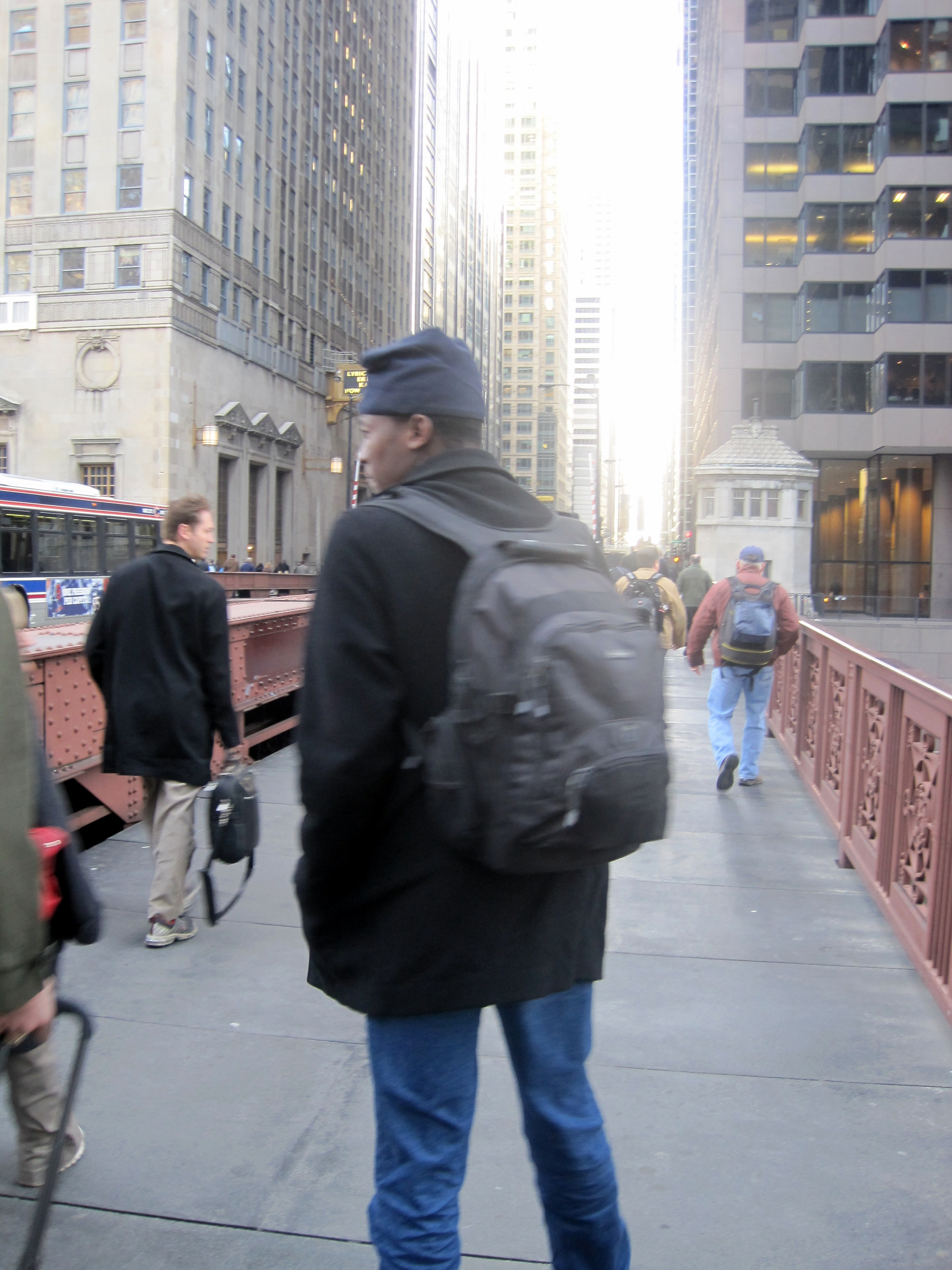
Away from accents for a little while. Less than two weeks ago, I was sitting in a bus stop at 5th and Missouri Metrolink train station waiting for the scheduled bus to take me from there back to Collinsville, and later to Edwardsville. Those familiar with the area would know how dangerous it could be at certain times of the day. It is in a part of Illinois called East St. Louis, just on the border of the state. It was evening, and it was cold. There were people around, but it didn’t give me any illusion of safety even as I put my iPod on and listened to some calming music. I was alert. There was a young African-American woman sitting beside me on the bench in the bus stop. A few seconds later, a young African-American man in sagged jeans and with a really loud phone, of perhaps around 24-25, who I’d seen prancing around talking to everyone passing by even when they didn’t stop to give him audience came towards me and said something. He was addressing me. I was listening to some of Fela’s best ballads. He was talking. I heard him clearly, but I didn’t pick out what he said, so I removed the earplugs and looked at him. I didn’t smile. He repeated what he was saying, and I still didn’t understand it, yet it sounded vaguely like English, so I gave up. I asked him to say it again and he did, for the last time. As she saw that I honestly didn’t understand him, the lady beside me looked at the young man and said “No, he don’t smoke/have weed.” What? That was what he’d been asking me (and the many other people) all the while, whether I had marijuana to share? Good Lord have mercy. Why didn’t he just say so in English? Well, he eventually left because I immediately turned my attention back to my music, and ignored his presence. Yet in me I wondered what would have happened if I’d said more than a sentence, and he’d discovered that I was not American, but an African with a heavy/strange English accent. Would that have made me a bigger target for mugging? There was a laptop in my bag, and there were my debit cards, along with my iPod and mobile phone. And my distinguished Nigerian passport. As I got on the bus a few long minutes later, I understood why George Bernard Shaw said that Britain and America are two countries divided by a common language.

And so today – thanks to patience, persistence, and prayers – I checked my account balance to find that my money has been refunded. Thanks providence. However, the part of it that inspired this post was in the email response I got from the bank representatives. I had sent them a complaint in an email, stating that I had made a transaction on Monday to the tune of a thousand dollars. From the response I got back, I have found out that it may be possible that American English doesn’t have any such expression as “to the tune of” in their language. Is this the case? I don’t think so too, but even if it is not, it doesn’t remove from the fact that Bernard Shaw could have been right after all.

Please read. It’s unedited, except for my account balance ;).

Dear KT, Thank you for contacting customer service. With reference to your e-mail, we regret to inform you that we do not see a transaction of over thousand dollars for “the tune” but there was a transaction on hold from SIUE Bursar’s Office, EDWARDSVILLE, IL, for $1,057.87 on 04th January 2010. This amount is already credited back to your account on 08th January 2010 and your current balance is $xxxx.xx. Whenever a transaction is on hold and if the merchant does not approve the transaction then the amount is released back to your account in 3-5 working days. Regards JP Morgan.