Browsing the archives for the Observations category.

On Slavery Museums

Slavery in the world was an absolute evil, and its transatlantic brand has become one of the most visible and contemporary pointers to its gruesome reality. Many things have crossed my mind since I wrote the article for the Nigerian newspaper NEXT (reproduced here on the blog) on my experience at Badagry examining the slave relics and the role of African (nay, Nigerian) families in the propagation of the trade. One of the pressing ones was whether it was right or moral or fair that descendants of the slave traders were the owners of the many private museums now at Badagry housing the original relics of the horrible time. Unfortunately it is not a slam-dunk open and shut case.

On the one hand is the right of any citizen to make money off of anything as long as it doesn’t pose any harm to the other person. On the other hand is the tug of annoyance in our heads when we realize that every time we pay money to gain access into the private museums, we continue to fund the machinery that once profited at the expense of millions of helpless lives. Then there is the added complexity we find in the need for information from whatever source. The slave trade is a historical fact, and there is so much that needs to be told about it. Generations after us will retain the same level of curiosity as us, if not more, and would ask questions. And who best to answer them than the true descendants of the slavers who know either from word of mouth or from family treasures of relics exactly what went on at the time and the role their families played.

In a normal working society though, one would expect that those artifacts would be in custody of a working government, with sufficient documents and audio-visual materials there detailing all that needs to be told about the period, and the proceeds going to take care of the citizens. Will this, if implemented, violate some principle of “free market” and private ownerships? Maybe. But when descendants of slavers still profit from the trade this indirectly, it rubs the nose of the society in the indignity, and it elevates evil one some level. The Mobee “royal family” of Badagry are an elite family already there. I don’t assume that they need any more of the dirty money that must come from tourists all over the world wanting to know about slavery. How do they even deal with the shame it must bring to ask people to bring their money to see what your ancestors used to enslave others? Have they thought about it, or don’t they care about what their lineage represent in history? I imagine a private concentration camp in Germany – if there was one – being run today by descendants of the racist anti-semitic people and profiting from it, whether or not their descendants still retain the same level of hate for the descendants of the victims. Or descendants of John Wilkes Booth being the ones in charge of the Lincoln Presidenial Museum earning money by showing off a few of the killer’s tools to the world. Something is definitely wrong there.

My Gmail This Morning

Click on the image to enlarge. Not funny.

On Written English

Prompted by my sister’s observation on reading Larry King’s My Remarkable Journey. “The language is remarkably simple,” she said. The fact is that we have been so used to the literary culture that passes off grandiose English as the only true means of good literary communication that when we see one that pulls off a feat of enchanting us without pretending to be grand, we are pleasantly surprised and are forced to look at ourselves again.

How the literary culture in Nigeria (as borrowed from Britain) successfully evolved into the idea that it is better and more acceptable to write (and speak) as difficult possible when given the opportunity is really beyond me. And for all who bother about it, this is the singular most (de)pressing issue in Nigerian literature today. Not just the language of our writing – which will remain English for a long while – but the way we use it. The argument is long and tedious, and will – if not properly articulated – spill over into very many distracting directions, but what is clear is that we still haven’t mastered the ability to simply write, simply.

My favourite essay of all time is by George Orwell, titled Politics and the English Language(1946), and I’ve always recommended it for anyone wishing to be called a writer. In it, he highlights the very many wrong ways in which we use the English language a famous one being the rendering of a verse in Ecclesiastes in “modern” English. According to him, and I agree, this verse…

I returned and saw under the sun, that the race is not to the swift, nor the battle to the strong, neither yet bread to the wise, nor yet riches to men of understanding, nor yet favour to men of skill; but time and chance happeneth to them all.

would most likely be written by today’s writers as follows:

Objective considerations of contemporary phenomena compel the conclusion that success or failure in competitive activities exhibits no tendency to be commensurate with innate capacity, but that a considerable element of the unpredictable must invariably be taken into account.

He admits in the end, as I do now, that he too may have occasionally fallen into the temptation to use more words than necessary in order to sound grand, or just for the drought of ideas. Yet, it is inexcusable. There is a reason why I was able to complete Larry King’s book in two days and I’m yet to complete one by a Nigerian writer since more than a year ago, and it doesn’t have to do with their personalties, a glossy cover or their countries of origin. And it is the same reason why V.S. Naipaul is now one of my favourite Nobel Prize winners. There is just something enchanting about a simply but brilliantly-written work.

Father’s Day

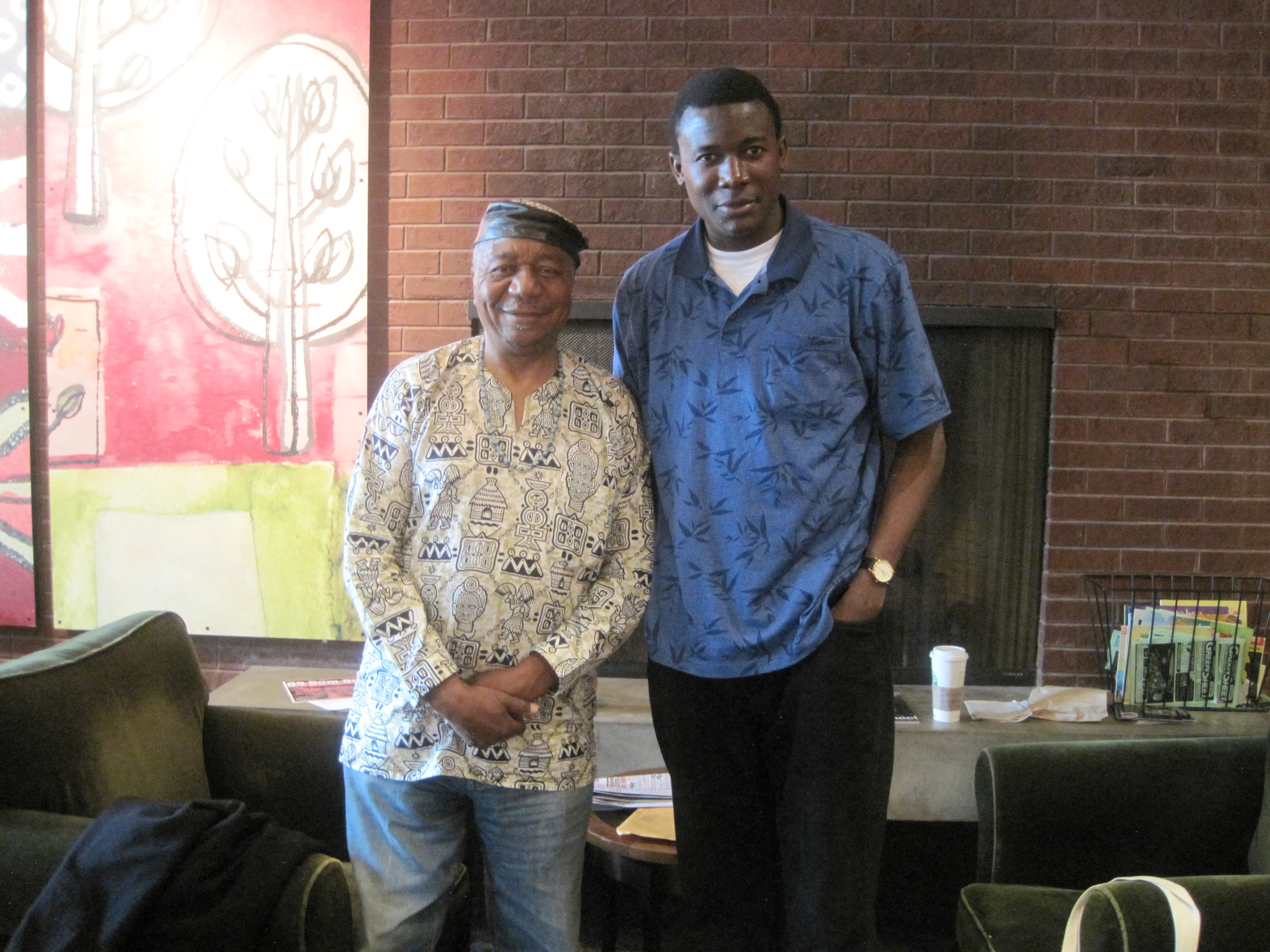
With poet Eugene Redmond. April 2010

Yesterday I had one of those long conversations with a friend about the strange nature of parenthood, and my participant observation on fatherhood and its many complexities, and how relationships with fathers inevitably shape our outlook on the world whether we like it or not. How could I have forgotten that today is Father’s Day?

There are many questions I would ask if I could sit my father down for one whole day in a conversation, many of them about his childhood and how his childhood adventures shaped his later preoccupations. I would ask for specific details, facts, and pointers, and I would write them all down because of a time that my child(ren) might want to ask me about their grandfather at a later time. I may not take all his advice on life, writing, broadcasting, women or children, but I would delight in listening to them for an umpteenth time while wondering, “What would I be like when I’m his age?”

This generation exists because of the last one, and the cycle continues. Happy Father’s Day to all fathers out there, including my own, and my adopted fathers, intending fathers, and to my brother, and to my brothers-in-law. You make the world go round. Or do you? 😉

His Remarkable Journey

It’s not always a bad thing to live in a town where electricity is barely on for seven hours a day. In two days, I have completed a feat I couldn’t while I was in Edwardsville. Larry King’s autobiography My Remarkable Journey. Covering adventures of the young son of immigrant parents from Europe, the book tells the story of how the Jewish kid Larry Zieger who never went to college made it through the very many interesting historical epochs of America to become the famous Larry King recognized worldwide for his voice, his show and his suspenders.

Like many autobiographies, there is the question of whether Larry the broadcaster was the same as Larry the autobiographer-the-writer who was able not only to remember in great detail many of the remarkable events of his childhood, but was able to write them in very fine prose in the 294 paged book. How much of it is fiction or embellishment of the ghostwriter, and how much is rooted in real facts of the broadcaster’s pen and memory?

He wrote of his first meeting with JFK, (it was a mild car accident in which Larry had run into the future president), he wrote of walking mistakenly into the full glare of cameras in the courtroom during O.J. Simpson’s trial without being a witness, how he won a lottery on just $2, and how he almost bribed the president elect Richard Nixon before the latter assumed the presidency. There are very many tender and happy moments in his life, and he recounts them with nostalgia. His many marriages (he was married eight times to seven women), his arrest and financial troubles at a time, his heart attacks and surgeries, and his relationship with his first son Larry King Jr. who he met when the latter was already thirty-three years old all took pride of place in the book.

For decades, the now seventy-seven year old man had helped people to open up themselves. In this work, he does it himself and does a good job of it. Fans and friends who would like to know his opinion of George W. Bush, Nelson Mandela, Barack Obama, Richard Nixon, Bill Clinton among others would do well to pick up the book. Talking about retirement, he hinted that his contract with CNN would be up by 2011, and he still doesn’t feel the need to retire. Hear him: “If I went off the air, what would it do to the ninety-nine year old woman who credits her longevity to watching my show every night?” That’s Larry King.

I’m now unto V.S Naipaul’s Miguel Street. This time, unlike the man making “a thing with no name”, I’m sure I’ll complete it in record time.