Browsing the archives for the Observations category.

On the Election

Like the last time Obama won in 2008, I am in Nigeria when his victory was confirmed after winning Ohio. It was about 5.12am, Lagos time.

About a week after the election, the news seems to have faded, at least in this part of the world. For many people, this time around didn’t have the same fierceness as the last one anyway. Many who seemed passionate about it either didn’t know why they should care this time around since “Obama hasn’t done anything significant for Africa since the last four years”, or have strong opinions on the president’s stance on gay marriage and abortions. Somehow, it seems that the GOP’s message of social conservatism has found its way out of America which has now rejected into every other part of the world open to imported beliefs.

I have had a number of short but bewildering conversations with Nigerians about the election. One of the most bizarre went somewhat like this:

“Obama is the anti-Christ.”

“What?”

“It has been signed. By 2013, everyone will now have the mark of the beast. It’s Obama’s law.

“What on earth are you talking about?”

“You didn’t hear? This program that he signed… this… Medicare. It’s the end of the world we’ve been warned about.”

“Oh my!”

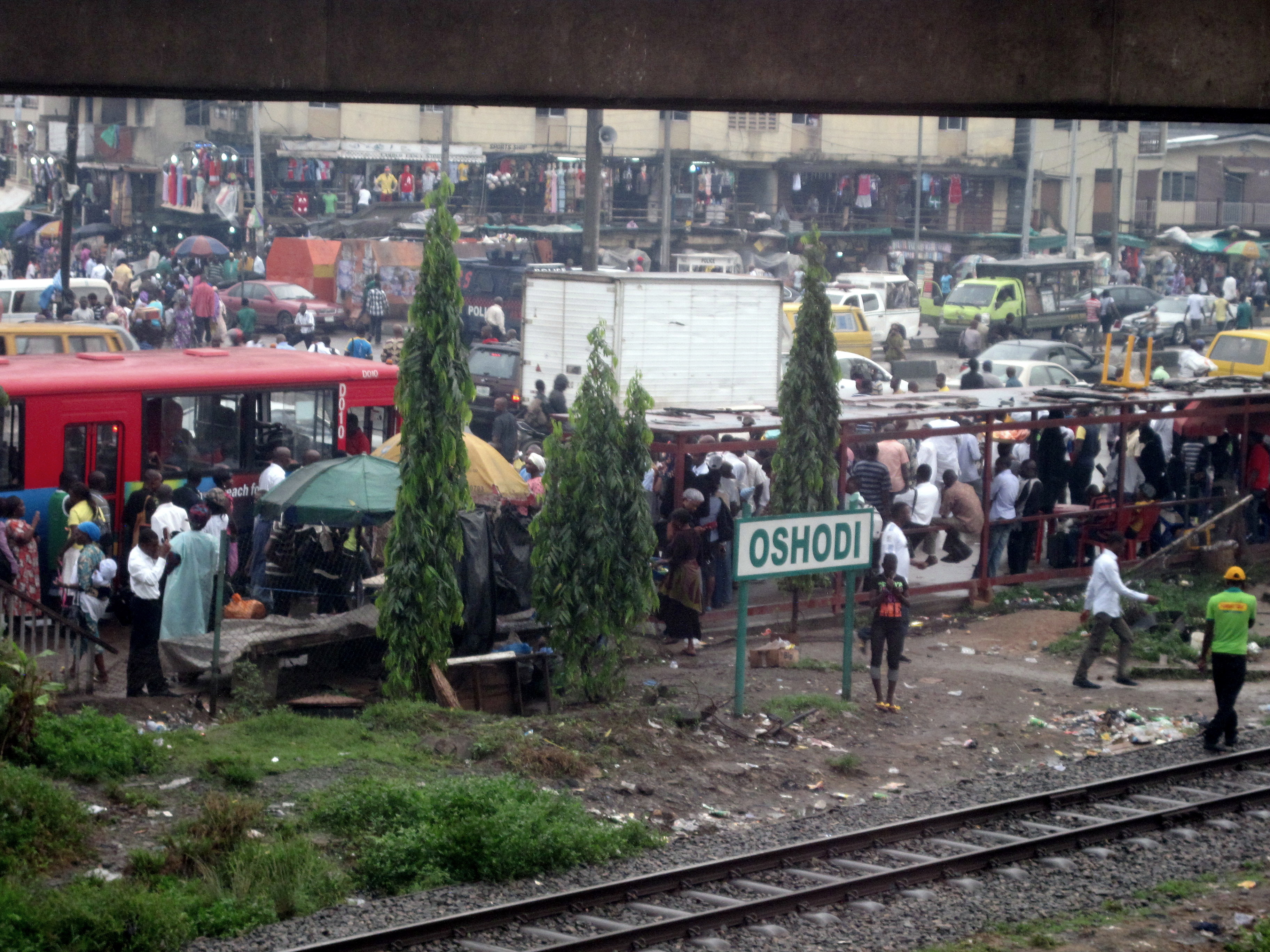
I gave up a few minutes later when it became virtually impossible to get past a perception that the president’s healthcare law was anything but that. A few months ago, under the bridge at Oshodi, I had come across some “calendars” and posters sold by local artists in which the president was portrayed with the numbers 666 on his head. Many of the other inscriptions on the poster said that the president signed a bill into law in 2009 that will mandate people to henceforth take a mark before they can be attended to… This was new to me, and till date, I still haven’t figured out how this piece of crap became news, and has now grained currency even among supposed educated folks.

I blame the cost of internet access.

In any case, back to reality, I suspect that the same reason many smart Americans elected Barack Obama is the same reason some smart Nigerians now dislike him: oil exports to the US from Nigeria has declined every year since 2009. As seen in this newspaper headline, the US economy is now on its way to some form of energy independence. If not for anything else, this piece of news should at least convince anyone who has any doubts that the president puts his country first. And that makes him a right choice for the country.

Sandy and the Frankeinstorm

I’ve never been in a hurricane. I have been in a tornado once, and the experience was better imagined than experienced. Yet the difference between a hurricane and a tornado would seem to appear like one between an elephant and a little puppy.

The images I’ve seen so far from the East Coast of the United States at the moment are heartbreaking: cars floating on floods, winds pushing people and properties around. When all is said and done, there would be millions of dollars in damages, and several efforts needed to repair. Homes would be lost, some people would be dead or wounded. And then the process of rebuilding will begin again.

I was in Joplin, Missouri, in June 2011 – another site of a horrible devastation. It was a tornado at that time, but the heartbreaking sights did not leave any space for such distinction. Homes, lives, and property were lost.

My thoughts and prayers are with the denizens of these affected areas. It is in times like these that the value of life and community is strongly cherished, along with agencies of government saddled with the responsibility of doing all necessary to get people back on their feet.

Stay safe, people. You’re in our thoughts.

Three First Classes

I resumed the first class today at about 11am. The boys looked as curious as did those in my class of Yoruba more than two years before. I introduced myself, this time more firmly as I did earlier university students who at least had a disciplined look of adult learners. This time, teaching fourteen to sixteen year old Nigerian secondary school students will not turn out as easy as teaching seventeen to twenty-two year old American undergraduates. It was the first of three classes I would be teaching on the first day of term.
I wrote my name on the board, along with a few exercises in spelling that was on the syllabus for the day. “I will be your teacher of English for the rest of the term.” I told them a few rules of the class, and stressed the importance of seriousness, then launched into a mini tirade that I had swirled in my head a few seconds before I walked in.

“Now, to begin, let’s understand why, although already speakers of this language, you might need to pay very good attention to a class meant to teach you the basics of the rules that govern the language. If you think that because your parents have spoken it to you all your life you now know enough to be competent, please check that arrogance out the door right away. I have met a few Americans who had the same erroneous impression of their own speaking abilities. It ended in disaster…”

After a few minutes, and after I finally arrested their attention in the details of a new course that is being sold nearly as the cure for all that ailed them, we went into the spelling exercises. One of the words on the board was “gaol”.

“Who can pronounce this?”

Nearly everyone screamed: “gaaaaooll”.

“Wrong! You have just learned your first lesson in English. Words in this language are not always pronounced the way they are written. This word is pronounced the same as “jail”. It was an old way of writing it, before the Americans simplified it to “jail”. It also means the same thing.

We went down a list of a few other words: risqué, sachet, beret, tomb, bomb, pomade, breakfast, prayer, steak, and corps. Everyone knew how “steak” was pronounced, but very few knew about “corps” or “pomade”, or risqué.

“We will all need to get a dictionary.” I said.

Then I told them the story of a popular American president who had pronounced Navy Corpsmen as Navy Corpse-men several times in a televised speech. He was pilloried on cable television for days on end.

“Who was that president?” One student asked.

Barack Obama,” I replied.

“Wooow!”

Whether that signified disappointment, or enlightenment, I am yet to find out, but the term is still very long, and it is still the first day of class.
The Messiah Complex

The rule is unwritten, but most likely more prevalent than reported: the traveller recently returning from a long stay abroad gets a major pass on the first few comments on discomfort with the new environment. The privilege of the pass lasts about a few weeks long, and then it ends. There is a second rule, that there is always a larger than needed (but mostly uncontrollable) tendency to compare the state of a present place to the state of the place where he/she had previously spent some time.

In Edwardsville: Why do American students dress so casually to class? What is the point of stop signs in deserted neighbourhoods? Why the need for so many guns in the hands of citizens? Why do people mind their business so much? Why does the advertising environment allow for so much name-calling of one’s opponent? Why is there so much money (and corruption) in the country’s politics? Why do people hate Obama so much? Why’re some republicans so dumb?

In Lagos: Why the absence of enough trash baskets by the roadside? Why do citizens choose to cross the road on foot rather than use the pedestrian bridges? Why do we pay so much for internet and get so little service? Why the prevalence of pay-as-you-go phone service instead of standard monthly packages? Why do policemen carry heavy arms openly on the roads? Why so many cars in this state? And why does a trip from one part of the state to the other take about the same time to travel from Ibadan back to Lagos, twice.

Purpose and meaning sometimes intersect at weird mental junctions in the head, and the self questions its own hubris. What is the point of intervention when things will move as they must no matter what? In the end, the cost of intervention sometimes isn’t worth the trouble of imposing an earlier image onto a current, living, one. I spied Nigeria’s Nobel Laureate for Literature, Wole Soyinka, at the Lagos airport a few weeks ago, his grey hair distinct somewhere ahead in the sea of a small crowd within the arrival lounge. For a man whose life has sometimes taken the form of a road itself around many continents and in many capacities, a faint resignation must exist somewhere in him about the nature of things and their need to finally merely remain what they are out of the worries of man and the hubris of his ambitions. Each society will exist in its own frame, and must rise and fall according to it, sometimes with or without explicit external influence. The fact of life and the inevitability of movement and exchange, in themselves, are perhaps already a signal of progress.

That resignation makes everything else easy to bear. The messiah in us takes a hint, and gently returns to bed soon enough, until something random suddenly ignites its ever excitable self again.

Of Tabs and Texts

I realized since a few months ago that I have a habit of opening too many tabs on my Google Chrome internet explorer. Everyone who peeped onto my computer screen while I work always wondered how I managed to concentrate on current tasks. My fiancée suggested that I most likely have attention deficit. In return, I argue that I have read enough reports that suggest that distracting oneself with stuff online actually led to efficiency. She has now asked that I limit my open tabs to ten. I have tried, and failed. Now I use Evernote to mark down some of the links I intend to read much later.

Today however, I recalled something that may be responsible for my interest in many things at once (much of them about politics, education, humour, literature, and news). Two words: my father. Thinking back now, I remember how there was always a room in every house we’ve lived in that has stacks of every current publication in Nigeria at the moment. Today, I remembered Prime People, Vintage People, Fun Times, Ikebe Super, Super Story, Vanguard, The Sketch, Newswatch, Daily Times, among very many others. Name it, we had every issue published, and they were always delivered by father’s vendor early in the day. Soon enough, the stack filled up a whole room. Literally.

It was impossible to be bored in an environment like that, and cartoon strips in the newspapers and magazines, and the continuing stories in legitimately fun publications like Ikebe Super, Fun Times, and Super Story sustained a literary interest for a very long time, long before it was eventually replaced with real literature, also from his bookshelves. So now, whenever I’m chided for opening too many webpages at once, I point back to the memory of a time when pleasure and work walked hand-in-hand while sitting on the floor of a living room with dozens of news and feature publications spread all around.

Sometime last year when an academic mentor in Ibadan asked if I had access to past issues of any Nigerian publications which used pidgin as the main language of communication, I immediately thought of Fun Times, Dauda the Sexy Guy, and Ikebe Super. He was working on a compilation of a comprehensive Nigerian Pidgin English dictionary. I have not asked father what he did with all his stack of past issues, but I assume that it will be a trip to return into the margins of those oldies at some point in the future, if they still exist. For now, new tabs and texts.