Browsing the archives for the Observations category.

Of Tabs and Texts

I realized since a few months ago that I have a habit of opening too many tabs on my Google Chrome internet explorer. Everyone who peeped onto my computer screen while I work always wondered how I managed to concentrate on current tasks. My fiancée suggested that I most likely have attention deficit. In return, I argue that I have read enough reports that suggest that distracting oneself with stuff online actually led to efficiency. She has now asked that I limit my open tabs to ten. I have tried, and failed. Now I use Evernote to mark down some of the links I intend to read much later.

Today however, I recalled something that may be responsible for my interest in many things at once (much of them about politics, education, humour, literature, and news). Two words: my father. Thinking back now, I remember how there was always a room in every house we’ve lived in that has stacks of every current publication in Nigeria at the moment. Today, I remembered Prime People, Vintage People, Fun Times, Ikebe Super, Super Story, Vanguard, The Sketch, Newswatch, Daily Times, among very many others. Name it, we had every issue published, and they were always delivered by father’s vendor early in the day. Soon enough, the stack filled up a whole room. Literally.

It was impossible to be bored in an environment like that, and cartoon strips in the newspapers and magazines, and the continuing stories in legitimately fun publications like Ikebe Super, Fun Times, and Super Story sustained a literary interest for a very long time, long before it was eventually replaced with real literature, also from his bookshelves. So now, whenever I’m chided for opening too many webpages at once, I point back to the memory of a time when pleasure and work walked hand-in-hand while sitting on the floor of a living room with dozens of news and feature publications spread all around.

Sometime last year when an academic mentor in Ibadan asked if I had access to past issues of any Nigerian publications which used pidgin as the main language of communication, I immediately thought of Fun Times, Dauda the Sexy Guy, and Ikebe Super. He was working on a compilation of a comprehensive Nigerian Pidgin English dictionary. I have not asked father what he did with all his stack of past issues, but I assume that it will be a trip to return into the margins of those oldies at some point in the future, if they still exist. For now, new tabs and texts.
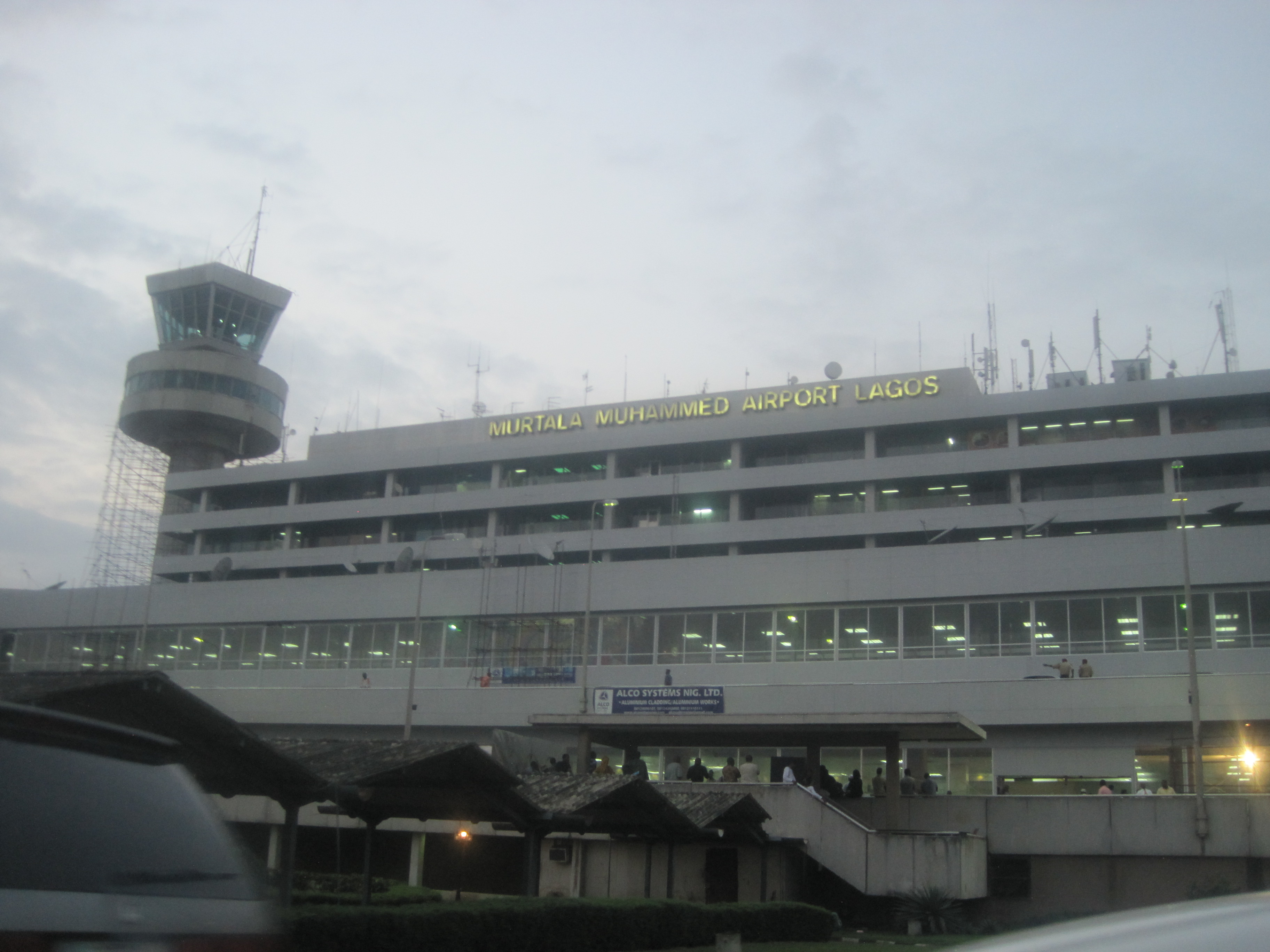
Image and the Lagos Airport

No visitor to the nation’s major international airport will miss the seeming rowdiness in the lobby of the departure lounge, but travellers who have used the place time and time again are probably already used to it.

Pulling over outside a few minutes earlier, it is hard not to make a fast comparison. The Lambert Airport in St. Louis (MO) can easily compare, at least in size if not in anything else. The difference in design of the arrival and departure areas however are stark. Having driven to the St. Louis airport now for more times than I can count, I immediately picture pulling over outside the departure lounge at the exact name of the airline with which the traveller is flying. It could be American Airline, or Delta, or United. They are all listed there.

In Lagos, there is nothing outside.

There is just the road, and a throng of people loitering around the exits, waiting for their loved ones to give them a call from inside that they are free to return home. Yes, unlike the airport in St. Louis, the new rules at the Lagos airport is that only the traveller is allowed into the lounge. Whether this rule is recent, or written down, is arguable. There are also a number of people out and about trying to sell you something or the other. This “rule”, as I later found, isn’t enforced either, but right at the entrance were about six armed policemen, each of them carrying heavy arms.

They ask, and I tell them that I am not the passenger. “You stay out,” they said.

“Why?”

“Are you travelling?” he asks again, and I get the message.

The lady isn’t pleased.

“Okay,” one of the officers speaks again. “Take care of us, and we’ll let you in.”

It is 12 in the afternoon.

“Don’t worry about it,” we both chorus, and I step back.

She looks back at me, and whispers, enough for anyone to hear, “I love you,” and heads inside.

“I love you too,” I reply, and waved.

Somewhere within those two seconds, the policemen heard us, and probably got a sting on their conscience. One of them – the most senior – looked remorseful, and waves me in. “G0. Follow her.”

****

There are many things wrong with the airport, but much of them, like the exchange I described, illustrate what is wrong with the country at large. I have mulled many of these questions in my head since I returned here, especially about the state of security, and well-being in the country, especially the role of the police.

  1. Why do policemen carry AK-47 rifles openly?
  2. Why do we have so many policemen at the entrance of the airport?
  3. If the answer to #2 is that “So as to prevent terrorists or any other criminals from coming in”, then why do they give people a pass to go in only after giving them “something” or after “taking care” of them?
  4. Why are there instead no metal detectors at the door of the departure lounge so that criminal elements are immediately accosted at entry, rather than law-abiding people coming to say goodbye to their loved ones?
  5. Why haven’t we made more use of technology in this way, including the use of surveillance cameras, undercover law enforcement officers, and sniffer dogs?
  6. Is this the best we can do?

****

Many new things are noticeable within the lobby itself, an impressive one of which is the installation of new equipments somewhere farther into the premises, where travellers would have to pass before getting into the plane. Word in town is that the government is spending an enormous amount of money to turn the airport into a world class facility. Admirable. This would not happen, however, until the human element of the facility is greatly improved. The last time I flew through this place, somewhere on my way to the plane, the custom officers who asked how much foreign currency I had on me, also managed to quip that it might help if I “helped” them out with some of it. I remember also that the last two times I arrived via this airport, there was no electricity, and we had to sweat through the rigorous checks that ushered us back into Lagos.

This is a terrible way to manage an image already terribly battered.

Home Never Leaves

I spent the last hour walking through a neigbourhood in Ibadan where I last visited about twenty years ago as a young boy. The memories have almost all faded along with the landscape. New homes and new streets have sprung up where trees and old buildings used to be, and I walked like a stranger that I now am, enjoying the pleasure of the welcome anonymity. None of the relatives I knew who lived around there live there anymore, thankfully. I would have expected shouts of “Kola! Is that you? What are you doing here? And who is this lovely woman walking with you?” Growing up has its perks.

I hope to spend the next hour checking out another part of this town that holds an even deeper memory: the neighbourhood where I spent the first thirteen years of life. The building in which I drew some of my very first breaths now exists in a different neighbourhood than the one I left it in. New neighbours, new ownership, and maybe a new paint job. I don’t know right now. I haven’t seen it in more than ten years. There exists a huge memory of my growing up that lay within the walls of the compound, and has gone with me everywhere I go. There also exists, at some level, a stronger desire to make a reunion with that memory permanent. If I ever become rich, I will pursue the desire. For now, this will become another tour of the long memory lane.

I have my camera ready, and the last image of that building in my head as I saw it through the rear-view mirror of the truck that took us out of there in April 1995.

For the Dying

  1. Brutal anti-Semitic Terrorist Attack in Bulgaria
  2. Assassination of a Nigerian Senator in Jos. Nigeria
  3. Syria is and an interminable cycle of violence.

I discovered yesterday, to great sadness, that the man in #2 was the same gentleman – by then not yet a Senator – that invited a group of about six young “Youth Corpers” in Riyom, Plateau State, to his modestly furnished house, sometime in 2005, for a friendly, happy reception and exchange of ideas. I was one of his guests.

Update: 3.40am. Breaking News on tv says there is a mass shooting in progress at Aurora, Colorado. Two gunmen have opened fire on a group of theatreogoers in a packed theatre watching the premier of the new Batman Movie.

Update 9.15pm. The victims included 12 dead, and over 50 wounded. The suspect is in custody, lawyering up. His third floor apartment is being prised open by trained officers. A new debate arises on the liberal gun laws in the United States.

Boiling over Healthcare

Yesterday, the signature legislative achievement of the Obama Administration – the Healthcare Reform (also called Obamacare) was upheld by the Supreme Court in a 5-4 vote. Among other things, it prevents insurance companies from dropping people from insurance who have a pre-existing condition. It keeps children on their parents’ healthcare plan until they are twenty-six. It basically fundamentally changes the way healthcare has been provided in the United States – a success that has eluded many presidents for many years.

I spied a few newspaper headlines today to see how the people on the ground relate to the ruling. I was only in Iowa, so my perspective is limited to a swing midwestern state. The USA today as well as an Iowa newspaper were basically optimistic, cautiously celebratory while advising that rather than repeal it as Republicans and other conservative groups have sworn, they should work to improve on the parts of the law that they find objectionable. Returning to the chatter on cable news tonight, what I find is that this is going to be an uphill task.

I’m only a foreigner anyway, with just a little knowledge of the country’s history spanning a few generations. I know however that the divisiveness and polarization of the nation’s politics is as old as Lincoln and as young as Monica Lewinsky. What is most stunning however is that this much of a fight is going to be waged over the right of people to have access to affordable and patient-oriented healthcare like the rest of other developed countries. In a hundred years from now, no matter who wins the final battle to be waged on election day in November, those alive in the world would be able to look back and see how – like the time of slavery – a group of privileged people were willing to stake the future of the country for a chance to get their way and keep the status quo.

On the one hand, I’m now confident of the historical place for the president for his fortitude and perseverance, on the other hand, I fear for a country in which this kind of fight becomes elevated to national attention. America, you fascinate me.