Browsing the archives for the Observations category.

Syria on My Mind

Nerve gases are no laughing matter
as hundreds of shrouds tell, in pictures,
removed from this world where allegiances
lay in voting colours and voting districts.

Another brown spot on the world map
spills around the palette of our apathy.
Thousands today and another, and more,
But history tosses us in fracas of wonder.

So, a click on the remote, and it’s gone,
shrieks of pain, and wailing siblings, countrymen.
A tab takes the blood of our screens
into another page with a dancing Miley.

The dead fare no better, though punctured
in lace around the flesh: hollow-point lead.
War is peace, until the air sours on the breath.
Decision hangs the wise on a noose with idiocy.

We are here again, a decade-long sobriety
in the same pit, different boots, and piety.


Driving in Lagos

One of the most problematic obstacles to driving anywhere in Nigeria is the process of obtaining a driver’s license. Living in Lagos adds an additional layer of having to compete with one of about two million motorists that have to get the new driver’s license being mandated by the Federal Road Safety Commission. From the response I’ve got from those who have applied for this new license, it takes from three months to seven to finally lay hands on the official card. (As some consolation, however, drivers are given a temporary form, also called the permit, with which to drive until the seven months – or whatever length of time one is given – is complete). Oh, the length of time to get said card is also dependent on whom one knows, and how much one has!

It’s hard to talk about this without the inevitable comparison to other places where the highest it takes from the time one passes the road driving test to getting the official certified card is about fifteen minutes, tops! But that now out of the way, it’s important to ask what exactly is the problem with decentralization of card issuance, and government employing more (adhoc?) staff for summer jobs to take care of the backlog? And if the government can’t handle it, what is wrong with outsourcing it to a monitored private enterprise?

I have noted down a few other (less depressing) observations about discovering roads and routes on Lagos roads, but they will come with subsequent blogposts. For now, it’s enough to rail at a government, in 2013, that is still too reluctant to move into the electronic century.

Fledgling Whispers of a Story – A Review

This week, I discuss my thoughts on Abubakar Adam Ibrahim’s Whispering Trees, the fourth story on the shortlist of the 2013 Caine Prize for African Writing. Many other bloggers are participating in what Aaron Bady spearheaded as a “Blog Carnival”: thoughts and opinions on each of the shortlisted stories. Find the rest of the reviews on twitter via the hashtag #CainePrize.

_____________

Of all the stories I have read since this Caine Prize carnival began, Whispering Trees is one I have read twice fully, from beginning to end. It is a story about Salim, a young man who became disabled, and lost his eyesight, in a car accident and along with it his dignity and prospects, and who eventually finds a different kind of vision staring at “souls” of people, and seeing visions.

I read the story twice not because I particularly enjoyed and understood it all the first time, but because I didn’t fully grasp it and wanted to be sure about the intentions of the author and the character. Many of my thoughts from the first reading were confirmed by a second reading: it is a story about coping with disability, but a little also about faith, and psychic and supernatural outer body experiences, and love. The author doesn’t succeed in developing each of these areas, but we see that it was his intention that we see them. Away from the second reading, I realized that there were no hidden meanings other than the fact of the hero’s disabilities and eventual psychic evolution. It tried very hard to be didactic, but failed at that too. The last line, italicized for effect, read “I realize that happiness lies, not in getting what you want, but in wanting what you have.” I certainly had not come to that conclusion merely by reading the story, and including it as the last line did not drive it in either.

I could be uncharitable and say that Whispering Trees could have borrowed a leaf from the handling of the crises of faith and disability from reading Tope Folarin’s Miracle, or that it could have portrayed the homeliness of young hapless men under a tree deliberately named by reading Elnathan John’s Bayan LayiHeck, it could have done better with romance under pressure by reading Pede Hollist’s Foreign Aid, but that would be assuming that the author wrote the story with the Caine Prize in mind, only after reading these other stories. It is most certainly not the case, so I will only say that whatever moved the author to write this story could most certainly have been better served by a shorter and smarter handling of the plot. There are many issues that can be raised from this story about of the helplessness of disabled people in Nigeria, particularly those wounded as a result of man-made disasters like car accidents. There are also angles of societal neglect and the non-existence of public facilities to make the life of disabled folks much easier. These however are from my own mining of the story’s schizzy fields. The author doesn’t consciously lead me to them.

The part of the story detailing the problems of disability were affecting, but seemed artificial and forced, helped by the tortured use of some figures of speech. The most uncharitable word for these instances of use is “amateurish”, providing a major obstacle to enjoying the story. Here are a few:

Personifications:

Sometimes it worked beautifully: “I remained there until my anger forced tears out of my damaged eyes”, but most times it didn’t: “Silence answered me.”, “Insomnia would claim me every night”, “My mind climbed up to the gates of heaven once more, seeking admittance”, “She would talk and weep until blessed sleep stole her away”, “I heard the trees screaming in agony as they were cut down”, and “But my mind was not very happy about this.” Nobody should ever write like that.

Similes:

There were some passable lines: “Her tears, like rain, fell on the wild fire of anger raging in my heart and extinguished it.” Others were not: “I discovered a whole new world of numbers and was as excited as Columbus must have been when he stumbled upon America” and “She pranced in front of the house calling for Saratu just like Achilles before the walls of Troy.”

Hyperbole:

In describing a rash and angry response of an otherwise reasonable citizen, the following was written: “Faulata fetched some petrol and poured it on the house. She was about to set it ablaze when they seized her. She struggled fiercely and wept because they would not let her burn down the house. Later, Saratu’s parents came to apologise. Neither Faulata nor I said a word to them. Then the elders came and delivered a long, boring lecture about forgiveness and reconciliation and, to get rid of them, I said it was over. So Saratu kept her distance.” The attempted arson described here could as well be the most hurried description I’ve ever read. I am trying to see how Faulata could have poured petrol on the house. The event to which Faulata was responding by trying to set a fire ablaze didn’t also seem to warrant this kind of response either, so I chalked it down as a failed hyperbole regarding plot.

In another part of the story, a character makes an attempt at quoting Oscar Wilde. The original poem, from The Ballad of Reading Gaol, reads:

Yet each man kills the thing he loves
By each let this be heard.
Some do it with a bitter look,
Some with a flattering word.
The coward does it with a kiss,
The brave man with a sword!

In Ibrahim’s story, there was the following:

Hamza and I talked some more until he rose and said, “I must leave now. Now that you are here, I can leave. But see how beautiful this place is, see how pure and full of life it is. Yet, someday, the living will come and destroy everything.” He started off, “Man destroys that which he claims to love.”

In another instance, the author tries to write in Nigerian Pidgin English, yet gave us the following:

The oga’s voice was raucous. “How much you find for ’im body?”

The first man said, “Four thousand naira, sir.”

The oga grumbled, “These ones se’f, them no carry plenty money. Oya, put ‘im body with the others but hide the money before people come.”

Yes, that was ‘im body, se’f, and other unconvincing attempts at Nigerian Pidgin. In pidgin, there would be no apostrophe in any of those words, and “body” would surely have been written as bodi.

I realize then why I found the story hard to enjoy as fiction, or anything other than the writer’s attempt to be profound and didactic with magical realism: it tried too hard, with little skill, and failed (at least as a worthy representative of this year’s shortlist of the best of African fiction. As some have wondered aloud: “thank goodness we won’t have to read the other ninety non-shortlisted pieces!”).

Now, so that this does not end up as a completely disappointed rant against something that Mr. Ibrahim surely put a lot of effort into writing, let me admit that I found the first sentence quite charming and inviting: “It’s strange how things are on the other side of death.” Had the promise of that initial sentence been followed by equally strong and well sustained passages, and had the story been a lot shorter, or at least the characters better developed, we might have had a different offering.

The other paragraph that I found absolutely delightful is as follows:

“The rains came and went. The grasses grew lush green and faded into a pale, hungry brown. I could hear the dry, cold harmattan winds blowing through the starved savannah; I could feel it on my desiccated skin. The weather grew unpleasantly chilly. Everything was cold, including my heart. Faulata was gone”

Unfortunately, gems like this were far in-between, and did not tie the story together as a tale of resurrection, redemption, and a soulful realization of an inner strength and power as the author clearly intended the story to be.

___________

Also published on the NT LitMag
Amusing the Muse

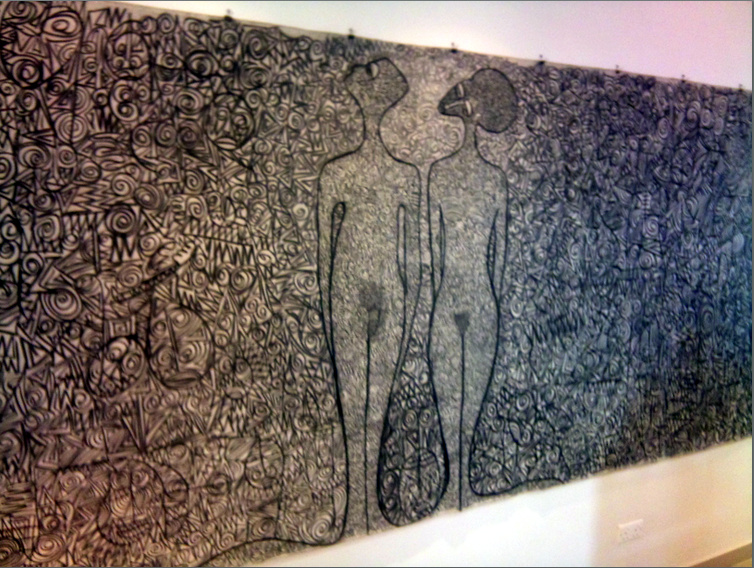
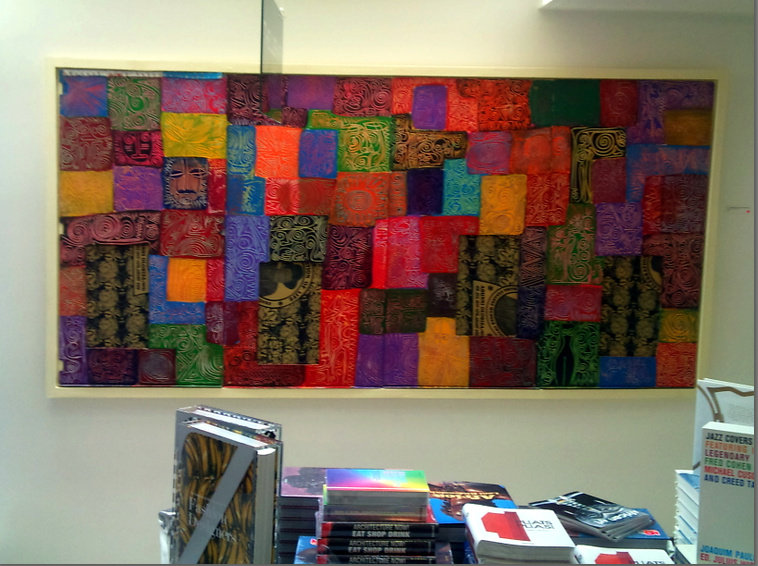
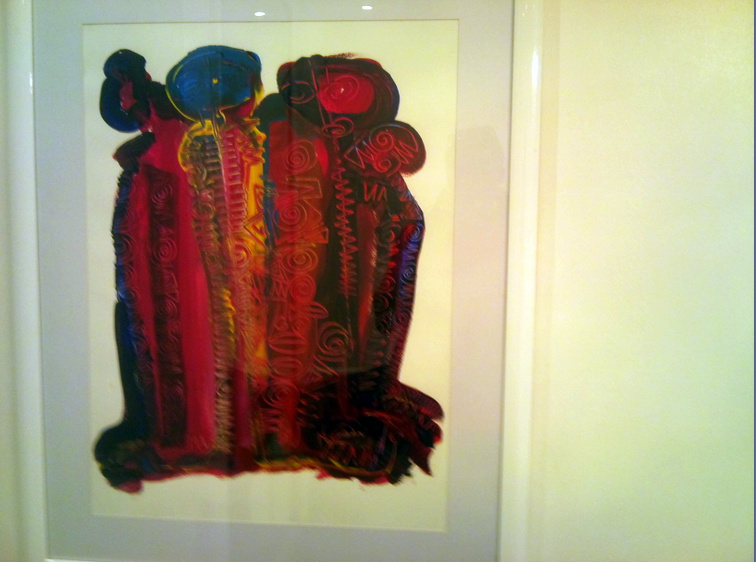
Fullscreen capture 672013 111018 AM.bmpFullscreen capture 672013 110748 AM.bmpFullscreen capture 672013 110824 AM.bmpFullscreen capture 672013 110929 AM.bmp Fullscreen capture 672013 111831 AM.bmp Fullscreen capture 672013 112457 AM.bmp Fullscreen capture 672013 112547 AM.bmp Fullscreen capture 672013 112631 AM.bmp Fullscreen capture 672013 112722 AM.bmpHere are photos taken at the exhibition of photos and paintings by Nigerian artist Victor Ehikhamenor.

The exhibition, titled Amusing the Muse, took place between April 27 and May 31, 2013, at Temple Muse, 21 Amodu Tijani street, Off Sanusi Fafunwa, Victoria Island, Lagos.

The artworks beautifully arranged around the premises of the  Temple Muse (which is also an events shop, bookstore, and a fashion & lifestyle showroom), were given names like “I don’t know where to but let’s go”,  “To all the first ladies who love themselves”,  “Coup plotter before shower”, “Your head is correct”, “Home sweet home”, “Mr president after the coup”, “Adam and Eve waiting for a flight out of Eden”, “Your dancing is music inside my head”, “Yesterday and today waiting for tomorrow.”, “Your music is dancing inside my head”, “Nobody came to us”, and “Opportunities in the land of closed doors”.

Of form, the work varied from “Charcoal on canvass” to “Paintforation on handmade paper”, “Charcoal and oil pastel on canvas”, “Ink wash and acrylic on paper”, “Latex paint and charcoal on handmade paper”, and “Acrylic on wood and fabric”.

My interview with Victor has just been published at NigeriansTalk.

The Travails of Logan – A Review of “Foreign Aid”

Here are my thoughts on the third story on the Caine Prize shortlist: Foreign Aid by Pede Hollist

___________

I began reading this story with trepidation, and a worry that after reading Elnathan John’s “Bayan Layi” which moved me in a disturbing yet endearing way, and Tope Folarin’s “Miracle”, which made me think a lot about dimensions of faith and unbelief in the socialization process of young Africans, I had lost the innocence of my expectations, and thus perhaps irreparably damaged in my ability to see any new (or delightful) surprises in any of the last three shortlisted stories. After finishing Pede Hollist’s story Foreign Aid, I can now reluctantly admit that the trepidation was unnecessary.

The really long short-story that is Foreign Aid follows the travails of a returnee American, Balogun (who became Logan as part of his necessary painful American socialization experience)  all the way from America where he had emigrated with hopes of becoming an economist to his Sierra Leonean homeland where he had come, after a long absence, to visit his parents and right some wrongs. Things didn’t go quite as planned, and thus the story. Nothing explains the length of this work – a little over 10,000 words – except a guess that, like many of the others, it is part of a longer story that continues beyond the limit of a short story. To the its credit, the plot captivates one enough to take the reader from one part to the next one, onto an eventual, climatic (if predictable) end.

Many parts of the story made me smile, a few others made me very upset, and a couple more made me feel sorry for the protagonist, Logan, who reminds me of a number of American emigrés returning home for the first time in years. The accent, the impatience, and the righteous indignation at the state of things in the homeland is carefully depicted in a believable way. Much of the depictions of the warm, cheerful receptions in Freetown, and Logan’s introduction to long-lost relatives reminded me of a book I’d recently re-“read” in audio form – a story of another young man visiting his “hometown” this time for the very first time. It is Dreams from my Father by Barack Obama. The depiction of Kenya’s physical and human landscapes were affecting, and vivid in DFMF, as it was in Mr. Hollist’s work.

Here’s one from Foreign Aid:

Over the next two hours, in the television-less but now mosquito-filled
room, Father, Mother, and son chatted quietly, beginning with the events
at the ferry terminal and working their way back twenty years, alternating
stories of home and abroad, their conversation punctuated by the occasional
horn from a speeding car and Mother’s palms crushing hapless mosquitoes
that ventured within her reach.
“We’ve arranged a thanksgiving service for you to thank God for
protecting you and making your life a success.”
“I don’t go to church,” Logan said.
“America!” Mother sighed.
“What does that mean?” Father, a lifetime chorister, quizzed.
“God was nowhere when I gat kicked outta my cousin’s house, had no
job, nothing!”
“Were you praying and going to church?” Mother asked.
“All I know is that I gat no one but me,” Logan poked his chest, “to
thank for where I’m today.” He proceeded to tell the story of his twenty-year
sojourn in America. They went to bed that night with smiles and handshakes,
but they were like those offered through the bars of a jail cell between a prisoner and visiting relatives—well-meaning and hopeful but grounded in two
different realities, and neither party fully understood the reality of the other.

The “coming home” factor brought an affecting quality to the story that makes it hard to judge Logan as harshly as one would have if we had just encountered him at a bus park, a train station, or at an airport, screaming impatiently at a bus driver for driving too slow, or for losing his luggage. We know him intimately, we come to believe, and we take as much pity on him as we would if he were us. His reflection at the end of the scene quoted above is common through the story. Like Obama’s in his own autobiography, but unlike him in the circumstances of their return, their relationships with the hosts, the eventual consequences of their return, and the depth of their reflection, there is a sense of keen observation, reflection, and disappointments.

In many ways then, the story is one of transition, of hope and disappointments, of the price of alienation and intervention, and of the futility of assuming on returning to an old place that things would remain the same or remain within one’s reach to improve. The metaphor of the changing of name from the Yoruba name Balogun (warrior) to the Americanese “Logan” is a sad and constant reminder of this transition and its ramification for immigrants everywhere. It’s more enhanced by a realization that these Yoruba group in Sierra Leone may have originally migrated from Nigeria themselves over a certain period of time. And, importantly, that Sierra Leone was founded as a resettling spot for freed slaves from America who had also – at some point far up in history – come from these parts and others around West Africa.

In one last, moving, scene, Logan speaks to a youth at the airport already contemplating his own migration pattern:

“Do you go to school?”
“Form five.” Lahai puffed his chest.
“What do you want to do after school?”
“Go to Nigeria and study to become a pilot.”
“Nigeria! Why not America?”
The youth chuckled. “I won’t have the money for America, but maybe
I will have enough for Nigeria.”

The – I assume, authorial – self-reflection, and the notable irony of this opposite migratory pattern eastwards as contrasted with Logan’s own to the West, created – for me – a moment of profound empathy. It is not hard to imagine the youth one day taking on a Nigerian name, and maybe a Nigerian wife of his own in the nearest future.

There was another brief moment of such reflection when we find out that [spoiler alert] the Coral scum who had impregnated the author’s sister was not a foreigner at all, but a native Sierra Leonean himself [/spoiler alert]. It was not a long scene, but readers sensitive to challenges on the continent relating to belonging and nationality might find it significant. Reading the author’s bio as having interests in “the literature of the African imagination—literary expressions in the African continent as well as in the African diaspora” puts all of this exploration of movements into a proper perspective. He could as well be a Chimamanda Adichie, an Uwem Akpan, a Chika Unigwe, or – with some finesse – even a Teju Cole.

The story may have been told before in many different forms, but the development of the characters here, and the attention the writer pays to them and their foibles makes for a refreshing, if entertaining, perspective. I do not know much about Sierra Leone and its political and social situation, so this gave me a little glimpse. I didn’t know how similar to Nigeria it was. This helped. I also like the unapologetic use of the Sierra Leonean Creole throughout. Those who pay attention would easily spot that Tenki ya meant “thank you”, that Sa meant “sir”, that Luk ya meant “look at you”, that Salone meant Sierra Leone, that Yu no yehri wetin a se? asked “Can’t you hear what I said?”, or that Minista bizi meant “the minister is busy.” They may not know that Coral referred to a bastardized form of “Korean” or basically “Asian” (or any brown foreigner, used to refer to Lebanese immigrants in Africa), or the meaning of Borbor, except they are familiar with the pidgins of West Africa. They would not have lost much however, as they story flowed nevertheless.

I have saved my beef with the writing for last – a minor but irritating quirk of the writer to capitalize “white” whenever it referred to a Caucasian woman in the story: “The White officer grumbled” (262), “two marriages, one to a White woman, and three child-support payments later” (258), and “to his mother that he would take care of himself and not marry a White woman…” (258). It was unnecessary, ungrammatical, and needlessly distracting. It is also jarring enough, I would assume, to not have escaped the eyes of a diligent journal editor. Overall, it is a brilliant and enjoyable work that improves on re-reading; challenged, perhaps, for this competition, only by its incredible length.

____________

Also published on the Nigerianstalk LitMag