Browsing the archives for the Literature category.

Finding Chris Abani

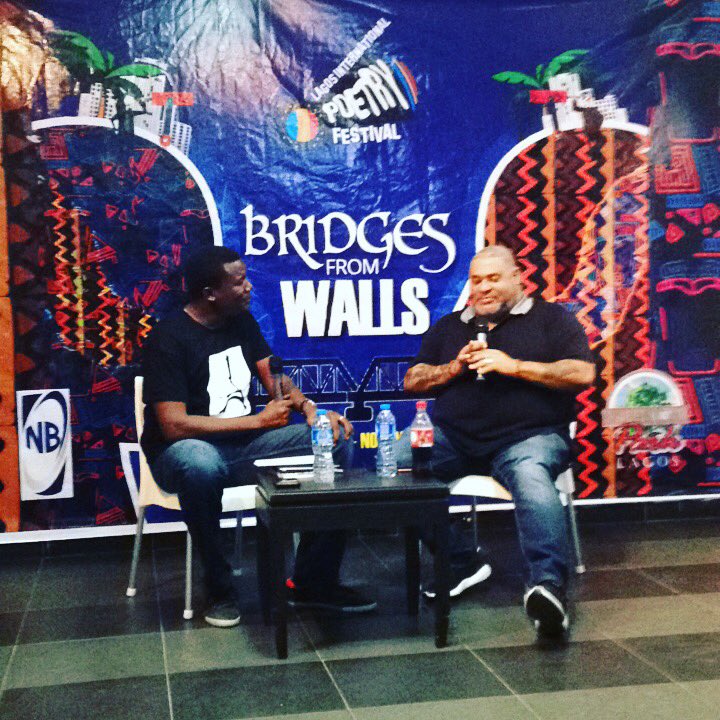
To know Chris Abani is to love him. I spent about an hour today at the Lagos International Poetry Festival interrogating the affable Nigerian/British writer about his life, his work, his vocations, and a few other matters. It was our first ever sit-down conversation about anything, although I had known and admired him for a while, read his work, and exchanged pleasantries when we’ve met at other literary events (last year at the Aké Arts and Book Festival, for instance).

But this time, at a formal setting, I had looked forward to being able to learn a bit more about what motivates him as an artist, and to do it within the stipulated hour. It turned out to be a conversation that was as enjoyable as it was challenging. His reputation, drive, and breath of literary production span an impressive and sometimes intimidating stretch. He is a full-time writer in California, but also an apprentice babaláwo, publisher (and curator of a number of poetry competitions and chapbooks with Professor Kwame Dawes), and author of many award-winning books including Graceland (2004).

There were a number of questions, but one of the most enjoyable parts of the conversation for me was a detour on the true definition of literacy in an African environment. Too often, we have defined literary competence, and even a state of being culturally literate, as merely being able to understand the translation of terms from one language or culture to the other. Whereas, what is true literacy is being able to successfully occupy the full extent of being in that culture and maybe another as well. He mentioned an example of listening to a performance either of the chanting of the Odù Ifá or a poetry performance in Afikpo, where he was born and raised, and being able not just to understand what is being said, but successfully occupying the spiritual and mental state in which the work was conceived and performed. The nearest familiar example from my end would be a literate Yorùbá citizen, listening to a cultural performance with a dozen other not-as-literate people, and having a better, more enhanced experience of the same work of art just because of a capacity to understand the meaning of each talking drum pattern played under each public chant. In Yorùbá traditional art, there are sufficient depictions, as a satire on the importance of this skill, of novice or despised chiefs or kings dancing glibly to a drummer’s feverish patterns without knowing that the drummer was actually insulting them through the delightful ambiguity that the tonal patterns of the Yorùbá talking drums provide.

Chris Abani is a truly literate and competent artist in this way, which greatly helped the conversation along. One hour suddenly felt like a few good minutes. But the writer, in spite of his many achievements, also carries himself in a way that is relatable – which is what you’ll expect of someone still intent on learning the very many ways of being, and of existing as a true and competent artist.

I may have ruffled him a bit with an elephant-in-the-room question about a once controversial portion of his biography relating to his imprisonment in Nigeria in the eighties which, a few years ago, put him in the crosshairs of some Nigerian writers who accused him of not just fraud but sabotage: he was portraying Africa in a horrible light for foreigners for his own artistic advancement, and deserved censure. It was an argument that played into the big contemporary hoopla about poverty porn and the perception of Africa in world literature as a nest of ills. In Abani’s response, he gave as strong a defense as one can find for the freedom to be private about elements of one’s life story especially in the face of what he thought was an unfair and relentless attack, and anger at those who he said had tried, though unsuccessfully, to damage his name and livelihood in their blood lust for his scalp through a witch-hunt disguised as a defence of autobiographical fidelity, or the country’s honour. It made sense to me, and I was glad to have given him a chance to defend himself on the topic in a public forum.

What he is known for today, along with his impressive literary output, is his work with the African Poetry Book Fund with Professor Kwame Dawes where dozens of new African writers are discovered every year and published in chapbook and box sets which are sold all over the United States and around the world. His explanation on the breadth of work that the Fund does was thorough and detailed. How he is able to cope with that work along with every other thing he does is one of the wonders of his impressive career.

In the end, I was greatly impressed by the writer as an artist, an important and talented voice in the African writing space, as well as a bearer of important stories.

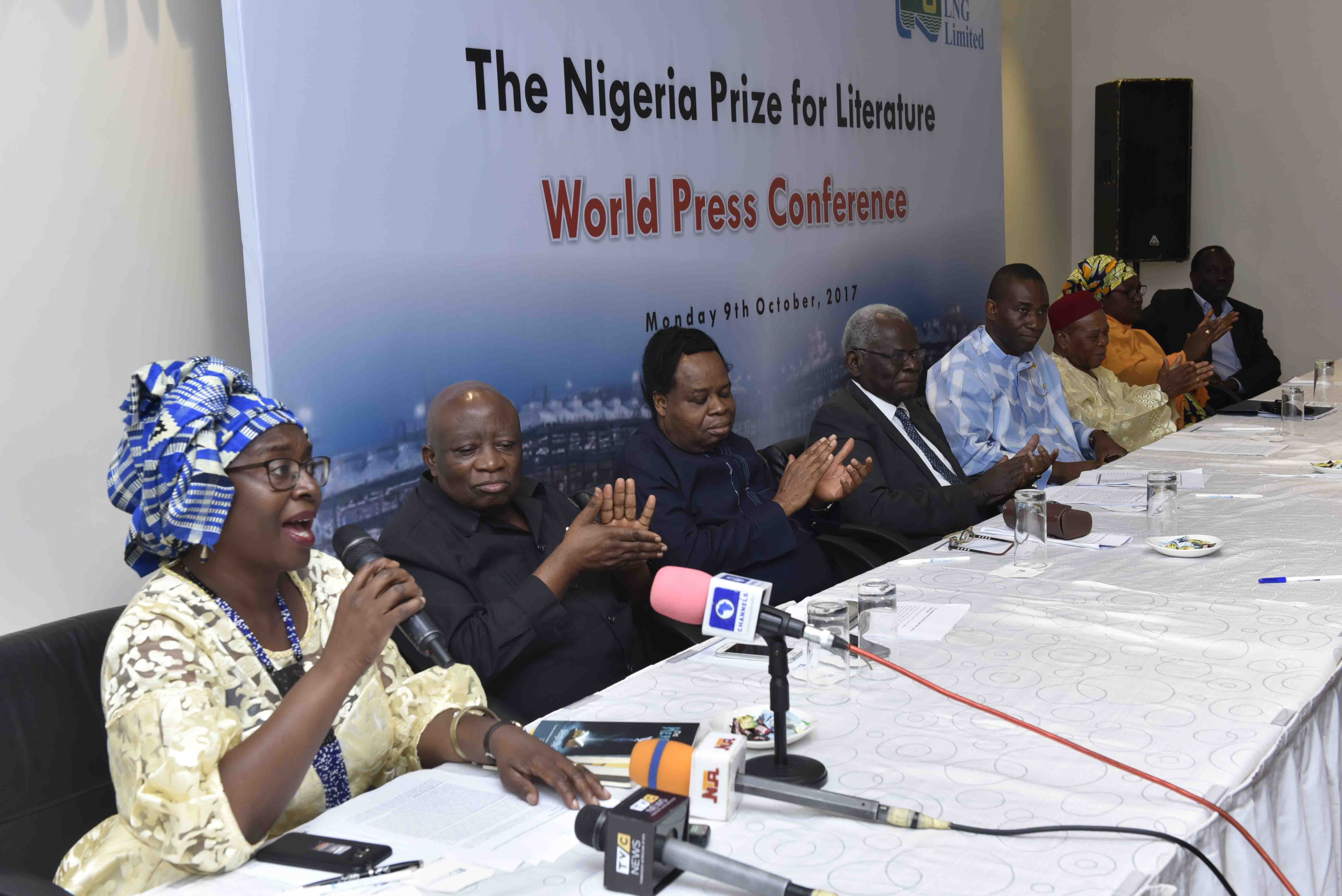
The Judges’ Report of the 2017 Nigeria Prize

A total of 184 poetry collections were received for this year’s competition.

The seriousness with which the NLNG literary prize is received by the teeming population of writers in Nigeria is a sign that the expectations of writers swing beyond the prize itself to that of portraying their creativity. The prestige, associated with the prize saw the 184 entrants of collections of poetry in various sizes and of diverse themes setting out for the stiff competition. At the beginning, the initial weeding was carried out following one of the primary criteria; quality and validity of publication year.   

A total of 101 collections were disqualified at the initial combined sitting of the Advisory Board and the panel of judges for not meeting the basic and fundamental guidelines. 83 closely screened entries were left in the competition and the judges were given a month to come up with the long list of 50 and 25 simultaneously. The next step was to synchronise the shortlist of 11 which the panel carried out in accordance with the set criteria approved by the Advisory Board.

The meeting which saw the emergence of the final list of 3 was long and the scrutiny all encompassing because the panel did not just focus on the quality of production but more on relevance to contemporary Nigerian Literature. The succinct development of Nigerian literature from the classical tradition is something the panel consider an act of brevity and enriching to contemporary Nigerian literature.

At this final phase, we examined the strengths of each of the three books on the final list namely: Ogaga Ifowodo’s A Good Mourning, Tanure Ojaide’s Songs of Myself: Quartet and Ikeogu Oke’s The Heresaid.

Ogaga Ifowodo’s A Good Mourning published by Parresia Books, focusses on the tragedy, ambiguity and contradictions of human experience recreated from poetic vision and language. The work has been likened to “an itinerary that shifts from one notorious platform of human bestiality to another — from the Slave Trade to the Holocaust, the theatres of war in Palestine and the Congo, and the genocide fields of Rwanda and Darfur and so on”.

Songs of Myself: Quartet by Tanure Ojaide published by Kraft Books Limited explores paradoxes in contemporary times presented in discursive lyricism. It reflects the journey to the deepest vicissitudes of the adventurer himself. Ojaide’s volume directs a vigilant gaze toward the artist, society and the world at large. In its breadth and sweep, it undergirds and reiterates the rich linguistic resources available to the artist from indigenous sources.

Ikeogu Oke’s The Heresaid published by Kraft Books Ltd, employs the epic form in questioning power and freedom. It probes metaphorically the inner workings of societies and those who shape them. The volume addresses the question of freedom in all its ramifications.

In assessing and ranking the three works, the judges paid close attention to maturity and depth of vision in the execution of themes, and considered the collections holistically rather than scoring high for one or two poems. After much consideration of these criteria, the competition was narrowed down to between Tanure Ojaide’s Songs of Myself:Quartet and Ikeogu Oke’s The Heresaid.

Oke’s poetry collection reveals a conscious/deliberate manipulation of language and philosophy in the style that reminds us of the writings of great Greek writers of Homeric and Hellenistic periods. Ojaide’s collection refreshes in its day to day experiences of the ordinary man/writer, his travels and other cross-gender exploits. The collection explores paradoxes in contemporary times presented in discursive lyricism. Ikeogu stylistically reaches out to classicism, and Ojaide, to traditional quintessential orature. Both seem to complement each other and collectively reveal and reflect the highest level of poetic craftsmanship in Nigeria. The two authors and their works demonstrate the scope and scale of ambition which The Nigeria Prize for Literature deserves. In their respective ways they push and extend the boundaries of the practice of the art of poetry and of poetry’s engagement with society.

The judges found this seeming complementarity quite appealing and considered recommending both works as a tie for the award

However, the judges went further to apply decisively and scrupulously the Assessment Criteria for the 2017 The Nigeria Prize for Literature competition in their minutest detail thus:

Assessment Criteria for 2017 The Nigeria Prize for Literature competition


  1. Scope  
  • Themes/subjects with regard to relevance to society
  • Time (historical, contemporary and topical)


  1. Maturity and depth of vision
  • Seriousness of content
  • Handling of language


  1. Unity and coherence of content
  2. Thematic engagement
  • Artistic commitment
  • Social commitment
  1. Creative use of language
  • Mechanical correctness of use of language
  • Diction
  • Imagery and other poetic devices
  • Contribution to Nigerian Literature
  • Content
  • Technique


  1. Quality of production
  • Physical
    -Design/presentation
    – Quality of binding

-Print quality, choice and size of font, readability


After diligent considerations and critically objective application of the guidelines and criteria, the judges decided to recommend Ikeogu Oke’s The Heresaid as the 2017 winner of The Nigeria Prize for Literature. This decision is based on its apt topicality, relevance, artistic heft and the pursuit of artistic provenance. In a world of increasingly threatened by encroaching totalitarianism and even bare-faced tyranny and intolerance, the wit, wisdom and message of the The Heresaid are infinitely crucial.

It is our hope and goal that the kind of vibrancy which we have found in the collections of poetry submitted is a vital evidence that NLNG is making unprecedented difference in the intellectual development of Nigeria and Nigerian today.


The 2017 Literary Criticism Competition

The Panel of Judges for the Poetry competition was also charged with the task of assessing the entries for the 2017 Literary Criticism Prize. Compared to the 184 entries received for the Poetry competition, the Literary Criticism entries numbered a paltry five! Of these five, three were disqualified. The guidelines for submission specified that the essays to be submitted must be written not more than three years prior to the year of competition namely nothing published before 2014. The three disqualified essays were published between 2010 and 2012 contrary to the stipulation in the guidelines. The judges considered just two essays abysmally inadequate for a competition of this magnitude. Therefore, no recommendation is made for this award in 2017. The judges wish to further draw the attention of tertiary institutions in Nigeria to the paucity of the responses to this competition as a direct reflection on those tertiary institutions particularly the universities. It is our hope that responses will be a lot better in future from professors and lecturers in our more than one hundred universities in Nigeria. It is a challenge that they should be glad to embrace!


PANEL OF JUDGES

Prof Ernest Emenyonu  (Chairman, Panel of Judges)

Dr Razinatu Mohammed

Tade Ipadeola

Prof Abena Busia (External Consultant)


ADVISORY BOARD

Prof Ayo Banjo (Chairman, Advisory Board)

Prof Ben Elugbe

Prof Jerry Agada


Nigeria Prize for Literature 2017: The International Consultant’s Report

by Abena P.A Busia

Finalists:

Ogaga Ifowodo: A Good Mourning (Origami Books/Parresia Publishers Ltd, Lagos Nigeria 2016); Tanure Ojaide: Songs of Myself (Kaftgriots/Kraft Books Ltd, Ibadan Nigeria, 2015); Ikeogu Oke: The Heresiad (Kaftgriots/Kraft Books Ltd, Ibadan Nigeria, 2017)

This has been a surprisingly difficult decision as each collection has very strong merits to recommend it for this prestigious prize. The three volumes, though very different, are the work of three extremely accomplished poets who in fact have significant aspects in common. I single out as the most salient of these traits a firm belief in the place of poetry in the service of social justice, and the desire, shared by each of them, to forge a poetic form that can contain the often difficult subject matter of the worlds they interrogate, within their structures. I discuss them here in alphabetical order by author.

Ogaga Ifowodo: A Good Mourning. The thoughtful intelligence of the arrangement of these poems, is one of the strengths of the volume though it is necessary to be diligent about reading through the whole collection because in the end the opening poems, though they capture well both the exuberance (History Lesson) or the bewilderment (Perfect Vision) of youth, are in the end weaker poems than the ones we find towards the end such as the poignant sympathy evident in the details of Algiers, April 2000 and A Rwandan Testimony.  These poems arranged to unveil with a growing sensibility to a larger world than the one in which we begin. Or rather, what they succeed in doing is taking us on the poet’s journey as the outside world which form the fantasies of childhood become experienced through all the ambiguity and contradictions the poems make us witness. There are wonderfully wrought juxtapositions as in the through line of song in “Where is the Earth’s Most Infamous Plot” which opens the third section of the collection. Impressive also is the evident experimentation in form and prosody though the end results are uneven in some of the poems, in others, such as Liberation Camp the containment suggested by the strict form works with evocative brilliance when we reach the last line.  However, in the end, I rank this collection third.

Tanure Ojaide: Song of Myself. This collection displays such mastery in its presentation of the varieties of form and subject matter and yet still remains a unified whole. Clearly a master of his craft, Ojaide’s brief forward explicating the grounding of his quartet in in the traditional compositions of udje poets is instructive and succeeds in guiding us to a way of reading that enriches the experience. Everything is indeed a metaphor and Ojaide explores his mother hen of a muse with remarkable effect. As with the other two collections, a sympathetic poet’s eye sees with clarity both the quotidian and the grand and finds a way to keep them harnessed together. Ojaide is a painter with words and his poetry leads you into the places he walks, talks, eats with a clarity that makes you an occupant of all those spaces. And particularly in Book II, Song of Myself, where all the poems offered are in carefully controlled couplets the narrating poet, grounded in his own markets and homesteads comments freely on everything the affects and infects his private and public worlds. Lovers and politicians all are drawn into a fine web of shared observations and thus responsibilities. His world is a capacious world of caring whether for the drowned at Lampedusa or the wind that still blows, his poems bear witness to the truth that “so many memories assault me not to forget the beauty I have seen”. And most assuredly this is demonstrated also through the variety and number of love songs contained in the volume. But these loves and not romantic, or sentimental, they are fierce, contradictory, honest; born of a life that recognizes “Everywhere isn’t easy to reach”.

Choosing between Ojaide and Oke has been hard, and I confess to vacillating between them enough to ask if the prize can be shared. Both of them make it explicit through their titles and introductory comments that they see their volumes as a coherent whole rather than individual parts, that is they have both given us different experiments in long-form poetry, and have both succeeded admirably in the control of a difficult project.

Ikeogu Oke: The Heresiad: This is a bold and wonderful experiment whose great strength also could have been its great weakness. That Oke manages to create a poem that keeps quite strictly over 100 pages to the lyric pentameter and still hold the attention of the reader is a singular achievement. The experiment in lesser hands could have led to a deadening of the senses. The volume itself is structured on a great conceit; a bold venture in defense of the art of poetry itself. The narrator is a griot narrating a great battle between supporters and detractors in defense of the humanities, and has succeeded in creating a modern epic. The mastery of form is a tour de force exemplary of the dedication to the craft the poem is inscribed to defend.  It would have been wonderful if this work had not only been published in print, but had been released with an audio version because indeed its singular achievement is its sustaining of narrative that displays the arguments of the contending parties, and yet at the same time keeps so clear the voice of the griot. And we can indeed hear the musicality in the rigor of the lines, and the absoluteness of the rhyming scheme of heroic couplets sustained throughout the work.  In the end, if there must be a choice, my selection goes with this collection for the technical feat it performs. The deciding factor was the inclusion of the music, which I attempted playing and in doing that it brought home to me how very carefully the performativity of this work has been thought through; Oke has made ancient forms new again.

______

Professor Abena Busia is a Ghanaian writer, poet, feminist, lecturer, and diplomat, currently the ambassador of Ghana to Brazil. She is the external consultant on the 2017 Nigeria Prize for Literature (Poetry)

“We Trust That We’re Investing in a Good Cause” | Kudo Eresia-Eke of the NLNG

The General Manager External Relations for the Nigerian Liquefied Natural Gas (NLNG), Dr. Kudo Eresia-Eke, is a regular face at the annual announcement of the Science and Literature Prizes endowed by NLNG. He, naturally, has a number of strong opinions on the prize, as well as deep knowledge on the breadth of NLNG’s commitment to the Nigerian project via its Corporate Social Responsibility.

He told me, in this interview, that the NLNG has sponsored numerous scholarships across Nigeria and has also built world-class laboratories in six universities across Nigeria, including a vocational centre in Bonny. He also mentioned the commitment of NLNG to build a “Mini Dubai” in the city of Bonny in the Niger Delta, among others. These are things I didn’t know before.

There were a number of other things I wanted to know, including whether the NLNG is committed to retaining the Science and Literature Prizes at $100,000 (it used to be $20,000, $30,000 and $50,000), and whether the Science Prize is a reward or an incentive.

His responses were frank and incisive. Watch.

I also found out on this day that Dr. Eresia-Eke himself is a creative writer. I asked him about this in the video below.

Watch the previous interviews here

The Nigeria Prize Writers Read Excerpts from their Work

The announcement of the winner of the 2017 Nigeria Prize for Literature is very near now. In three short days, the wait will be over and a new winner will be crowned for this year’s Poetry Prize. Last year’s Prize was for Prose Fiction and was won by Abubakar Adam Ibrahim. The prize is worth $100,000.

Winners for the 2017 Prize for Literary Criticism will also be announced on Monday, October 9, 2017.

The writers on this year’s shortlist for the Poetry Prize are Tanure Ojaide (Songs of Myself), Ogaga Ifowodo (A Good Mourningand Ikeogu Oke (The Heresiad). Since the beginning of this week, I have spoken with each of the writers and posted the interviews here.

Today I want to share videos of the writers reading from their work. For anyone interested in any of the books, you can get them on OkadaBooks.com, Nigeria’s online and mobile bookstore.

Here is Tanure Ojaide reading from his book Songs of Myself.

Here is Ogaga Ifowodo reading from his book A Good Mourning.

Here is Ikeogu Oke reading from his work The Heresiad.

May the best writer win!

______

On Sunday, October 8, 2017, do come back to watch the last interview, with Dr. Kudo Eresia-Eke who is the General Manager External Relations of the NLNG, on the future of the Nigeria Prize.